Six Degrees of Separation from  Knife by Salman Rushdie to The Likeness

It’s time again for Six Degrees of Separation, a monthly link-up hosted by Kate at Books Are My Favourite and Best. Each month a book is chosen as a starting point and linked to six other books to form a chain. A book doesn’t need to be connected to all the other books on the list, only to the one next to it in the chain.

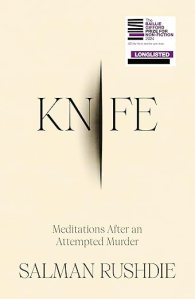
This month we start with Knife: Meditations After an Attempted Murder by Salman Rushdie, a searing, deeply personal account of enduring—and surviving—an attempt on his life thirty years after the fatwa that was ordered against him.

My first link is The Subtle Knife by Philip Pullman, the second book in the His Dark Materials trilogy. Taken together the books form a grand epic, encompassing parallel universes and their inhabitants. It’s a fabulous story, featuring armoured bears who talk, witches, spectres, angels, and tiny hand sized creatures who fly on the backs of dragonflies.

In The Subtle Knife the action takes place in several universes and Will becomes the bearer of the Subtle Knife, which enables him to cut windows from one universe into a parallel one. In one of these worlds he meets Lyra and they join forces.

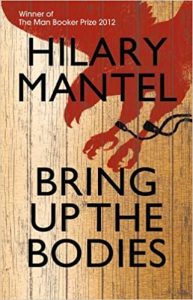
My second link is Bring Up the Bodies by Hilary Mantel, the second book in her Wolf Hall trilogy. I didn’t enjoy it as much as the first book Wolf Hall and I had just a little feeling of anti-climax about it, but then the novelty of Wolf Hall for me was the way Hilary Mantel not only brought the Tudor world alive but also how she overturned my ideas of both Thomas Cromwell and Sir Thomas More. As there is no denying that I knew that Anne Boleyn was not going to make a go of her marriage to Henry VIII, there was little drama there for me. I didn’t even want her to escape her fate.

And yet, Bring Up the Bodies is still a brilliant book. It’s beautifully written, full of colour and detail so that there is no doubt that this is 16th century England, with vivid descriptions of the people, buildings, fabrics, and landscapes of both town and countryside.

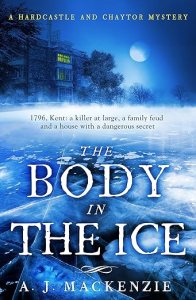
My third link is a book with just one body, The Body in the Ice by A J MacKenzie, the 2nd Hardcastle and Chaytor Mystery set in Romney Marsh and the surrounding countryside in 1796-7. This is the period after the end of the American War of Independence, so Britain and America are at peace, but Britain and revolutionary France are at war with the constant threat of a French invasion. A J Mackenzie is the pseudonym of Marilyn Livingstone and Morgen Witzel, an Anglo-Canadian husband-and-wife team of writers and historians.

Version 1.0.0

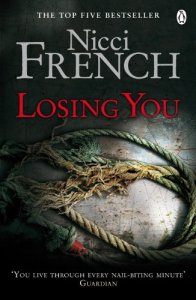
My fourth link is Losing You by Nicci French, a fast paced, take-your-breath-away book about Nina whose teenage daughter, Charlie goes missing. I read it at break-neck speed, switching between being completely engrossed, and desperate for her to find her daughter before it’s too late and being annoyed by her attitude to the police. It’s set on Sandling Island (a fictional place based on Mersea Island, Essex) off the east coast of England and the feelings of isolation and oppression fill the book. ‘Nicci French’ is the pseudonym of wife and husband Nicci Gerard and Sean French.

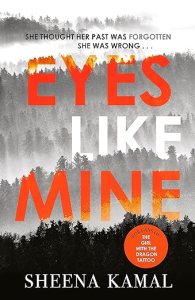
My fifth link is to another missing teenage daughter in Eyes Like Mine by Sheena Kamal, her debut novel. Everything about this book fascinated me from the characters and in particular the main character, Nora Watts, the gripping storylines that kept me racing through the book, to the atmospheric, gloomy setting in Vancouver and in beautiful British Columbia with its snow, mountains and plush ski resorts.

The plot is intricate, complicated and fast moving, highlighting various issues such as mixed race inheritance and differences in treatment based on skin colour, homelessness, and environmental issues. These never overpower the story, but form part of the book as a whole.

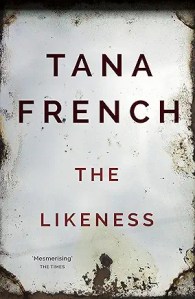
My final link is the word like in the title – The Likeness by Tana French, which I read recently for Reading Ireland Month 2025. It’s a gripping fast paced book, set in Ireland, with well drawn characters, including a group of five friends living in a large house in the countryside. French portrays each of these friends in detail, and as the story progresses their backgrounds and relationships are revealed. The book begins as one of the friends, Lexie Madison is murdered.

Astonished by the fact that Lexie is her double, Detective Cassie Maddox, who played a small role in In the Woods, is persuaded to go undercover at the house, and assume the dead women’s identity, the police having told her friends she wasn’t killed, but was merely wounded. Far-fetched, yes, but it didn’t take me long before I found myself accepting this was feasible. 

My chain goes from Rushdie’s Knife to another book with the word ‘knife‘ in the title, then to two books that are second books in trilogies, two books with a body/bodies in the titles, to two books featuring missing teenagers and finally to two books with ‘like‘ in the titles. It travels from New York, through parallel universities, Tudor England, Romney Marsh, Sandling Island, Vancouver and British Columbia and Ireland.

What is in your chain, I wonder?

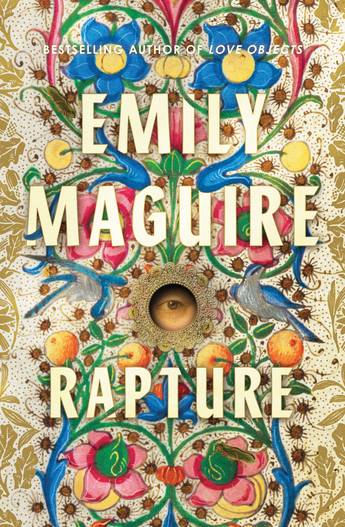
Next month (May 3 , 2025), we’ll start with an historical novel longlisted for the 2025 Stella Prize, Rapture by Emily Maguire.

Six Degrees of Separation from  Prophet Song by Paul Lynch to

It’s time again for Six Degrees of Separation, a monthly link-up hosted by Kate at Books Are My Favourite and Best. Each month a book is chosen as a starting point and linked to six other books to form a chain. A book doesn’t need to be connected to all the other books on the list, only to the one next to it in the chain.

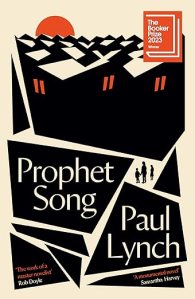
This month we start with Prophet Song by Paul Lynch, the winner of the Booker Prize in 2023. It’s set in a dystopic Ireland as it’s in the grip of a government turning towards tyranny and Eilish can only watch helplessly as the world she knew disappears. When first her husband and then her eldest son vanish, Eilish finds herself caught within the nightmare logic of a collapsing society.

I haven’t read Prophet Song so I decided to start my chain by linking to the word song in the title.

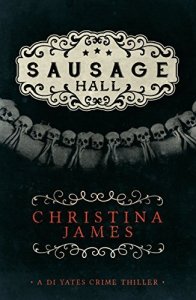
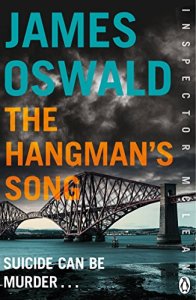
My first link is The Hangman’s Song by James Oswald, the third in his Inspector McLean series set in Edinburgh. a dark, tense book; crime fiction with elements of the supernatural  and parapsychology thrown in. McLean is working on two separate cases – one investigating a group of prostitutes and the subsequent death of their pimp, Malky Jennings, who was beaten to death – and the second, two suicides, which he and his DC, MacBride consider to be suspicious. Digging deeper, McLean finds answers something terrifying stalking the city streets.

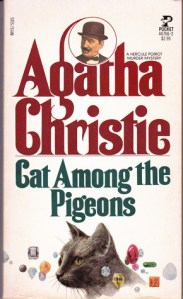
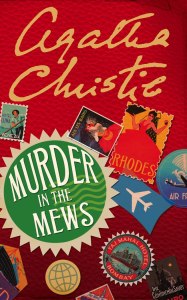
My second link is Murder in the Mews by Agatha Christie, one in a collection of short stories, featuring Hercule Poirot. At first it looks as though a young widow, Mrs Allen has committed suicide, but as the doctor pointed out the pistol is in her right hand and the wound was close to her head just above the left ear, so it’s obvious that someone else shot her and tried to make it look like suicide. The plot is tightly constructed, with a few red herrings to misguide Poirot and Inspector Japp and a moral question at the end. 

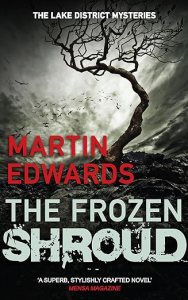
For my third link is a book I read just before Murder in the MewsThe Frozen Shroud by Martin Edwards. It’s the sixth book in his Lake District Mystery series. It begins at Halloween in Ravenbank, an isolated community on the shores of Ullswater. Gertrude Smith who was murdered on Hallowe’en, just before the First World War was found, battered to death, her face reduced to a pulp and covered with a woollen blanket like a shroud. Her murderer wasn’t hanged and the story goes that her tormented spirit 

I enjoyed the previous five, featuring historian Daniel Kind and DCI Hannah Scarlett, head of the Cold Case Review Team and this one is no exception; it kept me guessing almost to the end.

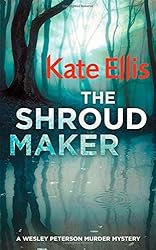
My fourth link is The Shroud Maker by Kate Ellis, the 18th Wesley Peterson Mystery.

It’s the Palkin Festival in Tradmouth, a town in Devon, when the body of a strangled women is discovered floating out to sea in a dinghy. A year earlier Jenny Bercival had disappeared from the festival and her mother returns to look for her bringing with her anonymous letters claiming she is still alive. DI Wesley Peterson and his boss DCI Gerry Heffernan are investigating the two cases. Are they connected and is there a link to a fantasy website called ‘Shipworld’ which features the 14th century mayor and privateer of Tradmouth, Palkin as a supernatural hero with a sinister, faceless nemesis called the ‘Shroud Maker’?

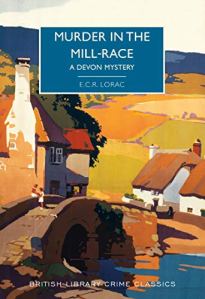
My fifth link is to another book set in Devon, Murder in the Mill Race by E R C Lorac, a Chief Inspector Robert Macdonald book.

A few months after the Dr Raymond Ferens’ arrival at Milham in the Moor in North Devon Sister Monica, the warden of a children’s home, is found drowned in the mill race, the stream leading into the water mill. Everyone says that Sister Monica is a saint – but is she? Chief Inspector Macdonald faces one of his most difficult cases in a village determined not to betray its dark secrets to a stranger.

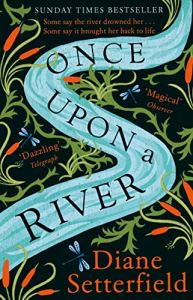
My final link is to Once Upon a River by Dianne Setterfield, in which a drowned body is also found, this time it’s that of a little child in the River Thames.It’s mystifying as hours later the dead child, miraculously it seems, takes a breath, and returns to life. The mystery is enhanced by folklore, by science that appears to be magic, and by romance and superstition. It is a beautifully and lyrically told story, and cleverly plotted so that I was not completely sure at times what it was that I was reading. It’s historical fiction with a touch of magic that completely beguiled me.

What is in your chain, I wonder?

Next month (April 5, 2025), we’ll start with Salman Rushdie’s memoir, Knife.

Six Degrees of Separation from  Dangerous Liaisons by Pierre Choderlos de Laclos to Mansfield Park by Jane Austen

It’s time again for Six Degrees of Separation, a monthly link-up hosted by Kate at Books Are My Favourite and Best. Each month a book is chosen as a starting point and linked to six other books to form a chain. A book doesn’t need to be connected to all the other books on the list, only to the one next to it in the chain.

This month we start with Dangerous Liaisons by Pierre Choderlos de Laclos first published in 1782 as Les Liaisons Dangereuses. I read this many years ago when I was taking an Open University course and I’ve not reviewed this on my blog. It’s an epistolary novel, told through the letters written by different characters to one another. I loved it. The Goodreads summary describes it as a:

novel of moral and emotional depravity is a disturbing and ultimately damning portrayal of a decadent society. Aristocrats and ex-lovers Marquise de Merteuil and Vicomte de Valmont embark on a sophisticated game of seduction and manipulation to bring amusement to their jaded lives. While Merteuil challenges Valmont to seduce an innocent convent girl, he is also occupied with the conquest of a virtuous married woman. Eventually their human pawns respond, and the consequences prove to be more serious—and deadly—than the players could have ever predicted.

My first link is Lady Susan by Jane Austen, which see wrote between 1794 and 1795, adding a conclusion in 1805, but not published until James Edward Austen-Leigh, her nephew, published it in his Memoir of Jane Austen in 1871.

Lady Susan is about Lady Susan Vernon, told in a series of letters, just like Laclos’s Les Liaisons Dangereuses. Both have manipulative and evil characters without any moral scruples, who delight in their power to seduce others. It’s the  story of an unscrupulous widow who plans to force her daughter into a marriage against her wishes. Lady Susan is an attractive and entertaining and totally wicked character, who nevertheless almost manages to fool people for some of the time at least. She is also trying to captivate her sister-in-law’s brother, whilst still holding on to the affections of a previous lover.

My second link is also a book of letters, but real letters, not fictional ones – Jane Austen’s Letters edited by Deirdre Le Faye, First published in 1932 in this edition Le Faye has added new material that has come to light since 1932, and reordered the letters into their correct chronological sequence. She provided new biographical, topographical and general indexes, annotation, and information on watermarks, postmarks and other physical details of the manuscripts. This gives a unique insight into the daily life of the novelist both intimate and gossipy, observant and informative. The letters bring Jane’s family and friends to life, as well as her surroundings and contemporary events. This is one of my TBRs, but I have dipped into it and read some of the letters.

For my third link I’m staying with Jane Austen with The Genius of Jane Austen: Her Love of Theatre and Why She Is a Hit in Hollywood by Paula Byrne, a radical look at Jane Austen as you’ve never seen her – as a lover of farce, comic theatre and juvenilia. It also looks at stage adaptations of Austen’s novels (including one called Miss Elizabeth Bennet by A. A. Milne) to modern classics, including the BBC Pride and Prejudice and Persuasion, Emma Thompson’s Sense and Sensibility, and Clueless, adapted from Emma.

This book explores Jane Austen’s love of the theatre — she acted in amateur productions, frequently attended the theatre, and even scripted several early works in play form. Austen’s letters show, says Byrne, that she was steeped in theatre and that was a keen theatregoer, watching actors like Dora Jordan.

My fourth link is the theatre and Dora Jordan in Mrs Jordan’s Profession by Claire Tomalin, the biography of Dora Jordan who was acclaimed as the greatest comic actress of her day. Dora and the third son of George III, William, the Duke of Clarence , who, although not legally married, lived together as Mr and Mrs Bland.  She was known as ‘Mrs Jordan’, although there was never a Mr Jordan. She made her stage debut in 1777 at the age of 15 and her first Drury Lane appearance in 1785. The two met and she became his mistress in 1790. The book is packed with information, brilliantly bringing the late 18th and early 19th centuries to life as she tells the story of Dora and her relationship with the Duke of Clarence, later King William IV.

My fifth link is to George III in Alan Bennett’s The Madness of King George. This play premiered on 28 November 1991 and was made into a film in 1994. The introduction to the screenplay includes Bennett’s production diary, notes comparing his stage and screen versions, and the political background to the Court of George III. Also included are a selection of stills from the film. I’ve seen the 1994 film with Nigel Hawthorne as King George and Helen Mirren as Queen Charlotte, which I thought was excellent, but have not read the the book or the play itself.

My final link takes me back to Jane Austen’s books and also to Paula Byrne’s book The Genius of Jane Austen and the theatre. It’s Mansfield Park, which I read about 10 years ago. Fanny Price, as a child of 10 goes to live with her wealthy aunt and uncle, Sir Thomas and Lady Bertram at Mansfield Park. The younger members of the family, convert the library into a theatre and stage a risqué play called Lover’s Vows. I’ll be rereading Mansfield Park later on to refresh my memory and consider what it reveals about Jane Austen’s own views of the theatre in the light of Paula Byrne’s book.

The links in my chain are epistolary novels, Jane Austen’s letters and books, the theatre, and George III, using fiction and nonfiction.

What is in your chain, I wonder?

Next month (March 1, 2025), we’ll start with the 2023 Booker Prize winner, Prophet Song by Paul Lynch.

Six Degrees of Separation from Orbital by Samantha Newman to Bleak House by Charles Dickens

It’s time again for Six Degrees of Separation, a monthly link-up hosted by Kate at Books Are My Favourite and Best. Each month a book is chosen as a starting point and linked to six other books to form a chain. A book doesn’t need to be connected to all the other books on the list, only to the one next to it in the chain.

This month starts with Orbital by Samantha Harvey, the 2024 Booker winner:

A team of astronauts in the International Space Station collect meteorological data, conduct scientific experiments and test the limits of the human body. But mostly they observe. Together they watch their silent blue planet, circling it sixteen times, spinning past continents and cycling through seasons, taking in glaciers and deserts, the peaks of mountains and the swells of oceans. Endless shows of spectacular beauty witnessed in a single day.

The fragility of human life fills their conversations, their fears, their dreams. So far from earth, they have never felt more part – or protective – of it. They begin to ask, what is life without earth? What is earth without humanity?

Yet although separated from the world they cannot escape its constant pull. News reaches them of the death of a mother, and with it comes thoughts of returning home. They look on as a typhoon gathers over an island and people they love, in awe of its magnificence and fearful of its destruction.

My first link is The Western Wind by Samantha Harvey. I came to the end of this book and immediately wanted to start it again. What seems at first to be a simple tale is actually a multi-layered and complex book. I really enjoyed reading it. It’s set in the late 15th century in a small village in Somerset. A man disappears, presumed drowned – but how and why did he die?

My second link is a book also set in the 15th century, The Sunne in Splendour by Sharon Penman, a fascinating novel about Richard III’s life from his childhood to his death at Bosworth Field in 1485. I think this is one of the best historical novels that I’ve read. It is full of detail, but Sharon Penman’s research sits very lightly in this book, none of it feels like a history lesson, and it all brings Richard’s world to life.

I’m staying in the 15th century for my third link, Red Rose, White Rose by Joanna Hickson, set in 15th century England during the Wars of the Roses when Cecily Neville was torn between both sides. Her father was Richard Neville, the Duke of Westmorland and a staunch Lancastrian and she married Richard Plantagenet of York and became the mother of Edward IV and Richard III. Told through the eyes of Cicely and her half-brother Cuthbert, this is the story of one of the most powerful women in England during one of its most turbulent periods.

For my fourth link I’m using the words ‘white rose‘ in the title and moving from the 15th century to the 20th with White Rose, Black Forest by Eoin Dempsey, a World War 2 novel. It’s told from the perspective of a German who opposed the Nazis and is set in the Black Forest, Germany in 1943, where Franka Gerber is living alone in an isolated cabin, having returned to her home town of Freiburg after serving a prison sentence for anti-Nazi activities.

My fifth link is to another novel set in World War 2 – Checkmate to Murder by E C R Lorac, a Chief Inspector Robert Macdonald murder mystery. What I found fascinating in this book is the insight into what life was like in wartime London, complete with the London fog and the details of the blackout and although the Blitz was over there were still plenty of bangs and noise so that a gunshot wasn’t easily heard. 

For my final link I’m moving to London in the 19th century with Bleak House by Charles Dickens about the obscure case in the Court of Chancery of Jarndyce and Jarndyce. Here’s his description of fog in Chapter 1:

Fog everywhere. Fog up the river, where it flows among green aits and meadows; fog down the river, where it rolls defiled among the tiers of shipping and the waterside pollutions of a great (and dirty) city. Fog on the Essex marshes, fog on the Kentish heights. Fog creeping into the cabooses of collier-brigs; fog lying out on the yards and hovering in the rigging of great ships; fog drooping on the gunwales of barges and small boats. Fog in the eyes and throats of ancient Greenwich pensioners, wheezing by the firesides of their wards; fog in the stem and bowl of the afternoon pipe of the wrathful skipper, down in his close cabin; fog cruelly pinching the toes and fingers of his shivering little ‘prentice boy on deck. Chance people on the bridges peeping over the parapets into a nether sky of fog, with fog all round them, as if they were up in a balloon and hanging in the misty clouds.

My chain moves from the International Space Station to London in the 19th century and has travelled through the 15th century with a brief stop in the 20th century. The books are historical and crime fiction

What is in your chain, I wonder?

Next month (February 1, 2025), we’ll start with a classic – Dangerous Liaisons by Pierre Choderlos de Laclos.

Six Degrees of Separation from Sandwich by Catherine Newman to A Shilling for Candles by Josephine Tey

It’s time again for Six Degrees of Separation, a monthly link-up hosted by Kate at Books Are My Favourite and Best. Each month a book is chosen as a starting point and linked to six other books to form a chain. A book doesn’t need to be connected to all the other books on the list, only to the one next to it in the chain.

This month starts with Sandwich by Catherine Newman, a book set in Cape Cod, described as a moving, hilarious story of a family summer vacation full of secrets, lunch, and learning to let go.

My first link is The Widow’s War by Sally Gunning. This is historical fiction set in 1761 about a whaler’s wife, Lyddie, in the Cape Cod village of Satucket in Massachusetts, living with the daily uncertainty that her husband Edward will simply not return. And when her worst fear is realised, she finds herself doubly cursed. She is overwhelmed by grief, and her property and rights are now legally in the hands of her nearest male relative: her daughter’s overbearing husband, whom Lyddie cannot abide. She decides to challenge both law and custom for control of her destiny, but she soon discovers the price of her bold “war” for personal freedom to be heartbreakingly dear.

My second link is a book about another widow, The Widow’s Tale by Mick Jackson. It’s narrated by the widow and is rather rambling as befits a woman in her sixties on the verge of a nervous breakdown. Her husband has died, she’s taken it badly, and goes to live in a rented cottage on the bleak Norfolk coast, shunning other people. She drinks to forget herself, sits in pubs alone, doing the crossword and reading a book to pass the time. She drives out to places she once knew, goes for solitary walks,  gets stuck in the saltmarshes, and is definitely quirky and obsessional.

Elly Griffith’s character, archaeologist Ruth Galloway also lives in a cottage on the Norfolk coast. So, My third link is The Janus Stone. Ruth is called in to investigate when builders, demolishing a large old house in Norwich, uncover the skeleton of a child – minus the skull – beneath a doorway. Is it some ritual sacrifice or just plain straightforward murder? The house was once a children’s home. When DCI Harry Nelson meets the Catholic priest who used to run it he tells him that two children did go missing forty years before – a boy and a girl. They were never found. When carbon dating proves that the child’s bones predate the children’s home, Ruth is drawn more deeply into the case. But as spring turns to summer it becomes clear that someone is trying very hard to put her off the scent by frightening her half to death…

More missing children are the subject of My fourth link. It’s On Beulah Height by Reginald Hill. When a child goes missing during one long, hot dry summer it reminds Dalziel of the three little girls who had gone missing 15 years earlier from the village of Dendale in Yorkshire just before it was flooded to provide a new reservoir. No bodies were ever found. Once again during another hot summer the waters of the reservoir recede and the old village re-emerges from the depths.

This book is tightly plotted with many twists that made me change my mind so many times I gave up trying to work out who the murderer was and just read for the pleasure of reading. Hill’s descriptive writing is rich and full of imagery.

There is a bird on the cover of On Beulah Height, so My fifth link is to another book with a bird on the coverThe Crow Trap by Ann Cleeves, the first Vera book. Rachael, Anne and Grace are all staying at Baikie’s an isolated cottage on the North Pennines whilst they carry out an environmental survey. When Rachael arrives at the cottage she is confronted by the body of her friend Bella Furness, who it appears has committed suicide. Then Grace is found dead and the mystery really begins and it is down to DI Vera Stanhope, to get to the bottom of the mystery. Vera is a great character and even though I do like Brenda Blethyn’s portrayal of her in the TV series, I prefer her as she is in the books –  a woman in her fifties, who looks like a bag lady. 

My final link is A Shilling for Candles by Josephine Tey in which Inspector Alan Grant also investigates an apparent suicide. A young and beautiful film star, Christine Clay was found dead beneath the cliffs of the south coast. But he soon discovers that it was in fact murder as a coat button was found twisted in her hair and he suspects a young man, Robin Tisdall who had been staying with Christine in a remote cottage near the beach, especially when it is revealed that she has named him as a beneficiary in her will. Tisdall has lost his coat and so the search is on to find it to prove either his innocence or guilt.

The books in my chain are mainly a mix of crime and historical fiction.

What is in your chain, I wonder?

Next month (January 4, 2025), we’ll start with the 2024 Booker winner, Orbital by Samantha Harvey.

Six Degrees of Separation from  Intermezzo by Sally Rooney to White Nights

It’s time again for Six Degrees of Separation, a monthly link-up hosted by Kate at Books Are My Favourite and Best. Each month a book is chosen as a starting point and linked to six other books to form a chain. A book doesn’t need to be connected to all the other books on the list, only to the one next to it in the chain.

This month starts with Intermezzo by Sally Rooney. I haven’t read this book, so this is the description on Amazon UK:

Aside from the fact that they are brothers, Peter and Ivan Koubek seem to have little in common.

Peter is a Dublin lawyer in his thirties – successful, competent and apparently unassailable. But in the wake of their father’s death, he’s medicating himself to sleep and struggling to manage his relationships with two very different women – his enduring first love Sylvia, and Naomi, a college student for whom life is one long joke.

Ivan is a twenty-two-year-old competitive chess player. He has always seen himself as socially awkward, a loner, the antithesis of his glib elder brother. Now, in the early weeks of his bereavement, Ivan meets Margaret, an older woman emerging from her own turbulent past, and their lives become rapidly and intensely intertwined.

For two grieving brothers and the people they love, this is a new interlude – a period of desire, despair and possibility – a chance to find out how much one life might hold inside itself without breaking.

My first link is Thin Air, a novel by Michelle Paver also about two brothers. Kanchenjunga, the third highest mountain in the world, had claimed many lives and no one had reached the summit. Held to be a sacred mountain, it is one of the most dangerous mountains in the world – believed to be the haunt of demons and evil spirits. An unsuccessful attempt had been made in 1907, led by Edmund Lyell, when only two men had returned. The group in 1935, led by Major Cotterell, attempted to follow the 1907 route up the south-west face. Their story is narrated by medic, Dr. Stephen Pearce, accompanying his older brother, Kits. The brothers have always been rivals and this continues as they make their way up the mountain. Things start to go wrong almost straight away and Stephen is full of foreboding.

My second link is a book that also has ‘air’ in the title – Coming Up For Air, Sarah Leipciger’s second novel. It is a beautiful novel, a story of three people living in different countries and in different times. How their stories connect is gradually revealed as the novel progresses. As the author explains at the end of the novel it is a mix of fact and fiction and has its basis in truth. There is grief and loss and despair in each story, but above all, it is about love, and the desire to live. I think Sarah Leipciger is a great storyteller. It is an inspiring book, beautifully written, which emphasises the importance of the air we breathe and the desire to live. I read this book in June 2021.

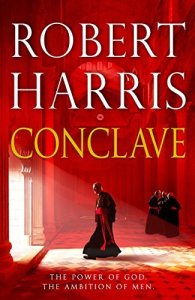
My third link is An Officer and a Spy, historical fiction by Robert Harris, another book I read in June 2021. It is a gripping book about the Dreyfus affair in 1890s France. Alfred Dreyfus, a young Jewish officer, was convicted of treason by passing secrets to the Germans in 1895 and sent to solitary confinement on Devil’s Island. It’s narrated by Colonel George Picquart, who became convinced that Dreyfus was innocent. Harris goes into meticulous detail in staying accurate to the actual events, but even so this is a gripping book and I was completely absorbed by it from start to finish.

My fourth link is The Count of Monte Cristo, historical fiction by Alexandre Dumas, in which the main character is also wrongly imprisoned on an island. It begins in 1815 when Edmond Dantès, a sailor, having returned to Marseilles is wrongly accused of being a Bonapartist and imprisoned in the Chateau d’If on the Isle of Monte Cristo, for fourteen years. It’s a great story, action-packed, and full of high drama and emotion. Montecristo is a real island in the Tyrrhenian Sea, part of the Tuscan Archipelago, and administered by the municipality of Portoferraio in the province of Livorno.

So My fifth link is also set on a real island, that of the isolated island of Elliðaey off the coast of Iceland in Ragnar Jónasson’s novel The Island, a murder mystery with elements of horror. Four friends visit the island ten years after the murder of a fifth friend, Katla, but only three of them return. One of them, Klara, fell to her death from a cliff – but did she jump or was she pushed? Detective Inspector Hulda Hermannsdóttir is sent to investigate. A suspect had been charged, but had committed suicide before the verdict was announced and the case had been closed. But are the two murders connected, even though they are ten years apart? This book is the second in Jónasson’s Hidden Iceland series.

My final link is also the second book in a series, that is White Nights by Ann Cleeve, the second in her Shetland Quartet, featuring Detective Jimmy Perez. It’s set mainly in the village of Biddista, when Kenny Thomson finds a man’s body hanging in the hut where the boat owners of the village keep their lines and pots. At first it looks as though the man, his face covered by a clown’s mask, has committed suicide, but he’d been dead before he was strung up. As well as the mystery of who killed the man in the clown mask and why, there is also the disappearance 15 years earlier of Kenny’s older brother Lawrence. It was thought that he left the island after Bella had broken his heart. Kenny hadn’t heard from him since and at first thought the dead man could be him.

The books in my chain are mainly a mix of crime and historical fiction. And the chain has become a circle with the last book connecting to the starting book and the first book, all containing two brothers.

What is in your chain, I wonder?

Next month (December 7, 2024), we’ll start with a beach read – Sandwich by Catherine Newman.