Sandlands by Rosy Thornton

SandlandsSandlands is a beautiful collection of short stories that held me spellbound from start to finish. This is all the more extraordinary as I am not a great fan of short story collections. I often find that they leave me feeling that something is missing – either the storyline is not developed enough, or the characters are not convincing, or that they are just too trite or banal. In other words that they are disappointing.

Not so with Sandlands – I think this is a special collection of well written stories set in the Suffolk landscape, describing real people, and containing well- researched detail into myths and folklore, wildlife, and environmental changes that slips seamlessly into the fiction. They are just the right length for me, perfect little cameos each one complete and satisfying – that’s not to say that all the ends are neatly tied up, as some, such as Nightingale’s Return, about an Italian visiting the farm where his father had worked  as a prisoner of war, end leaving me wondering what happened next, or rather just what had happened in the past.

The individual stories are varied, some looking back to the past, some are sad leaving me with tears in my eyes, and some have a supernatural element. I loved all of them, but a few are outstanding, for example, Curlew Call in which a teenager spends time during her gap year living in an old house overlooking the the salt marshes, as a companion to Agnes, an old lady who is wheel-chair bound. She is fascinated by the landscape and the wildlife, in particular the curlews, calling out across the reed beds each evening, before she goes to sleep:

You wonder what they’re doing out there in the dark, sleepless and crying like that. And if you lie still and listen – really  listen – there’s something so pitiful about the sound, it could nearly break your heart. like someone whistling hopelessly over and over for a dog that’s lost. (pages 220 – 221)

Agnes paints, but not the usual East Anglian landscape of sky and clouds with a low horizon. I was really taken with the descriptions of her paintings, nearly all foreground, with reeds at the top and the rest of the painting taken up with the mudflats, showing the swirls and squiggles left by the tide. And the colours she’d used held my attention:

You think that mud is only grey and brown but when you look properly, the way Agnes had, you can see she’s right, and that it’s also the blackest black, and pure white, and it holds glints of red and gold and ochry yellow, and reflected blues and greens, and deep, imperial purple. (page 226)

As the story unfolds, so does the story of Agnes’ life.

And I finished reading the final story, Mackerel, with tears in my eyes when I came to the last paragraph, even though I had begun to realise what was inevitably the outcome. This is the story of a grandmother and her granddaughter, Hattie, set in a fishing village near the Suffolk sea. Ganny, as Hattie calls her has lived all her eighty nine years in the same place and is expert at handling and cooking fish.

Hattie, by way of contrast has an honours degree in marine ecology, has travelled the world, but also loves the Suffolk landscape and the world of her grandparents – the sights, smells and Ganny’s cooking, kippers, fish pie and above all the mackerel. This story is filled with images of Ganny filleting the mackerel, coating them in oatmeal to fry in butter, or to bake in greaseproof sprinkled with lemon or cider in a tight parcel. It made my mouth water reading about it.

As in Curlew Call, Ganny’s life unfolds and this story too is full of colour, this time of the sand instead of the mudflats:

This is a land of sand. The earth hereabouts is nothing but; it’s a wonder anything grows in it at all. On the common it’s a powder grey, soft as ash and lifted by the the slightest breeze, but on the roads it’s as golden yellow as any treasure island beach.

… You could almost fancy it the work of strange secret tides which rise in the night to cover the fields and lanes, then slip away before daylight to leave new spits and spars like a signature on the landscape. A land with the imprint of the sea. (page 256)

It’s impossible for me to do justice to these stories. If you like strong, atmospheric stories, stories that bring to life the world of the past, tying them to the present, stories of family life, of the natural world, of folklore and the mystery and wonder of it all then you’ll love this book as much as I did.

With grateful thanks to Rosy Thornton for sending me this lovely book to review. It’s published tomorrow. And she has also written full length novels that captivated as much as this collection – do read them. For more details see her website.

  • Paperback: 320 pages
  • Publisher: Sandstone Press Ltd (21 July 2016)
  • Language: English
  • ISBN-10: 191098504X
  • ISBN-13: 978-1910985045

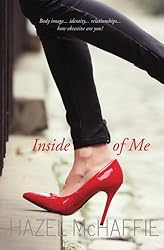
Inside of Me by Hazel McHaffie

I’ve read one of Hazel McHaffie’s books in the past – Over My Dead Body and was impressed by the way she weaves facts into her fiction so seamlessly that it doesn’t detract from the story. So, when she asked if I would like to read Inside of Me I didn’t hesitate to say yes please. And I wasn’t disappointed. I think this is an excellent book and once I started reading it I didn’t want to stop, keen to find out what was going to happen next.

Hazel McHaffie’s novels all cover medical ethics issues and the issues in Inside of Me concern body image, in particular, but not exclusively, about anorexia; identity, and relationships. There is also a mystery – teenage girls are going missing, the latest one being Maria aged sixteen, last seen walking alone along Regent’s Park Canal. Tonya Grayson is worried, no terrified is a better description, that her missing husband, Victor, could be involved. But the police are convinced he is dead; his clothes were found neatly folded in a beach, although his body was never found. India, their daughter, who was eight at the time, believes, even after seven years, that he is still alive, reinforced by hearing his voice in a crowded London station, the day after Maria was reported missing.

The narrative, told in the first person, switches between Tonya and India living in Scotland, and Chris, who works in a florist shop in London, mourning the loss of a daughter. Chris, after reading the newspaper report about the missing teenager, spots Maria at a local car boot sale, offers to help and ends up taking her home, anxious about her safety.

India is anorexic, but won’t accept the truth, either that her father is dead or that she has a weight problem. Tonya tries to help her but cannot get through to her and for most of the book seems completely out of her depth, unable to move forward herself. She is plagued with doubts about Victor and his relationship with India, which had been very close. India’s best friend, Mercedes is also obsessed with her weight and encourages India both to find her father and to take even more drastic ways to gain her target weight.

Hazel McHaffie has got right inside each character’s mind, making this a compelling and convincing story. And it is a gripping story, easy to read, but by no means a comfortable read, in turns emotional and troubling. It conveys the complex dilemmas of living with eating disorders, problems with body image and difficult family relationships, issues with control and coping with emotional disturbance, obsessions and compulsive behaviour. Added to all this there is the mystery of what happened to Victor – his pile of clothes on the beach reminded me of Reginald Perrin (from the TV series  in the 1970s). I think it is a wonderful book and I don’t think I’ve read another novel like it. I’ve only touched its surface in this post!

  • Paperback: 242 pages
  • Publisher: VelvetEthics Press (5 Mar. 2016)
  • Language: English
  • ISBN-10: 099262312X
  • ISBN-13: 978-0992623128
  • Source: Review copy from the author

Hazel McHaffie is a Scottish author. For details of her background and qualifications as a nurse, midwife, PhD in Social Sciences and Research Fellow in Medical Ethics see her website, where she also lists her awards, life changing experiences, and more personal stuff such as her character traits, addictions (including good books), and hobbies. She also writes a most interesting blog.

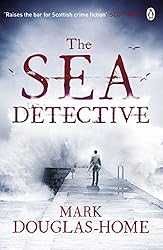
The Sea Detective by Mark Douglas-Home

Lovereading.co.uk  sent me a copy of  The Sea Detective by Mark Douglas-Home for review in advance of the publication of the third title in the series The Malice of Waves on 19 May and I’m glad to say that I thoroughly enjoyed it.

It’s one of those books that grabbed my attention right from the start when two young teenage girls from India are sold into the sex trafficking trade, completely unaware of the dangers and terror that awaits them. Then, Edinburgh-based oceanographer, Cal McGill is caught on camera planting a rare wild flower in the garden of the Scottish Environment Minister in a campaign to make politicians aware of the dangers of climate change. Detective Inspector Ryan wants to charge him with vandalism but the minister’s wife wants to keep the plant!

From then on the story gets complicated. It’s more of an investigative story than crime fiction, with several strands to the story, but it’s so well told that I had no difficulty in following all of them: a story of unsolved mysteries both from the present day and from the Second World War, and of two Indian girls, sold into the sex trafficking trade. It’s set mainly in Scotland with a strong sense of place throughout.

The main characters are all fully rounded and complex – Cal McGill works for environmental organisations tracking oil spills using wind speeds and data on ocean currents; DI David Ryan and DC Helen Jamieson are investigating the appearance of severed feet in trainers that had been washed on shore on islands miles apart – tests had revealed that they belonged to the same body; and Basanti, one of the Indian girls, whose resourcefulness saved her life. I especially liked Helen Jamieson, the overweight policewoman, whose boss, Ryan mistakenly thinks is stupid, and the way she deals with him.

The strand that interested me most concerns Cal’s grandfather, from the (fictional) island of Eilean Iasgaich. He had died during the Second World War, washed overboard during a storm, whilst their trawler was patrolling the sea around Norway, one of seven men who had died ‘“ and yet his name had not been included in the island’s war memorial. Cal eventually discovers the truth about what actually happened and how his grandfather met his death.

It’s a gripping and emotional story. I loved it.

The Sea Detective is Mark Douglas-Home’s first book. Before writing books he was the editor of Scotland’s leading daily newspaper, The Herald, and The Sunday Times Scotland. He is the nephew of the late Sir Alec Douglas-Home who was Prime Minister of the UK from October 1963 to October 1964. He lives in Edinburgh.

I’m looking forward to reading his second book, The Woman who Walked into the Sea as well as his third, The Malice of Waves.

Reading Challenges: Read Scotland 2016 – by a Scottish author and set in Scotland.

Six Tudor Queens: Katherine of Aragon, the True Queen by Alison Weir

I received a proof copy of Six Tudor Queens: Katherine of Aragon, the True Queen as a member of the reader review panel for Lovereading.co.uk. It’s the first book in a series of novels about Henry VIII’s Queens and is due to be published in May 2016.

This is fictional biography at its most straight forward, written in an uncomplicated style. Told from Katherine’s point of view it follows her life from the time she arrived in England at the age of sixteen to marry Prince Arthur, the elder of Henry VII’s two sons, to her death in 1536.

I knew the brief facts about Katherine, the daughter of Isabella and Ferdinand of Spain, married first to Prince Arthur and then to his brother Henry after a papal dispensation allowing the marriage after Arthur’s death; her subsequent failure to produce a living male heir, suffering a series of miscarriages; the only baby to survive was a daughter, Mary; and her divorce in 1533 from Henry VIII, who was by then besotted with Anne Boleyn.

This novel fills in the facts in great detail including the question of whether her first marriage was consummated. Katherine maintained it wasn’t and based on research Weir takes her word as the truth. In her Author’s Note she refers to recent research by Giles Tremlett and Patrick Williams that shows ‘we can be fairly certain that Katherine’s marriage to Prince Arthur was not consummated and that he died of tuberculosis.’  She cites the basis of her account of Arthur’s illnesss on Dr. Alcaraz’s testimony, given on 1531 at Zaragoza. She portrays Katherine as a determined woman who never ceased loving Henry and above all who did everything she could to protect the legitimacy of her daughter.

Katherine is portrayed as a woman of her time – obedient to her parents and her husband, conscientious about doing her duty  and active in maintaining an alliance between England and Spain. But even so, she resisted Henry in his demands for an annulment of their marriage. She was heart-broken both at her failure to produce a living male heir and to keep Henry’s love – because they were in love at the beginning – and maintained that she was the true queen right up to her death. I tend to forget the length of their marriage, glibly remembering the mnemonic ‘Divorced, beheaded, died, divorced, beheaded, survived‘. Katherine and Henry were married for over 20 years. I did get tired of the account of their endless wrangling, going over and over the same arguments, never getting anywhere – but then I suppose that was how it was for them both.

Overall I enjoyed this book. It’s a long and comprehensive study, which has increased my knowledge and understanding of Katherine of Aragon and the early 1500s. It is obviously based on extensive research and written with great attention to historical accuracy, but in places this made it tedious and too drawn out.

  • Hardcover: 624 pages – also available as a Kindle edition
  • Publisher: Headline Review (5 May 2016)
  • Language: English
  • ISBN-10: 1472227476
  • ISBN-13: 978-1472227478
  • Product Dimensions: 15.3 x 5.6 x 23.4 cm
  • Source: Review copy

Too Soon a Death by Janet O’Kane

Janet O’Kane’s second book Too Soon a Death follows on from No Stranger to Death, set in a fictional village in the Scottish Borders and continues the story of Doctor Zoe Moreland, a widow and one of the doctors at the local health centre. A boy’s body is discovered on the banks of the River Tweed, near the Chain Bridge, linking Scotland and England and Zoe is asked to help identify the body because he had a note in his clothing giving the health centre’s address and phone number – but he was not one of their patients.

Zoe is not without her own problems. I think this book reads well as a stand alone book, but it certainly helps to have read the previous book, which explains her current condition. At the beginning of Too Soon a Death she is still recovering from a vicious attack (details in No Stranger to Death) and is heavily pregnant.

As the events unfold, she receives anonymous phone calls and is followed by someone in a blue car, who at one point almost runs her down. Added to that her best friend Kate Mackenzie, a deaf genealogist, is having problems both with her ex-husband and a client, with disastrous results. Can Zoe trust a new acquaintance, the vet Patrick Dunin – she wonders who it is that keeps phoning him claiming his attention? A large, vicious looking dog attacks Zoe’s own dog and is savaging sheep. Where has he come from? And that is not all – Zoe has secrets in her own past that are finally revealed in this book.

In some respects Too Soon a Murder has a Midsomer Murders atmosphere, and a general ‘cosy’ feel, but it is not without violence. Its main focus, however, is on Zoe, how she is coping with her pregnancy, her plans for Keeper’s Cottage, which she has bought from Kate’s brother and her hopes to become a partner in the health centre. The crimes are investigated by DCI Erskine Mathers and Sergeant Trent, with Zoe’s assistance, although there are things she can’t tell the police because of patient confidentiality. It has a great sense of location (this may be helped because I know the area a little bit, living a few miles away on the English side of the Border), and the characters are well grounded and believable people, even the minor characters such as Margaret Howie, the practice receptionist, comes across as a character in her own right.

My thanks to Janet O’Kane for providing me with a copy to read and review. I’m looking forward to reading her third book, which she is currently writing.

Reading challenges: My first book for the Read Scotland Challenge –  a book set in Scotland.

Nagasaki: Life After Nuclear War by Susan Southard

Nagasaki: Life after Nuclear War by Susan Southard is an amazing, heart-wrenching book.

The facts are horrendous – on August 9th 1945, two days after the atomic bombing of Hiroshima, a five-ton plutonium bomb was dropped on the small coastal town of Nagasaki. The effects were cataclysmic.

This must be one of the most devastatingly sad and depressing books I’ve read and yet also one of the most uplifting, detailing the dropping of the bomb, which killed 74,000 people and injured another 75,000. As the subtitle indicates this book is not just about the events of 9 August 1945 but it follows the lives of five of the survivors from then to the present day. And it is their accounts which make this such an emotive and uplifting book, as it shows their bravery, how they survived, and how they were eventually able to tell others about their experiences. Along with all the facts about the after effects of the bombing, the destruction, and radiation, it exposes the true horror of atomic warfare, making it an impressive and most compelling account of pain, fear, bravery and compassion.

Throughout the book the black and white photos illustrate the true horror of the effects of the bomb – photos of Nagasaki both before and after the bomb was dropped, of five survivors – Wada Kohi (aged 18 in August 1945), a street car operator; Nagano Etsuko (aged 16), who worked on a production line in a Mitsubishi airplane parts factory;  Taniguchi Sumiteru (aged 16), who worked at Minchino-o Post Office; Yoshida Katsuji (aged 13), a student at Nagasaki Prefecture Technical School on a ship building course; and Do-oh Mineko (aged 15), formerly a student at Keiho Girls High School, working at the Mitsubishi Arms Factory Onashi Plant. There are also maps showing Japan today and of Nagasaki 1945 showing the Scope of Atomic Bomb Damage.

Susan Southard’s ten years of research has resulted in this impressive book as she reveals what happened in particular to these five survivors, their immediate injuries, the radiation-related cancers and illnesses they have suffered, and their difficulties of daily living still in pain both physical and emotional.

In addition to all that Nagasaki ‘reveals the censorship that kept the suffering endured by the hibakusha [atomic bomb-affected people] hidden around the world. For years after the bombings news reports and scientific research were censored by U.S. occupation forces and the U.S. government led an efficient campaign to justify the necessity and morality of dropping the bombs’ (from the jacket sleeve).

I knew a bit about Hiroshima and Nagasaki before I read this book but it has opened my eyes to the true horror of nuclear war and the need to prevent anything like this happening again.

Many thanks to Souvenir Press Ltd for sending me a complimentary copy for review.

  • Hardcover: 416 pages
  • Publisher: Souvenir Press Ltd (2 Nov. 2015)
  • Language: English
  • ISBN-10: 0285643274
  • ISBN-13: 978-0285643277