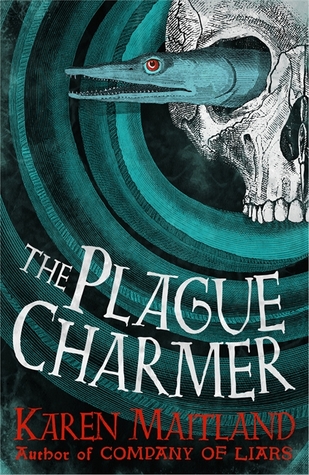
The Plague Charmer by Karen Maitland

The Plague Charmer

Karen Maitland is a great storyteller.

The Plague Charmer is a fascinating medieval tale full of atmosphere and superstition. It’s a long but an unputdownable book, bringing the medieval world to life in all its brutality and hardship. I thoroughly enjoyed it. I received an uncorrected proof copy of this, her latest novel, from Lovereading. The book is set in Porlock Weir in 1361 where a village is isolated by the plague when the Black Death spreads once more across England.  Following an eclipse of the sun, as a storm rages along the coast, a ship is blown ashore bringing a dark stranger, Janiveer, to the village. She warns the villagers that the plague, raging in other parts of the country will soon spread to their village and offers to save them – but for a terrible price.

It’s a complex story, told from different characters’ perspectives, following the lives of Will, a ‘fake’ dwarf, Sara, a packhorse man’s wife and her family, Matilda, a religious zealot, and Christina at nearby Porlock Manor amongst others. It’s a tale of folklore, black magic, superstition, violence, torture, murder, and an apocalyptic cult – and also of love. As the plague spreads and more horrendous deaths pile up bringing  fear and hysteria, families are broken up, and hostilities surface as the village is isolated, left to fend alone.

I thought Will a fascinating character. He was not born a dwarf, but was subjected to horrific treatment as a baby, strapped into an iron bridle, compressed and deformed as he grew to form a squat little dwarf. He is remarkably free of bitterness and capable of more humanity than most of the other characters. Sara, too shows strength of character as she perseveres in her search for her two missing sons.

I like the Historical Notes, providing more detailed information about the period, the people and the location, as well as the legends, and the answers to the medieval riddles that head Will’s chapters. I particularly like the information about the plague and the various religious cults of the period. The Glossary is also invaluable, helping to flesh out the detail.

The Plague Charmer is a superb combination of historical fact and fiction. I really enjoyed reading this detailed and chillingly dark atmospheric book. It’s a memorable story with a colourful cast of characters, full of suspense and drama.

My thanks to Headline for also providing a proof copy via NetGalley.

  • Hardcover: 576 pages (also as an e-book)
  • Publisher: Headline Review (20 Oct. 2016)
  • Language: English
  • ISBN-10: 1472235827
  • ISBN-13: 978-1472235824

Amazon UK link

On the Black Hill by Bruce Chatwin

One of my favourite books – On the Black Hill by Bruce Chatwin was first published in 1982 when it won the James Tait Black Memorial Prize and the Whitbread First Novel of the Year Award. The Black Hill is one of the Black Mountains on the border of England and Wales, although fictionalised in this book. It was made into a film in 1988. And today it is released in an e-book edition by Open Road Integrated Media.

It’s a gentle, richly descriptive book of both the landscape and the characters, about lonely lives on a farm, largely untouched by the 20th century. It follows the lives of identical twins, Lewis and Benjamin Jones, a period of over 80 years. They are inseparable, Benjamin in particular suffering whenever they are apart. Their lives are hard, lonely, brutal at times, but full of love for their mother and the land they farm.

I love this book and most of all I love they way Chatwin brought the characters to life, not just Lewis and Benjamin, but all the other personalities, some eccentric, some comic and some tragic. His attention to detail is remarkable ‘“ at no time does it seem excessive, or intrusive but all the little minutiae of daily life are essential to the book. It highlights questions of love, religion, death and above all relationships. It is most definitely not a book to race through to find out what happens, although I did want to know, but one to savour ‘“ and one to re-read.

  • File Size: 6409 KB
  • Print Length: 236 pages
  • Publisher: Open Road Media (October 18, 2016)
  • Publication Date: October 18, 2016
  • Language: English
  • ASIN: B01K6GBLWI
  • Source: review copy from the publisher via NetGalley

Amazon US link


The Songlines by Bruce Chatwin

The Songlines by [Chatwin, Bruce]

As I loved On the Black Hill by Bruce Chatwin I was keen to read The Songlines when the publishers, Open Road Integrated Media, asked if I’d like to read and review this e-book edition. It includes an illustrated biography of Bruce Chatwin including rare images and never-before-seen documents from the author’s estate. The Songlines was originally published in 1987.

It’s set in Australia exploring the ‘Songlines’, the labyrinth of invisible pathways which cross and re-cross Australia, ‘known to Europeans as ‘Dreaming-tracks’ or ‘Songlines’; to the Aboriginals as the Footprints of the Ancestors’ or the ‘Way of the Law’.

On the one hand this is a fascinating account of Chatwin’s visit to Australia to find out about the Songlines and the myths of the legendary totemic beings who sang the world into existence as they wandered over the continent in the Dreamtime. It’s an account of Chatwin’s exploration of the Songlines, in the company of a Russian, Arkady Volchek who was mapping these sacred sites for a railway company so that they could work round the Songlines rather than obliterating them with the railroad.

On the other hand it is much more than that – and this is where I found the book a bit difficult – in the middle of his account of his travels Chatwin throws in a whole hodge-podge of ideas, quotations from numerous writers and philosophers, travel notes, speculations on the origins of life and anecdotes all thrown into the mix before he gets back to writing about his travels and the people he met. I marked lots of passages in the section ‘From the Notebooks‘, particularly on the subject of walking – for example:

Above all, do not lose your desire to walk: every day I walk myself into a state of well-being and walk away from every illness; I have walked myself into my best thoughts, and I know of no thought so burdensome that one cannot walk away from it … but by sitting still, and the more one sits still, the closer one comes to feeling ill … Thus if one just keeps on walking, everything will be all right.

Søren Kierkegaarde, letter to Jette (1847)

and on nomads and the nomadic life:

Psychiatrists, politicians, tyrants are forever assuring us that the wandering life is an aberrant form of behaviour; a neurosis; a form of unfulfilled sexual longing; a sickness which, in the interests of civilisation must be suppressed. …

Yet in the East, they still preserve the once universal concept: that wandering re-establishes the original harmony which once existed between man and the universe.

The Songlines contains beautiful descriptions of the Australian landscape such as this:

A pair of rainbows hung across the valley between the two mountains. The cliffs of the escarpment, which had been a dry red were now a purplish-black and striped like a zebra, with vertical chutes of white water. The cloud seemed even denser than the earth, and beneath its lower rim, the last of the sun broke through, flooding the spinifex with shafts of pale light.

I really don’t know whether this book fits into any particular genre. Chatwin was an author, a novelist and a travel writer – a skilled storyteller. It seems to me that this book combines all these forms of writing. I enjoyed both the account of Chatwin’s experiences in Australia and the long and loosely connected middle section of the book, but would have preferred these to stand on their own rather than be combined in one book.

My thanks to Open Road Integrated Media for a review copy via NetGalley.

  • File Size: 6061 KB
  • Print Length: 281 pages
  • Publisher: Open Road Media (October 18, 2016)
  • Publication Date: October 18, 2016
  • Language: English
  • ASIN: B01K6GBLVY

Amazon US link

The Black Caravel by Harry Nicholson

The Black Caravel by Harry Nicholson is his second novel about Tom Fleck: a Novel of Cleveland and Flodden, which I reviewed in 2011.

Blurb:

This story follows the struggles of a farm labourer in North-East England. The series began with the novel, ‘˜Tom Fleck’, in which we followed Tom’s adventures, loves, and troubles in the year 1513, the year of the Battle of Flodden. The present book re-enters his life twenty-three years later in 1536, in the dark year of the dissolution of the monasteries and the subsequent rebellion known as ‘˜The Pilgrimage of Grace’. Tom is on a journey with his wife and blind daughter and must travel through the chaos.

My view:

Once again I was transported back to the 16th century with Tom Fleck and his family, this time it is 1536. He now has grown-up sons, Francis and Isaac, both at sea, part of the crew of the Plenty under Captain Ben Hood, a daughter of seventeen, Kate, who is blind and twins aged 15. Tom is now a farmer, living for the past twenty years at Crimond Hall on the Durham coast. As Henry VIII’s dissolution of the monasteries begins Tom and Rachel, his wife, together with their daughter Kate set out for London to visit a lawyer as Rachel has been bequeathed five hundred gold sovereigns in her father’s friend’s will.

As the blurb indicates their journey is not without danger, bringing them into contact with the rebels led by Robert Aske (a real historical character who led the Pilgrimage of Grace protest). Tom’s sons, Francis and Isaac are also in trouble as the Plenty runs aground on the Goodwin Sands in the Dover Straits, encounters a ‘plague ship’, a grounded Portuguese caravel with just one man and a dog left on on board, and engages battle with Barbary pirates from North Africa.

The Black Caravel is a fascinating story about ordinary people set against the background of national affairs and how it affects their lives, for example one character refers to ‘poor Anne Boleyn what’s got no head‘ and he thinks that Richard of York was the true King, not Henry VIII. I was immersed in the time and place – the landscape, the bird sounds, the plants and animals, the towns and the seascape are all beautifully described; for example this passage describing the scene as the fog over the Goodwins lifted:

The fog shifted. Then swirled. Driven before a freshening breeze the murk swept away to the northeast. The shore boat approached the grounded Plenty in bright noon sun. In the shallows around her, the sea was a burnished duck-egg green. Farther out, the surface glowed steel-bright and sparkled with a million ripples. The drying sandbanks threw back white light, fierce to the eyes.

An urgent shout came from the Plenty. The rowers bent harder. A hoard of dark shapes undulated across the sandbank. The seals bugled in alarm while they jostled to plunge into the sea. A flock of pied birds lifted in panic before the approach of men who ran full tilt armed with crossbows and spears. The oystercatchers flew overhead, bleating. Urgent hands reached over the side to heave the heavy captain onto the deck of the cog.(page 59)

There is so much packed in this short novel, reflecting the way of life and the attitudes of the times such as the religious fervour as England broke away from Rome, the ways of treating illness (Kate is blind as a result of a blow to her head) and the anti-semitism that prevailed. I thoroughly enjoyed reading it.

My thanks to Harry Nicholson for sending me a copy to read and review.

  • Paperback: 188 pages
  • Publisher: CreateSpace Independent Publishing Platform (30 Aug. 2016)
  • Language: English
  • ISBN-10: 1535378085
  • ISBN-13: 978-1535378086
  • Source: Review copy from the author

Magpie Murders by Anthony Horowitz

I previously enjoyed The House of Silk by Anthony Horowitz, so when I saw Magpie Murders  on NetGalley I was keen to read it and delighted when I received an uncorrected proof. I think it is an outstanding book by a master story-teller, with a wonderfully intricate plot. It’s a prime example of a puzzle-type of crime fiction combining elements of the vintage-style golden age crime novel with word-play and cryptic clues and allusions to Agatha Christie and Arthur Conan Doyle. It’s also a novel within a novel, with mystery piled upon mystery. I loved it.

The outer story and the contemporary mystery is that of Alan Conway, the author of the Atticus Pund Mysteries. His editor, Susan Ryeland is reading a manuscript of his latest novel Magpie Murders, expecting to enjoy it as much as his earlier books, even though she really couldn’t stand Conway himself. What she wasn’t prepared for is that this book would change her life.

The inner story, that told in Conway’s novel is a whodunnit, a murder mystery full of twists and turns with plenty of red herrings. I was enjoying it as much as Susan as she read of the death of Mary Blakiston in the little village of Saxby-on-Avon in 1955. Mary was an unpleasant character. She had been found dead at the bottom of the stairs at Pye Hall where she was the cleaner for the owner, Sir Magnus Pye. It appeared that she had tripped and fallen down the stairs.Then Magnus is also found dead, but this was obviously murder as he had been beheaded.

So back to the outer story. When Susan came to the end of the manuscript she found it wasn’t finished – there was no denouement. And she couldn’t contact Conway to get the final chapters of the book and then she discovered that he was dead. So, she sets out to find the missing chapters and in so doing discovers even more mysteries – was Conway’s death an accident, suicide or murder? Like Mary Blakiston in his novel, he was not a popular man, and there are a number of other parallels between his novel and his real life.

Magpie Murders is a really satisfying read, with believable characters, set in beautifully described locations, tantalisingly mysterious and so, so readable. I also particularly liked the use of the rhyme of ‘One for Sorrow’ in the chapter headings of Conway’s novel in the same way that Agatha Christie used ryhmes in some of her books. It’s quite long, but the pages sped by as I was drawn into both stories and keen to find the answers to all the questions all the mysteries it had posed.

Many thanks to NetGalley and the publishers Orion Books for an ARC.

The Bottle Factory Outing by Beryl Bainbridge

I’ve recently read The Bottle Factory Outing by Beryl Bainbridge and I enjoyed it immensely.

It is the story of two unlikely friends, Freda and Brenda. Their relationship is the central focus of this book – it’s basically a friendship of convenience as they are complete opposites. Their backgrounds and personalities are very different. They met by chance in a butcher’s shop, where Brenda having left her drunken brute of a husband and a mad mother-in-law was in floods of tears. They share a room and work together in an Italian wine factory in London, gluing labels onto the bottles. Freda is sixteen stone, with blonde hair and blue eyes, Brenda has reddish shoulder-length stringy hair, with a long thin face and short sighted eyes who never looks properly at people. The difference between them is epitomised in Bainbridge’s description,

At night when they prepared for bed Freda removed all her clothes and lay like a great fretful baby, majestically dimpled and curved. Brenda wore her pyjamas and her underwear and a tweed coat.

Brenda desperately tries to escape the the amorous attentions of Rossi, the factory manager – as Freda says Brenda is a born victim, who’s asking for trouble. But it’s not just Brenda who runs into trouble. Freda, who is in love with Vittorio, the trainee manager and nephew of the factory owner, organises a factory outing in the hope that she can seduce him, but the outing goes from bad to worse.The van arranged to take them to a stately home fails to turn up so only those who can fit into two cars set off, then there are fights at Windsor Castle, and a bizarre visit to a safari park. Passions rise, tempers flare, barrels of wine are consumed and it ends in violence and tragedy.

The book begins as a comedy, but then continues with an uneasy undercurrent as the outing gets under way before descending into a dark tragedy that is surreal and farcical and also desperately sad.  Beryl Bainbridge’s writing, so easily readable, is rich in descriptions. The book is superbly paced; the tension rises in an atmosphere of seediness, and frustration, before reaching an unbelievable and grotesque climax.  I had no idea how Bainbridge could draw this story to an end and was completely taken by surprise at the bizarre twist at the end, which I thought was brilliant. It’s savagely funny, full of pathos, touching moments, frustrations, shame, stress and unhappiness, all combining to make this a most entertaining book.

Beryl Bainbridge (1932 ‘“ 2010) was made a Dame in 2000. She wrote 18 novels, three of which were filmed, two collections of short stories, several plays for stage and television, and many articles, essays, columns and reviews. Five of her novels were nominated for the Booker Prize, but none of them won it. Years ago before I began writing BooksPlease I read two of her books, historical novels, one being According to Queenie, published in 1999, a novel about the life of Samuel Johnson as seen through the eyes of Queeney, Mrs Thrale, and the other Master Georgie, published in 1998, set in the Crimean War telling the story of George Hardy, a surgeon.

Since then I have read three more of her books and loved each one –  A Quiet Life, published in 1976, a semi-autobiographical novel, using her own childhood and background as source material; An Awfully Big Adventure, another semi-autobiographical novel set in 1950, based on Beryl Bainbridge’s own experience as an assistant stage manager in a Liverpool theatre, published in 1989 and shortlisted for the Booker Prize; and The Birthday Boys, a novel about Captain Scott’s last Antarctic Expedition, published in 1991.

The Bottle Factory was inspired by Beryl Bainbridge’s experience working part time in a bottle factory in 1959. It was first published in 1974 and was shortlisted for the Man Booker Prize in that year.

Thanks to the publishers, Open Road Integrated Media, via NetGalley for my copy of this ebook edition, featuring an illustrated biography of Beryl Bainbridge including rare images from the author’s estate. It’s due to be released in the US on 4 October.

Amazon US link