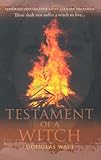
Testament of a Witch by Douglas Watt

Testament of a Witch by Douglas Watt is the second book of his that I’ve read. The first one Death of a Chief I read 5 years ago! Both books are set in late 17th century Scotland (1686 and 1687) and feature a Gaelic speaking, Edinburgh lawyer John MacKenzie and his clerk Davie Scougall. I like the way Douglas Watt incorporates the historical background into the narrative without detracting from the story.

In Testament of a Witch MacKenzie investigates the death of Grissell Hay, Lady Lammersheugh accused of witchcraft in a village overwhelmed by superstition, resentment and puritanical religion. Then the same accusations are made against the Euphame, Grissell’s daughter.  I wasn’t too keen on the horrifying and explicit descriptions of how the witch hunter identified and dealt with women accused of being witches, which involved torture and sleep deprivation, but apart from that I enjoyed this book.

I liked the interaction between Mackenzie, a Highlander and Scougall, a Lowland Scot. Scougall is convinced of the reality of witchcraft, whereas Mackenzie has ‘grave doubts about the crime of witchcraft‘, believing ‘it is nothing more than superstition‘. The religious fervour and political unrest are clearly demonstrated in this book, setting the frenzied persecution of those suspected of witchcraft in context. Watts’ Historical Note on The Scottish Witch-hunt at the end of the book gives the background, when Scottish society was in a state of flux.

Change caused anxiety and fear, unleashing frenzies of witch-hunting . … It has been estimated that the Scottish witch-hunt was ten times more deadly than the English one in terms of executions per head of population. Probably more than a thousand men and women were executed for witchcraft in Scotland during the sixteenth and seventeenth centuries.

The witch-hunt could not have occurred without a widespread belief in magic, charming and divination, and the acceptance of Satan as a real presence in the life of the people.

Witch-hunting declined when the revolutionary zeal of the Scottish Reformation ran out of steam in the late seventeenth century. Scotland began to turn its back on persecution and look towards the more tolerant and commercial age of the Enlightenment.

Testament of a Witch is well-researched and although it gets off to a slow start and I didn’t enjoy it quite as much as Death of a Chief, I was immersed into the fascinating and terifying world of the witch-hunt in 17th century Scotland as I was reading. It’s a book that qualifies both for the Read Scotland 2014 Challenge and this year’s R.I.P. Challenge, as well as the Historical Fiction Challenge and the My Kind of Mystery Challenge.

Douglas Watt is a Scottish historian, poet and novelist, who lives in Linlithgow. He has a PhD in Scottish History from Edinburgh University and is the author of The Price of Scotland, a history of Scotland’s Darien Disaster, which won the Hume Brown Senior Prize in Scottish History in 2008. 
Still Catching Up

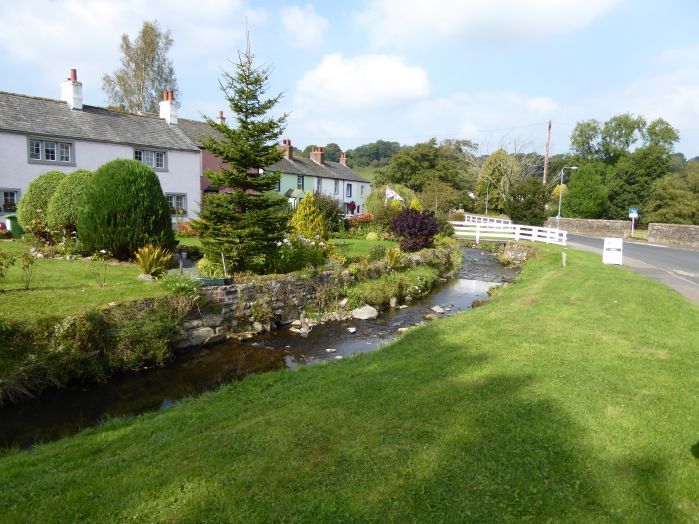
I’ve been missing from my blog for most of September, but I’ve still been reading. We’ve just returned from a  few days in the Lake District – such a beautiful part of the UK!

Caldbeck P1010042
Caldbeck Cumbria

I managed to squeeze in some reading time as well as walking in the fells near Caldbeck and visiting the Pencil Museum in Keswick, Castlerigg Stone Circle, the Honister Pass, Ullswater and Aira Force. I’ll post some photos later on.

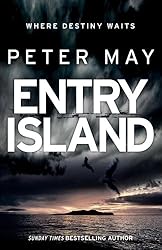
I took two books with me that I had already begun reading and finished one of them – Entry Island by Peter May. I’ve previously read May’s Lewis Trilogy – The Blackhouse, The Lewis Man and The Chessmen all of which I loved and whilst I did enjoy Entry Island I don’t think it quite lives up to the Lewis books. However, as I discovered when I came home this weekend Entry Island has been awarded the third annual Deanston Scottish Crime Book of the Year Award at the Bloody Scotland Crime Writing Festival.

Entry Island is set in present day Magdalen Islands, part of the province of Quebec, in the Gulf of St Lawrence, and in the nineteenth century on the Isle of Lewis at the time of the Highland Clearances.  It mixes together two stories and two genres, crime fiction and historical fiction. It has a strong sense of place in both locations and beautiful descriptions of the landscape as for example in this passage:

It was another ten minutes before the ferry slipped out of the harbour, gliding past the outer breakwater on a sea like glass, to reveal Entry Island in the far distance, stretched out on the far side of the bay, the sun only now rising above a gathering of dark morning cloud beyond it. The island drew Sime’s focus and held it there, almost trancelike, as the sun sent its reflection careening towards him, creating what was almost a halo effect around the island itself. There was something magical about it. Almost mystical. (page 14)

The characters are convincing – Detective Sime Mackenzie, based in Montreal is part of the team sent to Entry Island to investigate the death of the wealthy businessman, James Cowell found stabbed to death. His wife, Kirsty is the obvious suspect. Sime is suffering from insomnia, a situation made worse by the fact that his ex-wife is also on the investigating team. Sime is convinced that he knows Kirsty, although they have never met before and he doubts that she is the culprit. Running parallel to this crime fiction element is the historical one, linked by Sime’s ancestor, also called Sime who was a crofter’s son on the Isle of Lewis and whose love for the laird’s daughter seemed doomed from the start. The story of life on Lewis and the harsh treatment the crofters received during the potato famine, followed by the terrible conditions they endured during their transportation to Canada is powerfully and emotionally portrayed.

The two stories are linked together well, but I found the present day investigation not too convincing and rather contrived as the team seemed to jump to conclusions without much thought or thorough investigation of the evidence. And I thought that the historical element was dominant at the expense of the modern day crime story making the book a little unbalanced. However, as I said I liked the book, which is an entertaining read that held my interest to the end.

Peter May is a prolific author. He was born and brought up in Scotland, but he now lives in France. As well as The Lewis Trilogy he has also written The Enzo Files, a series of seven books featuring Scottish forensic scientist, Enzo MacLeod, who lives in France, teaches at a university in Toulouse, and is working on solving seven of France’s most famous cold cases by applying the latest scientific techniques and The China Thrillers, a series of six books featuring Beijing detective Li Yan and Margaret Campbell, forensic pathologist from Chicago. He has also had a successful career as a television writer, creator, and producer. 

I still have three other books to write about, including my first book for this year’s R.I.P. Challenge, Testament of a Witch, which like Entry Island also qualifies for the Read Scotland 2014 Challenge. Will I ever catch up with myself?

The Three Graces by Jane Wallman-Girdlestone

I’ve read a couple of novels this year that deal with mental illness – The Bell Jar by Sylvia Plath, which I found a bit confusing and disjointed and The Grass is Singing by Doris Lessing. My reaction to both books was that they are bleak and depressing, showing the breakdown of a personality and I struggled to read them. (See my thoughts on Doris Lessing’s book in this post.)

So, I was a bit hesitant about reading The Three Graces when I realised that it was a novel dealing with the subject of schizophrenia. I needn’t have been concerned as it is by no means a depressing novel. This is Jane Wallman-Girdlestone’s description of her book (taken from her website):

… Grace Hunter, the newly appointed Team Rector for the town, turns out to be nothing like people expect.  Nobody suspects that she has a guilty secret.  No one guesses that the local funeral director is the answer to the Rector’s prayers.  No one in their right mind would have thought that workaholic Grace was tormented by imaginary friends who dominated everything she did. 

My view:

Grace Hunter is trying to adjust to her new appointment as Team Rector, but her confusion grows as she begins to have hallucinations. It’s a remarkable book because although told in the third person at times I wasn’t sure that the people she sees were just in Grace’s head. I think it’s a very clever portrayal as the reader sees things through Grace’s eyes and mind whilst she is carrying on with everyday living and her job as Rector. Grace’s behaviour becomes reckless, at times divorced from reality. It clearly demonstrates how difficult/impossible it is for her to distinguish between what is real and what is not.

The Three Graces follows Grace’s life and to a lesser extent that of her family – husband Tom, Josh and Ros her step-children and her father-in-law, Charlie. They are all having to adjust to Tom and Grace’s marriage and the move to St Anthony’s, their third in five years. And they’re all feeling very unsettled. The dominant character in the novel is Grace; it all revolves around her and as her confusion grows it affects them all. It is an engrossing book, the writing is clear and concise, and the characters are clearly defined. It’s a well-structured novel, the tension and emotional atmosphere gradually rising and Grace’s feelings of despair and confusion and are all very evident. The book is certainly an enlightening read for me.

About the author (From Amazon):

Jane Wallman-Girdlestone was born and grew up in Tooting, South London. She began writing about her life experiences at eight. Jane taught briefly before working in theatre as a writer and director. She later worked as a Vicar and chaplain for some years before lecturing in Theology and Spirituality. Jane works with people who are on retreat offering creative and spiritual mentoring and as a counsellor.

Jane lives in the Highlands of Scotland in the UK, where she writes and paints. She is married and has three Newfoundland dogs and a cat.

The Three Graces is the second book in the Brayston series. Sausages and Trash is the first and the third, with the working title Sleight of Hand, will be published on Kindle in December. This will feature some of the characters from the first two books and I’ll be looking out for it.

NB:  The Three Graces is temporarily unavailable on Kindle.

Dark Matter by Philip Kerr

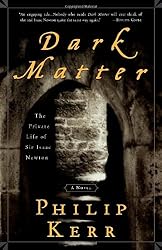
Dark Matter by Philip Kerr is a book from my to-be-read piles. I bought it at a library sale a couple of years ago now, attracted by the title. I soon realised that it is not about Newton, the mathematician and physicist because the sub-title is : The Private Life of Sir Isaac Newton. It is actually historical crime fiction, set in 1696 when Newton was the Warden of the Royal Mint at the Tower of London.

Christopher Ellis, the narrator of the book, is sent to the Tower to assist Newton to hunt down counterfeiters during the period of the Recoinage of the currency, when fake gold coins were being forged. This leads to the discovery in the Tower moat of the body of the former clerk of the Mint , followed by yet more murders. Newton at times seems remarkably like Sherlock Holmes in his powers of observation and deduction, as he and Ellis follow the trail of the murderers, involving tales of the missing treasure of the Knights Templars, (was the clue to its whereabouts in a book hidden in the Tower?), a difficult code to decipher, plots against Roman Catholics, astronomy and alchemy all thrown into the mix.

It’s very atmospheric, with shadowy London streets and back alleys; the Tower itself a centre of suspicion and intrigue. I liked the mix of fact and fiction. Titus Oates, Samuel Pepys and Daniel Defoe among others, make brief appearances, there’s the war with France and the mix of religion, science and politics that characterised the late 17th century. But I did find the characters, apart from Newton and Ellis confusing at times, having to backtrack a few times to sort them out. Newton himself is seen through Ellis’s eyes, a person who doesn’t like to speak  ‘anything that is extraneous to my business‘. But at times his sense of humour and wit, his dedication to his work, and his resolution of the science/faith conflict all come through.

I liked Dark Matter and reading it has certainly made me interested to know more about Newton, in particular about his religious beliefs. Although I’m happy to read this as fiction I wonder just how much is based on fact? In his Author’s Note, Philip Kerr explains that much is known about Newton’s work at the Royal Mint and that Christopher Ellis was in fact his assistant, following the mysterious disappearance of the previous clerk. As for his religious beliefs, Kerr writes:

Newton’s interest in alchemy, as well as his dissenting, not to say blasphemous, Arian view, which made him violently opposed to the ruling Trinitarian religious orthodoxy of the day, is also accurate. And anyone wishing to know more should read Richard Westfall’s magisterial biography of Newton, as I have done. But any mistakes in the novel are my own. (page 345)

And I also want to know did he really have a cat, and if so did he call it Melchior?

Although I didn’t read it just to fit in with several reading challenges I’ve joined, it is ideal for several and I’ve indicated those challenges in the Categories listed below this post.

Philip Kerr, is a Scot, born in Edinburgh. ‘He is the author of more than 20 books, including seven Bernie Gunther novels, several standalone thrillers, and six books in the young-adult series Children of the Lamp under the pen name of P.B. Kerr.

In 2009, he won the British Crime Writers’ Association Ellis Peters Historical Fiction Award and Spain’s RBA International Prize for Crime Writing for his Bernie Gunther series. A former advertising copywriter who released his first book in 1989 and in 1993 was named one of Granta magazine’s Best Young British Novelists, he now divides his time between London and Cornwall.’ (copied from his website)

Read Scotland 2014 Challenge: two books

I’ve got a bit behind with writing reviews, so here are some notes on two books I’ve recently read, both of which fit into the Read Scotland 2014 Challenge.

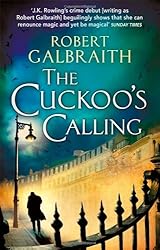
It’s common knowledge now that Robert Galbraith is J K Rowling’s pseudonym. I wish I’d read The Cuckoo’s Calling without knowing that, as although I have no problem with authors writing under pseudonyms, I found myself thinking how like the Harry Potter books it is in some ways and I doubt I’d have thought that if I’d read it ‘blind’.

Anyway, I liked The Cuckoo’s Calling. It is crime fiction, set in the world of Cormoran Strike (a Harry Potterish name, I thought), an ex-army private detective, who is struggling to get clients and pay his bills, sleeping on a camp bed in his office. Along comes Robin Ellacott, from the Temporary Solutions Agency to help out (think, Hermione Granger). She’s intelligent, efficient, remarkably resourceful, and she soon has Strike organised, which is essential as he is asked by John Bristow, a lawyer and the brother of a childhood friend to investigate the death of his sister, Lula Landry. The police are satisfied that Lula, a model, had committed suicide, but Bristow is certain that she didn’t.
What follows is at times a leisurely narrative and the plot is quite complex, but not too difficult to work out. The characters are convincing, Robin in particular soon became my favourite. She has an enquiring mind, ‘fascinated by the interior workings of other people’s minds‘ and despite her fiancé’s opposition to her job, she carries on, motivated by her fascination with investigating, and her secret ambition to be a private detective. In fact without Robin, Strike would have really struggled to get to the truth.

I’ve counted this book towards the Read Scotland 2014 Challenge because J K Rowling, although she was born in England has lived in Scotland for twenty-one years and plans to spend the rest of her life in Scotland. Whereas the author of the next book, Muriel Spark is an author who was born and grew up in Edinburgh, but who later lived in London. To qualify for this challenge books have to be by Scottish authors, either by birth or immigration, or about or set in Scotland – quite a wide brief!

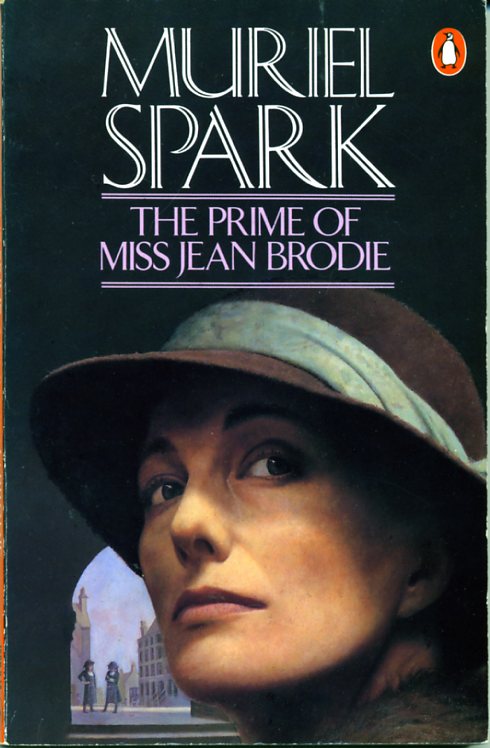
brodie001The Prime of Miss Jean Brodie is perhaps Muriel Spark’s most famous novel. I’ve read it before and seen the film, with Maggie Smith in the title role. Each time I’ve read it I’ve really enjoyed it – it’s one of those books that isn’t spoilt by knowing what happens, because part of the pleasure of reading it is the fact that I do know who betrayed Miss Brodie. Despite her declaration: ‘Give me a girl at an impressionable age and she will be mine for life‘, it is one of the ‘Brodie set’ who causes her downfall, that and her pride and self-absorption.

But what really impresses me about this book is the writing, so compact, so perceptive and so in control of the shifts in time backwards and forwards. It’s a joy to read. I’ve written more about it in this post.

Book Beginnings: The Crow Road by Iain Banks

It was the day that my grandmother exploded. I sat in the crematorium, listening to my Uncle Hamish quietly snoring in harmony to Bach’s Mass in B Minor, and I reflected that it always seemed to be death that drew me back to Gallanach.

A dramatic opening that caught my attention when I began reading Iain Bank’s novel The Crow Road. I’ve read on further and so far I’m intrigued and amused by this family saga of the McHoans, that switches about between the generations.

Every Friday Book Beginnings on Friday is hosted by Gillion at Rose City Reader where you can share the first sentence (or so) of the book you are reading, along with your initial thoughts about the sentence, impressions of the book, or anything else the opener inspires.