My Friday Post: Housekeeping

Book Beginnings ButtonEvery Friday Book Beginnings on Friday is hosted by Gillion at Rose City Reader where you can share the first sentence (or so) of the book you are reading, along with your initial thoughts about the sentence, impressions of the book, or anything else the opener inspires.

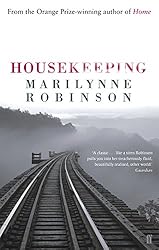
This week’s book is Housekeeping by Marilynne Robinson.

It begins:

My name is Ruth. I grew up with my younger sister, Lucille, under the care of my grandmother, Mrs Sylvia Foster, and then when she died, of her sisters-in-law, Misses Lily and Nona Foster, and when they fled of her daughter, Mrs Sylvia Fisher.

Friday 56

A sad opening, I thought. Two young children passed from pillar to post.

Also every Friday there is The Friday 56, hosted by Freda at Freda’s Voice.

These are the rules:

  1. Grab a book, any book.
  2. Turn to page 56, or 56% on your eReader.
  3. Find any sentence (or a few, just don’t spoil it) that grabs you.
  4. Post it.
  5. Add the URL to your post in the link on Freda’s most recent Friday 56 post.

Page 56:

Sylvie put her hands in her pockets. “I think I should stay for a while,” she said. The aunts are too old. I think it’s best for now, at least.”

See my previous post for the synopsis.

Short Story Sunday: The Shepherdess and the Sweep

Short story questI’m taking part in Carl’s Once Upon a Time event, specifically in the Short Story Quest, which involves the reading of one or more short stories that fit within at least one of the four genres of Fairy Tale, Folklore, Fantasy and Mythology, during the course of any weekend, or weekends, during the challenge. Ideally, posting about your short story readings on Sundays or Mondays, but this is not strictly necessary.

This will be a weekly event for me, until the end of the event on 21 June. I’m reading some of Hans Christian Andersen’s Fairy Tales ‘“ I first read a lot of the tales as a child. Andersen was a Danish author, born in 1805 in Odense. He was a prolific writer of plays, travelogues, novels, and poems, as well as fairy tales. Some of his most famous fairy tales include The Emperor’s New Clothes, The Little Mermaid, The Nightingale, The Snow Queen, The Ugly Duckling, Thumbelina, and many more. He died in 1875.

I’m reading from my mother’s book: P1010936This week it’s another fairy tale that I don’t remember reading before – The Shepherdess and the Sweep.

Unlike The Rose Elf, the story I read last week, The Shepherdess and the Sweep is not a gruesome story, but a story of love, romance, and bravery.

The Shepherdess and the Sweep are two china figures who fall in love but their love is threatened by a strange looking carved satyr the children called the Goatsleg-Highadjutant-general-militarycommandant, as he had goat’s legs, short horns and a long beard and was constantly grinning. He stood on top of a very old wooden cabinet, looking down on the beautiful Shepherdess on the table opposite and wanted her for his wife. There is also a bigger china figure than the little couple – a big old Chinese, who could nod his head. He claims authority over the Shepherdess and says she will marry the satyr that night.

So the two little china figures decide to leave the table and venture out into the wide world. In their desperation to escape they decide to climb the chimney, but when they get to the top the Shepherdess is overcome with fear and cries “This is too much” she sobbed, “That I can never bear. The world is too large; oh, were I but back again on the table under the looking glass!”

Illustration from “Fairy Tales, 1850” by Vilhelm Pedersen, Andersen’s first illustrator (from Wikipedia)

Spoiler follows – don’t read the next paragraph if you don’t want to know how this story ends.

The sweep can’t console her and so they climb back down even though he thought it was foolish. But they find that the Chinese figure in his attempt to follow them had fallen and broken into three pieces. The family mended him but his head, which had rolled far off into a corner of the room had to be riveted onto his neck, so that he could no longer nod. He was too proud to tell the Satyr and so when he asked if he were to have the Shepherdess or not, the Chinese figure was silent. And the little couple remained together. So, a happy ending for this tale.

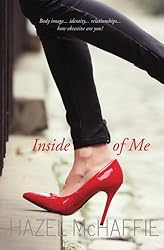
Inside of Me by Hazel McHaffie

I’ve read one of Hazel McHaffie’s books in the past – Over My Dead Body and was impressed by the way she weaves facts into her fiction so seamlessly that it doesn’t detract from the story. So, when she asked if I would like to read Inside of Me I didn’t hesitate to say yes please. And I wasn’t disappointed. I think this is an excellent book and once I started reading it I didn’t want to stop, keen to find out what was going to happen next.

Hazel McHaffie’s novels all cover medical ethics issues and the issues in Inside of Me concern body image, in particular, but not exclusively, about anorexia; identity, and relationships. There is also a mystery – teenage girls are going missing, the latest one being Maria aged sixteen, last seen walking alone along Regent’s Park Canal. Tonya Grayson is worried, no terrified is a better description, that her missing husband, Victor, could be involved. But the police are convinced he is dead; his clothes were found neatly folded in a beach, although his body was never found. India, their daughter, who was eight at the time, believes, even after seven years, that he is still alive, reinforced by hearing his voice in a crowded London station, the day after Maria was reported missing.

The narrative, told in the first person, switches between Tonya and India living in Scotland, and Chris, who works in a florist shop in London, mourning the loss of a daughter. Chris, after reading the newspaper report about the missing teenager, spots Maria at a local car boot sale, offers to help and ends up taking her home, anxious about her safety.

India is anorexic, but won’t accept the truth, either that her father is dead or that she has a weight problem. Tonya tries to help her but cannot get through to her and for most of the book seems completely out of her depth, unable to move forward herself. She is plagued with doubts about Victor and his relationship with India, which had been very close. India’s best friend, Mercedes is also obsessed with her weight and encourages India both to find her father and to take even more drastic ways to gain her target weight.

Hazel McHaffie has got right inside each character’s mind, making this a compelling and convincing story. And it is a gripping story, easy to read, but by no means a comfortable read, in turns emotional and troubling. It conveys the complex dilemmas of living with eating disorders, problems with body image and difficult family relationships, issues with control and coping with emotional disturbance, obsessions and compulsive behaviour. Added to all this there is the mystery of what happened to Victor – his pile of clothes on the beach reminded me of Reginald Perrin (from the TV series  in the 1970s). I think it is a wonderful book and I don’t think I’ve read another novel like it. I’ve only touched its surface in this post!

  • Paperback: 242 pages
  • Publisher: VelvetEthics Press (5 Mar. 2016)
  • Language: English
  • ISBN-10: 099262312X
  • ISBN-13: 978-0992623128
  • Source: Review copy from the author

Hazel McHaffie is a Scottish author. For details of her background and qualifications as a nurse, midwife, PhD in Social Sciences and Research Fellow in Medical Ethics see her website, where she also lists her awards, life changing experiences, and more personal stuff such as her character traits, addictions (including good books), and hobbies. She also writes a most interesting blog.

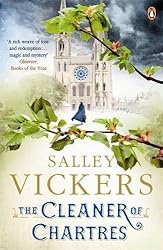
The Cleaner of Chartres by Salley Vickers

Once more I am behind with writing about the books I’ve read, so this is a short post with brief thoughts on The Cleaner of Chartres by Salley Vickers. I enjoyed it immensely.
This is a beautiful book, beautifully written, with the character of Agnès Morel at its centre. Agnès was found as a baby in a straw shopping basket, wrapped in a white tablecloth, with just a single turquoise earring in the bottom of the basket that may or may not indicate her parentage. She was brought up by the Sisters of Our Lady of Mercy at Evreux. It tells of how Agnes became the cleaner of the Cathedral of Notre Dame in Chartres, in central France, north of Paris, and not only of the cathedral but also a cleaner for other residents of the town.
So, there is a mystery about her origins and also about her life before she arrived in Chartres. Moving between the past and the present, the details are slowly revealed. There are many characters, some likeable people including the Abbé Paul, Professor Jones, who teaches Agnes to read, Philippe Nevers, and Alain Fleury, who works on the cathedral restoration and some unlikeable characters such as Madame Beck and Sister (later Mother) Veronique whose interfering ways cause Agnes such a lot of trouble. All are convincing characters with depth.

I liked it all, the slow build up as Agnès’s history unfolds, the interaction of the characters and the description and history of the cathedral also added to my enjoyment of the book.

Short Story Sunday: The Rose Elf

Short story questI’m taking part in Carl’s Once Upon a Time event, specifically in the Short Story Quest, which involves the reading of one or more short stories that fit within at least one of the four genres of Fairy Tale, Folklore, Fantasy and Mythology, during the course of any weekend, or weekends, during the challenge. Ideally, posting about your short story readings on Sundays or Mondays, but this is not strictly necessary.

I’m beginning this Sunday, with what I hope will be a weekly event for me, until the end of the event on 21 June. I’ll be reading some of Hans Christian Andersen’s Fairy Tales – I first read a lot of the tales as a child. Andersen was a Danish author, born in 1805 in Odense. He was a prolific writer of plays, travelogues, novels, and poems, as well as fairy tales. Some of his most famous fairy tales include The Emperor’s New Clothes, The Little Mermaid, The Nightingale, The Snow Queen, The Ugly Duckling, Thumbelina, and many more. He died in 1875.

I’m reading from my mother’s book: P1010936

beginning with The Rose-Elf.

I don’t remember reading this story before – and I think I would if I had read it, because it’s such a gruesome story. The Rose-Elf is very short and surprised me by the horror of the events it unfolds.

It begins by describing the Rose-Elf, who is so small he can’t be seen by human eyes. He is a beautiful creature, with two transparent wings reaching from his shoulders to the soles of his feet, making him look like an angel. He lives, as you would suppose in a rose tree, having little rooms behind each rose petal:

‘… what delicious scent filled all his apartments, and how beautifully clear and bright were the walls, for they were the delicate, pale red rose leaves themselves.’

He danced on the wings of butterflies, walked along the veins of leaves, which he looked upon as roads. But one day the weather grew cold and the leaves closed before he could get back inside the roses, so he flew to a honeysuckle for shelter and here he came across a pair of young lovers – a handsome young man and a charming girl. It’s at this point that the story moves from a cosy fairy tale that you would be happy to read to very small children into something dark and chilling. For the girl has a jealous, wicked brother who plots to get rid of the young man and kills him.

The girl is heartbroken and the Rose-Elf who witnesses the murder of her lover, does what he can to help her but this is a tragedy. It’s not an ‘and they all lived happily ever after’ ending. The horror is not in the actual killing but in what happens to the corpse afterwards.

The Queen of the bees hums her praise of the Rose-Elf saying ‘how beneath the smallest leaf dwells one who can expose and avenge crime.’

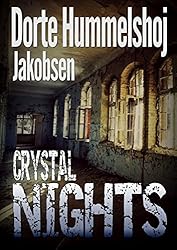
Crystal Nights by Dorte Hummelshoj Jakobsen

I recently read Crystal Nights: a Scandinavian mystery by Dorte Hummelshoj Jakobsen, who kindly sent me an e-version of the ARC of her book. The Danish edition of the book, Krystalnætter, won a national competition in 2013.

Once I started reading Crystal Nights I was hooked. It begins with an extract from Hans Christian Andersen’s The Snow Queen, a fairy tale about the struggle between good and evil, when a magic mirror was smashed into many pieces, which then entered the eyes, hearts and minds of people infecting them with evil.

Crystal Nights moves between events in Germany in 1938 to Kalum, a fictional village in Denmark, in the 1960s. In Berlin in 1938 Jewish families, including the Stein family, Simon, his wife Sara, and Miriam and Isaac, their two young children flee from the events of Krystallnacht, the “night of broken glass”.  Their journey doesn’t get them to safety though and ends with Sara desperate as her son becomes dangerously ill and Simon refuses to get medical help.

Moving on to the 1960s in Kalum, the story divides into the years 1963 and 1967. In 1963 a middle-aged smallholder from Brook Farm, north of Kalum is killed in a road accident. The relevance of this death only becomes apparent towards the end of the book. In 1967 a young boy, Lars-Ole disappears. His mother believes he had gone to stay with his father, but eventually everybody except for his friend Niels, assumes he is dead although his body has not been found. Niels finds Lars-Ole’s notebook, in which he had written some coded messages and sets out to discover what has happened to him, putting himself into great danger.

I particularly liked the comparison between Andersen’s fairy tale and the events of Krystallnicht and I think the characters of both Lars-Ole and Niels are well-drawn, with the village setting in the 1960s particularly convincing. I was carried away by the story, a story of how evil touched so many lives with such terrible consequences and how by patience and perseverance the truth was revealed.

You can see photos and maps showing the area in this picture companion to the book.

  • Format: Kindle Edition
  • File Size: 820 KB
  • Print Length: 187 pages
  • Publisher: Candied Crime; 1 edition (6 May 2015)
  • Source: Review copy from the author

Reading Challenges: Mount TBR Reading Challenge 2016