The Mill on the Floss by George Eliot

I was pleased when the Classics Club Spin number came up as 8, because for me that was The Mill on the Floss, a book I’ve had for years, so it was time I read it. I think one of the reasons I hadn’t read it is the size of the font – it’s small. But then I realised that there is a free e-book, so I read it on my Kindle as I could increase the font size.
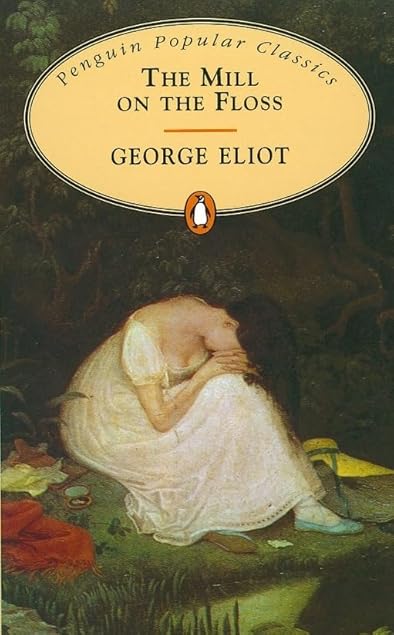
Description (from my paperback copy of the Penguin Popular Classics 1994 edition, shown above):

George Eliot drew on her own anguished childhood when she depicted the stormy relationship between Maggie and Tom Tulliver. Maggie’s often tormented battle to do her duty and belong on the one hand, and to be  herself, wild and natural, on the other, propels her from one crisis to another. As the Tulliver fortunes decline and fall, the rift between Maggie and her family becomes almost irreconcilable. But Maggie’s biggest mistake of all is to fall in love with Stephen Guest who is engaged to another woman.

Both a sharp and observant picture of English rural life and a profoundly convincing analysis of a woman’s psychology, The Mill on the Floss is a novel that tackles the complexities of morality versus desire.

My thoughts:

The Mill on the Floss was first published in 1860. The story begins in the late 1820s, when Maggie, who is ‘big for her age, gone nine‘ and her brother, Tom aged about twelve are living at Dorlcote Mill on the banks of the river Floss near the town of St Oggs. Their father is anxious that Tom should have a good education so that he can go into business – he does not want him to be a miller. But it is Maggie who is the keen reader, enjoying books like The History of the Devil by Daniel Defoe, Aesop’s Fables and the Pilgrim’s Progress.

I enjoyed parts of the book more than other parts. The first part of this book, covering Maggie and Tom’s childhood for example is fascinating and a study of early 19th century rural life and education. Tom goes away from home to study under a tutor, Mr Stelling and meets Philip Wakem, whose father is a lawyer, Mr Tulliver’s opponent in a lawsuit. Maggie and Tom’s relationship is difficult, although she professes she ‘loves him better than anyone else in the world’, even when he rebukes her. Meanwhile Maggie becomes more friendly with Philip than Tom and her family like.

There are some lovely scenes, for example Maggie’s escapade when she leaves home to live with the gypsies. And I liked all the scenes with Mrs Tulliver’s sisters, who look down on her for marrying a miller and criticise Maggie’s appearance and behaviour, for Maggie is full of high spirits and energy. The sisters also provide comic relief, at times being miserly and self-centred, with a strong sense of their own importance. But things go from bad to worse for the Tullivers, when Mr Tulliver loses the lawsuit and eventually loses the mill.

In other places, between scenes there are long, rambling passages, that I found too wordy and philosophical and I waited impatiently to get back to the story. But overall I liked the book, more than I liked Adam Bede, but not as much as I remember liking Middlemarch, which I read long before I began this blog.

The Mill on the Floss is an epic novel encompassing various themes such as love, marriage, family loyalty, the social conventions of the times, and the struggle to survive. Feminism, education, and the role of women in society are to the fore, as Maggie is torn between two men who love her and is judged harshly for her behaviour.

It is a character driven plot; the river Floss plays a major part in the story, running through a wide plain, hurrying on to the sea, laden with ships. It’s a noisy place with Dorlcote Mill is on its banks near a stone bridge and the rush of the water is deafening, along with the ‘thunder of the huge covered wagon coming home with sacks of grain‘.

And it is the Floss that provides the huge climax which took me by surprise. It’s a dramatic ending and yet I found it rather unsatisfactory, not sure that I could believe what I had read, and shocked by such a sad ending. Looking back after I finished the book I realised that it had been foreshadowed almost from the start and I had missed it.

Reading Challenges: Mount TBR 2016 and The Classics Club.
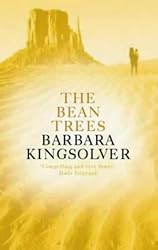
The Bean Trees by Barbara Kingsolver

If I don’t write about a book as soon as I’ve finished it the details begin to fade. I finished reading  Barbara Kingsolver’s first novel, The Bean Trees a few weeks ago. So this is a short post on the book, which doesn’t really do justice to it!
My thoughts:

I loved this book. Barbara Kingsolver writes in such a way that I can easily visualise the scenes, beginning with the opening paragraph in which she describes a tractor tire blowing up, flinging a man up in the air and throwing him over the top of a Standard Oil sign. Taylor (originally called Marietta/Missy) grew up in rural Kentucky. She left home when she had saved enough to buy a car, an old VW. She changed her name to Taylor after the first place where she ran out of petrol, which just happened to be Taylorville. She drove on until the car broke down in the middle of nowhere, on land owned by the Cherokee tribe. And it was there at a garage that an Indian woman abandoned a baby girl in Taylor’s car – she called the baby, Turtle.

They travel on to Tucson, where she settled for a while, living with Lou Ann, a mother whose husband, Angel Ruiz left before their son was born, and working for Mattie at ‘Jesus Is Lord Used Tires’. Mattie, however, is also involved in an underground railway moving illegal Guatemalan and Salvadoran immigrants to safe houses. She talks of the obligation under the United Nations ‘something or other’ ‘to take in people whose lives are in danger’. And Taylor becomes involved in helping her.

There are several themes running throughout this short, but well written book – both political and social including family relationships, particularly mother/child, sexual and physical abuse of small children, the integration of cultures, as well as the always current issue of refugees and illegal immigrants. I thought it was all thought-provoking as well as fascinating reading.

I have read some of Barbara Kingsolver’s later books, including The Poisonwood Bible, a longer and much more complex book, which I’ve read twice and loved. There is a sequel to The Bean Trees that I really want to read now – Pigs In Heaven.

Reading Challenges: What’s In a Name? in the category of a book with the word ‘tree’ in the title.

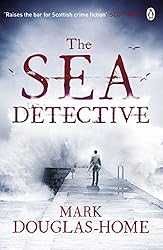
The Sea Detective by Mark Douglas-Home

Lovereading.co.uk  sent me a copy of  The Sea Detective by Mark Douglas-Home for review in advance of the publication of the third title in the series The Malice of Waves on 19 May and I’m glad to say that I thoroughly enjoyed it.

It’s one of those books that grabbed my attention right from the start when two young teenage girls from India are sold into the sex trafficking trade, completely unaware of the dangers and terror that awaits them. Then, Edinburgh-based oceanographer, Cal McGill is caught on camera planting a rare wild flower in the garden of the Scottish Environment Minister in a campaign to make politicians aware of the dangers of climate change. Detective Inspector Ryan wants to charge him with vandalism but the minister’s wife wants to keep the plant!

From then on the story gets complicated. It’s more of an investigative story than crime fiction, with several strands to the story, but it’s so well told that I had no difficulty in following all of them: a story of unsolved mysteries both from the present day and from the Second World War, and of two Indian girls, sold into the sex trafficking trade. It’s set mainly in Scotland with a strong sense of place throughout.

The main characters are all fully rounded and complex – Cal McGill works for environmental organisations tracking oil spills using wind speeds and data on ocean currents; DI David Ryan and DC Helen Jamieson are investigating the appearance of severed feet in trainers that had been washed on shore on islands miles apart – tests had revealed that they belonged to the same body; and Basanti, one of the Indian girls, whose resourcefulness saved her life. I especially liked Helen Jamieson, the overweight policewoman, whose boss, Ryan mistakenly thinks is stupid, and the way she deals with him.

The strand that interested me most concerns Cal’s grandfather, from the (fictional) island of Eilean Iasgaich. He had died during the Second World War, washed overboard during a storm, whilst their trawler was patrolling the sea around Norway, one of seven men who had died ‘“ and yet his name had not been included in the island’s war memorial. Cal eventually discovers the truth about what actually happened and how his grandfather met his death.

It’s a gripping and emotional story. I loved it.

The Sea Detective is Mark Douglas-Home’s first book. Before writing books he was the editor of Scotland’s leading daily newspaper, The Herald, and The Sunday Times Scotland. He is the nephew of the late Sir Alec Douglas-Home who was Prime Minister of the UK from October 1963 to October 1964. He lives in Edinburgh.

I’m looking forward to reading his second book, The Woman who Walked into the Sea as well as his third, The Malice of Waves.

Reading Challenges: Read Scotland 2016 – by a Scottish author and set in Scotland.

My Reginald Hill Reading Project

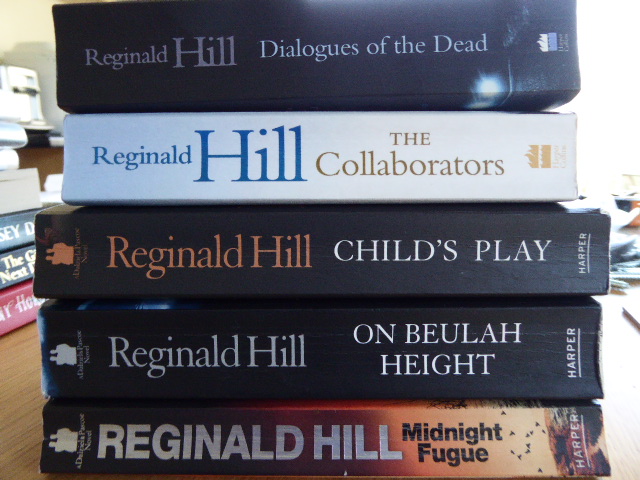
Inspired by reading Reginald Hill’s Bones and Silence recently I decided I want to read more of his books and I’ve made a page to record my progress. When I visited two secondhand bookshops this last week I stocked up on as many of his books that were on the shelves that I haven’t read:

P1010900

They are all Dalziel and Pascoe novels, apart from The Collaborators, which is a standalone novel set in 1945 in Paris. From the top down they are (synopses from Amazon, essentially the blurbs on the back covers) :

  • Dialogues of the Dead: A man drowns. Another dies in a motorbike crash. Two accidents ‘ – yet in a pair of so-called Dialogues sent to the Mid-Yorkshire Gazette as entries in a short story competition, someone seems to be taking responsibility for the deaths.In Mid-Yorkshire CID these claims are greeted with disbelief. But when the story is leaked to television and a third indisputable murder takes place, Dalziel and Pascoe find themselves playing a game no one knows the rules of against an opponent known only as the Wordman.
  • The Collaborators:Paris, 1945. In the aftermath of the French liberation, Janine Simonian stands accused of passing secret information to the Nazis.She is dragged from her cell before jeering crowds, to face a jury of former Resistance members who are out for her blood. Standing bravely in court, Janine pleads guilty to all charges.Why did Janine betray, not just her country, but her own husband? Why did so many French men and women collaborate with the Nazis, while others gave their lives in resistance?What follows is a story of conscience and sacrifice that portrays the impossible choice between personal and national loyalty during the Nazi occupation.
  • Child’s Play:When Geraldine Lomas dies, her huge fortune is left to an animal rights organization, a fascist front and a services benevolent fund. But at her funeral a middle-aged man steps forward, claiming to be her long-lost son and rightful heir. He is later found shot dead in the police car park, leaving behind a multitude of suspects. And Superintendent Dalziel and Peter Pascoe find themselves plunged into an investigation that makes most of their previous cases look like child’s play’¦
  • On Beulah HeightFifteen years ago they moved everyone out of Dendale. They needed a new reservoir and an old community seemed a cheap price to pay. But four inhabitants of the valley could not be moved, for nobody knew where they were: three little girls who had gone missing, and the prime suspect in their disappearance, Benny Lightfoot. This was Andy Dalziel’s worst case and now he looks set to relive it. Another child goes missing in the next valley, and old fears arise as someone sprays the deadly message on Danby bridge: BENNY’S BACK!
  • Midnight FugueGina Wolfe is searching for her missing husband, believed dead, and hopes Superintendent Andy Dalziel can help. What neither realize is that there are others on the same trail. A tabloid hack with some awkward enquiries about an ambitious MP’s father. The politician’s secretary who shares his suspicions. The ruthless entrepreneur in question ‘and the two henchmen out to make sure the past stays in the past.Four stories, two mismatched detectives trying to figure it all out, and 24 hours in which to do it: Dalziel and Pascoe are about to learn the hard way exactly how much difference a day makes’.

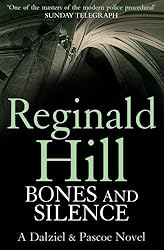
Bones and Silence by Reginald Hill

I found a lot to enjoy in Bones and Silence, Reginald Hill’s 11th book in his Dalziel and Pascoe series, first published in 1990.

Blurb (from the back cover):

When Detective Superintendent Andy Dalziel witnesses a bizarre murder across the street from his own back garden, he is quite sure who the culprit is. After all, he’s got to believe in what he sees with his own eyes. But what exactly does he see? And is he mistaken? Peter Pascoe thinks so.

Dalziel senses the doubters around him, which only strengthens his resolve. To make matters worse, he’s being pestered by an anonymous letter-writer threatening suicide. Worse still, Pascoe seems intent on reminding him of the fact.

Meanwhile the effervescent Eileen Chung is directing the Mystery Plays. And who does she have in mind for God? Dalziel of course. He shouldn’t have too much difficulty in acting the part …

My thoughts:

I liked all the complications of plot and sub-plots in this book and the interplay of the characters. It’s full of interesting characters and humour, but it is the plot that takes precedence. It is so tricky, with numerous red herrings and plot twists. Dalziel is positive that he saw Philip Swain shoot his wife; shooting her at close range, destroying much of her face and removing the top of her head. But Swain insists it was an accident – he was trying to stop her from killing herself and the gun went off. The only other witness, Greg Waterson, backs up Swain’s story – and then disappears.

My image of Dalziel comes from Warren Clark’s portrayal of him in the TV series because I watched the programmes before I read any of Hill’s books. To me Warren Clarke is Dalziel, just as David Suchet is Poirot. Dalziel is a larger than life character, speaks his mind and is never politically correct. He is is positive in his belief in Swain’s guilt even when everyone else thinks his wife’s death was an accident:

Andrew Dalziel, despite what his friends said, was no paranoiac. He did not believe himself to be infallibly perfect or unjustly persecuted. His great strength was that he walked away from his mistakes like a horse from its droppings, and as he himself once remarked, if you leave crap on people’s carpets, you’ve got to expect a bit of persecution.

But when he believed himself right, he did not readily accept evidence that he might be wrong, not while there was any stone left unturned. (page 242)

But it doesn’t help that Swain has been cast in the role of the devil opposite Dalziel’s God in the mystery play and the two are constantly sparring. The whole sub-plot of the mystery play is brilliant. Each Part of the book is headed by a quotation from the York Cycle of Mystery Plays, each one relevant to the events that follow. And the vision of Dalziel as God is so funny, especially when the fat man has to climb a narrow ladder up the back of a triple decker stage mounted on a flat car. Dalziel has to sit on a tiny platform over the upper deck, perched above polystyrene clouds.

Pascoe has recently returned to work after a period of sick leave, following an accident and, impatient to find evidence against Swain, Dalziel delegates the anonymous letters to Pascoe to discover who has been sending them. This sub-plot about the identity of the letter writer is the only part of the book that I’m not sure about. I had several thoughts about who it could be, but I was wrong and in the end when the author was revealed I wasn’t completely convinced that that character could have known all the information given in the letters. Still, it makes a dramatic conclusion to the book and came as a complete surprise to me.

Although Bones and Silence is a long book (524 pages) I read it quite quickly, completely absorbed in its mysteries and impressed both with the ingenuity of the plot and the quality of the writing. I really mustn’t leave it very long before I read some more of Reginald Hill’s books.

  • Paperback: 528 pages
  • Publisher: Harper (25 Jun. 2009)
  • Language: English
  • ISBN-10: 0007313128
  • ISBN-13: 978-0007313129
  • Source: I bought the book

Reginald Charles Hill FRSL (3 April 1936 ‘“ 12 January 2012) was an English crime writer, and the winner in 1995 of the Crime Writers’ Association Cartier Diamond Dagger for Lifetime Achievement.

Reading Challenges: Mount TBR Reading Challenge 2016 – a book I’ve owned for four years.

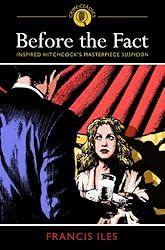
Before the Fact by Francis Iles

On the face of it Before the Fact is a straight forward story. It tells the tale of wealthy, intelligent but plain Lina McLaidlaw whose family are against her marriage to the handsome, charming and fascinating Johnnie Aysgarth; Lina’s father tells her Johnnie is a ‘rotter’. But right from the opening paragraph it’s obvious that Lina’s father is right. In fact Johnnie is much worse than her father realised:

Some women give birth to murderers, some go to bed with them, and some marry them. Lina Aysgarth had lived with her husband for nearly eight years before she realized that she was married to a murderer.

First published in 1932 by Francis Iles (* see below*), Before the Fact is a Golden Age crime fiction novel that is a psychological character study of its two main characters, Lina and Johnnie. It’s cleverly written. Lina slowly realises Johnnie’s true nature – that of a compulsive liar and gambler, a manipulative scoundrel who thinks nothing of being unfaithful, even of arranging a murder, or two.  But still she stays with him, trying to control and change him, believing his lies until she has to accept him for what he is, with disastrous consequences.

As Lina’s eyes are slowly opened I became exasperated at her naiveté, her acceptance of what she she has discovered about Johnnie. She comes across as a fool besotted by him and desperate for his love and attention, and even though her suspicions are aroused she still deliberately ignored all the warning signs, descending from panic, terror, horror and despair into passivity. She is maddening, a born victim and I began to wonder how it could possibly end. It was even more chilling than I had imagined.

*About the Author (copied from the publishers):

Frances Iles was a pseudonym of Anthony Berkeley Cox, who was born in 1893 in Watford. After serving in the army during the First World War, Berkeley worked as a journalist for many years before his first foray into the crime genre with The Layton Court Mystery (1925).

His two primary non-de-plumes were Francis Iles and Anthony Berkeley. As the former, he was a master of the psychological suspense genre, always with a wry humorous tenor to his writing; as the latter he acted as a trailblazer in the classic ‘Golden Age’ of crime and detective novels.

An intensely private man who always shunned publicity, Berkeley died in 1971.

As I read I marked a few passages that although not directly connected with the story I found interesting:

About artistic criticism – in particular female criticism:

If one did not happen to like a certain book, picture, or piece of music, one took it for granted that the book, picture, or piece of music was just bad; and the people who thought it was good, were, quite simply and plainly, mistaken. It never occurred to any female critic that a book might possibly be above her own level of intelligence (the men of course read only detective stories). (page 42)

on artists:

‘Aren’t artists intelligent?’ Lina asked innocently.

‘Of course they’re not. Most of them haven’t got the brains of a mouse. They just have this odd knack of being able to put things on canvas, and that’s all. They are the dullest of all the creators. Musicians are the nicest: you never hear a musician talk about himself at all. Then the really good authors. They don’t thrust their work down one’s throat; they’ve no need to. Then the second-rate authors, who do, and have. And then the painters, a long way bottom.’ (page 125)

I wonder who he was referring to?

And on murder:

When you incite a person to do something which both of you know will probably kill him – is that legally murder or not? (page 177)

Lina discusses this point with Isobel Sedbusk (based on Dorothy L Sayers), a writer of detective stories, thinking that it wasn’t ‘real murder, like giving the man poison, or shooting him, or anything like that.’ Isobel replies:

‘No, I’m inclined to doubt whether it would be murder, from the legal point of view. The legal definition of murder is ‘to kill with malice aforethought’. Still, you’ve got the malice aforethought all right. And if he knowingly incited the man to commit an act which would result in his death …’

Malice Aforethought – another novel by Francis Iles (published in 1931) begins with revealing the identity of the murderer. I shall have to read that one soon.

Reading Challenges: