First Chapter, First Paragraph: The Invention of Wings

First chapterEvery Tuesday Diane at Bibliophile by the Sea hosts First Chapter First Paragraph Tuesday Intros to share the first paragraph sometimes two, of a book that she’s reading or planning to read soon.
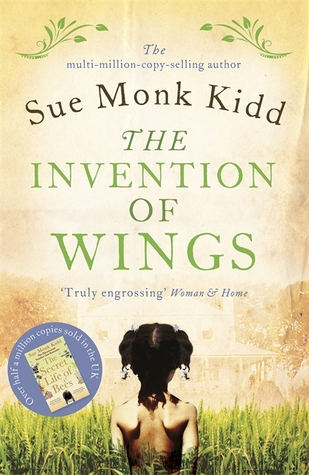
This week I’m featuring The Invention of Wings by Sue Monk Kidd, a book I’ll be reading this month for my book group.

The Invention of Wings

It begins:

There was a time in Africa the people could fly. Mauma told me this one night when I was ten years old. She said, Handful, your granny-mauma saw it for herself. She say they flew over trees and clouds. She say they flew like blackbirds. when we came here, we left the magic behind.

From the back cover:

Handful’s always been in trouble. A slave in the Grimké household like her beloved mother Charlotte, Handful knows the rules, in all their brutality, but no one can stop her pushing them to the limit. When, ten years old, she’s presented to the owner’s most difficult daughter, Sarah, as a birthday present, the sparks begin to fly …

I think I’m going to enjoy this book very much. It’s set in Charleston in the early nineteenth century and is based on the lives of sisters, Sarah and Angelina Grimké, the first female abolition agents and among the earliest American feminist thinkers.

What do you think? Would you carry on reading?

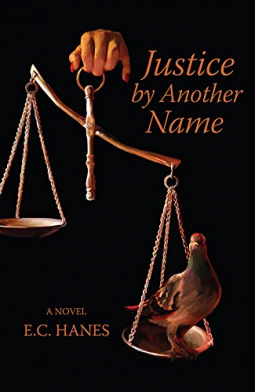
Justice By Another Name by E C Hanes

Blurb:

Set against the backdrop of North Carolina’s powerful hog-producing industry, Justice by Another Name tells the story of Paul Reavis’s suspicious workplace death followed a year later by a senseless death of his young son Paulie. Lana Reavis, who believes her husband was murdered and her son the victim of deliberate negligence, enlists the aid of her long-ago boyfriend, Will Moser, who is currently chief deputy of Hogg County and the heir apparent to the local sheriff.

As Will’s investigation unfolds, suspicious activities and cover-ups begin to emerge. All evidence points to Oris Martin, the powerful owner of Martin Farms, a huge hog-production enterprise and Hogg County’s largest employer, as the mastermind. Despite political pressure and physical threats to look the other way, Will continues his search for what really happened. Meanwhile, Lana, convinced that Oris will be beyond the reach of justice, devises a plan to avenge her family and destroy everything precious to Oris Martin.

My thoughts

I had no idea when I downloaded the ARC of this book from NetGalley just how much I was going to enjoy Justice by Another Name. I had never heard of E C Hanes and had no expectations that a murder in the hog-producing industry would be so enthralling.

But as soon as I began reading I had a feeling that this was going to be a good book. It has a dramatic opening as two boys, Paulie Reavis and Hank Grier are playing in Mitchell Creek in Hogg County, North Carolina. There’d been a violent storm and water was pouring down the creek sweeping huge tree trunks and other debris with it. At the top they saw a gigantic whirlpool and were taken by surprise when the lagoon of hog waste from Oris Martin’s farm above the creek burst through its retaining wall. Five million gallons of putrid black hog faeces and urine flooded down the gulley, taking the boys with it. Hank, survives, although badly injured, but Paulie dies. Imagine the horror of drowning in pig waste!

From that point on I was fascinated by the investigations into Paulie’s death and into the death of Paul, his father, a year earlier. Paul had worked on Martin’s pig farm and Lana, his wife is convinced his death was not an accident. I was just as fascinated by the details of the pig farming, the conditions the pigs are kept in, the diseases they carry and how the pig waste is dealt with, the whole process of constructing and operating the lagoons.

The mystery is not just how they met their deaths, but why. Was Paulie’s death an accident, a result of the storm damage or has someone been negligent? Was his father’s death really an accident? And just what caused the hog cholera epidemic that had hit the Martin Farms?

I was engrossed in the mystery, amazed that I found the details of the pig farming industry so interesting. The setting in North Carolina and the characters came to life as I read on. The feelings of fear, hate and grief escalated and as the book moved to its conclusion I realised that, as Lana says, ‘what’s revenge but justice by another name.

My thanks to the author, the publishers and NetGalley for my copy of this book.

  • Format: Kindle Edition
  • File Size: 965 KB
  • Print Length: 235 pages
  • Publisher: RaneCoat Press (1 Mar. 2017)
  • My rating: 5*

Books I Read in February

These are the books I read in February, listed in the order I read them:

  1. Eyes Like Mine by Sheena Kamal 5*
  2. The Chalk Pit by Elly Griffiths 3.5*
  3. The Good People by Hannah Kent 5*
  4. All the Light We Cannot See by Anthony Doerr 3*
  5. Harriet Said by Beryl Bainbridge 3.5*
  6. The Cheltenham Square Murder by John Bude 4*
  7. Let the Dead Speak by Jane Casey 5* – my post is on its way
  8. Everything But The Truth by Gillian McAllister 5* –  my post is on its way
  9. Sweet Tooth by Ian McEwan 3* (a re-read) my opinion hasn’t changed from the first time I read it, well written but a bit flat and contrived
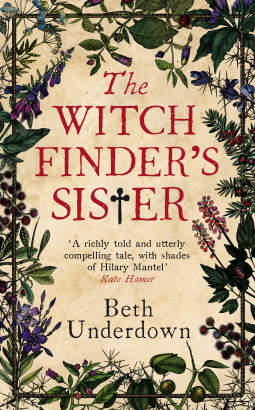
  10. The Witchfinder’s Sister by Beth Underdown 5*

A fantastic reading month – ten books and I gave 5 stars to five of them! They are all fiction – contemporary and historical with three crime fiction and just one book from my TBRs.

And with five 5 star books it is almost impossible to choose a favourite, as they are all excellent, but the book that moved and interested me most is Eyes Like Mine by Sheena Kamal, an excellent psychological suspense novel

with gripping storylines that kept me racing through the book as Nora Watts searches for her missing daughter, a child she gave up for adoption as a baby. Set in Canada, the plot is intricate, complicated and fast moving, highlighting various issues such as mixed race inheritance and differences in treatment based on skin colour, homelessness, and environmental issues. These never overpower the story, but form part of the book as a whole. I loved it.

The Witchfinder’s Sister by Beth Underdown

‘The number of women my brother Matthew killed, so far as I can reckon it, is one hundred and six…’

1645. When Alice Hopkins’ husband dies in a tragic accident, she returns to the small Essex town of Manningtree, where her brother Matthew still lives.

But home is no longer a place of safety. Matthew has changed, and there are rumours spreading through the town: whispers of witchcraft, and of a great book, in which he is gathering women’s names.

To what lengths will Matthew’s obsession drive him?
And what choice will Alice make, when she finds herself at the very heart of his plan?

Based on the true story of the man known as the Witchfinder General, this exquisitely rendered novel transports you to a time and place almost unimaginable, where survival might mean betraying those closest to you, and danger lurks outside every door.

My thoughts:

When I read the description of The Witchfinder’s Sister by Beth Underdown I was immediately drawn to the story based on the life of the 1640s witchfinder Matthew Hopkins. As well as a good story it is a fascinating look at life in England during the Civil War, set in 1645, a time of great change and conflict in politics, religion and philosophical ideas, coinciding with a growth in the belief in witchcraft.

I enjoyed it immensely. It’s historical fiction that combines fact and fiction, told through the eyes of Matthew’s sister, Alice, a fictional character. Beth Underdown has researched and used the historical sources so well. What is so chilling about this book is that the events it describes really did happen.

There is a glossary at the end of the book describing, among other terms, the methods used to investigate women accused of being witches, such as ‘searching‘ where their bodies were inspected for ‘teats’, ‘swimming‘, an ordeal by water in which women were bound and lowered into a pond or river; they were innocent if they sank, and ‘watching‘ in which a suspected woman would be tied to a stool in the middle of a room, kept awake and observed for hours. Women were treated in this way if they were accused of causing harm to their neighbours for such things as the death of a neighbour’s horse or for the unexplained deaths of children. For the superstitious every sudden death, or accident, every miscarriage or illness, was considered to be caused by witchcraft.

There is a pervading sense of fear and terror as Alice discovers what Matthew is doing, intensified when he forces her to help with his investigations, travelling throughout Essex. She tries to stop him, but fearful of him accusing her mother-in-law, Bridget, she has to go along with him. She also discovers family secrets about their parents and Matthew’s birth. The witch hunts escalated as grief-stricken and angry women accused other women and their names were added to Matthew’s list. After his investigations the women were then sent to prisons to await their trials.

It is clear that the women accused were vulnerable, often widows living isolated lives, some suffering with what we would consider to be a mental illness, with no male family members to keep them safe from persecution. Matthew’s own mother showed signs of mental illness, subject to many strange habits and obsessive compulsive behaviour. But Matthew is unable to accept the facts and grows ever more fanatical.

It all hangs together as a piece of fiction, with clearly described and defined characters, making their feelings and actions perfectly believable – even Matthew comes across as a well-rounded character – and set against the background of a country in the midst of civil war. It makes harrowing reading and I found it deeply moving.

I grew very fond of Alice and her maid Grace but was appalled by the final twist at the end of the book.

Beth Underdown lectures in Creative Writing at the University of Manchester. The Witchfinder’s Sister is her first novel.

My thanks to the publishers and NeGalley for my copy of this book. It is to be published on 2 March 2017.

  • Format: Kindle Edition
  • File Size: 6546 KB
  • Print Length: 361 pages
  • Page Numbers Source ISBN: 0241978033
  • Publisher: Penguin (2 Mar. 2017)

Library Loot

The mobile library came yesterday and I borrowed three books:

Liby-bks-Feb-2017

You Are Dead by Peter James – this is the 11th in his Roy Grace series. I’ve only read two (the first and the third) of the earlier books. I know I should probably read them in order but sometimes you have to take what’s available at the time and fill in the gaps later. I’m hoping it reads well as a stand-alone.

It’s set in Brighton and it’s about current cases of missing women and the discovery of the remains of women who went missing in the past. Are these events connected and if so how?

Duchess of Death: the Unauthorised Biography of Agatha Christie by Richard Hack, drawing on over 5000 unpublished letter, documents and notes. I’m not at all sure I shall actually read this book, but I thought I’d borrow it just to have more time to look at it. I’ve read Agatha Christie’s Autobiography, which is an excellent book that took her 15 years to write, and a few other biographies about her, some better than others.

I don’t like the title, Duchess of Death, which I suppose Hack chose for its alliteration. The jacket cover blurb says it is ‘as full of romance, travel, wealth and scandal as any whodunit she crafted.’ I have a feeling this will not be one of the better biographies.

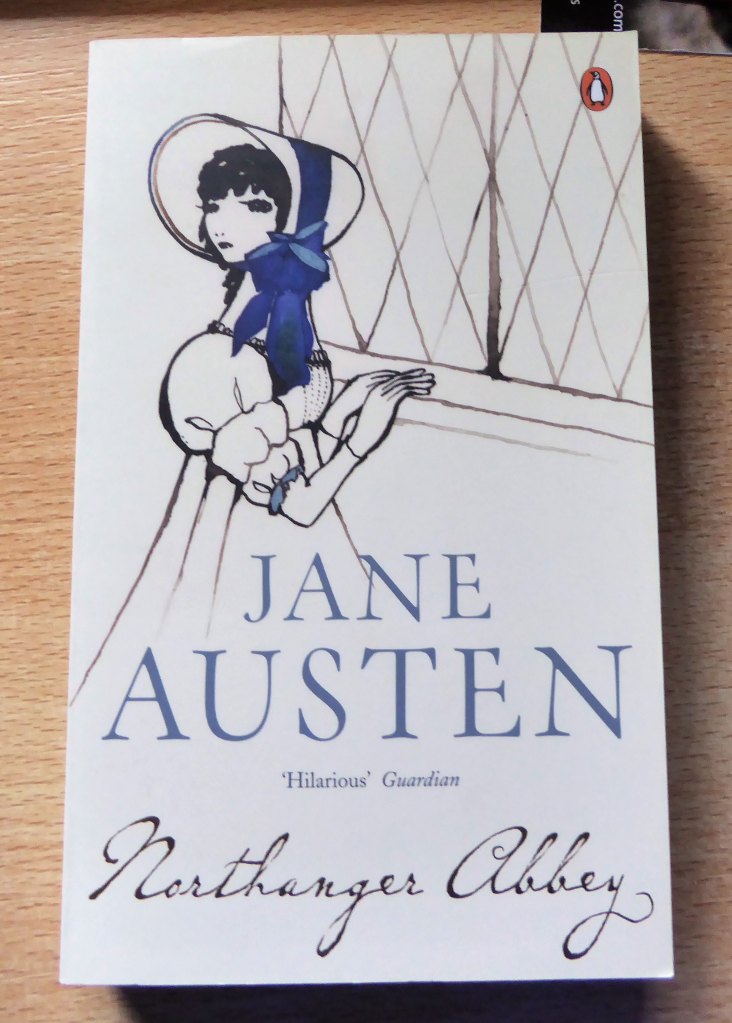
And finally I borrowed Northanger Abbey by Val McDermid, one of the Austen Project series (in which six bestselling contemporary authors write their own take on Jane Austen’s novels). I’ve been wondering whether to read any of these books for some time now and also meaning to read Val McDermid’s books, so when I saw this sitting on the mobile library’s shelves I thought why not at least have a proper look at it.

I first read Jane Austen’s Northanger Abbey many years ago (it could have been in the second year at Grammar School) and as far as I remember, despite loving Pride and Prejudice, I wasn’t too taken with it. I’ve been thinking of reading it again for some while now. I didn’t watch the TV adaptation a few years back, so I’m coming to both books with fresh eyes.

This is my copy with its awful cover:

Northhanger-Austen

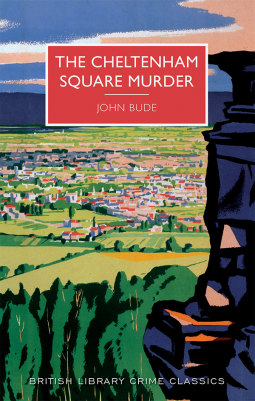
The Cheltenham Square Murder by John Bude

A Golden Age Murder Mystery

Blurb:

In the seeming tranquillity of Regency Square in Cheltenham live the diverse inhabitants of its ten houses. One summer’s evening, the square’s rivalries and allegiances are disrupted by a sudden and unusual death ‘“ an arrow to the head, shot through an open window at no. 6.

Unfortunately for the murderer, an invitation to visit had just been sent by the crime writer Aldous Barnet, staying with his sister at no. 8, to his friend Superintendent Meredith. Three days after his arrival, Meredith finds himself investigating the shocking murder two doors down. Six of the square’s inhabitants are keen members of the Wellington Archery Club, but if Meredith thought that the case was going to be easy to solve, he was wrong’¦

The Cheltenham Square Murder is a classic example of how John Bude builds a drama within a very specific location. Here the Regency splendour of Cheltenham provides the perfect setting for a story in which appearances are certainly deceiving.

My thoughts:

The Cheltenham Square Murder by John Bude was first published in 1937. Previously I’ve read John Bude’s second book- The Lake District Murder, a police procedural, showing in intricate detail how detectives investigated a crime, particularly in rural areas in the mid 1930s, in which I found his calculations of the times and distribution of petrol deliveries a bit difficult to follow.

But by the time he wrote The Cheltenham Square Murder Bude’s style had become more refined and I found it much easier to follow, whilst still writing in detail about the suspects and how the crime could have been and was committed. It is quite complicated, a real puzzle to solve, first of all just how the murder was carried out and secondly who out of the several suspects was the murderer.

There is a plan of the fictional Regency Square showing the layout of the ten houses and their occupants. Bude describes the residents giving a good idea of their personalities and relationships. As in all communities, they don’t all get on, ‘outwardly harmonious yet privately at loggerheads’. Those who belong to the Wellington Archery Club are keen, even fanatically keen archers, so immediately they are suspects.

It is fortunate for the local police that Superintendent Meredith from the Sussex County Constabulary is staying in the Square and helps Inspector Long unravel the mystery, but not before another there is a second victim, again murdered with an arrow in the head.

It’s a slow-paced mystery, both Meredith and Long spend much time working out how the murder was committed and Bude drops in several red herrings to confuse matters as first one then another of the residents comes under suspicion. I enjoyed trying to work it out, but although I had an idea about the guilty person I couldn’t see how the murders had been achieved until the method was revealed.

Martin Edward’s introduction gives a brief biography of John Bude, whose real name was Ernest Carpenter Elmore (1901 – 1957). For a time he was a games master at St Christopher School in Letchworth where archery was one of the pupils’ activities.

My thanks to the publishers, Poisoned Pen Press in association with the British Library, and NetGalley for my copy of this book which has an introduction by Martin Edwards.

  • Amazon link to the paperback edition to be published on 7 March 2017
  • Amazon link to the Kindle edition
  • My rating – 4 stars