It’s Autumn: Time for the R.I.P. Challenge

It’s that time of year for the R.I.P. Challenge (1 September to 31 October), hosted by Estella’s Revenge, the aim being to read books in the categories of Mystery, Suspense, Thriller, Dark Fantasy, Gothic, Horror, and Supernatural.

I wasn’t going to join in this year as I’ve been cutting back on the number of challenges. But the emphasis in R.I.P. is not on the word ‘challenge’, instead it is about coming together as a community and embracing the autumnal mood. I’ve also realised that the book I’m currently reading is one that easily fits into more than one of those categories. It’s The Taxidermist’s Daughter.

The Taxidermist's Daughter

It’s set in 1912 in the Sussex salt marshes and is full of mystery, suspense with Gothic overtones and a menacing atmosphere.

Dead for all these long and many years. The smell of sulphur and the grave. The smell of rotting and unpreserved flesh. The darkening glass. They sullied the beauty of the place. Destroyed all that was wonderful and made it dark. (page 63)

Old sins have long shadows.

In the next few weeks I’ll probably read a few more books that fit into the categories. Looking at some of my TBRs I have Extraordinary People by Peter May (another book I’ve just started to read), The Blood Doctor by Barbara Vine, and The Tree of Hands by Ruth Rendell, to name but three.

So, I’ve decided that I shall join in, and for the time being I’ll be participating at the level of Peril the Third, which involves reading at least one book from the above categories. If I read more than I’ll move on to Peril the First, which involves reading at least four books from the above categories.

South Riding by Winifred Holtby

South Riding

Blurb:

The community of South Riding, like the rest of the country, lives in the long shadow of war. Blighted by recession and devastated by the loss, they must also come to terms with significant social change.Forward-thinking and ambitious, Sarah Burton is the embodiment of such change. After the death of her fiancé, she returns home to Yorkshire focused on her career as headmistress of the local school. But not everyone can embrace the new social order. Robert Carne, a force of conservatism, stands firmly against Sarah. A tormented man, he carries a heavy burden that locks him in the past.

As the villagers of South Riding adjust to Sarah’s arrival and face the changing world, emotions run high, prejudices are challenged and community spirit is tested. 

My View:

I bought Winifred Holtby’s sixth and last novel, South Riding, after watching the BBC television adaptation by Andrew Davies, starring Anna Maxwell Martin and David Morrissey, broadcast in February 2011. And I’ve  only just got round to reading it – it was well worth the wait. It’s one of those books that make you feel as though you are there taking part in the action – I was totally immersed in the story and I loved it.

The book was first published in 1936, six months after Winifred Holtby’s death, aged 37, from Bright’s disease. Set in the early 1930s in Yorkshire it paints a moving and vivid portrait of a rural community struggling with the effects of the depression.

South Riding is a fictional place – Yorkshire consists of a North, East and West Riding – there is no South Riding. The word Riding is derived from a Danish word ‘thridding’, meaning a third. The invading Danes called representatives from each Thridding to a thing, or parliament and established the Ridings System. South Riding is based on the East Riding where Winifred Holtby’s mother was a county alderman, but she explained in a prefatory letter to her mother that Alderman Mrs Beddows was not Alderman Mrs Holtby, that the characters were not her colleagues on the county council and that the incidents in the book were not derived from her mother’s experience.

Nevertheless,the main focus of the novel is centred on local politics and the work of the county council in dealing with a variety of issues  including social issues, education, unemployment, local building programmes, poor relief and the treatment of the insane. There is a large cast of characters and a list is given at the start of the book, which I found most helpful.

It is an intensely detailed story, involving many sub-plots as the lives of all the characters unfold. The main characters are Sarah Burton, the new headmistress of Kiplington High School for Girls, a fiercely passionate and dedicated teacher; Councillor and farmer Robert Carne of Maythorpe Hall and his struggles both personal and financial; Joe Astell, a socialist fighting poverty; and Mrs Beddows, the first woman alderman of the district, a strong older woman (age 72), a generous and charitable woman – my favourite character. This is how Winifred Holtby describes her:

She was a plump sturdy little woman, whose rounded features looked as though they had been battered blunt by wear and weather in sixty years or more of hard experience. But so cheerful, so lively, so frank was the intelligence which beamed  benevolently from her bright spaniel-coloured eyes, that sometimes she looked as young as the girl she still, in her secret dreams, felt herself to be. (pages xxiv-xxv)

And here is one of the passages in which she describes Sarah Burton:

Sarah believed in action. She believed in fighting. She had unlimited confidence in the power of the human intelligence and will to achieve order, happiness, health and wisdom. It was her business to equip the young women entrusted to her by a still inadequately enlightened state for their part in that achievement. She wished to prepare their minds, to train their their bodies, and to inculcate their spirits with some of her own courage, optimism and unstaled delight. (page 42)

I could go on – all the characters are clearly defined and well rounded people and the locations bring the area to life, showing the contrast in living conditions between the different sections of society.

In short South Riding is a wonderful book, portraying life in the 1930s. I would very much like to re-read and enjoy it again and again. I’m sure that I would find plenty in it that I’ve missed on this first reading.

  • Paperback: 560 pages
  • Publisher: BBC Books (6 Jan. 2011)
  • Language: English
  • ISBN-10: 1849902038
  • ISBN-13: 978-1849902038
  • Source: I bought the book
  • My Rating: 5*

South Riding is my 18th book for Bev’s Mount TBR 2017 challenge and my final book for Charlie’s What’s in a Name Challenge 2017.

First Chapter First Paragraph: Falling in Love

Every Tuesday Diane at Bibliophile by the Sea hosts First Chapter First Paragraph Tuesday Intros to share the first paragraph sometimes two, of a book that she’s reading or planning to read soon.

This week’s first paragraph is from a library book that I’ll be reading soon, Falling in Love by Donna Leon. It’s the 24th Commissario Brunetti novel.

Falling in Love (Brunetti 24)

It begins:

The woman knelt over her lover, her face, her entire body stiff with terror, staring at the blood on her hand. He lay on his back, one arm flung out, palm upturned as if begging her to place something into it; his life, perhaps. She had touched his chest, urging him to get up, so they could get out of there, but he hadn’t moved, so she had shaken him, the same old sleepy-head who never wanted to get out of bed.

Blurb (from back cover):

As an opera superstar at La Fenice in Venice, Flavia is well acquainted with attention from adoring fans and aspiring singers. But when anonymous admirer inundates her with bouquets of yellow roses, which start to appear in her dressing room and even inside her locked apartment, she begins to fear for her safety and calls in an old friend.

Enter Commissario Brunetti.

But soon the threat becomes more serious. Brunetti must enter the psyche of an obsessive fan and find the culprit before anyone, especially Flavia, comes to harm.

I’ve only read a few of the Brunetti novels and certainly not in the order they were written. Apparently Flavia appeared in the first book, Death at La Fenice, in which Flavia Petrelli, one of Italy’s finest living sopranos had been the prime suspect in the poisoning of a renowned German conductor – until Brunetti cleared her name.

This title doesn’t say this book is crime fiction to me. What do you think?

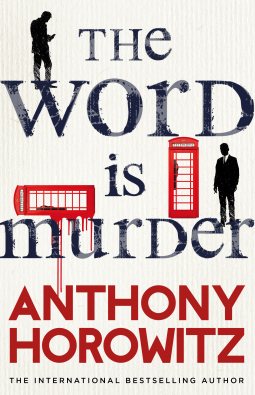
The Word is Murder by Anthony Horowitz

Publication date: 24 August 2017, Century

Source: Review copy via NetGalley

My rating: 5*

Blurb:

A wealthy woman strangled six hours after she’s arranged her own funeral.
A very private detective uncovering secrets but hiding his own.
A reluctant author drawn into a story he can’t control.
What do they have in common?

Unexpected death, an unsolved mystery and a trail of bloody clues lie at the heart of Anthony Horowitz’s page-turning new thriller.

SPREAD THE WORD. THE WORD IS MURDER.

My thoughts:

The Word is Murder is a very clever and different type of murder mystery. I don’t think I’ve read anything like it before, one in which the author himself plays a major role.

Diana Cowper was killed later the same day after making the arrangements for her funeral. She was strangled in her own home. The police at first thought she’d been killed during a burglary, but there were no fingerprints or indeed any other clues to help find her killer.

The novel goes into a different realm with the introduction of ex-policeman, Daniel Hawthorne, who had been an adviser for Horowitz’s Foyle’s War series. The police call on Hawthorne as a consultant on out-of-the ordinary cases and he is working on the Diana Cowper murder. He proposes that Horowitz writes a book about him and his investigations into the case. However, they disagree about what Horowitz should write, which highlights the difference between writing crime fiction and true life crime books – and Horowitz gets dragged into the investigations.

At first I was slightly confused – were the details about Horowitz fact or fiction (a lot of it is true), was Hawthorne a real person or a fictional character, what was fact and what was fiction? It really is one of the most complicated and bemusing books I’ve read, full of realistic characters acting in a mystery full of red herrings and multiple twists and turns. I was soon totally immersed in this fascinating novel. I loved Magpie Murders, and I think Horowitz The Word is Murder is equally as amazing and maybe even better! I was totally unable to solve the mystery, the clues were all there, but I was so involved in sorting out what was real and what wasn’t and enjoying the puzzle that I completely missed them.

I am so delighted that I received a copy of this book from the publisher, via NetGalley, for review.

The Break by Marian Keyes

The Break

Publication date 7 September 2017, Michael Joseph

Source: review copy via NetGalley

Blurb:

Amy’s husband Hugh isn’t really leaving her.

At least, that’s what he promises. He is just taking a break – from their marriage, their children and, most of all, from their life together. For six-months Hugh will lose himself in south-east Asia, and there is nothing Amy can say or do about it.

Yes, it’s a mid-life crisis, but let’s be clear: a break isn’t a break up – yet

It’s been a long time since Amy held a briefcase in one hand and a baby in the other. She never believed she’d have to go it alone again. She just has to hold the family together until Hugh comes back.

But a lot can happen in six-months. When Hugh returns, if he returns, will he be the same man she married? And will Amy be the same woman?

Because falling in love is easy. The hard part – the painful, joyous, maddening, beautiful part – is staying in love.

My view:

I think it was a mistake requesting this book from NetGalley! Years ago I read Under the Duvet, which I remember as amusing and entertaining, and I enjoy seeing Marian Keyes when she’s on programmes such as It Takes Two talking about Strictly Come Dancing – she’s very funny. The Break  is not the sort of book I usually read, but I’d thought it would be a change from my usual fiction.

But, I’m sorry to say I didn’t enjoy it. There are many characters, but I didn’t warm to any of them, particularly the main ones, Amy and Hugh. There’s lots of dialogue, which is OK but also lots of description of clothes – too much description of clothes.

It’s written in a chatty, gossipy style that gets very wearing after a while and although it’s easy reading it didn’t grip me and I struggled to finish it. So much so that each time I put it down I didn’t really want to carry on with it. I think my problem with it is that is very slow-paced and I thought it was over-long and drawn out. I did want to know what happened to Amy and Hugh, but it was all too predictable – not my cup of tea!

There are many 5* and 4* ratings on Goodreads, so I expect that if you’re a fan of her books you’ll love it.

  • Format: Kindle Edition
  • File Size: 1049 KB
  • Print Length: 570 pages
  • Page Numbers Source ISBN: 0718179730
  • Publisher: Penguin (7 Sept. 2017)
  • My rating: 2*

Did You See Melody? by Sophie Hannah

Publication date: 24 August 2017, Hodder & Stoughton

Source: review copy via NetGalley

I was attracted to read Did You See Melody? by Sophie Hannah by this description on NetGalley:

She’s the most famous murder victim in the country.

What if she’s not dead?

Did You See Melody? is a different kind of Sophie Hannah novel.

It is a stand alone.

It is pure psychological suspense, with a chilling hook and a killer central mystery.

It combines Sophie’s critically acclaimed writing with a pacy and twisty plot.

So, I was expecting it to be a gripping, tense and intriguing mystery. But I became increasingly disappointed as I read pages and pages of description of the five-star Swallowtail Resort and Spa in the foothills of Camelback Mountain, Arizona at the beginning of the book. I like description but this was far too much even for me. It’s like reading a promotional article for the resort. It picked up pace a bit when the subject of Melody was introduced. She was seven when she disappeared and although her body had not been discovered her parents were tried and found guilty of murdering her.

Cara has left her husband and two children at home in Hertford in England without telling them where she was going, but leaving them a note saying she’d be back on 24 October. She’d booked herself into the Swallowtail and arrives, exhausted from her journey only to find that her room is already occupied by a man and a young teenage girl. However, the receptionist is extremely apologetic and settles her into a casita with her own private infinity pool at no extra charge.

The first hint about what had happened to Melody comes the next morning when one of the guests announces that she’s seen Melody and eventually Cara’s curiosity is aroused and she discovers the tragic story of Melody’s murder. Cara wonders if the girl she’d seen the previous night was Melody. At first Cara’s reason for leaving home as she did is not explained and when it was I was less than impressed and I didn’t really warm to her character.

From that point my own interest in the story picked up as the details of what had happened to Melody are gradually revealed as Cara talks to Tarin, a fellow guest, reads accounts on the internet and excerpts from the TV talk show, Justice With Bonnie, hosted by the truly terrible Bonnie Juno. Bonnie is described as a legal commentator and I really disliked her and her interference in the case.

There is quite a lot of hyperbole and contrasting depictions of both the American and British characters, which made me wonder if this is a spoof, as really, most of the story just beggars belief. It’s far-fetched, contrived and over complicated. But once I’d got past the lengthy opening section I did want to know what happened next and it is in the last few pages of the book that I found something that really did send a little shiver down my spine – and left me wondering just what had really happened to Melody, and what would happen next.

My thanks to NetGalley and Hodder & Stoughton, the publishers for a review copy.

  • Format: Kindle Edition
  • File Size: 2826 KB
  • Print Length: 336 pages
  • Publisher: Hodder & Stoughton (24 Aug. 2017)
  • My rating: 3*