A Climate of Fear by Fred Vargas

A Climate of Fear (Commissaire Adamsberg #10)

A Climate of Fear by Fred Vargas (see below*), translated from the French by Siân Reynolds, is her 9th Commissaire Adamsberg book.

I had high expectations for this book and I wasn’t disappointed. It’s as quirky and original as the other Commissaire Adamsberg books I’ve read (I’ve read five of them, including this one). I like Adamsberg; he’s original, a thinker, who doesn’t like to express his feelings, but mulls things over. He’s an expert at untangling mysteries, an invaluable skill in this, one of the most complicated and intricate mysteries I’ve read. He’d compared the investigation right from the start to a huge tangled knot of seaweed, and summed it up at the end:

… you can’t just plunge into a thing like that. We were pulling out tiny little broken fragments, and getting drawn into other traps. We had elements, clues, but they were floating, dozens of them, just under the surface without any apparent connection between them, in a sort of fog. The whole thing had been drowned in confusion by this twisted and determined killer. (pages 393-394)

The ‘tangled knot‘ is most confusing to begin with, made up of a woman found bleeding to death in her bath, having apparently committed suicide, a strange symbol that appears at subsequent death scenes, a secretive society studying and re-enacting scenes from the French Revolution, and two deaths ten years earlier on an isolated island off the coast of Iceland, where the afturganga, the demon who owns the island summons people to their death.

As in earlier books, Fred Vargas brings in elements of the supernatural, of folk tales, myths and legends, all of which is fascinating and intricately woven into the murder mystery. I loved all of it, especially the tense and fraught relationship that developed between Adamsberg and his team as they became increasingly unable to follow Adamsberg’s line of thought. I also enjoyed reading the details about Robespierre and the part he played in the French Revolution during the Reign of Terror, plus the little quirky details such as those about the cat who sleeps on the photocopier and the tame wild boar that guards one of the characters.

All in all, a brilliant book.

  • Hardcover: 416 pages
  • Publisher: Harvill Secker (14 July 2016)
  • Language: English
  • ISBN-10: 1910701386
  • ISBN-13: 978-1910701386
  • Source: I borrowed it from my local library
  • My Rating: 5*

These are the other books I’ve read by Fred Vargas:

* Fred Vargas is the pseudonym of the French historian, archaeologist and writer Frédérique Audoin-Rouzeau.

My Friday Post: Extraordinary People

Book Beginnings Button

Every Friday Book Beginnings on Friday is hosted by Gillion at Rose City Reader where you can share the first sentence (or so) of the book you are reading, along with your initial thoughts about the sentence, impressions of the book, or anything else the opener inspires.

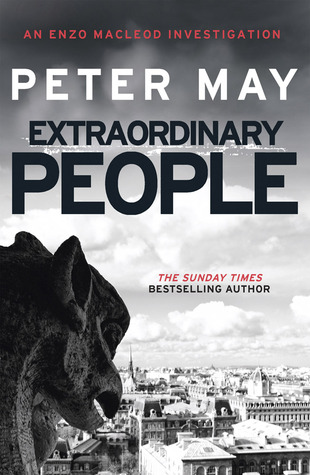
This week I’m featuring Extraordinary People by Peter May

Extraordinary People (The Enzo Files, #1)

Prologue

August 1996

He finds himself in a cobbled courtyard, breath hissing back at him from buttressed walls. A rasping, gasping breath, full of fear and the certainty of death.

Also every Friday there is The Friday 56, hosted by Freda at Freda’s Voice. These are the rules:

  1. Grab a book, any book.
  2. Turn to page 56, or 56% on your eReader.
  3. Find any sentence (or a few, just don’t spoil it) that grabs you.
  4. Post it.
  5. Add the URL to your post in the link on Freda’s most recent Friday 56 post.

Page 56

‘He’s Scottish,’ Raffin said.

Thomas made a slight forward thrusting movement of his jaw to indicate his contempt for anyone who wasn’t Parisian.

Blurb:

An old mystery. 
As midnight strikes, a man desperately seeking sanctuary flees into a church. The next day, his sudden disappearance will make him famous throughout France.

A new science. 
Forensic expert Enzo Macleod takes a wager to solve the seven most notorious French murders, armed with modern technology and a total disregard for the justice system.

A fresh trail. 
Deep in the catacombs below the city, he unearths dark clues deliberately set – and as he draws closer to the killer, discovers that he is to be the next victim.

What do you think? Would you continue reading?

My Week in Books: 13 September 2017

This Week in Books is a weekly round-up hosted by Lypsyy Lost & Found, about what I’ve been reading Now, Then & Next.

IMG_1384-0

A similar meme,  WWW Wednesday is run by Taking on a World of Words.

Now: I’m currently reading The Taxidermist’s Daughter by Kate Mosse.

The Taxidermist's Daughter


Blurb:

The clock strikes twelve. Beneath the wind and the remorseless tolling of the bell, no one can hear the scream . . .

1912. A Sussex churchyard. Villagers gather on the night when the ghosts of those who will not survive the coming year are thought to walk. And in the shadows, a woman lies dead.

As the flood waters rise, Connie Gifford is marooned in a decaying house with her increasingly tormented father. He drinks to escape the past, but an accident has robbed her of her most significant childhood memories. Until the disturbance at the church awakens fragments of those vanished years . . .

Then: I’ve just finished reading A Climate of Fear by Fred Vargas which I really enjoyed. My review will follow soon.

A Climate of Fear (Commissaire Adamsberg #10)


Blurb:

A woman is found dead in her bath. The murder has been disguised as a suicide and a strange symbol is discovered at the scene.

Then the symbol is observed near a second victim, who ten years earlier had also taken part in a doomed expedition to Iceland.

How are these deaths, and rumours of an Icelandic demon, linked to a secretive local society? And what does the mysterious sign mean? Commissaire Adamsberg is about to find out.

Next: For once I know exactly what I’ll be reading next, The Poisonwood Bible by Barbara Kingsolver. This is a re-read of a book I first read and loved years ago:

The Poisonwood Bible

Blurb:

Told by the wife and four daughters of Nathan Price, a fierce evangelical Baptist who takes his family and mission to the Belgian congo in 1959, The Poisonwood Bible is the story of one family’s tragic undoing and remarkable reconstruction over the course of three decades in postcolonial Africa.

How about you? Have you read any of these books?  If so, what did you think of them? And what have you been reading this week?

It’s Autumn: Time for the R.I.P. Challenge

It’s that time of year for the R.I.P. Challenge (1 September to 31 October), hosted by Estella’s Revenge, the aim being to read books in the categories of Mystery, Suspense, Thriller, Dark Fantasy, Gothic, Horror, and Supernatural.

I wasn’t going to join in this year as I’ve been cutting back on the number of challenges. But the emphasis in R.I.P. is not on the word ‘challenge’, instead it is about coming together as a community and embracing the autumnal mood. I’ve also realised that the book I’m currently reading is one that easily fits into more than one of those categories. It’s The Taxidermist’s Daughter.

The Taxidermist's Daughter

It’s set in 1912 in the Sussex salt marshes and is full of mystery, suspense with Gothic overtones and a menacing atmosphere.

Dead for all these long and many years. The smell of sulphur and the grave. The smell of rotting and unpreserved flesh. The darkening glass. They sullied the beauty of the place. Destroyed all that was wonderful and made it dark. (page 63)

Old sins have long shadows.

In the next few weeks I’ll probably read a few more books that fit into the categories. Looking at some of my TBRs I have Extraordinary People by Peter May (another book I’ve just started to read), The Blood Doctor by Barbara Vine, and The Tree of Hands by Ruth Rendell, to name but three.

So, I’ve decided that I shall join in, and for the time being I’ll be participating at the level of Peril the Third, which involves reading at least one book from the above categories. If I read more than I’ll move on to Peril the First, which involves reading at least four books from the above categories.

South Riding by Winifred Holtby

South Riding

Blurb:

The community of South Riding, like the rest of the country, lives in the long shadow of war. Blighted by recession and devastated by the loss, they must also come to terms with significant social change.Forward-thinking and ambitious, Sarah Burton is the embodiment of such change. After the death of her fiancé, she returns home to Yorkshire focused on her career as headmistress of the local school. But not everyone can embrace the new social order. Robert Carne, a force of conservatism, stands firmly against Sarah. A tormented man, he carries a heavy burden that locks him in the past.

As the villagers of South Riding adjust to Sarah’s arrival and face the changing world, emotions run high, prejudices are challenged and community spirit is tested. 

My View:

I bought Winifred Holtby’s sixth and last novel, South Riding, after watching the BBC television adaptation by Andrew Davies, starring Anna Maxwell Martin and David Morrissey, broadcast in February 2011. And I’ve  only just got round to reading it – it was well worth the wait. It’s one of those books that make you feel as though you are there taking part in the action – I was totally immersed in the story and I loved it.

The book was first published in 1936, six months after Winifred Holtby’s death, aged 37, from Bright’s disease. Set in the early 1930s in Yorkshire it paints a moving and vivid portrait of a rural community struggling with the effects of the depression.

South Riding is a fictional place – Yorkshire consists of a North, East and West Riding – there is no South Riding. The word Riding is derived from a Danish word ‘thridding’, meaning a third. The invading Danes called representatives from each Thridding to a thing, or parliament and established the Ridings System. South Riding is based on the East Riding where Winifred Holtby’s mother was a county alderman, but she explained in a prefatory letter to her mother that Alderman Mrs Beddows was not Alderman Mrs Holtby, that the characters were not her colleagues on the county council and that the incidents in the book were not derived from her mother’s experience.

Nevertheless,the main focus of the novel is centred on local politics and the work of the county council in dealing with a variety of issues  including social issues, education, unemployment, local building programmes, poor relief and the treatment of the insane. There is a large cast of characters and a list is given at the start of the book, which I found most helpful.

It is an intensely detailed story, involving many sub-plots as the lives of all the characters unfold. The main characters are Sarah Burton, the new headmistress of Kiplington High School for Girls, a fiercely passionate and dedicated teacher; Councillor and farmer Robert Carne of Maythorpe Hall and his struggles both personal and financial; Joe Astell, a socialist fighting poverty; and Mrs Beddows, the first woman alderman of the district, a strong older woman (age 72), a generous and charitable woman – my favourite character. This is how Winifred Holtby describes her:

She was a plump sturdy little woman, whose rounded features looked as though they had been battered blunt by wear and weather in sixty years or more of hard experience. But so cheerful, so lively, so frank was the intelligence which beamed  benevolently from her bright spaniel-coloured eyes, that sometimes she looked as young as the girl she still, in her secret dreams, felt herself to be. (pages xxiv-xxv)

And here is one of the passages in which she describes Sarah Burton:

Sarah believed in action. She believed in fighting. She had unlimited confidence in the power of the human intelligence and will to achieve order, happiness, health and wisdom. It was her business to equip the young women entrusted to her by a still inadequately enlightened state for their part in that achievement. She wished to prepare their minds, to train their their bodies, and to inculcate their spirits with some of her own courage, optimism and unstaled delight. (page 42)

I could go on – all the characters are clearly defined and well rounded people and the locations bring the area to life, showing the contrast in living conditions between the different sections of society.

In short South Riding is a wonderful book, portraying life in the 1930s. I would very much like to re-read and enjoy it again and again. I’m sure that I would find plenty in it that I’ve missed on this first reading.

  • Paperback: 560 pages
  • Publisher: BBC Books (6 Jan. 2011)
  • Language: English
  • ISBN-10: 1849902038
  • ISBN-13: 978-1849902038
  • Source: I bought the book
  • My Rating: 5*

South Riding is my 18th book for Bev’s Mount TBR 2017 challenge and my final book for Charlie’s What’s in a Name Challenge 2017.

First Chapter First Paragraph: Falling in Love

Every Tuesday Diane at Bibliophile by the Sea hosts First Chapter First Paragraph Tuesday Intros to share the first paragraph sometimes two, of a book that she’s reading or planning to read soon.

This week’s first paragraph is from a library book that I’ll be reading soon, Falling in Love by Donna Leon. It’s the 24th Commissario Brunetti novel.

Falling in Love (Brunetti 24)

It begins:

The woman knelt over her lover, her face, her entire body stiff with terror, staring at the blood on her hand. He lay on his back, one arm flung out, palm upturned as if begging her to place something into it; his life, perhaps. She had touched his chest, urging him to get up, so they could get out of there, but he hadn’t moved, so she had shaken him, the same old sleepy-head who never wanted to get out of bed.

Blurb (from back cover):

As an opera superstar at La Fenice in Venice, Flavia is well acquainted with attention from adoring fans and aspiring singers. But when anonymous admirer inundates her with bouquets of yellow roses, which start to appear in her dressing room and even inside her locked apartment, she begins to fear for her safety and calls in an old friend.

Enter Commissario Brunetti.

But soon the threat becomes more serious. Brunetti must enter the psyche of an obsessive fan and find the culprit before anyone, especially Flavia, comes to harm.

I’ve only read a few of the Brunetti novels and certainly not in the order they were written. Apparently Flavia appeared in the first book, Death at La Fenice, in which Flavia Petrelli, one of Italy’s finest living sopranos had been the prime suspect in the poisoning of a renowned German conductor – until Brunetti cleared her name.

This title doesn’t say this book is crime fiction to me. What do you think?