First Chapter First Paragraph: The Midnight Line by Lee Child

eca8f-fistchapEvery Tuesday Diane at Bibliophile by the Sea hosts First Chapter First Paragraph Tuesday Intros to share the first paragraph sometimes two, of a book that she’s reading or is planning to read soon.

Last week I featured one of my Christmas presents, so I thought I’d follow that with another one of my Christmas presents, The Midnight Line by Lee Child.

The Midnight Line (Jack Reacher, #22)


It begins:

Jack Reacher and Michelle Chang spent three days in Milwaukee. On the fourth morning she was gone. Reacher came back to the room with coffee and found a note on his pillow. He had seen such notes before. They all said the same thing. Either directly or indirectly. Chang’s note was indirect. And more elegant than most. Not in terms of presentation. It was a  ballpoint scrawl on motel notepaper gone wavy with damp. But elegant in terms of expression. She had used a simile, to explain and flatter and apologize all at once. She had written, You’re like New York City. I love to visit, but I could never live there.

Blurb:

Jack Reacher takes an aimless stroll past a pawn shop in a small Midwestern town. In the window he sees a West Point class ring from 2005. It’s tiny. It’s a woman cadet’s graduation present to herself. Why would she give it up? Reacher’s a West Pointer too, and he knows what she went through to get it.

Reacher tracks the ring back to its owner, step by step, down a criminal trail leading west. Like Big Foot come out of the forest, he arrives in the deserted wilds of Wyoming. All he wants is to find the woman. If she’s OK, he’ll walk away. If she’s not … he’ll stop at nothing.

He’s still shaken by the recent horrors of Make Me, and now The Midnight Line sees him set on a raw and elemental quest for simple justice. Best advice: don’t get in his way.

∼ ∼ 

Lee Child is a new-to-me author, but by no means a new author and this is the 22nd Jack Reacher thriller. The thing that strikes me about this opening paragraph is the straight forward style of writing and the short sentences, almost staccato, which makes me think this will be a fast-paced book. When I wrote about it in my Christmas Books post I was encouraged by some of the comments about his books, so I’m looking forward to reading it very soon.

What do you think – would you read on?

Six Degrees from No. 1 Ladies Detective Agency to White Nights

I love doing Six Degrees of Separation, a monthly link-up hosted by Kate at Books Are My Favourite and Best. Each month a book is chosen as a starting point and linked to six other books to form a chain. A book doesn’t need to be connected to all the other books on the list, only to the one next to it in the chain.

This month the chain begins with Alexander McCall Smith’s No.1 Ladies Detective Agency, a book I haven’t read although I have watched the TV version.

The No. 1 Ladies' Detective Agency  (No. 1 Ladies' Detective Agency #1)

Precious Ramotswe is a kind, warm-hearted and large African lady. She is also the only female private detective in Botswana. Her agency – the No.1 Ladies’ Detective Agency – is the best in the country. With help of her secretary, Mma Makutsi, and her best friend, Mr JLB Matekoni, she solves a number of difficult problems. A missing husband, a missing finger and a missing child – she will solve these mysteries in her own special way.

Although I haven’t read No.1 Ladies Detective Agency I have read a few of Alexander McCall Smith’s books including The Careful Use of Compliments, an Isabel Dalhousie Novel, one of the Sunday Philosophy Club series, set in Edinburgh.

The Careful Use of Compliments (Isabel Dalhousie, #4)

Isabel has just had a baby, Charlie, and is in a relationship with his father, Jamie (14 years her junior) who is her niece’s, ex-boyfriend. There is a mystery about a painting, whether or not it is a forgery, but for me it’s the philosophical questions that are always uppermost in Isabel’s mind and conversations, her way of ‘interring’ in matters which she considers ‘helping’, and her kindhearted nature that was more interesting.

The next link in my chain is to an another book set in Edinburgh. The Inspector’s Daughter by Alanna Knight, the first in the Rose McQuinn Mystery series, set in Edinburgh in 1895, when the Forth Railway Bridge had just been opened.

The Inspector's Daughter

Rose, recently returned from America’s Wild West, steps into the shoes of her father, DI Faro. She lives in an isolated house at the foot of Arthur’s Seat and is helped by a wild deerhound who appears just when she needs him.

Arthur’s Seat, the extinct volcano within Holyrood Park, east of Edinburgh Castle is also mentioned in Ian Rankin’s The Falls, the 12th Inspector Rebus book.

The Falls (Inspector Rebus, #12)

Rebus investigates the disappearance of ‘Flip’ a university student. One lead is a carved wooden doll found in a tiny coffin. Rebus concentrates on the tiny coffin and finds a whole series of them had turned up over the years dating back to 1836 when 17 were found on Arthur’s Seat.

The Strange Case of Dr. Jekyll and Mr. Hyde and Other Tales of Terror

In The Falls Rankin also refers to Burke and Hare, the 19th century resurrectionists and this leads me on to the next link in my chain – to The Body Snatcher, which is one of the Tales of Terror by Robert Louis Stevenson, published in the same volume as The Strange Case of Dr. Jekyll and Mr Hyde. This is a traditional Christmas ghost story, beginning with four men gathered in an inn on a dark winter’s night telling tales of grisly deeds as they sit round the fireside. One of the stories is based on the activities of body snatchers, Burke and Hare in Edinburgh in the 1820s.

The next book, also by Robert Louis Stevenson is in contrast to his tale of terror  – it’s A Child’s Garden of Verses, poems I loved as a child.

This is one of my favourite poems – it brings to mind the power  and fury of the wind:

Windy Nights

Whenever the moon and stars are set,
Whenever the wind is high,
All night long in the dark and wet,
A man goes riding by.
Late in the night when the fires are out,
Why does he gallop and gallop about?

Whenever the trees are crying aloud,
And ships are tossed at sea,
By, on the highway, low and loud,
By at the gallop goes he;
By at the gallop he goes, and then
By he comes back at the gallop again.

The last link in my chain is to a book with Nights in its title – White Nights by Ann Cleeves, the second in her Shetland Quartet, featuring DI Jimmy Perez. The ‘white nights’ are the summer nights when the sun never really goes down.

White Nights (Shetland Island, #2)

It’s set mainly in Biddista, a fictional village where artist Bella Sinclair throws an elaborate party to launch an exhibition of her work at The Herring House, a gallery on the beach. The party ends in farce when one the guests, a mysterious Englishman, bursts into tears and claims not to know who he is or where he’s come from. The following day the Englishman is found hanging from a rafter, and Jimmy Perez is convinced that the man has been murdered.

From books about different detective series my chain moved through a tale of terror, then to a children’s book of poetry and back to another murder mystery –  from Botswana to Edinburgh and the Shetland Isles.

Next month (February 3, 2018),  the chain begins with the book that won the Man Booker Prize in 2017 – Lincoln in the Bardo by George Saunders.
Christmas Books 2017

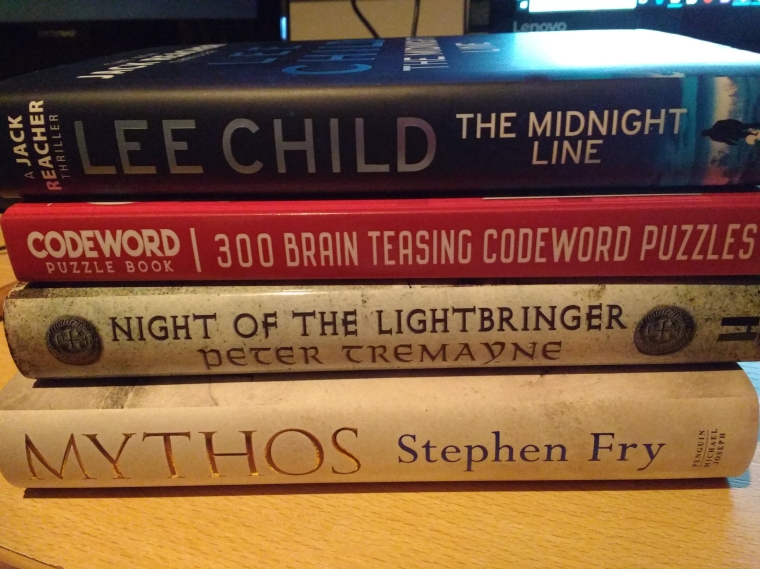
I was delighted to get these books for Christmas:

img_20180103_184002627.jpg


The Midnight Line by Lee Child. I’ve never read any books by Lee Child, so I’m looking forward to reading it. Philip Pullman is quoted on the back cover – ‘I always seize the latest Lee Child with pleasure.‘ It’s no. 22 in his Jack Reacher thriller series. I wonder if this will set me off reading another series?

Codeword Puzzle Book: 300 Brain Teasing Codeword Puzzles. I’m a Codeword addict -they’re also known as Alphapuzzles – and I like to do at least two a day, so this book is ideal for me.

Night of the Lightbringer by Peter Tremayne – a signed copy of his latest Sister Fidelma mysteries! Another series to tempt me as this is the 28th medieval murder mystery,  featuring Sister Fidelma, a Celtic nun and also an advocate of the ancient Irish law system. It’s set in Ireland in AD 671 on the eve of the pagan feast of Samhain.

Mythos: The Greek Myths Retold by Stephen Fry I’ve already written a First Chapter, First Paragraph post about this book. These are stories about gods, monsters and heroes – stories about Zeus, Apollo, Poseidon and Adonis and Aphrodite, for example.

My Week in Books: 3 December 2017

This Week in Books is a weekly round-up hosted by Lypsyy Lost & Found, about what I’ve been reading Now, Then & Next.

IMG_1384-0

A similar meme,  WWW Wednesday is run by Taking on a World of Words.

Now:

Victoria: A Life

I’m still reading Victoria: a Life by A N Wilson (I began reading it last October!) and am now in Part 4. At the end of Part 3 Albert had died (14 December 1861). Part 4 begins with the marriage of Bertie and Princess Alexandra of Denmark on 10 March 1862. Victoria was still suffering to cope with Albert’s death but she, along with the general public, adored the princess.

I’m also reading Notes From an Exhibition by Patrick Gale.  I’m really enjoying this book about Rachel, an artist, found dead in her studio – the secrets of her life are slowly revealed as the book moves backwards and forwards in time. I’ve read just over half the book and currently I’m finding out about her life as a teenager.

Then:

The last book I finished is Martin Chuzzlewit by Charles Dickens. This was my book in the November/December Classics Club Spin and I’ll be writing more about it later on. It is long, starts very slowly and then gets more interesting, with great characters and some comic and satirical episodes. It’s a study of selfishness and hypocrisy.

Next:

Turning for Home by Barney Norris, which  will be published on 11 January 2018. It looks as though it will be so good – I hope so.

Blurb:

‘Isn’t the life of any person made up out of the telling of two tales, after all? People live in the space between the realities of their lives and the hopes they have for them. The whole world makes more sense if you remember that everyone has two lives, their real lives and their dreams, both stories only a tape’s breadth apart from each other, impossibly divided, indivisibly close.’

Every year, Robert’s family come together at a rambling old house to celebrate his birthday. Aunts, uncles, distant cousins – it has been a milestone in their lives for decades. But this year Robert doesn’t want to be reminded of what has happened since they last met – and neither, for quite different reasons, does his granddaughter Kate. Neither of them is sure they can face the party. But for both Robert and Kate, it may become the most important gathering of all.

Have you read any of these books?  Do any of them tempt you? 

First Chapter First Paragraph: Mythos by Stephen Fry

Happy New Year to One and All –  Let’s hope it’s a good one!

eca8f-fistchap

Every Tuesday Diane at Bibliophile by the Sea hosts First Chapter First Paragraph Tuesday Intros to share the first paragraph sometimes two, of a book that she’s reading or is planning to read soon.

This week’s opening is from Mythos: the Greek Myths Retold by Stephen Fry, one of my Christmas presents.

Mythos: A Retelling of the Myths of Ancient Greece

It begins:

These days the origin of the universe is explained by proposing a Big Bang, a single event that instantly brought into being all the matter from which everything and everyone are made.

The ancient Greeks had a different idea. They said that it all started not with a bang, but with CHAOS.

Was Chaos a god – a divine being – or simply a state of nothingness? Or was Chaos, just as we would use the term today, a kind of terrible mess, like a teenager’s bedroom only worse.

Think of Chaos perhaps as a kind of grand cosmic yawn. As in yawning chasm or a yawning void.

Blurb:

No one loves and quarrels, desires and deceives as boldly and brilliantly as Greek gods and goddesses. They are like us, only more so – their actions and adventures scrawled across the heavens above.

From the birth of the universe to the creation of humankind, Stephen Fry – who fell in love with these stories as a child – retells these myths for our tragic, comic, fateful age. Witness Athena born from the cracking open of Zeus’s great head and follow Persephone down into the dark realm of Hades. Experience the terrible and endless fate of Prometheus after his betrayal of Zeus and shiver as Pandora opens her jar of evil torments.

The Greek gods are the best and worst of us, and in Stephen Fry’s hands they tell us who we are. Mythos – smart, funny, and above all great fun – is the retelling we deserve by a man who has been entertaining the nation for over four decades.

∼ ∼ 

I was delighted to receive this as a Christmas present. I loved Greek myths when I was a child and want to know more. In his Foreword Fry writes that you don’t need to know anything to read this book – but I’m looking forward to reading about the ones I do know as well as others I don’t.

What do you think – would you read on?

White Bodies by Jane Robins

A Tale of Obsession and Manipulation

Publication date 28 December 2017, HQ

Review copy from the publishers, via NetGalley

My rating:  2.5 stars (I’ve rounded this up to 3 on Goodreads)

Blurb:

‘He’s so handsome and clever and romantic. I just wished he hadn’t forced Tilda under the water and held her there so long.’

Callie loves Tilda. She’s her sister, after all. And she’s beautiful and successful.

Tilda loves Felix. He’s her husband. Successful and charismatic, he is also controlling, suspicious and, possibly, dangerous. Still, Tilda loves Felix.

And Callie loves Tilda. Very, very much.

So she’s determined to save her. But the cost could destroy them all…

Sometimes we love too much.

My thoughts:

Twins, Callie and Tilda are two very different people, both in appearance and personality. The blurb doesn’t give away much of the book but the idea interested me. It begins with Felix’s death and then goes back over the events that led to his death. So far, so good and I thought this was an interesting opening and that I was going to enjoy this book, even though it’s written in the present tense (not my preferred style). But very early on I realised what the eventual outcome would be when a certain film was mentioned and I know this is not unique – many other books are based on earlier books or plays and it is said that there are just seven basic plots in literature – but it really irritated and disappointed me. So it has left me in two minds about this book.

Parts of it fascinated me (I wanted to know how Felix died for example), the characters are certainly interesting/weird – not likeable, except for Wilf, Callie’s boyfriend. It’s really a story of obsession in various forms, manipulation and the dangers of the internet. Callie’s obsession with Tilda (eating her hair, teeth etc), Tilda’s obsession with herself and Felix’s obsession with OCD, control (re-organising Tilda’s flat), tidiness and neatness (aligning cutlery and wrapping crockery etc in clingfilm). The events are seen through Callie’s perspective and at times I felt sympathy for her in her desire to protect Tilda from the dangers she could see she was in from Felix. But is her view skewed? And her foray into an internet forum is the beginning of the end for her.  But overall, I wasn’t convinced by the book and I didn’t find it particularly tense or chilling, just rather strange. Maybe I’ve been reading too many books in this genre to be convinced.

My thanks to the publishers for a review copy via NetGalley.

Other people, however, have enjoyed this book far more than me – for example see Fanfiction’s review and this one from Cleo.

Amazon UK link
Amazon US link