WWW Wednesday: 5 June 2019

IMG_1384-0

WWW Wednesday is run by Taking on a World of Words.

The Three Ws are:

What are you currently reading?
What did you recently finish reading?
What do you think you’ll read next?


Currently reading: I’m still making slow progress with reading  D H Lawrence: the Life of an Outsider by John Worthen,  but I’ve almost finished Sweet Thursday by John Steinbeck. So, I’ve started to read Those Who Are Loved by Victoria Hislop, one of the books on my 20 Books of Summer list.

Those Who Are Loved is historical fiction, set against the backdrop of the German occupation of Greece, the subsequent civil war and a military dictatorship, all of which left deep scars. I know very little about Greece during the Second World War so I’m finding it very interesting, but it is very slow going. It begins as Themis remembers her life and the conflicts within her family as well as their experience of the war.

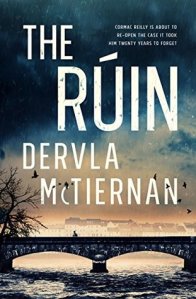
I’ve recently finished The Ruin by Dervla Mactiernan and will be writing more about it in a later post.

Ruin

Blurb:

It’s been twenty years since Cormac Reilly discovered the body of Hilaria Blake in her crumbling Georgian home. But he’s never forgotten the two children she left behind…

When Aisling Conroy’s boyfriend Jack is found in the freezing black waters of the river Corrib, the police tell her it was suicide. A surgical resident, she throws herself into study and work, trying to forget – until Jack’s sister Maude shows up. Maude suspects foul play, and she is determined to prove it.

DI Cormac Reilly is the detective assigned with the re-investigation of an ‘accidental’ overdose twenty years ago – of Jack and Maude’s drug- and alcohol-addled mother. Cormac is under increasing pressure to charge Maude for murder when his colleague Danny uncovers a piece of evidence that will change everything…

My next book could be:

I think, but I could always change my mind, it’ll be Anything You Do Say by Gillian Mcallister, another book that is on my 20 Books of Summer list.

Anything you do say

Blurb:

Joanna is an avoider. So far she has spent her adult life hiding bank statements and changing career aspirations weekly.

But then one night Joanna hears footsteps on the way home. Is she being followed? She is sure it’s him; the man from the bar who wouldn’t leave her alone. Hearing the steps speed up Joanna turns and pushes with all of her might, sending her pursuer tumbling down the steps and lying motionless on the floor.

Now Joanna has to do the thing she hates most – make a decision. Fight or flight? Truth or lie? Right or wrong?

Have you read any of these books?  Do any of them tempt you? 

Reading in May

I’ve been reading eight books in May, and have finished reading six of them, but only reviewed four of them:

  1. The Butterfly Room by Lucinda Riley 4* –  a family saga spanning generations  revealing the dark secret hidden behind the locked door of the Butterfly Room
  2. Mrs Whistler by Matthew Plampin 5* – not about his mother, but about him and his model and mistress, Maud Franklin
  3. Codename Villanelle by Luke Jennings 3* – the basis for the TV series Killing Eve 
  4. The Doll Factory by Elizabeth Macneal 5* –  the story of Iris who dreamed of being an artist and her involvement with the Pre-Raphaelites

The other two books I finished are:

Before the Fall by Noah Hawley, which I didn’t enjoy and I’m just writing a few notes here about it. It won the 2017 Edgar Award for Best Novel and was selected by The Sunday Times as one of the top page-turners of summer 2017, so I’m in the minority because I thought it was boring and tedious. The plot is simple – a plane crashes into the sea after taking off from Martha’s Vineyard, just two people survive and the mystery is why did the plane crash and who was responsible. The main part of the book is made up of the long backstories of the people on the plane. It’s not gripping or thrilling and definitely not a page-turner. 1*

However I thoroughly enjoyed The Ruin Dervla McTiernan’s debut novel and I’ll be writing more about it in the next few days. Now this is a page-turner, about a current murder linked to a cold case. It’s complex and compelling reading as DI Cormac Reilly unravels a web of secrets. 4*

I’m still reading two books:

D H Lawrence: the Life of an Outsider by John Worthen, from his childhood in Nottinghamshire to his death at the age of 44. I’m reading this slowly and it will be some time before I finish it. An ‘outsider’, he always felt he didn’t fit in or belong either with his family or his work colleagues or the literary elite of the times.

The other book I’ve been reading is Sweet Thursday by John Steinbeck, my Classics Club Spin book that I was hoping to finish by the end of May. I’ve only read half of it so far. It’s a follow up to Cannery Row, with some of the same characters and I’m enjoying its humour and view of life in Monterey in the 1950s.

And now it’s June! I’ll be concentrating on reading the books I’ve listed for the 20 Books of Summer challenge – and hoping I won’t be distracted by too many other books!

Six Degrees of Separation: from Murmur to Alan Turing: The Enigma

I love doing Six Degrees of Separation, a monthly link-up hosted by Kate at Books Are My Favourite and Best. Each month a book is chosen as a starting point and linked to six other books to form a chain. A book doesn’t need to be connected to all the other books on the list, only to the one next to it in the chain.

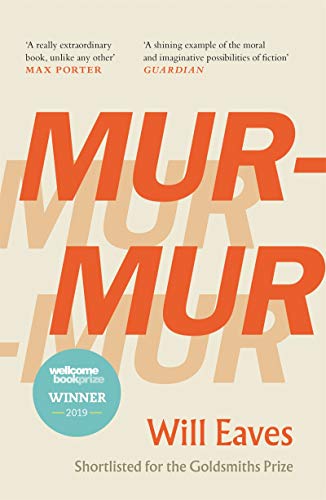
Murmur

This month the chain begins with a book I haven’t read or heard of before, Murmur by Will Eaves. This is the summary from Amazon: Taking its cue from the arrest and legally-enforced chemical castration of Turing, Eaves fictionalises the devastating period before the mathematician’s death in an extraordinary contemplation of consciousness.

Murmur has won several prizes including the 2019 Wellcome Book Prize, an annual award, open to new works of fiction or non-fiction. To be eligible for entry, a book should have a central theme that engages with some aspect of medicine, health or illness.

I checked back to see if I had read any of the earlier  Wellcome Book prize winners. I had to go back to 2010 when The Immortal Life of Henrietta Lacks by Rebecca Skloot was the winning book. I read this in April and thought it was excellent. Henrietta Lacks died of cervical cancer in 1951. The cancer cells taken from her tumour were cultured and became known as HeLa cells which have formed the basis for medical research and drug development ever since.

The Quarry by Iain Banks is a novel about Guy, a man dying from cancer. He lives in a house that is gradually falling to pieces, situated on the edge of a quarry in the Pennines..Feeling his death is imminent, Guy gathers around him his oldest friends as they reminisce about their time as film students and search through the house for a video tape they had made that could ruin all of their lives if it became public.  It’s the last book Iain Banks wrote – whilst writing it he, himself, was diagnosed with cancer.

Another house in ruins is the setting for the opening of The Ruin, Dervla McTiernan’s debut novel. DI Cormac Reilly has left his high-flying Dublin career to return to Galway, where he is confronted with a case that has haunted him for twenty years. As a young constable he was called to a decrepit country house where he found two silent, neglected children and their mother lying dead upstairs.

Another debut novel is Everything But the Truth by Gillian McAllister set in Newcastle and Oban. This is a thriller about lies, secrets and relationships; about how we get to know people and learn to trust them.

Also set partially in Newcastle is Harbour Street by Ann Cleeves. It begins ten days before Christmas, as the Newcastle Metro is packed with shoppers, babies screaming, office workers merry after pre-Christmas parties where an old lady, Margaret Krukowski, is found fatally stabbed. This book was adapted for TV adaptation, but with many changes from the original.

Another adaptation is the film The Imitation Game starring Benedict Cumberbatch and Keira Knightley about Alan Turing as he tries to crack the German Enigma code.  It’s an adaptation of the book Alan Turing: The Enigma by Andrew Hodges. In 1952 Turing’s homosexuality rendered him a criminal and he was subjected to humiliating treatment. In 1954, aged 41, Alan Turing took his own life – thus linking back to Murmur.

I’ve started and ended with books about Alan Turing, linked by books that have won the Wellcome Book Prize, books about cancer, set in ruined houses, debut novels, books set in Newcastle and books that have been adapted for TV and film.

The books are mostly crime fiction, all of which I’ve read. Although I haven’t read Andrew Hodges’ book I have seen the film – which is excellent!

Next month (July 6, 2019), the chain will begin with the children’s classic, Where the Wild Things Are by Maurice Sendak.

My Friday Post: Snowblind by Ragnar Jónasson

Book Beginnings Button

Every Friday Book Beginnings on Friday is hosted by Gillion at Rose City Reader where you can share the first sentence (or so) of the book you are reading, along with your initial thoughts about the sentence, impressions of the book, or anything else the opener inspires.

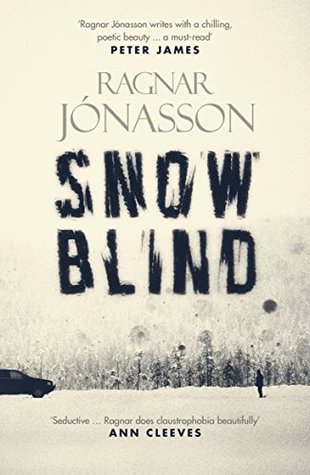
The book I’m featuring this week is Snowblind by Ragnar Jónasson, one of my TBRs.

Snowblind

The red stain was like a scream in the silence.

Also every Friday there is The Friday 56, hosted by Freda at Freda’s Voice.

30879-friday2b56These are the rules:
  1. Grab a book, any book.
  2. Turn to page 56, or 56% on your eReader. If you have to improvise, that is okay.
  3. Find any sentence (or a few, just don’t spoil it) that grabs you.
  4. Post it.
  5. Add the URL to your post in the link on Freda’s most recent Friday 56 post.

Page 56:

Ari Thor picked up the book he had bought, in spite of the promise he’d made to himself to save it until after dinner. He was eking out his small pleasures to keep the boredom at bay. Only a few pages into the book, he realised that he hadn’t taken anything in.

Blurb:

Siglufjörður: an idyllically quiet fishing village in Northern Iceland, where no one locks their doors – accessible only via a small mountain tunnel.

Ari Thór Arason: a rookie policeman on his first posting, far from his girlfriend in Reykjavik – with a past that he’s unable to leave behind. When a young woman is found lying half-naked in the snow, bleeding and unconscious, and a highly esteemed, elderly writer falls to his death in the local theatre, Ari is dragged straight into the heart of a community where he can trust no one, and secrets and lies are a way of life.

An avalanche and unremitting snowstorms close the mountain pass, and the 24-hour darkness threatens to push Ari over the edge, as curtains begin to twitch, and his investigation becomes increasingly complex, chilling and personal. Past plays tag with the present and the claustrophobic tension mounts, while Ari is thrust ever deeper into his own darkness – blinded by snow, and with a killer on the loose.

~~~

What do you think? Would you keep reading?


WWW Wednesday: 22 May 2019

IMG_1384-0

WWW Wednesday is run by Taking on a World of Words.

The Three Ws are:

What are you currently reading?
What did you recently finish reading?
What do you think you’ll read next?


Currently reading: Three books,  D H Lawrence: the Life of an Outsider by John Worthen, Sweet Thursday by John Steinbeck and The Doll Factory by Elizabeth Macneal.

I’ve made more progress with D H Lawrence: the Life of an Outsider. It’s a thorough and detailed account of his life and I’ve just got up to 1912 when he first met Frieda Weekley, the wife of Ernest Weekley, a Nottingham University professor of modern languages. Lawrence had finished writing ‘Paul Morel‘ (Sons and Lovers) and had needing a break he decided to travel – to go to Germany. He got in touch with Weekley to ask for his advice.

Sweet Thursday is my Classics Club spin book to read by 31 May. So far I’ve only read a few chapters. This is a follow on from Steinbeck’s Cannery Row which I loved. Set after the Second World War in Monterey, on the California Coast, Sweet Thursday is what they call the day after Lousy Wednesday, which is one of those days that’s just naturally bad.

I’ve included The Doll Factory in my 20 Books of Summer challenge and I made the mistake of looking at it and before I knew it I’d read 20%. It really is compelling reading for me – historical fiction set in London beginning in 1850 as the Grand Exhibition is being built in Hyde Park. Twin sisters Iris and Rose paint dolls for a living but Iris dreams of a life as an artist. This is the period when the Pre-Raphaelite Brotherhood are making their mark in the art world.

Recently finished Codename Villanelle by Luke Jennings, the basis for the BAFTA-winning Killing Eve TV series. I enjoyed this but not as much as the TV version. See my review here.

Codename Villanelle

My next book could be:

As usual I’m not at all sure what it could be, but after reading Codename Villanelle I’ve got my eye on No Tomorrow by Luke Jennings, which continues the story.

No tomorrow

Blurb (Amazon):

In a hotel room in Venice, where she’s just completed a routine assassination, Villanelle receives a late-night call.

Eve Polastri has discovered that a senior MI5 officer is in the pay of the Twelve, and is about to debrief him. As Eve interrogates her subject, desperately trying to fit the pieces of the puzzle together, Villanelle moves in for the kill.

The duel between the two women intensifies, as does their mutual obsession, and when the action moves from the high passes of the Tyrol to the heart of Russia, Eve finally begins to unwrap the enigma of her adversary’s true identity.

Have you read any of these books?  Do any of them tempt you? 

Codename Villanelle by Luke Jennings

Codename Villanelle

John Murray|6 September 2018|224 pages|Review e-book copy|3*

Originally published as ebook singles: Codename VillanelleHollowpointShanghai and Odessa.

Synopsis from the publishers:

She is the perfect assassin. A Russian orphan, saved from the death penalty for the brutal revenge she took on her gangster father’s killers. Ruthlessly trained. Given a new life. New names, new faces – whichever fits. Her paymasters call themselves The Twelve. But she knows nothing of them. Konstantin is the man who saved her and the one she answers to. She is Villanelle. Without conscience. Without guilt. Without weakness.

Eve Polastri is the woman who hunts her. MI5, until one error of judgment costs her everything. Then stopping a ruthless assassin becomes more than her job. It becomes personal.

I loved the brilliant TV series Killing Eve and when I saw that Codename Villanelle by Luke Jennings was the basis for the series I was really keen on reading it. However, this is one of those rare occasions when I preferred the adaptation to the book. That’s not to say I didn’t enjoy the book, because I did – just not as much as the TV version. Now, that may be because I watched the TV series first – but I don’t think so. They begin at different points in the story. Codename Villanelle begins by introducing Villanelle, giving her background, real name and the details of her training as an assassin with the codename Villanelle, and her paymasters, known as The Twelve. Thus the suspense in that is built up in the TV series by not knowing anything about her other than her codename, just isn’t there in the book.

Both are fast paced, although the action sequences come over much better on TV, as you would expect.  Both portray Villanelle as a young woman who is psychologically invulnerable – a ruthless and successful killer, experiencing neither pain nor horror and totally unaffected by the pain she inflicts on others or the murders she carries out. But the dynamic between Villanelle and Eve Polastri that plays a large role in the TV series is missing in the book and there are several other changes too.

The book ends before the ending shown in the TV series and I’m assuming the next book Killing Eve: No Tomorrowwill continue the story, which I’m planning to read in the near future. There is a third book on the way too – Killing Eve: Endgame

About the Author

Luke Jennings is a London-based author and journalist who has written for The Observer, Vanity Fair, The New Yorker and Time. He is the author of Blood Knots, short-listed for the Samuel Johnson and William Hill prizes, and the Booker Prize-nominated Atlantic.

My thanks to the publishers, John Murray, for my review copy via NetGalley.