Reading in July

I read nine books in July – it was a really good batch of books. I’ve written about 7 of them – click on the titles to see my reviews.

  1. The Stranger Diaries by Elly Griffiths 3*
  2. Katharina: Fortitude by Margaret Skea 5*
  3. The House by the Loch by Kirsty Wark 4*
  4. The Bear Pit by S G Maclean 5*
  5. Who Killed Ruby? by Camilla Way 3.5*
  6. Dolly by Susan Hill 5*
  7. Blood on the Tracks edited by Martin Edwards *
  8. Clouds of Witness by Dorothy L Sayers 4*
  9. The Art of Dying by Ambrose Parry 4*

I’ll be writing more about Clouds of Witness and The Art of Dying later this month, but for now here are my initial thoughts.

Clouds of witnessClouds of Witness by Dorothy L Sayers is the second Lord Peter Wimsey book. I really enjoyed this book. It has wit and humour as  as well as being a murder mystery. Lord Peter Wimsey’s brother, the Duke of Denver is accused of murder and refuses to explain or defend himself, so it’s down to Peter to get to the truth. The murder took place at the duke’s shooting lodge and Lord Peter’s sister was engaged to marry the dead man. One of the things I like about it is that it is clearly a book of its time with all the class distinctions and snobbery of the 1920s clearly on display.

Art of DyingThe Art of Dying by Ambrose Parry, anothoer book I really enjoyed is a new publication due out on 29 August this year.  It’s the sequel to Ambrose Parry’s debut novel, The Way of all Flesh. Ambrose Parry is a pseudonym for a collaboration between Chris Brookmyre and Marisa Haetzman. It’s historical fiction set in Edinburgh in 1850 as  patients are dying all across the city, with doctors finding their remedies powerless. Will Raven returns to Edinburgh as a doctor having been in Europe studying. Dr. James Simpson is being blamed for the death of a patient in suspicious circumstances, and Will and former housemaid Sarah Fisher are determined to clear his name.


Six Degrees of Separation: from Gaudy Night to The Cuckoo’s Calling

I love doing Six Degrees of Separation, a monthly link-up hosted by Kate at Books Are My Favourite and Best. Each month a book is chosen as a starting point and linked to six other books to form a chain. A book doesn’t need to be connected to all the other books on the list, only to the one next to it in the chain.

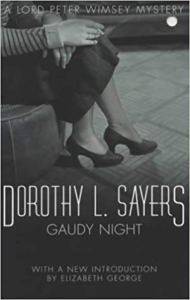
This month it’s a wild card – the chain begins with the book that ended our July chains, which means that my starting book is Gaudy Night by Dorothy L Sayers.

Gaudy Night

It’s set at Shrewsbury College at Oxford University. Harriet Vane attends the Shrewsbury Gaudy (a college reunion involving a celebratory dinner). It doesn’t go well – there are poison pen letters, nasty graffiti and vandalism causing mayhem and upset. It’s 1935 and explores the role of women in society, particularly with regard to education and marriage and the importance of truth and honesty. 

My first link is the word night’ in the title:

Endless Night by Agatha Christie. It differs from most of her other books in that it is a psychological study. It reminded me very much of Ruth Rendell’s books, writing as Barbara Vine. It has the same suffocating air of menace throughout the book, with more than one twist at the end. It’s a murder mystery, but there is little or no detection, and no investigators – no Poirot or Miss Marple – to highlight the clues to the murders, for there are several.

So, my second link is, The Brimstone Wedding, by Barbara Vine, also a book full of a menacing atmosphere. In it Stella, reveals her past as she talks to Jenny, one of the carers at the retirement home where she lives. It’s all very subtle at first with tantalising hints about what had really happened in Stella’s past. But the full horror is left to the end –  it’s not horrific in the overblown graphic sense, but in a sinister, psychological way that really is ‘chilling’ and inexpressibly sad.

And my third link takes me to another chilling book, The Craftsman by Sharon Bolton –  a remarkably powerful book, full of tension and fear. Assistant Commissioner Florence Lovelady attends the funeral of Larry Glassbrook, the convicted murderer she arrested thirty years earlier. The victims had been buried alive. But as she revisits the scenes of the burials she starts to think that maybe Larry wasn’t the murderer after all.

Moving away from chilling books about death and burials my mind jumped to a completely different book about death – The Graveyard Book by Neil Gaiman. This is the story of Bod, the baby who escapes a murderer. He stumbles into the local disused graveyard where he is rescued by ghosts. Silas, who is neither dead nor alive appoints himself as his guardian. It’s about life, love and friendship, loyalty and the fight between good and evil. Above all it is about growing up and the excitement and expectations that Bod has about life.

Another character called Silas is Silas Marner, written by George Eliot about a weaver who was wrongly accused of theft and left his home town to live a lonely and embittered life in Raveloe where he became a miser, hoarding his gold and counting it each night. George Eliot is the pen name of Mary Anne Evans.

Finally this leads me to my last link, The Cuckoo’s Calling by Robert Galbraith, J K Rowling’s pen name. It’s crime fiction, set in the world of Cormoran Strike , an ex-army private detective, who is struggling to get clients and pay his bills, sleeping on a camp bed in his office.

My links are via the word ‘night’, chilling books, death and burials, characters called Silas and authors using pen names (the links on titles are to my posts on the books). I have read and enjoyed all these books.

Next month (September 7, 2019), we’ll begin with A Gentleman in Moscow by Amor Towles – a book I haven’t read, or even heard of before.

My Friday Post: An April Shroud by Reginald Hill

Book Beginnings Button

Every Friday Book Beginnings on Friday is hosted by Gillion at Rose City Reader where you can share the first sentence (or so) of the book you are reading, along with your initial thoughts about the sentence, impressions of the book, or anything else the opener inspires.

An April Shroud by Reginald Hill is one of my 20 Books of Summer that I’ll be reading soon. It’s the 4th book in his Dalziel and Pascoe series.

April Shroud


No one knew how it came about that Dalziel was making a speech. Pascoe had with great reluctance let himself be persuaded into a church wedding, partly by the argument sentimental (Mum’s looking forward to it), partly by the argument economic (Dad’s paying for it), but mainly by the suspicion, hotly denied but well supported by circumstantial evidence, that Ellie herself wanted it.

Also every Friday there is The Friday 56, hosted by Freda at Freda’s Voice.

30879-friday2b56These are the rules:

  1. Grab a book, any book.
  2. Turn to page 56, or 56% on your eReader. If you have to improvise, that is okay.
  3. Find any sentence (or a few, just don’t spoil it) that grabs you.
  4. Post it.
  5. Add the URL to your post in the link on Freda’s most recent Friday 56 post.

Page 56:

‘So you’re not too worried about the boy?’

‘In the sense that he is too sensible to contribute willingly to his own harm, no. But as you say, the weather is appalling and, in addition, we live in troubled times, Mr Dalziel.’

Blurb:

Superintendent Dalziel falls for the recently bereaved Mrs Fielding’s ample charms, and has to be rescued from a litter of fresh corpses by Inspector Pascoe.

Superintendent Andy Dalziel’s holiday runs into trouble when he gets marooned by flood water. Rescued and taken to nearby Lake House, he discovers all is not well: the owner has just died tragically and the family fortunes are in decline. He also finds himself drawn to attractive widow, Bonnie Fielding.

But several more deaths are to follow. And by the time Pascoe gets involved, it looks like the normally hard-headed Dalziel might have compromised himself beyond redemption.

What do you think? Would you keep reading?

This is one of the early Dalziel and Pascoe novels, first published in 1975. Although it begins with Pascoe’s wedding, the main story is centred around Dalziel, my favourite character in these books. I like to have a few books lined up to read and as I’ve nearly finished The Adventures of Maud West, Lady Detective, I think I’ll start An April Shroud today.

My Friday Post: Gallows Court by Martin Edwards

Book Beginnings Button

Every Friday Book Beginnings on Friday is hosted by Gillion at Rose City Reader where you can share the first sentence (or so) of the book you are reading, along with your initial thoughts about the sentence, impressions of the book, or anything else the opener inspires.

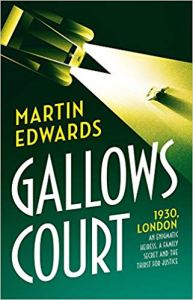
I’ve just started Gallows Court by Martin Edwards, the first in a series set in 1930s London.

Gallows Court

‘Jacob Flint is watching the house again.’ The housekeeper’s voice rose. ‘Do you think he knows about …?’

Also every Friday there is The Friday 56, hosted by Freda at Freda’s Voice.

30879-friday2b56These are the rules:

  1. Grab a book, any book.
  2. Turn to page 56, or 56% on your eReader. If you have to improvise, that is okay.
  3. Find any sentence (or a few, just don’t spoil it) that grabs you.
  4. Post it.
  5. Add the URL to your post in the link on Freda’s most recent Friday 56 post.

Page 56:

‘I told you last night not to threaten me, Mr Flint. You should heed my advice. There are worse fates than the misfortune that befell Thomas Betts.’

Blurb:

London, 1930.
A headless corpse; an apparent suicide in a locked room; a man burned alive during an illusionist’s show in front of thousands of people. Scotland Yard is baffled by the sequence of ghastly murders unfolding across the city and at the centre of it all is mysterious heiress Rachel Savernake. Daughter of a grand judge, Rachel is as glamorous as she is elusive.

Jacob Flint, a tenacious young journalist eager to cover the gruesome crimes, is drawn into Rachel’s glittering world of wealth and power. But as the body count continues to rise, Jacob is convinced Rachel is harbouring a dark secret and he soon becomes part of a dangerous game that could leave him dancing at the end of the hangman’s rope if he pursues the truth.

What do you think? Would you keep reading?

I have high expectations of this book as I’ve thoroughly enjoyed all of Martin Edwards’s books that I’ve read, particularly his Lake District murder mysteries. Gallows Court has been on my radar since it was published last year so it’s time I read it, especially as now I see that his next book, due out in March next year, is to be Mortmain Hall, a sequel to Gallows Court. 

Blood on the Tracks: Railway Mysteries edited by Martin Edwards (British Library Crime Classics)

I’ve said before that I’m not a big fan of short stories, often finding them disappointing. So I’m glad to say that I enjoyed this anthology edited by Martin Edwards: Blood on the Tracks: Railway Mysteries. Some stories, of course, are better than others.

Blood on the tracks

There are fifteen railway themed stories in the collection and an introduction on classic railway mysteries by Martin Edwards. He has also prefaced each story with a brief biographical note, which I found useful as some of the authors were new to me. I read the collection slowly over a few months, which I find is the best way to approach a short story collection.

Train travel provides several scenarios for a mystery – the restriction of space on trains, with or without a corridor, means that there are a limited number of suspects and they can also provide an ideal place for a ‘locked room’ crime or an ‘impossible crime’ story. This collection also includes a couple of crimes with a supernatural element.

The mysteries are presented in roughly chronological order from 1898 up to  the 1950s. The ones I enjoyed the most are by R Austin Freeman, Roy Vickers, Dorothy L Sayers, F Tennyson Jesse and Freeman Crofts Willis.

  1. The Man with the Watches by Arthur Conan Doyle featuring an un-named sleuth, ‘a well-known criminal investigator’, about a man shot through his heart on the London to Manchester train. He had no ticket on him but had six valuable gold watches in his possession. This was first published in The Strand Magazine in 1898.
  2. The Mystery of Felwyn Tunnel by L T Meade and Robert Eustace. This was also first published in 1898 in which a signalman is found dead at the mouth of the tunnel. When another man dies in in the same place it looks as though something very strange is the cause of their deaths.
  3. How He Cut His Stick by Matthias McDonnell Bodkin. In this story Lady Detective Dora Myrl investigates the theft of £5,000 in gold and notes from a locked railway carriage.
  4. The Mysterious Death on the Underground Railway (1901) by Baroness Orczy, featuring the Old Man in the Corner, an ‘armchair detective’ as he sits in a teashop and tells journalist Polly Burton the solution to the murder of a young woman on the Underground, whilst he fiddles with a piece of string.
  5. The Affair of the Corridor Express by Victor L Whitechurch featuring the railway detective Thorpe Hazell. He investigates the kidnapping of the son of a millionaire.
  6. The Case of Oscar Brodski by R Austin Freeman, an ‘inverted’ detective story, in which the reader knows everything, whereas the detective knows nothing and it all hinges on the significance of trivial details, including fragments of glass, biscuit crumbs, a piece of string and threads of fabric.
  7. The Eighth Lamp by Roy Vickers – an underground mystery about switching off the station lamps after the last train had gone down the line, with a rather spooky supernatural ending.
  8. The Knight’s Cross Signal Problem by Ernest Bramah, in a steam engine crashes into a light train, killing twenty seven people and injuring forty plus. The cause of the accident is a mix up with the signals. I think this is one of the less successful stories for me.
  9. The Unsolved Puzzle of the Man with No Face (1928) by Dorothy L Sayers (a Lord Peter Wimsey story), . The body of a man is found on a lonely beach, his face slashed, and with no means of identification. Wimsey’s discussion of the crime with his fellow passengers as they travel into London, helps D I Winterbottom to solve the mystery – a most intriguing story.
  10. The Railway Carriage by F Tennyson Jesse (1931) – this is possibly my favourite story in the collection. It’s a supernatural mystery in which Solange Fontaine, a female sleuth with a ‘feeling for evil’ features meets two passengers on a train. Both the elderly woman, dressed in shabby black and the insignificant-looking man in a grey felt hat seem to be locked in their own thoughts and she feels very ill at ease. Then the train crashes. An excellent story.
  11. Mystery of the Slip-Coach by Sapper (1933), the creator of ‘Bulldog’ Drummond – an example of an ‘impossible crime’ in which the clue of a raw egg supplies the solution to the murder – I wasn’t convinced by this story.
  12. The Level Crossing by Freeman Crofts Willis ( 1933) in which a man is found dead, lying near an unmanned railway crossing. A mystery that shows the effects of unforeseen circumstances even on a well planned murder.
  13. The Adventure of the First-class Carriage by Ronald Knox (1947) a Sherlock Holmes pastiche with an ‘impossible crime’ scenario.
  14. Murder on the 7.16 by Michael Innes, a John Appleby mystery in which he investigates a murder in a railway carriage on trestles, not on wheels, as it is part of a film set.
  15. The Coulman Handicap by Michael Gilbert (1950s). I found this rather confusing as the police follow a woman passing on stolen goods as she uses the Underground to give them the slip. I think this is possibly the one story in the collection that failed to hold my interest.

My thanks to the publishers for my review copy via NetGalley.

  • Paperback: 358 pages
  • Publisher: Poisoned Pen Press (3 July 2018) in association with the British Library
  • Language: English
  • ISBN-10: 1464209693
  • ISBN-13: 978-1464209697
  • My rating: 3*

My Friday Post: Clouds of Witness by Dorothy L Sayers

Book Beginnings Button

Every Friday Book Beginnings on Friday is hosted by Gillion at Rose City Reader where you can share the first sentence (or so) of the book you are reading, along with your initial thoughts about the sentence, impressions of the book, or anything else the opener inspires.

I’m currently reading Clouds of Witness by Dorothy L Sayers, the second Lord Peter Wimsey book and one of my 20 Books of Summer.

Clouds of witness


Lord Peter Wimsey stretched himself luxuriously between the sheets provided by the Hôtel Meurice.

Also every Friday there is The Friday 56, hosted by Freda at Freda’s Voice.

30879-friday2b56These are the rules:

  1. Grab a book, any book.
  2. Turn to page 56, or 56% on your eReader. If you have to improvise, that is okay.
  3. Find any sentence (or a few, just don’t spoil it) that grabs you.
  4. Post it.
  5. Add the URL to your post in the link on Freda’s most recent Friday 56 post.

Page 56:

From amid the mud and the fallen leaves he retrieved a tiny glittering object – a flash of white and green between his finger-tips.

It was a little charm such as women hang upon a bracelet – a diminutive diamond cat with eyes of bright emerald.

Blurb:

The Duke of Denver, accused of murder, stands trial for his life in the House of Lords.
Naturally, his brother Lord Peter Wimsey is investigating the crime – this is a family affair. The murder took place at the duke’s shooting lodge and Lord Peter’s sister was engaged to marry the dead man.
But why does the duke refuse to co-operate with the investigation? Can he really be guilty, or is he covering up for someone?

What do you think? Would you keep reading?