Clouds of Witness by Dorothy L Sayers

Clouds of Witness by Dorothy L Sayers, is the second Lord Peter Wimsey book and one of my 20 Books of Summer. It was first published in 1926. My copy was reprinted in 1984 and I bought it secondhand four years ago.

Clouds of witness Sayers

From the back cover of my paperback:

A man is found shot, and the Duke of Denver is charged with his murder. Naturally, it is his brother, Lord Peter Wimsey, who is called in to investigate the crime. This is a family affair, for the murdered man was the fiancé of the sister of Denver and Wimsey.

Why, then, does the Duke refuse to co-operate with the investigation? Is he really guilty, or is he covering up for someone? Why is Wimsey attacked by an enraged farmer on the lonely moors? Why is an attempt made on his life in a Soho street?

My thoughts:

So many questions! And as I read even more popped into my mind – why did Lady Mary, Wimsey’s sister, leave the house at 3am on the morning of the murder? Why is she feigning illness? Whose footprints are those near the body of Denis Cathcourt (the murdered man)? What is the significance of the diamond cat charm with eyes of bright emeralds? And why won’t the Duke defend himself? Then there are the bloodstains and signs that the body had been dragged to the door of the conservatory where it was found, leading into the nearby thicket. If the Duke didn’t kill Cathcart who did and why?

The evidence against the Duke is circumstantial. So, Wimsey has his work cut out to prove his innocence and save him from the death penalty. Together with his friend, Inspector Charles Parker (who is in love with Lady Mary), and Bunter, his manservant, they look for clues and interview the family’s guests on the night of the murder. There are several strands to the story and minor characters who all manage to confuse the mystery.

There are some memorable scenes, such as Wimsey and Bunter’s escapade on the moors when they attempted to get to Grider’s Hole. The fog had come on them suddenly, blotting out their surroundings and they had no idea what direction to take. They strode forward gingerly unable to distinguish uphill from downhill – then Wimsey tripped into a bog, and found himself sinking up to his thighs. As well as struggling in the foggy bog, Wimsey also got shot and rather dramatically flew to New York in pursuit of evidence, a dangerous journey in a fragile plane as a deep depression was crossing the Atlantic bringing storms with heavy rain and sleet, rising to a gale as the plane lurched from gust to gust.

The trial scene in the House of Lords is fascinating:

The historic trial of the Duke of Denver for murder opened as soon as Parliament reassembled after the Christmas vacation. The papers had leaderettes on ‘Trial by his Peers’, by a Woman Barrister, and ‘The Privilege of Peers: should it be abolished?’ by a Student of History. The Evening Banner got into trouble for contempt by publishing an article entitled ‘The Silken Rope’ (by an Antiquarian), which was deemed to be prejudicial, and the Daily Trumpet – the Labour organ – inquired sarcastically why, when a peer was tried, the fun of seeing the show should be reserved to the few influential persons who could wangle tickets for the Royal Gallery. (pages 217 -218)

Clouds of Witness is a book of its time, there is much banter, wit and humour, and plenty of snobbery of all types clearly showing the class distinctions between the working and upper classes. It is a clever story, well told, with colourful characters and I liked the details it gives about Wimsey’s family as I’ve been reading these books totally out of order.

All in all, I enjoyed it – 4*.

Reading challenges: 20 Books of Summer, Calendar of Crime, and Mount TBR challenge 2019

The Family Upstairs by Lisa Jewell

 A house with the darkest of secrets.

Family upstairs

Random House UK Cornerstone|8 August 2019|464 pages|e-book |Review copy|5*

My Friday Post: The Seagull by Ann Cleeves

Book Beginnings Button

Every Friday Book Beginnings on Friday is hosted by Gillion at Rose City Reader where you can share the first sentence (or so) of the book you are reading, along with your initial thoughts about the sentence, impressions of the book, or anything else the opener inspires.

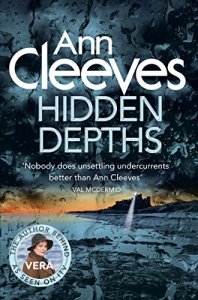
The Seagull by Ann Cleeves is one of my TBRs, that I should have read as soon as I got it – but didn’t. It’s the 8th book in her Vera series.

Seagull

Prologue

The woman could see the whole sweep of the bay despite the dark and the absence of street lights where she stood. Sometimes it felt as if her whole life had been spent on the half-light; in her dreams, she was moon-lit or she floated through the first gleam of dawn. Night was the time when she felt most awake.

I like the opening of this prologue and I’m wondering how it fits into the story that follows.

Chapter One

John watched the door from his wheelchair and wondered who’d be dragged in to speak to them today. An orderly carried through a mug of tea and left it on the floor beside him, though he must have realized it would be impossible for John to reach it from his chair.

Also every Friday there is The Friday 56, hosted by Freda at Freda’s Voice.

30879-friday2b56These are the rules:

  1. Grab a book, any book.
  2. Turn to page 56, or 56% on your eReader. If you have to improvise, that is okay.
  3. Find any sentence (or a few, just don’t spoil it) that grabs you.
  4. Post it.
  5. Add the URL to your post in the link on Freda’s most recent Friday 56 post.

Page 56:

Joe thought all that made sense. He imagined an elderly Robbie Marshall sitting in the sun on the balcony of a Spanish apartment, using a different name, his long nose even redder.

So, three extracts from The Seagull, and I’m wondering how they all fit together? Maybe the blurb will help …

Blurb:

When prison inmate and former police officer John Brace says he’s willing to give up information about a long-dead wheeler dealer in return for protection for his family, Vera knows that she has to look into his claims.

But opening up this cold case strikes much closer to home than Vera anticipates as her investigation takes her back in time to The Seagull, a once decadent and now derelict nightclub where her deceased father and his friends used to congregate.

As Vera’s past collides dangerously with the present, she will have to confront her unwanted memories and face the possibility that her father was involved in what happened. The truth is about to come out but is Vera ready for what it will reveal?

What do you think? Would you keep reading?

Reading in July

I read nine books in July – it was a really good batch of books. I’ve written about 7 of them – click on the titles to see my reviews.

  1. The Stranger Diaries by Elly Griffiths 3*
  2. Katharina: Fortitude by Margaret Skea 5*
  3. The House by the Loch by Kirsty Wark 4*
  4. The Bear Pit by S G Maclean 5*
  5. Who Killed Ruby? by Camilla Way 3.5*
  6. Dolly by Susan Hill 5*
  7. Blood on the Tracks edited by Martin Edwards *
  8. Clouds of Witness by Dorothy L Sayers 4*
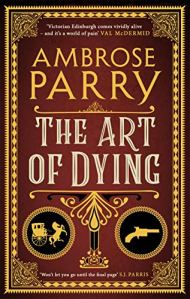
  9. The Art of Dying by Ambrose Parry 4*

I’ll be writing more about Clouds of Witness and The Art of Dying later this month, but for now here are my initial thoughts.

Clouds of witnessClouds of Witness by Dorothy L Sayers is the second Lord Peter Wimsey book. I really enjoyed this book. It has wit and humour as  as well as being a murder mystery. Lord Peter Wimsey’s brother, the Duke of Denver is accused of murder and refuses to explain or defend himself, so it’s down to Peter to get to the truth. The murder took place at the duke’s shooting lodge and Lord Peter’s sister was engaged to marry the dead man. One of the things I like about it is that it is clearly a book of its time with all the class distinctions and snobbery of the 1920s clearly on display.

Art of DyingThe Art of Dying by Ambrose Parry, anothoer book I really enjoyed is a new publication due out on 29 August this year.  It’s the sequel to Ambrose Parry’s debut novel, The Way of all Flesh. Ambrose Parry is a pseudonym for a collaboration between Chris Brookmyre and Marisa Haetzman. It’s historical fiction set in Edinburgh in 1850 as  patients are dying all across the city, with doctors finding their remedies powerless. Will Raven returns to Edinburgh as a doctor having been in Europe studying. Dr. James Simpson is being blamed for the death of a patient in suspicious circumstances, and Will and former housemaid Sarah Fisher are determined to clear his name.


Six Degrees of Separation: from Gaudy Night to The Cuckoo’s Calling

I love doing Six Degrees of Separation, a monthly link-up hosted by Kate at Books Are My Favourite and Best. Each month a book is chosen as a starting point and linked to six other books to form a chain. A book doesn’t need to be connected to all the other books on the list, only to the one next to it in the chain.

This month it’s a wild card – the chain begins with the book that ended our July chains, which means that my starting book is Gaudy Night by Dorothy L Sayers.

Gaudy Night

It’s set at Shrewsbury College at Oxford University. Harriet Vane attends the Shrewsbury Gaudy (a college reunion involving a celebratory dinner). It doesn’t go well – there are poison pen letters, nasty graffiti and vandalism causing mayhem and upset. It’s 1935 and explores the role of women in society, particularly with regard to education and marriage and the importance of truth and honesty. 

My first link is the word night’ in the title:

Endless Night by Agatha Christie. It differs from most of her other books in that it is a psychological study. It reminded me very much of Ruth Rendell’s books, writing as Barbara Vine. It has the same suffocating air of menace throughout the book, with more than one twist at the end. It’s a murder mystery, but there is little or no detection, and no investigators – no Poirot or Miss Marple – to highlight the clues to the murders, for there are several.

So, my second link is, The Brimstone Wedding, by Barbara Vine, also a book full of a menacing atmosphere. In it Stella, reveals her past as she talks to Jenny, one of the carers at the retirement home where she lives. It’s all very subtle at first with tantalising hints about what had really happened in Stella’s past. But the full horror is left to the end –  it’s not horrific in the overblown graphic sense, but in a sinister, psychological way that really is ‘chilling’ and inexpressibly sad.

And my third link takes me to another chilling book, The Craftsman by Sharon Bolton –  a remarkably powerful book, full of tension and fear. Assistant Commissioner Florence Lovelady attends the funeral of Larry Glassbrook, the convicted murderer she arrested thirty years earlier. The victims had been buried alive. But as she revisits the scenes of the burials she starts to think that maybe Larry wasn’t the murderer after all.

Moving away from chilling books about death and burials my mind jumped to a completely different book about death – The Graveyard Book by Neil Gaiman. This is the story of Bod, the baby who escapes a murderer. He stumbles into the local disused graveyard where he is rescued by ghosts. Silas, who is neither dead nor alive appoints himself as his guardian. It’s about life, love and friendship, loyalty and the fight between good and evil. Above all it is about growing up and the excitement and expectations that Bod has about life.

Another character called Silas is Silas Marner, written by George Eliot about a weaver who was wrongly accused of theft and left his home town to live a lonely and embittered life in Raveloe where he became a miser, hoarding his gold and counting it each night. George Eliot is the pen name of Mary Anne Evans.

Finally this leads me to my last link, The Cuckoo’s Calling by Robert Galbraith, J K Rowling’s pen name. It’s crime fiction, set in the world of Cormoran Strike , an ex-army private detective, who is struggling to get clients and pay his bills, sleeping on a camp bed in his office.

My links are via the word ‘night’, chilling books, death and burials, characters called Silas and authors using pen names (the links on titles are to my posts on the books). I have read and enjoyed all these books.

Next month (September 7, 2019), we’ll begin with A Gentleman in Moscow by Amor Towles – a book I haven’t read, or even heard of before.

My Friday Post: An April Shroud by Reginald Hill

Book Beginnings Button

Every Friday Book Beginnings on Friday is hosted by Gillion at Rose City Reader where you can share the first sentence (or so) of the book you are reading, along with your initial thoughts about the sentence, impressions of the book, or anything else the opener inspires.

An April Shroud by Reginald Hill is one of my 20 Books of Summer that I’ll be reading soon. It’s the 4th book in his Dalziel and Pascoe series.

April Shroud


No one knew how it came about that Dalziel was making a speech. Pascoe had with great reluctance let himself be persuaded into a church wedding, partly by the argument sentimental (Mum’s looking forward to it), partly by the argument economic (Dad’s paying for it), but mainly by the suspicion, hotly denied but well supported by circumstantial evidence, that Ellie herself wanted it.

Also every Friday there is The Friday 56, hosted by Freda at Freda’s Voice.

30879-friday2b56These are the rules:

  1. Grab a book, any book.
  2. Turn to page 56, or 56% on your eReader. If you have to improvise, that is okay.
  3. Find any sentence (or a few, just don’t spoil it) that grabs you.
  4. Post it.
  5. Add the URL to your post in the link on Freda’s most recent Friday 56 post.

Page 56:

‘So you’re not too worried about the boy?’

‘In the sense that he is too sensible to contribute willingly to his own harm, no. But as you say, the weather is appalling and, in addition, we live in troubled times, Mr Dalziel.’

Blurb:

Superintendent Dalziel falls for the recently bereaved Mrs Fielding’s ample charms, and has to be rescued from a litter of fresh corpses by Inspector Pascoe.

Superintendent Andy Dalziel’s holiday runs into trouble when he gets marooned by flood water. Rescued and taken to nearby Lake House, he discovers all is not well: the owner has just died tragically and the family fortunes are in decline. He also finds himself drawn to attractive widow, Bonnie Fielding.

But several more deaths are to follow. And by the time Pascoe gets involved, it looks like the normally hard-headed Dalziel might have compromised himself beyond redemption.

What do you think? Would you keep reading?

This is one of the early Dalziel and Pascoe novels, first published in 1975. Although it begins with Pascoe’s wedding, the main story is centred around Dalziel, my favourite character in these books. I like to have a few books lined up to read and as I’ve nearly finished The Adventures of Maud West, Lady Detective, I think I’ll start An April Shroud today.