Catching Up With My Reading

Once more I’ve been reading books and moving on without writing about them. Here are just two of the books I’ve read recently:

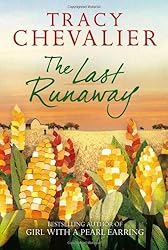
The Last Runaway by Tracy Chevalier – I really liked this book, historical fiction about the life of Honor Bright after she emigrated from Dorset to America in 1850 where she joined a Quaker community in Ohio. It intertwines her story with that of the ‘Underground Railroad’, helping the runaway slaves from the southern states to escape to Canada.

Honor is a quilter, but finds that American quilts are not the same as English ones, just as America is very different from England, both in landscape, temperature and culture. She struggles to fit in, finding it hard to adjust. I thought this was well handled and the sense of period and place is impressive, with a wealth of detail about the land and the struggles of the settlers. She can’t face the journey back across the Atlantic and marries Jack Haymaker, a young farmer whose mother and sister disapprove of her.

The slavery question caused Honor a real dilemma, as she became involved in the Underground Railroad, a network of safe houses and people willing to provide food and shelter for the runaways. Should she abide by the law, or follow her Quaker beliefs about equality, thus putting the rest of her family at risk as well as herself? This is compounded by her relationship with Belle Mills and her disreputable brother Donovan who has taken a liking to Honor, but is also a slave-catcher, ruthless in his pursuit.

I think it’s a very entertaining book, full of colourful characters, although some, like Jack are not as well developed as others. I liked the detail about quilting, even though I have never done any! But it was the account of life on the frontier and the Underground Railroad that made the book for me. Here are Honor’s thoughts about slavery:

She had begun with a clear principle born of a lifetime of sitting in silent expectation: that all people are equal in God’s eyes, and so should not be enslaved to one another. Any system of slavery must be abolished. It had seemed simple in England; yet in Ohio that principle was chipped away at, by economic arguments, by personal circumstances, by deep-seated prejudice that Honor sensed even in Quakers. …

When an abstract principle became entangled in in daily life, it lost its clarity and became compromised and weakened. (page 259)

I borrowed this book from the library.

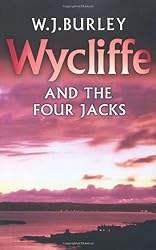
In complete contrast I moved on from The Last Runaway to Wycliffe and the Four Jacks by W J Burley, crime fiction set in Cornwall, featuring Chief Superintendent Wycliffe, who is on holiday but still gets drawn into a murder investigation.
Author David Cleeve, who writes under the pseudonym Peter Stride asks for Wycliffe’s advice about a series of sinister warnings he has received in the form of a playing card – the Jack of Diamonds. Then, a young woman is found dead, an apparently motiveless crime, but, as Wycliffe discovers, it follows a series of crimes, the clues all seeming to centre on an archaeological dig on Cleeve’s land. A further murder helps to pinpoint the culprit.

This is a quick read, with plenty of red herrings, but not too difficult to unravel. I liked it and I liked the personal touches that make Wycliffe a real person, a somewhat irritable man who likes his food, and gets on well with his wife. He is a thoughtful detective:

He was in a strange mood, suddenly everything had become unreal: the bare schoolroom with its peeling green walls, the battered tables, the scratched filing cabinets, his colleagues bending over their reports … He had known such experiences since childhood when, suddenly, everything seemed remarkable, nothing was ordinary any more. His mother would say: ‘Why aren’t you playing with your toys, Charles?’ Later, at school, it was ‘Day-dreaming again, Wycliffe!’ Now DS Lane was watching him and probably thinking, ‘Why dies he just sit there?’ (page 165)

It’s periods like this, however, that help Wycliffe focus his thoughts.

Wycliffe and the Four Jacks was first published in 1985. It’s the 12th in Burley’s series of 22 Wycliffe books.

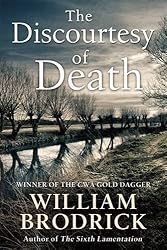
The Discourtesy of Death by William Brodrick

William Brodrick’s Father Anselm books never fail to meet my expectations. They are thought provoking and philosophical concerning moral dilemmas and on top of all that they’re crime fiction – an ideal combination for me. The Discourtesy of Death is the fifth Father Anselm novel and there is nothing simple or easy to solve in this book, be it the ethics or the crime, or whether Jennifer’s death was actually a crime at all.

Jennifer Henderson, a young woman, an acclaimed ballet dancer, was paralysed after a fall and later diagnosed with terminal cancer. She died and for two years her death was accepted as a peaceful death, a result of the cancer. But then an anonymous letter casts doubt on the matter – was her death assisted suicide, or murder?

Father Anselm, the lawyer-turned-monk, is asked by his Prior, who had received the letter, to investigate, even though there is no evidence of murder and on the face of it no suspects. So, this is by no means an ordinary investigation and Anselm has to work hard to get to the truth. Jennifer’s family and friends are the focus of his search and as he reviews the details of Jennifer’s last day he realises that any of them could have done something to her; but who, what and why?

The book explores the philosophical, moral and theological issues of the right-to-die, the questions about the nature of life and the choices available, whether mercy killing to stop another person’s suffering can ever be justified. Because of this the pace is slow, almost leisurely, even with the added drama of Jennifer’s father’s actions as part of the SAS in Northern Ireland, which continues to haunt him.

I was drawn into some of the red herrings, but in the end it was the question of what Anselm would decide to do with what he had discovered that exercised me. It left me wondering about the issues raised, which are thoroughly explored throughout the book with the implications of the various outcomes clearly stated.

One final thought about life and death comes from Anselm as he watched the fleeting appearances of the fish in the river, their flashes of bright silver disappearing so quickly before his eyes:

And, elevating his mind above carp and trout, Anselm thought that the glory of life – even brief and trimmed down to the point of seeming insignificance – remained utterly breathtaking. That death, with all its power, would always be the one who came afterwards, the latecomer who’d missed the party.

Whilst I don’t think The Discourtesy of Death is quite as good as the third Father Anselm book, A Whispered Name, which I thought was brilliant, it is still an excellent book, that I thoroughly enjoyed.

There are five Father Anselm novels, and I’ve read them out of order, so I’ve still got the fourth book, The Day of the Lie left to read.

  1. The Sixth Lamentation (2003)
  2. The Gardens of the Dead (2006)
  3. A Whispered Name (2008)
  4. The Day of the Lie (2012)
  5. The Discourtesy of Death (2013)
The Sixth LamentationThe Gardens of the DeadA Whispered NameThe Day of the Lie
The Discourtesy of Death
I

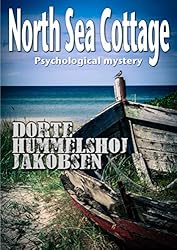
North Sea Cottage by Dorte Hummelshoj Jakobsen

Dorte Hummelshoj Jakobsen’s latest book, North Sea Cottage, is an e-book, a novella set in Denmark. It’s another dual time period book – it seems that each book I’ve read recently is one of these. This one is split between the present day and 1943/4 and it works very well.
I thoroughly enjoyed this book; the cottage in the title is owned by Tora’s aunt, Bergatora. As soon as I began reading I was immediately transported in place away to the other side of the North Sea to Denmark with Tora, and in time back to the Second World War, with her aunt, Bergatora. In just a few words Dorte Hummelshoj Jakobsen draws a vivid picture of the old fisherman’s cottage surrounded by dense sea fog.

Tora is struggling to overcome her own problems when she is faced with a new problem. The old stable next to the cottage catches fire during a thunder storm and in the aftermath of the fire Tora finds a skeleton in the potato cellar under the ruined stable. Who is it who had died in the cellar? Bergatora is reluctant to talk about the war years and her brother, Tora’s father, was too young at the time to help. It was a time when Denmark was under German occupation and a resistance movement was under way. Inspector Thomas Bilgren suspects the victim may have been related to the German occupation.

Tora, helped by Bilgren attempts to discover the truth, but is hampered by the strong character of her aunt and the silence surrounding what happened during the war. I loved this aspect of the book – the delving back into history, the way the narrative switches backwards and forwards, gradually revealing what had happened. North Sea Cottage is only about 90 pages but it has depth both in mystery and in characterisation and the setting is so atmospheric. I was fearful for Tora’s safety as she dug deeper into the mysteries from the past.

Thanks to Dorte Hummelshoj Jakobsen, who kindly sent me a copy of her book. She has a blog – Djskrimiblog and used to be a teacher. She writes both serious mysteries as well as humorous and cosy stories about the Gershwin family in Knavesborough, a fictional village in Yorkshire, publishing in Danish and English. I like her humorous stories but prefer the serious ones like North Sea Cottage and her previous novel, Anna Märklin’s Family Chronicles. She is currently at work on her next novel – Crystal Nights, to be published in 2014/5.

Books Read in May

I can’t quite believe it but despite spending many hours in the garden in May mowing the grass and weeding (there are still too many weeds!) I managed to read ten books, bringing my total for the year so far to 45. They’re a bit of a mixed bag of excellent and not very good, with some good ones in between!

They are, in the order I read them, with links to my reviews (* marks crime fiction novels):

  1. The Big Four* by Agatha Christie – a bit of a let down, not up to her best!
  2. The Lost Army of Cambyses by Paul Sussman – goodish
  3. The Dance of Love by Angela Young – her second book due out at the end of July. I loved it!
  4. The Wicked Day by Mary Stewart – good
  5. The Graveyard Book by Neil Gaiman – very good
  6. Nemesis* by Agatha Christie – disappointing
  7. The Witch’s Brat by Rosemary Sutcliff – good
  8. No Stranger to Death*by Janet O’Kane – very good, her first book
  9. The Little Coffee Shop of Kabul by Deborah Rodriguez -not very good and I don’t intend to write about it
  10. A Whispered Name* by William Broderick – excellent – see my thoughts below.

I’m not taking The Dance of Love into account in considering which book is my favourite book of the month because I’m saving my review for July when the book is published – but I can say now that it is brilliant!

The Graveyard Book and No Stranger to Death are both really good books and as I was reading each one I thought either could be my favourite book for May but then I read A Whispered Name and that decided it – it is my favourite book of the month and also my Crime Fiction Pick of the Month (hosted by Kerrie at Mysteries in Paradise)!


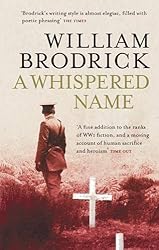
A Whispered Name by William Brodrick is the third Father Anselm novel, which won the Crime Writers’ Association Gold Dagger Award in 2009.

I think this is a most remarkable book and it kept me glued to the pages as I read about the First World War and the effects it had on those who took part, those left at home and on future generations. It is, of course, historical fiction.

From the back cover:

During the slaughter of Passchendaele in 1917, an Irish soldier faced a court martial for desertion. On the panel was a young captain, Herbert Moore, charged with a responsibility that would change him for ever.

After the war Herbert became a monk, one of the founders of Larkwood monastery, where Father Anselm came across two visitors, Kate Seymour and an unnamed old man, searching for Father Herbert. But he had died in 1985 and no one could answer their questions about the trial of a deserter, Joseph Flanagan and Father Herbert’s part in it. Father Herbert was revered and loved by all who knew him and Anselm was deeply dismayed at the thought that there was anything in his past that he had lied about and he set out to discover the truth.

I think the whole book is so well thought out with chapters revealing what happened from different characters’ viewpoints during the war and what Anselm discovered as he went through the records and talked to people. Nothing is straight forward, the records are ambiguous and there is confusion about identities. The horror of the war is there:

After the wallop, Herbert found himself prostrate with his face against the dirt, vaguely aware that time had passed, that water was creeping on him; that he would have to move or he’d drown.

… Herbert slid through a sludge of intestines and grit, hauling himself into the open. Staring across the beaten land he tried to gain his bearings … he couldn’t see anyone else from the regiment. (page 35)

And Herbert did indeed serve on a court martial that condemned Joseph Flanagan to death. But there is not just the horror of war in this book, it’s an intricate, evocative novel focussing on the themes of morality, justice, sacrifice and human redemption. It is a book above all that identifies the place of the individual within history, written so lyrically putting the past under a searching spotlight. One of the best books I’ve read for quite some time.

A Whispered Name is a thoroughly researched book with a list of sources at the end of the book, but it never reads like a dry factual account – it comes so vividly to life. Although based on fact, gathered from memoirs, reports, published research, Battalion War diaries and the original transcripts of trials, William Brodrick explains in his Author’s Note:

This novel is not about FGCMs [Field General Court Martial] in general. It does not imply a comprehensive critique of First World War executions from any perspective, be that historical, legal or moral. Rather, one might say, it is a parable of how a man found meaning in death, and how another – on seeing that – found faith in life. And it is about a fictional trial that cannot be compared with any genuine case. (p 344) (my emphasis)

William Brodrick became a barrister, having been an Augustinian monk for six years (the other way round from his fictional character, Father Anselm). After 10 years at the Bar, his interest in writing led him to writing the Father Anselm books.

The Father Anselm books are:

  1. The Sixth Lamentation (2003)
  2. The Gardens of the Dead (2006)
  3. A Whispered Name (2008)
  4. The Day of the Lie (2012)
  5. The Discourtesy of Death (2013)

I’ve now read the first three books and think A Whispered Name is probably the best. I have yet to read the next two – I hope to do so soon.

No Stranger to Death by Janet O'Kane

No Stranger to DeathMy thanks to Janet O’Kane for sending me a copy of her book,  No Stranger to Death, which I really enjoyed reading.  Once I’d started it I just wanted to keep on reading. I was surprised by how intricate and complex the plot is, with several sub-plots and a crowd of characters, all of whom are clearly defined. Set in the Scottish Borders, it also has a strong sense of location and it was refreshing to read a Scottish crime novel that is not set in Edinburgh, Glasgow or even in Shetland. It’s a fast-paced novel that kept me on the edge wanting to find out more.

No Stranger to Death begins with recently widowed Dr Zoe Moreland’s discovery of a body in the remains of a Guy Fawkes bonfire. Westerlea, a fictional village, is a place where everybody knows everyone, but even so it seems everyone has something to hide.  Zoe is new to the village, having moved from there from England to join the Health Centre as a GP and with the help of her new friend, Kate Mackenzie, she soon finds herself in the middle of a murder investigation. This is not a police procedural, although Detective Erskine Mather of Police Scotland is in charge of the investigation.

It’s not only the villagers who have secrets, as there is something in Zoe’s background that she wants to keep to herself and getting involved in a murder investigation is the last thing she wanted:

She had gone back to using her maiden name when she came to Scotland, but would that protect her against people whose job it was to dig up the past of anyone remotely connected with a sensational crime? (page 29)

As Zoe and Kate dig deeper quite a few nasty secrets come to light with almost disastrous consequences and Zoe is in fear of her own life. No Stranger to Death touches on some quite dark themes with an ending that took me by surprise.

Janet O’Kane lives in the Scottish Borders and she is currently writing a follow up to No Stranger to Death, again featuring Zoe Moreland. For more information see her blog – Janet O’Kane: Crime Fiction with a Heart and her Facebook page.

As well as being a really good book in its own right, No Stranger to Death meets the criteria for both the Read Scotland 2014 challenge and the My Kind of Mystery challenge.

Nemesis by Agatha Christie

Nemesis first published in 1971, is one of Agatha Christie’s later books written in her eighties. It is the last book she wrote about Miss Marple. There are two more books that were published later, but those were written earlier. It’s not among the best of her books, it’s slow moving, lots of dialogue, lots of recapping of events and clues, lots of moralising and social commentary. It follows on, although it is not a sequel to, A Caribbean Mystery in which Miss Marple met Mr Rafiel.

It’s slow moving because for quite a while Miss Marple doesn’t know what the crime is that she has been asked to investigate. Mr Rafiel, who she met in the West Indies, has left her £20,000 in his will on condition she investigates a certain crime, but doesn’t give her any details. He wrote that she had a natural flair for justice leading to a natural flair for crime and reminded her that the code word is Nemesis. Then she is invited to join a tour of Famous Houses and Gardens of Great Britain at Mr Rafiel’s expense. And off she goes.

As Miss Marple remarks:

Murders as reported in the press have never claimed my attention. I have never read books on criminology as a subject or really been interested in such a thing. No, it has just happened that I have found myself in the vicinity of murder rather more often than would seem normal. (page 90)

What an understatement!

Miss Marple has to first of all work out who she can trust.Very gradually through meeting people and talking to them in her usual rather scatty old-lady manner Miss Marple begins to uncover a crime committed years earlier, working largely on intuition. During this process Miss Marple ponders on a number of subjects from wondering how the three witches in Macbeth should be portrayed, during the visit Mr Rafiel had arranged for her with the three sisters at the Old Manor House, to her disapproval of the clothes young women wore. I suspect this was Agatha Christie using Miss Marple as a mouthpiece for her own views – just as this view of rape expressed by  another character, Professor Wanstead, a friend of Mr Rafiel may be her own thoughts too:

Girls you must remember, are far more ready to be raped nowadays than they used to be. Their mothers insist, very often, that they should call it rape. (page 182)

But I wondered about the whole premise of the book – would someone really ask a person to investigate a crime and not give them any details?  It seems highly improbable to me even if Mr Rafiel had wanted Miss Marple to approach the crime with an open mind. And surely if Mr Rafiel really wanted to discover the true facts about the crime he could easily have done so before he died.

I think Nemesis lacks tension and suspense. The characters are rather hard to differentiate, mainly because there are too many, and too many who have no part in the mystery. There are few red herrings to deflect the reader, just unexplained facts that Miss Marple clears up in the last chapters. But I think it is an unusual book and I quite enjoyed it.