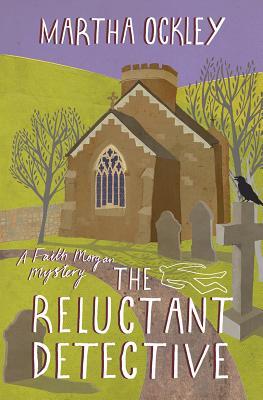
The Reluctant Detective by Martha Ockley

17742272I had little idea what to expect from Martha Ockley’s first Faith Morgan mysteryThe Reluctant Detective as I hadn’t come across the author before and all I had to go on was the description on LibraryThing’s Early Reviewers page last month:

‘Former cop Faith Morgan may have quit the world of crime, but crime has not let her go. Now a priest in the Church of England, she is assigned to the improbably named village of Little Worthy, and within an hour of her arrival she witnesses the sudden, shocking death of a fellow priest. To her distress, the detective assigned to the case is Ben, her former partner and former boyfriend.

As she meets her parishioners she learns some surprising details about her apparently well-loved predecessor, and starts to suspect a motive for his death. The cop may have donned a clerical collar, but the questions keep coming. How will she reconcile her present calling with her past instincts? Is she in danger herself? What should she do about Ben?’

I thought a detective who  was a priest and who used to be a policewoman sounded interesting. So, I am very pleased that The Reluctant Detective turned out to be a good read. Faith Morgan is a well-rounded character; she’s very likeable, observant, compassionate and the sort of person that people feel comfortable talking to – a bit like a young Miss Marple. Indeed, the book has an Agatha Christie feel to it – set in an apparently idyllic country village, with interesting and somewhat quirky characters and although there is one rather gruesome death, it’s not a gory thriller. In short it’s the type of murder mystery that I like, with plenty of complications that kept me guessing about the identity of the murderer for most of the book.

The church and village location are convincing. The parish church of St John is an old building dating from Saxon times, with a tower and church bells, set in the English countryside:

Faith avoided the main approach and followed a gravel path around the back of the church. A creamy cloud of ivory clematis cascaded over a grey stone wall. Beyond a solitary pony raised its chestnut head to gaze mournfully at her from a field of weeds. Some way off squatted a group of ramshackle farm buildings. (page 9)

Faith’s ex – Detective Inspector Ben Shorter, reluctantly allows Faith to contribute to the search for the murderer and the chemistry between the two of them is clearly evident even though he can’t understand why she left the police force for the church. Indeed, Faith herself wonders if she has done the right thing, cutting herself off from her old life and her old self as she realises that she likes investigating, and analyzing people, their expressions and body language and working out what makes them tick. But these are assets for a priest as well as for a police officer. And as for death:

It struck Faith how death is always startling, facing us with the greatest mystery: how the particular and the individual can vanish from this world so completely in a moment. (page 17)

The back cover reveals that Martha Ockley lives in the North East of England and has close links with the church, having grown up as the daughter of a minister. She is a full-time writer of both fiction and non-fiction. I was curious about Martha Ockley and wondered why she had given ‘special thanks to Rebecca Jenkins’ on the title page, so I searched online and discovered that ‘Martha Ockley’ is actually a pseudonym of Rebecca Jenkins, the daughter of the Rev David Jenkins, formerly the Bishop of Durham.

Thanks to LibraryThing and Lion Fiction/Kregel Publications for providing a copy for review. Based on my reading of The Reluctant Detective I shall certainly seek out more books by Martha Ockley/Rebecca Jenkins. There are two more Faith Morgan books:

  • The Advent of Murder
  • A Saintly Killing (to be published in October 2014)

And writing as Rebecca Jenkins:

The R F Jarrett books (the Regency Detective)

  • The Duke’s Agent (1997)
  • Death of a Radical (2010)

also Non Fiction:

  • Free to Believe (David Jenkins and Rebecca Jenkins (1991)
  • Fanny Kemble: a reluctant celebrity (2005)
  • The First London Olympics 1908 (2008)
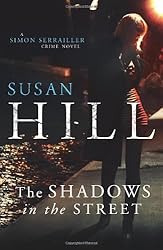
The Shadows in the Street by Susan Hill

The Shadows in the Streets is Susan Hill’s fifth Simon Serrailler crime novel. I’ve read the earlier books which I enjoyed, although I found the fourth book, The Vows of Silence rather a gloomy book not just because of the murders but also because of the unhappy state of Simon and his family. So, I decided to wait a while before moving on to the fifth book. And I am now way behind in reading the series, which will reach book 8 in October!

Susan Hill’s Serrailler novels, whilst being crime fiction, concern moral and social issues. They also follow the lives of the Serrailler family, the main characters being Simon and his sister, Dr Cat Deerbon, which is why I think it’s best to read them in order. I noticed that in this book there are references to events and characters in the earlier books and I had to look back to refresh my memory. Without knowing what happened before those incidents would not have made much sense. The books are character-driven, concentrating on the people involved in the crime rather than the police investigations, although that of course is also part of the story.

There are two major themes in this book. One concerns the murders of local prostitutes, found strangled and Susan Hill draws a sympathetic, but never a condescending or judgemental view of these women’s lives, resulting in a moving storyline of a young woman, Abi who is a single mother. Alongside this is the problem of mental illness, with Ruth Webber, who suffers from manic depression. She is the wife of the new Dean of the Cathedral and arrives full of plans to change things, which causes problems. When she too goes missing there are fears she may become one of the murder victims.

I think of these novels more as psychological studies than crime fiction – the characters and their lives predominate, whilst the police make slow progress in finding the murderer (much like real life, maybe). Anyway it’s the characters and their problems that interested me more in this book than the police procedures.

The Shadows in the Street is a complex book, but it is immensely readable and once the mystery really got under way it’s tense and full of suspense. I really enjoyed it.

Read Scotland 2014 Challenge: two books

I’ve got a bit behind with writing reviews, so here are some notes on two books I’ve recently read, both of which fit into the Read Scotland 2014 Challenge.

It’s common knowledge now that Robert Galbraith is J K Rowling’s pseudonym. I wish I’d read The Cuckoo’s Calling without knowing that, as although I have no problem with authors writing under pseudonyms, I found myself thinking how like the Harry Potter books it is in some ways and I doubt I’d have thought that if I’d read it ‘blind’.

Anyway, I liked The Cuckoo’s Calling. It is crime fiction, set in the world of Cormoran Strike (a Harry Potterish name, I thought), an ex-army private detective, who is struggling to get clients and pay his bills, sleeping on a camp bed in his office. Along comes Robin Ellacott, from the Temporary Solutions Agency to help out (think, Hermione Granger). She’s intelligent, efficient, remarkably resourceful, and she soon has Strike organised, which is essential as he is asked by John Bristow, a lawyer and the brother of a childhood friend to investigate the death of his sister, Lula Landry. The police are satisfied that Lula, a model, had committed suicide, but Bristow is certain that she didn’t.
What follows is at times a leisurely narrative and the plot is quite complex, but not too difficult to work out. The characters are convincing, Robin in particular soon became my favourite. She has an enquiring mind, ‘fascinated by the interior workings of other people’s minds‘ and despite her fiancé’s opposition to her job, she carries on, motivated by her fascination with investigating, and her secret ambition to be a private detective. In fact without Robin, Strike would have really struggled to get to the truth.

I’ve counted this book towards the Read Scotland 2014 Challenge because J K Rowling, although she was born in England has lived in Scotland for twenty-one years and plans to spend the rest of her life in Scotland. Whereas the author of the next book, Muriel Spark is an author who was born and grew up in Edinburgh, but who later lived in London. To qualify for this challenge books have to be by Scottish authors, either by birth or immigration, or about or set in Scotland – quite a wide brief!

brodie001The Prime of Miss Jean Brodie is perhaps Muriel Spark’s most famous novel. I’ve read it before and seen the film, with Maggie Smith in the title role. Each time I’ve read it I’ve really enjoyed it – it’s one of those books that isn’t spoilt by knowing what happens, because part of the pleasure of reading it is the fact that I do know who betrayed Miss Brodie. Despite her declaration: ‘Give me a girl at an impressionable age and she will be mine for life‘, it is one of the ‘Brodie set’ who causes her downfall, that and her pride and self-absorption.

But what really impresses me about this book is the writing, so compact, so perceptive and so in control of the shifts in time backwards and forwards. It’s a joy to read. I’ve written more about it in this post.

Catching Up With My Reading

Once more I’ve been reading books and moving on without writing about them. Here are just two of the books I’ve read recently:

The Last Runaway by Tracy Chevalier – I really liked this book, historical fiction about the life of Honor Bright after she emigrated from Dorset to America in 1850 where she joined a Quaker community in Ohio. It intertwines her story with that of the ‘Underground Railroad’, helping the runaway slaves from the southern states to escape to Canada.

Honor is a quilter, but finds that American quilts are not the same as English ones, just as America is very different from England, both in landscape, temperature and culture. She struggles to fit in, finding it hard to adjust. I thought this was well handled and the sense of period and place is impressive, with a wealth of detail about the land and the struggles of the settlers. She can’t face the journey back across the Atlantic and marries Jack Haymaker, a young farmer whose mother and sister disapprove of her.

The slavery question caused Honor a real dilemma, as she became involved in the Underground Railroad, a network of safe houses and people willing to provide food and shelter for the runaways. Should she abide by the law, or follow her Quaker beliefs about equality, thus putting the rest of her family at risk as well as herself? This is compounded by her relationship with Belle Mills and her disreputable brother Donovan who has taken a liking to Honor, but is also a slave-catcher, ruthless in his pursuit.

I think it’s a very entertaining book, full of colourful characters, although some, like Jack are not as well developed as others. I liked the detail about quilting, even though I have never done any! But it was the account of life on the frontier and the Underground Railroad that made the book for me. Here are Honor’s thoughts about slavery:

She had begun with a clear principle born of a lifetime of sitting in silent expectation: that all people are equal in God’s eyes, and so should not be enslaved to one another. Any system of slavery must be abolished. It had seemed simple in England; yet in Ohio that principle was chipped away at, by economic arguments, by personal circumstances, by deep-seated prejudice that Honor sensed even in Quakers. …

When an abstract principle became entangled in in daily life, it lost its clarity and became compromised and weakened. (page 259)

I borrowed this book from the library.

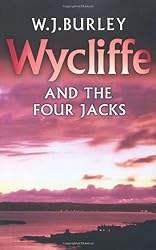
In complete contrast I moved on from The Last Runaway to Wycliffe and the Four Jacks by W J Burley, crime fiction set in Cornwall, featuring Chief Superintendent Wycliffe, who is on holiday but still gets drawn into a murder investigation.
Author David Cleeve, who writes under the pseudonym Peter Stride asks for Wycliffe’s advice about a series of sinister warnings he has received in the form of a playing card – the Jack of Diamonds. Then, a young woman is found dead, an apparently motiveless crime, but, as Wycliffe discovers, it follows a series of crimes, the clues all seeming to centre on an archaeological dig on Cleeve’s land. A further murder helps to pinpoint the culprit.

This is a quick read, with plenty of red herrings, but not too difficult to unravel. I liked it and I liked the personal touches that make Wycliffe a real person, a somewhat irritable man who likes his food, and gets on well with his wife. He is a thoughtful detective:

He was in a strange mood, suddenly everything had become unreal: the bare schoolroom with its peeling green walls, the battered tables, the scratched filing cabinets, his colleagues bending over their reports … He had known such experiences since childhood when, suddenly, everything seemed remarkable, nothing was ordinary any more. His mother would say: ‘Why aren’t you playing with your toys, Charles?’ Later, at school, it was ‘Day-dreaming again, Wycliffe!’ Now DS Lane was watching him and probably thinking, ‘Why dies he just sit there?’ (page 165)

It’s periods like this, however, that help Wycliffe focus his thoughts.

Wycliffe and the Four Jacks was first published in 1985. It’s the 12th in Burley’s series of 22 Wycliffe books.

The Discourtesy of Death by William Brodrick

William Brodrick’s Father Anselm books never fail to meet my expectations. They are thought provoking and philosophical concerning moral dilemmas and on top of all that they’re crime fiction – an ideal combination for me. The Discourtesy of Death is the fifth Father Anselm novel and there is nothing simple or easy to solve in this book, be it the ethics or the crime, or whether Jennifer’s death was actually a crime at all.

Jennifer Henderson, a young woman, an acclaimed ballet dancer, was paralysed after a fall and later diagnosed with terminal cancer. She died and for two years her death was accepted as a peaceful death, a result of the cancer. But then an anonymous letter casts doubt on the matter – was her death assisted suicide, or murder?

Father Anselm, the lawyer-turned-monk, is asked by his Prior, who had received the letter, to investigate, even though there is no evidence of murder and on the face of it no suspects. So, this is by no means an ordinary investigation and Anselm has to work hard to get to the truth. Jennifer’s family and friends are the focus of his search and as he reviews the details of Jennifer’s last day he realises that any of them could have done something to her; but who, what and why?

The book explores the philosophical, moral and theological issues of the right-to-die, the questions about the nature of life and the choices available, whether mercy killing to stop another person’s suffering can ever be justified. Because of this the pace is slow, almost leisurely, even with the added drama of Jennifer’s father’s actions as part of the SAS in Northern Ireland, which continues to haunt him.

I was drawn into some of the red herrings, but in the end it was the question of what Anselm would decide to do with what he had discovered that exercised me. It left me wondering about the issues raised, which are thoroughly explored throughout the book with the implications of the various outcomes clearly stated.

One final thought about life and death comes from Anselm as he watched the fleeting appearances of the fish in the river, their flashes of bright silver disappearing so quickly before his eyes:

And, elevating his mind above carp and trout, Anselm thought that the glory of life – even brief and trimmed down to the point of seeming insignificance – remained utterly breathtaking. That death, with all its power, would always be the one who came afterwards, the latecomer who’d missed the party.

Whilst I don’t think The Discourtesy of Death is quite as good as the third Father Anselm book, A Whispered Name, which I thought was brilliant, it is still an excellent book, that I thoroughly enjoyed.

There are five Father Anselm novels, and I’ve read them out of order, so I’ve still got the fourth book, The Day of the Lie left to read.

  1. The Sixth Lamentation (2003)
  2. The Gardens of the Dead (2006)
  3. A Whispered Name (2008)
  4. The Day of the Lie (2012)
  5. The Discourtesy of Death (2013)
The Sixth LamentationThe Gardens of the DeadA Whispered NameThe Day of the Lie
The Discourtesy of Death
I

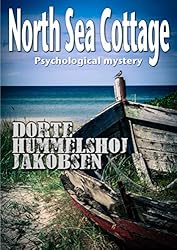
North Sea Cottage by Dorte Hummelshoj Jakobsen

Dorte Hummelshoj Jakobsen’s latest book, North Sea Cottage, is an e-book, a novella set in Denmark. It’s another dual time period book – it seems that each book I’ve read recently is one of these. This one is split between the present day and 1943/4 and it works very well.

I thoroughly enjoyed this book; the cottage in the title is owned by Tora’s aunt, Bergatora. As soon as I began reading I was immediately transported in place away to the other side of the North Sea to Denmark with Tora, and in time back to the Second World War, with her aunt, Bergatora. In just a few words Dorte Hummelshoj Jakobsen draws a vivid picture of the old fisherman’s cottage surrounded by dense sea fog.

Tora is struggling to overcome her own problems when she is faced with a new problem. The old stable next to the cottage catches fire during a thunder storm and in the aftermath of the fire Tora finds a skeleton in the potato cellar under the ruined stable. Who is it who had died in the cellar? Bergatora is reluctant to talk about the war years and her brother, Tora’s father, was too young at the time to help. It was a time when Denmark was under German occupation and a resistance movement was under way. Inspector Thomas Bilgren suspects the victim may have been related to the German occupation.

Tora, helped by Bilgren attempts to discover the truth, but is hampered by the strong character of her aunt and the silence surrounding what happened during the war. I loved this aspect of the book – the delving back into history, the way the narrative switches backwards and forwards, gradually revealing what had happened. North Sea Cottage is only about 90 pages but it has depth both in mystery and in characterisation and the setting is so atmospheric. I was fearful for Tora’s safety as she dug deeper into the mysteries from the past.

Thanks to Dorte Hummelshoj Jakobsen, who kindly sent me a copy of her book. She has a blog – Djskrimiblog and used to be a teacher. She writes both serious mysteries as well as humorous and cosy stories about the Gershwin family in Knavesborough, a fictional village in Yorkshire, publishing in Danish and English. I like her humorous stories but prefer the serious ones like North Sea Cottage and her previous novel, Anna Märklin’s Family Chronicles. She is currently at work on her next novel – Crystal Nights, to be published in 2014/5.