Vintage Crime Fiction

I’ve been thinking about joining Bev’s Vintage Mystery Cover Scavenger Hunt, but I didn’t think I had enough books in the Vintage Mystery genre to attempt it.

BUT, the Scavenger Hunt idea appeals to me and so I thought I would have a look at my own books, just to see exactly how many books I do have that match Bev’s definition of ‘Vintage Mystery’, which is:

* All books must be from the mystery category (crime fiction, detective fiction, espionage, etc.). The mystery/crime must be the primary feature of the book–ghost stories, paranormal, romance, humor, etc are all welcome as ingredients, but must not be the primary category under which these books would be labeled at the library or bookstore. 

*For the purposes of this challenge, the Golden Age Vintage Mysteries must have been first published before 1960. Golden Age short story collections (whether published pre-1960 or not) are permissible provided all of the stories included in the collection were originally written pre-1960.  Silver Age Vintage Mysteries may be first published any time from 1960 to 1989 (inclusive).  Again, Silver Age short story collections published later than 1989 are permissible as long as they include no stories first published later than 1989. 

And to my surprise, when I went to my shelves – instead of looking at my list in LibraryThing – I found I actually have 14 books first published pre-1960 and 7 first published between 1960 and 1989 (inclusive). My LibraryThing catalogue is certainly not complete!

So, in theory I do have enough books to attempt the Scavenger Hunt for both eras, provided that the covers show the objects listed for the Hunt! And as I do want to read all these books, it’s a no-brainer, so I’m going to do it. And I’m going in for both Eras!

The idea is  to find as many objects on the scavenger hunt list as possible on the covers of the mystery books you read. The minimum number of items to complete the challenge is six items from the covers of books read from a single Vintage Mystery Era.

These are my books in the Golden Age Vintage era. Some are Penguin books with no pictures on the covers and so I’ll look for alternative covers.

Vintage gold

And these are my books from the Silver Age Vintage era.

Vintage silver

The Challenge runs from January 1, 2016 to December 31, 2016. Sign up any time between now and November 1, 2016.  Any books read from January 1 on may count regardless of your sign-up date.

And “On the cover” may apply to either the front or the back cover of the book. For example, if you need a map or a chart for your scavenger hunt list, then Dell Mapbacks are perfect–with the map in question on the back cover. Also, the item should be found on the cover of the edition that you read. If at all possible either post a picture showing the item on the cover or provide a link to a page showing us. Exception:  If the edition you read has no picture whatsoever (hardbacks that have no dust jacket or e-copies, for example), then you may go on another scavenger hunt online to find a cover image–again, please provide a link to the edition used.

This is the list for the Golden Age Era there are 75 items!!! (The Silver Age Era lists the same items.)Scavenger Hunt1

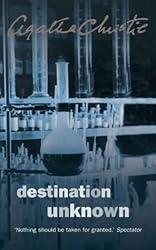
Destination Unknown by Agatha Christie

I had no great expectations when I began reading Agatha Christie’s Destination Unknown (first published in 1954) because I’ve not been keen on her stand-alone international intrigue/spy mysteries. But I thought it started very well and I was soon drawn into the story.
It’s the early 1950s and a number of scientists have disappeared, amongst them is Thomas Betterton, a brilliant nuclear scientist, who had discovered ZE Fission. The British Secret Service suspect that he and the other missing scientists have gone beyond the Iron Curtain, either kidnapped, or tempted by money or by the dream of an ideal world, working for the good of humanity. His wife, Olive, has no idea where he is, but sets off for Morocco, ostensibly on medical advice for a complete rest. However, the plane crashes and she is killed before she gets to her destination.

Hilary Craven, whose abundant red hair is similar to Olive’s, is intent on taking her own life, but she is recruited by Jessop, a British Secret Service Agent who persuades her that if she wants to kill herself she could help her country at the same time by impersonating Olive and thus trace Betterton. In doing so it leads her to a secret scientific complex hidden in the High Atlas mountains and a terrifying discovery.

It went over the top with a string of disasters, involving a faked air disaster, radio-active pearls, a leper colony, and secret laboratories all part of a vast organisation masterminded by a wealthy and powerful fanatic. And added to the international intrigue there is also a murder which is only revealed right at the end of the book. If the plot is bizarre and rather weak, and some of the characters are stereotypes, Hilary’s character is more convincing. And as in her other spy thrillers, Agatha Christie uses it as a vehicle for her own concerns about the state of the post-war world, decrying what she saw as the attempt to impose a world order and discipline, where individuality is suppressed. Hilary thinks she:

would rather have a world of kindly, faulty human beings, than a world of superior robots who’ve said goodbye to pity and understanding and sympathy. (page 102)

It’s a dangerous world where

Once you have got into that state of mind where the taking of human lives no longer counts, then if it is simpler to put a little explosive package under a seat in a plane than to wait about at the corner on a dark night and stick a knife in someone, then the package will be left and the fact that six other people will die also is not even considered. (pages 143-144)

Just as true today as in the 1950s!

I am nearing the end of reading Agatha Christie’s full length novels and now have just 2 left to read. Although Destination Unknown is not one of my favourites I did enjoy reading it – it moves quickly and kept me interested in its twists and turns. There’s a lot going on and it’s not easy to know who is telling the truth and who to trust.

****

Added on 15th January 2016:

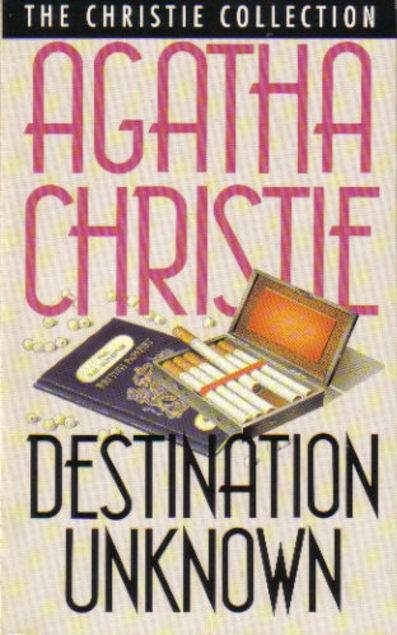
The edition of Destination Unknown that I read has this cover, fulfilling the cigarette/pipe category on the Golden Age Vintage Mystery Hunt card, as well as the Mount TBR Reading Challenge:

Imperium by Robert Harris

With not many days left until Christmas and the New Year I’ve just about got time to write a bit about two books I’ve read this month from my to-be-read books. I’ll be writing about the second book in a later post.

The first one is Imperium by Robert Harris, the first in his Cicero Trilogy.

I love historical fiction and over the years I’ve read quite a lot of it, including novels set in Ancient Rome, so I’m familiar with the characters in this book, but not about all the details that Robert Harris has packed into Imperium.

Beginning in 79 BC, this book set in the Republican era is a fictional biography of Marcus Tullius Cicero by Tiro, his slave secretary. Tiro was a real person who did write a biography of Cicero, which has since been lost in the collapse of the Roman Empire. Tiro is credited with the invention of shorthand. Harris has based Imperium on, among other sources, Cicero’s letters, which Tiro had recorded, successfully interweaving Cicero’s own words with his own imagination.  It is basically a political history, a story filled with intrigue, scheming and treachery in the search for political power as Cicero, a senator, works his way to power as one of Rome’s two consuls.

The first part of the book (and I think the best part) covers the trial of Verres, a corrupt governor of Sicily. I found this gripping as it was by no means obvious that Verres would be found guilty. Cicero builds the case against him and the resulting trial is a dramatic showdown.

After that the book dragged just a little bit for me as it moved on to describing a complicated struggle to change Rome’s government from a Republic to having an Emperor as absolute ruler. But it picked up again towards the end and overall I thought this was a very good book and I’m keen to read the second in the trilogy, Lustrum.

In such a short post as this is I cannot go into much detail – and the novel is very detailed. I marked many passages that struck me as interesting and felt much of the struggle for power applies as much today as it did in Ancient Rome. I’ll finish this post with one quotation (there are plenty of others I could have chosen):

You can always spot a fool, for he is the man who will tell you he knows who is going to win an election. But an election is a living thing – you might almost say, the most vigorously alive thing there is – with thousands upon thousands of brains and limbs and eyes and thoughts and desires, and it will wriggle and turn and run off in directions no one ever predicted, sometimes just for the joy of proving the wiseacres wrong. (page 471)

Stacking the Shelves: 19 December 2015

STSmall

Stacking The Shelves is all about sharing the books you are adding to your shelves. This means you can include ‘˜real’ and ‘˜virtual’ books (ie physical and ebooks) you’ve bought, books you’ve borrowed from friends or the library, review books, and gifts.

I’ve added just one book to my Kindle this week:

The Big Book of Christmas Mysteries: The Most Complete Collection of Yuletide Whodunits Ever Assembled

Blurb

Here, for your yuletide reading pleasure, are the collected crimes of Christmases Past and Present: sixty classic Christmas crime stories gathered together in the largest anthology of its kind ever assembled. And its an all-star line-up: Sherlock Holmes, Brother Cadfael, Miss Marple, Hercule Poirot, Ellery Queen, Rumpole of the Bailey, Inspector Morse, Inspector Ghote, A.J. Raffles, Nero Wolfe and many, many more of the world’s favourite detectives and crime fighters face unscrupulous Santas, festive felonies, deadly puddings, and misdemeanors under the mistletoe. Almost any kind of mystery you’re in the mood for – suspense, pure detection, humour, cozy, private eye, or police procedural – can be found within these pages.

Includes stories from (many of which are difficult or nearly impossible to find anywhere else): Arthur Conan Doyle, Robert Louis Stevenson, Thomas Hardy, Isaac Asimov, Sara Paretsky, Ed McBain, Agatha Christie, Ellis Peters, Mary Higgins Clark, H.F Keating, Donald E. Westlake and John Mortimer and more.

I couldn’t resist getting it! Some of the authors are familiar to me, some I’ve heard of and some are completely new-to-me. I hope to read some before Christmas.

I’ve also borrowed two from the library this week, which I’ll probably leave until after New Year. They are:

Blurb

A promise made to a dying man leads forensics ace Enzo Macleod, a Scot who’s been teaching in France for many years, to the study which the man’s heir has preserved for nearly twenty years. The dead man left several clues there designed to reveal the killer’s identity to the man’s son, but ironically the son died soon after the father.

So begins the fourth of seven cold cases written up in a bestselling book by Parisian journalist Roger Raffin that Enzo rashly boasted he could solve (he’s been successful with the first three). It takes Enzo to a tiny island off the coast of Brittany in France, where he must confront the hostility of locals who have no desire to see the infamous murder back in the headlines. An attractive widow, a man charged but acquitted of the murder–but still the viable suspect, a crime scene frozen in time, a dangerous hell hole by the cliffs, and a collection of impenetrable messages, make this one of Enzo’s most difficult cases.

I’ve enjoyed Peter May’s Lewis Trilogy. I hope this works well as a stand alone book as it’s the fourth Enzo Macleod book and I haven’t read the first three.

And

Blurb

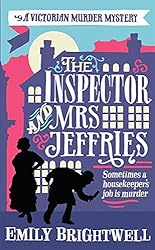
This charming series of Victorian murder mysteries features mild-mannered Inspector Witherspoon of Scotland Yard and, more importantly, Mrs Jeffries, his housekeeper. A policeman’s widow herself, her quick wits allow her to nudge the Inspector in the right direction to solve the crime.

When a doctor is discovered dead in his own office, Mrs Jeffries is on the look-out for a prescription for murder, determined to discover the culprit, despite how her employer feels about interviewing suspects . . . “He hated questioning people. He could never tell whether or not someone was actually lying to him, and he knew, shocking as it was, that there were some people who lied to the police on a regular basis.”

Emily Brightwell is a new-to-me author. I thought I’d see what this one is like.

Diamonds Are Forever by Ian Fleming

Diamonds Are Forever by Ian Fleming has been on my TBR shelves since 2011 and is one of the books I listed to read as part of the To Be Read Pile Challenge 2015.

This is the edition I read

I’ve seen most of the James Bond films but never read any of the books before. It was not as action packed as I expected but full of quite lengthy descriptions of what the characters looked like and the clothes they wore, and about gambling and horse racing. I like description but this got a bit tedious, although I did like Fleming’s descriptions of the locations from the African desert to Hatton Garden jewellers and the casinos of Las Vegas. Here for example is a description of the view from the plane taking Bond to New York, as the sun came up

… over the rim of the world and bathed the cabin in blood.

Slowly with the dawn, the plane came alive. Twenty thousand feet below, the houses began to show like grains of sugar spilt across a brown carpet. Nothing moved on the earth’s surface except a thin worm of smoke from a train, the straight white feather of a fishing boat’s wake across an inlet, and the glint of chromium from a toy motor car caught in the sun; but Bond could almost see the sleeping humps under the bedclothes beginning to stir and, where there was a wisp of smoke rising into the still morning air, he could smell coffee brewing in the kitchens. (page 62)

There is very little action until about half way through the book. It is easy to read and moves at a decent place, once it gets going and despite all the descriptive passages. The plot is quite simple – Bond is assigned to infiltrate and close down a diamond smuggling operation, run by the Spangled Mob, operating from Africa to the UK and the USA. It’s run by a couple of American gangsters, the Spang brothers, and the mysterious character known as ABC.

He meets Tiffany Case, a beautiful blonde, an intelligent and resourceful woman, who was gang-raped as a teenager. By the end of the book she and Bond have fallen in love and survived almost impossibly dangerous situations. Also helping Bond is the American Felix Leiter now no longer working for the CIA,  having lost an arm and a leg in a shark attack, but as a private detective employed by the Pinkerton  Detective Agency.

The James Bond in this book is not quite the James Bond of the movies, but still a very likeable character, with obstinate eyes in a lean brown face – Bond is maybe the one character in this book with not much description. The villains are not as evil and sinister as the movie villains – for example, there’s no Blofeld, or Rosa Kleb or Goldfinger. The Spang brothers are Jack and Serrafimo, who owns a western ranch and ghost town called Spectreville. Then there are a couple of thugs, Wint and Kidd, who come across as caricatures, but they are a serious threat to Bond, who gets quite a severe beating (no gory descriptions), when he is captured, only to  escape with Tiffany, ending in a wild chase across the western desert.

So, overall I think this is an entertaining if not a mind-stretching book. I enjoyed it.

The Murder at the Vicarage by Agatha Christie

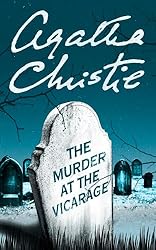
Ingenious! That’s what I thought when I’d finished reading The Murder at the Vicarage. Although Agatha Christie had written short stories featuring Miss Marple this is the first full length Miss Marple story, published in 1930.

I’ve been reading my way through Agatha Christie’s crime fiction for a few years now, totally out of order, which is why I’ve only just got round to reading The Murder at the Vicarage. I’d picked up along the way on the fact that Miss Marple uses her knowledge of people to help her solve the mysteries she investigates. And it is in this book that her use of analogy is made absolutely explicit, as she considers who could have killed Colonel Prothero, the unpopular churchwarden, found in the vicar’s study shot through the head. She comes up with seven suspects, all based on examples of human behaviour she has observed in the past.

Miss Marple is not the popular figure she appears in the later books as not everybody likes her. The vicar does, liking her sense of humour, and describing her as ‘a white-haired old lady with a gentle appealing manner’, whereas his wife describes her as ‘the worst cat in the village. And she always knows everything that happens – and draws the worst inference from it.

But it is very helpful to know what is going on in St Mary Mead, about Dr Stone, a well-known archaeologist superintending the excavation of a barrow on Colonel Protheroe’s land and about Mrs Lestrange, a mysterious woman who has recently moved to the village and also about who was coming and going to the vicarage and when.

It’s also helpful to have a a plan of St Mary Mead, showing where the main characters live, and plans of the layout of the vicarage and the vicar’s study, where the murder occurred.

After one of the suspects confesses to the murder Inspector Slack, who shows his contempt for Miss Marple, thinks the case is closed, but Miss Marple is puzzled – the facts seem to her to be wrong. The Murder at the Vicarage has an intricate plot, is full of red herrings and was impossible for me to unravel, but Miss Marple with her knowledge of ‘Human Nature’ solves the mystery.

I enjoyed this book very much, but Agatha Christie writing her Autobiography years later, wasn’t all that pleased with it. She thought it had too many characters and too many sub-plots; she is probably right. But she thought that the main plot was sound and that the village was as real to her as it could be. It’s real to me too.