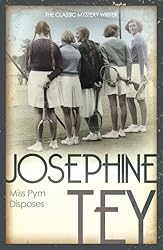
Miss Pym Disposes by Josephine Tey

Josephine Tey was a pseudonym for Elizabeth Mackintosh(1896 ‘“ 1952). She was a Scottish author who wrote mainly mystery novels (see the list at the end of this post). I read The Daughter of Time some years ago and thought it was an excellent book, a mix of historical research and detective work. Inspector Alan Grant is in hospital and to keep his mind occupied he decides to discover whether Richard III really did murder his nephews ‘“ the Princes in the Tower. I’ve also read The Franchise Affair, which I thought was also an excellent book.

I bought Miss Pym Disposes at the local village hall when I went to vote  in the European Election in June 2014. There was a table full of books for sale ‘“ nothing to do with the election, but a bonus for me! Based on the other two books I’d read by Tey I thought it would be a good buy. And it was. It is set in the 1940s and was first published in 1946.

I knew from the synopsis that Miss Pym was pleased and flattered to be invited to Leys Physical Training College to give a lecture on psychology. But then there was a’nasty accident‘.

So I was wondering about that ‘nasty accident’ as I began reading the book – who has the accident and is it really an accident, and if so who was responsible for the accident? It all seemed to be plain sailing until something happened that nobody expected and it was that that triggered the ‘accident’. It was intriguing and very cleverly written.

There is a long build up to the accident.  Miss Pym had been a French teacher at a girls’ High School until she inherited some money, left teaching and wrote a best-selling psychology book. She was invited to Leys by her old school friend, Henrietta Hodge, the college Principal and stayed on there for a few days, that extended into two weeks as she got to know and like the students and the staff. However, she realises that all is not as perfect at the college as she had thought, alerted to that fact that when one of the students, Teresa Desterro, tells her that everyone is just a little bit insane in this last week of term – ‘It is not a normal life they lead. You cannot expect them to be normal.‘ Miss Pym observes how strenuous their studies are and the stress and anxiety the senior students go through in their final exams and learn where Henrietta has found jobs for them, or if she has found jobs for them.

This is not a conventional crime fiction novel. It’s a psychological study focussing on the characters, their motivation and analysis of facial characteristics. It looks at the consequences of what people do and say and, as Miss Pym discovers who she thinks is responsible, it also looks at how much a person should intervene, or as one of the characters tells her, ‘Do the obvious right thing, and let God dispose.’ Miss Pym agonises over her decision, was she really going to condemn someone to death?

I thoroughly enjoyed this book, such a delight to read, a book that is beautifully written. I thought the slow build up to the ‘accident’ was perfect and I kept changing my mind about who would be involved – and it has such a good twist at the end.

It is the ideal book for these challenges: Bev’s Mount TBR Reading Challenge, her Vintage Mystery Cover Scavenger Hunt in the category ‘More Than Two people’, and Peggy Ann’s Read Scotland Challenge.

Josephine Tey’s books:

Alan Grant
The Man in the Queue (1929) aka Killer in the Crowd
A Shilling for Candles (1936) (the basis of Hitchcock’s 1937 movie Young and Innocent)
The Franchise Affair (1948) (my review)
To Love and Be Wise (1950)
The Daughter of Time (1951)
The Singing Sands (1952)

Novels
Kif: an Unvarnished History (1929) (writing as Gordon Daviot)
The Expensive Halo (1931)
Miss Pym Disposes (1946)
Brat Farrar (1949) aka Come and Kill Me
The Privateer (1952)
Non-Fiction

Claverhouse (1937) (writing as Gordon Daviot) A biography of John Graham of Claverhouse, 1st Viscount Dundee (1648 – 1689), known as “Bonnie Dundee” after leading the Jacobites to victory at the Battle of Killiecrankie in 1689, in which he lost his life.

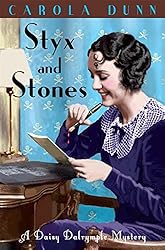
Styx and Stones by Carola Dunn

I always intend to write about the books I read soon after I’ve finished them, whilst the details and my reaction are fresh in my mind.  But recently I haven’t managed to do so and now have four books to review. I can deal with one of them quickly because I don’t have much to say about it – Styx and Stones by Carola Dunn. This is the seventh book in the Daisy Dalrymple Mystery series (there are 22 in total so far). I’ve read the first three and have been waiting to find the fourth to read them in order, but gave in when I saw this secondhand copy.

Set in the 1920s this is a cosy mystery that doesn’t tax the brain too much. Daisy’s brother-in-law, Lord John Frobisher, asks her to investigate a series of poison pen letters that many of the local villagers including himself have been receiving. So Daisy and her step-daughter, Belinda, go to stay with her sister and brother-in-law. Lord John is anxious to avoid a scandal, but when a murder is committed the local police have to be informed about the letters. Daisy’s fiancé, Detective Chief Inspector Alec Fletcher of Scotland Yard is concerned about Daisy and Belinda, so he gets involved informally, all the time trying to keep Daisy out of danger. The village is a hotbed of gossip, intrigue and resentment, with plenty of people with possible cause to commit murder. I liked the interaction of the members of the WI, bossed by the vicar’s wife and the way Daisy managed to get each of them to talk to her.

Styx and Stones is a quick and easy read, (although I didn’t guess the identity of the murderer until quite near the end) with the focus on Daisy and Alec’s relationship as well as on the poison pen and murder mysteries.

My Week in Books: 10 February 2016

This Week in Books is a weekly round-up hosted by Lypsyy Lost & Found, about what I’ve been reading Now, Then & Next.

IMG_1384-0

A similar meme,  WWW Wednesday is run by Taking on a World of Words.

Currently I’m reading two books:

Six Tudor Queens: Katherine of Aragon, the True Queen by Alison Weir, a proof copy – expected publication 5 May 2016. This is the first novel of the Six Tudor Queens series.

Blurb:

A Spanish princess. Raised to be modest, obedient and devout. Destined to be an English Queen. Six weeks from home across treacherous seas, everything is different: the language, the food, the weather. And for her there is no comfort in any of it. At sixteen years-old, Catalina is alone among strangers. She misses her mother. She mourns her lost brother. She cannot trust even those assigned to her protection.

Acclaimed, bestselling historian Alison Weir has based her enthralling account of Henry VIII’s first wife on extensive research and new theories. She reveals a strong, spirited woman determined to fight for her rights and the rightful place of her daughter. A woman who believed that to be the wife of a King was her destiny.

History tells us how she died. This captivating novel shows us how she lived.

I’m also reading SPQR: a History of Ancient Rome by Mary Beard, the Kindle edition.

Blurb:

Ancient Rome matters. Its history of empire, conquest, cruelty and excess is something against which we still judge ourselves. Its myths and stories – from Romulus and Remus to the Rape of Lucretia – still strike a chord with us. And its debates about citizenship, security and the rights of the individual still influence our own debates on civil liberty today. 

SPQR is a new look at Roman history from one of the world’s foremost classicists. It explores not only how Rome grew from an insignificant village in central Italy to a power that controlled territory from Spain to Syria, but also how the Romans thought about themselves and their achievements, and why they are still important to us.

Covering 1,000 years of history, and casting fresh light on the basics of Roman culture from slavery to running water, as well as exploring democracy, migration, religious controversy, social mobility and exploitation in the larger context of the empire, this is a definitive history of ancient Rome.

SPQR is the Romans’ own abbreviation for their state: Senatus Populusque Romanus, ‘the Senate and People of Rome’.

I’ve recently finished Too Soon a Death by Janet O’Kane, crime fiction set in the Scottish Borders.

You can read my thoughts on this book in my previous post.

And next I’ll be reading Slade House by David Mitchell, or at least I think I’ll be reading this next. When the time comes I could fancy something completely different.

Blurb:

Born out of the short story David Mitchell published on Twitter in 2014 and inhabiting the same universe as his latest bestselling novel The Bone Clocks, this is the perfect book to curl up with on a dark and stormy night.

Turn down Slade Alley – narrow, dank and easy to miss, even when you’re looking for it. Find the small black iron door set into the right-hand wall. No handle, no keyhole, but at your touch it swings open. Enter the sunlit garden of an old house that doesn’t quite make sense; too grand for the shabby neighbourhood, too large for the space it occupies.

A stranger greets you by name and invites you inside. At first, you won’t want to leave. Later, you’ll find that you can’t.

This unnerving, taut and intricately woven tale by one of our most original and bewitching writers begins in 1979 and reaches its turbulent conclusion around Hallowe’en, 2015. Because every nine years, on the last Saturday of October, a ‘guest’ is summoned to Slade House. But why has that person been chosen, by whom and for what purpose? The answers lie waiting in the long attic, at the top of the stairs…

What have you been reading this week and what have got in mind to read next?

Too Soon a Death by Janet O’Kane

Janet O’Kane’s second book Too Soon a Death follows on from No Stranger to Death, set in a fictional village in the Scottish Borders and continues the story of Doctor Zoe Moreland, a widow and one of the doctors at the local health centre. A boy’s body is discovered on the banks of the River Tweed, near the Chain Bridge, linking Scotland and England and Zoe is asked to help identify the body because he had a note in his clothing giving the health centre’s address and phone number – but he was not one of their patients.

Zoe is not without her own problems. I think this book reads well as a stand alone book, but it certainly helps to have read the previous book, which explains her current condition. At the beginning of Too Soon a Death she is still recovering from a vicious attack (details in No Stranger to Death) and is heavily pregnant.

As the events unfold, she receives anonymous phone calls and is followed by someone in a blue car, who at one point almost runs her down. Added to that her best friend Kate Mackenzie, a deaf genealogist, is having problems both with her ex-husband and a client, with disastrous results. Can Zoe trust a new acquaintance, the vet Patrick Dunin – she wonders who it is that keeps phoning him claiming his attention? A large, vicious looking dog attacks Zoe’s own dog and is savaging sheep. Where has he come from? And that is not all – Zoe has secrets in her own past that are finally revealed in this book.

In some respects Too Soon a Murder has a Midsomer Murders atmosphere, and a general ‘cosy’ feel, but it is not without violence. Its main focus, however, is on Zoe, how she is coping with her pregnancy, her plans for Keeper’s Cottage, which she has bought from Kate’s brother and her hopes to become a partner in the health centre. The crimes are investigated by DCI Erskine Mathers and Sergeant Trent, with Zoe’s assistance, although there are things she can’t tell the police because of patient confidentiality. It has a great sense of location (this may be helped because I know the area a little bit, living a few miles away on the English side of the Border), and the characters are well grounded and believable people, even the minor characters such as Margaret Howie, the practice receptionist, comes across as a character in her own right.

My thanks to Janet O’Kane for providing me with a copy to read and review. I’m looking forward to reading her third book, which she is currently writing.

Reading challenges: My first book for the Read Scotland Challenge –  a book set in Scotland.

First Chapter, First Paragraph: Runaway

First chapterEvery Tuesday Diane at Bibliophile by the Sea hosts First Chapter First Paragraph Tuesday Intros, where you can share the first paragraph, or a few, of a book you are reading or thinking about reading soon.

Runaway by Peter May is one of the books I’m thinking of reading this month. I’ve read some of his other books, the Lewis Trilogy and Entry Island and thoroughly enjoyed them, real page-turners. So I’m hoping that Runaway will be just as good.

It begins with a Prologue:

London

He wakes in a cold sweat from a dream pervaded by darkness and blood. And after a lifetime of being someone else in another land, he wonders who he is now. This man, who, he knows, is fading all too soon. A life squandered for a love lost. A life that seems to have passed in the blink of an eye.

and moves on to Chapter One in 2015:

Glasgow

Jack stepped down from the bus almost at the end of Battlefield Road and raised his head towards the darkening sky with a sense of foreboding. He took in the brooding silhouette of the smoke-stained Victoria Infirmary that climbed the hill above the field of battle where Mary, Queen of Scots, was once defeated by James VI, and felt as if someone had just walked over his grave.

Now, reading this, I am keen to read on. Flicking through the book I can see that it alternates between 1965 and 2015.

The back cover reveals that in 1965, five teenage friends fled Glasgow for London to pursue their dream of musical stardom. Yet before year’s end three returned, and returned damaged. In 2015, a brutal murder forces those three men, now in their sixties, to journey back to London and finally confront the dark truth they have run from for five decades.

 What do you think?

Would you keep reading?

Sparkling Cyanide by Agatha Christie

Sparkling cyanideAC

Sparkling Cyanide (published as Remembered Death in America) was first published in 1945. It is a novel in which a crime is investigated a year after it was committed.

Rosemary, the wife of wealthy George Barton dies suddenly at her birthday party at a West End Restaurant, the Luxembourg, after drinking a glass of champagne laced with cyanide. Rosemary had been in a depressed and unhappy state of mind after having a bout of influenza.The official verdict was that she had committed suicide but a year on George, having received anonymous letters stating her death wasn’t suicide, is convinced that she was murdered. He arranges another party, this time for Iris, Rosemary’s younger sister, inviting the same guests, hoping to identify the murderer. But his plan goes awry, as after drinking a toast to Rosemary’s remembrance the party ends with yet another death.

Rosemary was a wealthy heiress in her own right and after her death her inheritance had passed to Iris. George had invited Colonel Race* to both parties, but he had been absent both times. He had known George since his boyhood but had only once met Rosemary, who he thought of as ‘a singularly lovely nit-wit – but certainly not a melancholic type‘. He helps Chief Inspector Kemp of Scotland Yard to investigate both deaths. As well as Iris and George the guests at the party were Ruth Lessing, George’s efficient secretary, and Rosemary’s friends, Anthony Browne, a man with a dubious past and a politician Stephen Farraday and his wife Sandra.

In a series of flashbacks Agatha Christie highlights each person and their relationships with Rosemary and it appears that each one, including George and Iris had a motive for killing her. I was convinced quite early on that one particular character had to be the murderer, but reading further on I began to have doubts, switching from one person to another. As it turned out I was right about my first suspect – Agatha Christie was expert at writing things that could be taken two ways. If I was right about the ‘who’ I couldn’t work out the ‘how’, particularly for the second death, but knew that where everyone sat at the round table was significant. When that was revealed I thought it was difficult to believe, which is why I don’t place it among her best books – but it’s still a very enjoyable read. And it was popular with the public achieving sales of thirty thousand in the first year of publication.

*Colonel Race – first appeared in The Man in the Brown Suit, also in Cards on the Table and Death on the Nile. His appearance in Sparkling Cyanide was his last. He was an agent working for the British Secret Service, often sent on difficult or sensitive missions. In this book he is over sixty, described as ‘a tall, erect, military figure with sunburnt face, closely cropped iron-grey hair, and shrewd dark eyes‘.

Reading Challenges: Mount TBR Reading Challenge and Vintage Mystery Cover Scavenger Hunt for the Golden Age in the category of ‘Bottle/Glass for drinking’.