Cauldstane by Linda Gillard

Linda Gillard describes her book, Cauldstane  as ‘a gothic novel in the romantic suspense tradition of Daphne du Maurier, Mary Stewart & Victoria Holt.‘ It is a ghost story, set in a Scottish tower house in the Highlands:
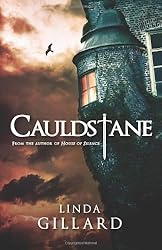
Cauldstane stood, heroic, long-suffering, defying all that the centuries had thrown at it. (Wet rot and dry rot have proved more damaging to many a castle than the depredations of enemy artillery). I saw an ivy-clad tower, much taller than it was wide, with more windows than I could easily count, the whole topped by conical-roofed turrets and looking, from a distance, like a toy. (page 6)

The narrator is Jenny Ryan who is employed by Sholto MacNab, a retired adventurer and Laird of the castle, to ghost write his memoirs. Cauldstane, a beautiful castle is fast falling into disrepair and the MacNabs are struggling to maintain or even keep it.

When he employs Jenny Sholto jokes that every castle should have its ghost. Cauldstane not only has a ghost, there is also the MacNab curse, which affects the women the McNabs marry, with three deaths (two accidents and a suicide) attributed to the curse, and the legend of the Cauldstane claymore, supposed to possess supernatural powers to protect the MacNabs from evil.

Jenny immediately falls in love with the castle, but as she settles in a few things begin to disturb her – her notes on her laptop disappear. As she learns more about the MacNabs and their history, family secrets begin to surface. But what is the truth behind these stories? It seems to hinge on Meredith, Sholto’s second wife who was killed in a horrific car crash.

Cauldstane is peopled by well drawn colourful characters, a beautifully described atmospheric setting and a wealth of story-telling, recreating the past seamlessly interwoven with the present. Jenny not only falls in love with the castle, but also with Sholto’s heir, his son Alec and as she does so more strange events occur and it becomes obvious that there is a malign presence in the castle that doesn’t want her there. And it makes its presence known in a modern way – through Jenny’s laptop. No ghostly visions or  spooky voices, but a thoroughly evil presence capable of writing on the laptop as well as moving objects and putting Jenny’s life in danger, along with the music that apparently only Jenny can hear.

As well as being a gripping tale Cauldstane is also about fear. The epigraph from The Devil’s Dictionary by Ambrose Bierce (1842 – 1914) sets the tone: ‘Ghost: the outward and visible sign of an inward fear‘.  The MacNabs are not the only ones with things to fear in their past, for Jenny too has a troubled past and both have to learn how to overcome their fears. Cauldstane is also about loss and revenge, about good versus evil and the power of love.

Linda Gillard lives in the Scottish Highlands. She has written seven novels. I enjoyed this one very much but my favourite of hers is still Star Gazing. For more information about Linda Gillard and her books see her website, Linda Gillard – Author.

Reading challenges: Read Scotland 2014, My Kind of Mystery and R.I.P. IX.
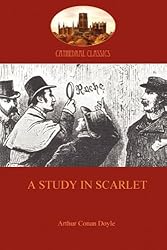
A Study in Scarlet by Sir Arthur Conan Doyle

This is the first Sherlock Holmes and Dr Watson mystery, published in 1887. A Study in Scarlet is a novel in two parts. The first, narrated by Dr John Watson, begins in 1881 with Watson on nine months convalescent leave from the army, having been shot in his shoulder whilst in Afghanistan, followed by an attack of enteric fever. As a result he was weak and emaciated – ‘as thin as a lather and as brown as a nut.‘ He was looking for lodgings when he met a friend who introduced him to an acquaintance who was working in the chemical laboratory at the hospital – Sherlock Holmes, who he described as ‘a little too scientific for my tastes – it approaches to cold-bloodedness. … He appears to have a passion for definite and exact knowledge.’ 
They get on immediately and take a suite of rooms in 221B Baker Street, after Holmes astounded Watson by deducing that Watson had served in Afghanistan. Holmes describes his occupation as a ‘consulting detective‘ solving crimes for both private individuals and the police, using his intuition, observation and the rules of deduction. Tobias Gregson and Lestrade both Scotland Yard detectives regularly ask Holmes for his help.

Very soon they are involved in investigating the murder of Enoch J Drebber, an American found dead in the front room of an empty house at 3 Lauriston Gardens, off the Brixton Road,  with the word “RACHE” scrawled in blood on the wall beside the body.

A Study in Scarlet is a superb story introducing Conan Doyle’s characters – Holmes reminds Watson of

… a pure-blooded well-trained foxhound as it dashes backwards and forwards through the covert, whining in its eagerness, until it comes across the lost scent.

Holmes is his brilliant best, leaving the police officers behind as he discovers the killer. And there then follows a flashback, narrated in the third person, to Part II The Country of the Saints to America in 1847, specifically to a Mormon community, explaining the events that led up to to the murder, where John Ferrier and his adopted daughter Lucy are first rescued from death in the desert and then subjected to the community’s rules, specifically with regard to Lucy’s marriage. At first I just wanted to get back to the murder inquiry and find out how Holmes discovered the murderer’s identity, but soon I was engrossed in the American story. Eventually the two parts come together in Chapter VI as Watson resumes the narrative and  Holmes reveals how he solved the problem by reasoning backwards and from a ‘few very ordinary deductions‘ was able to catch the criminal within three days.

I thoroughly enjoyed this story, written in a straightforward style with enough description to visualise both Victorian London and the American Wild West. I’d watched the TV version A Study in Pink in the Sherlock series, which although very different in some respects is surprisingly faithful to the book in others. I like both versions.

Sir Arthur Conan Doyle was born in Edinburgh in 1859 and died in 1930. He studied medicine at Edinburgh University, becoming the surgeon’s clerk to Professor Joseph Bell said to be the model for Sherlock Holmes’ methods of deduction. He gave up being a doctor with his success as an author and became involved in many causes – including divorce law reform, a channel tunnel, and inflatable life jackets. He was instrumental in the introduction of the Court of Criminal Appeal and was a volunteer physician in the Boer War. Later in life he became a convert to spiritualism.

See Fantastic Fiction for a list of works by Sir Arthur Conan Doyle.

Challenges: Read Scotland 2014, the Colour Coded Challenge, Mount TBR 2014 and My Kind of Mystery.

The Lake District Murder by John Bude

I first came across John Bude’s books nearly a year ago on Martin Edward’s blog Do You Write Under Your Own Name and thought they looked very interesting. His books are amongst those published by the British Library – reprints of unknown and undiscovered murder mysteries written in the thirties.  John Bude, whose real name was Ernest Carpenter Elmore, was writing in the Golden Age of detective fiction in the years between the two world wars. In 1953 he became one  of the founding members of the Crime Writers’ Association.

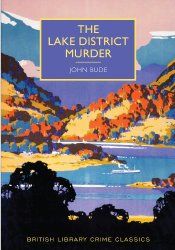
Anyway I made a mental note about the name and it lodged in the back of my mind until this September when I was in the Lake District and came across The Lake District Murder in the tourist information office in Glenridding on the shores of Ullswater. It has a striking cover, reproduced from a London & North Eastern Railway travel poster dating from the 1920s, showing a small steamer boat sailing on Ullswater, surrounded by the hills and mountains of the Lake District.

The LD mystery

The artist was John Littlejohns, who was born in Devon in 1874. He was a painter, illustrator, writer and teacher. As we had just been on a boat trip on Ullswater, in the Lady of the Lake (originally a steamboat), this immediately caught my eye.

The Lake District Murder as Martin Edwards writes in the introduction is ‘a world away from the unreality of bodies in libraries and cunningly derived killings on transcontinental trains.’ It is a police procedural, showing in intricate detail how the detectives investigate a crime. In this case a body is discovered in a car outside a lonely garage on a little used road. At first it appears that Jack Clayton one of the garage owners had committed suicide, but there are a couple of clues pointing to murder and when Inspector Meredith discovers that Clayton was planning to marry and move abroad it turns into a murder investigation. But what is the motive for murder and as everyone seems to have an alibi, who had the opportunity to kill Clayton? 

This book really takes you back in time. It was first published in 1935, which means that police methods of investigations particularly in rural areas was very different. Inspector Meredith uses buses or trains or travels the local roads on a motor cycle with a side car and pops into the local post office to use the telephone. It’s a slow process.

Having recently visited the Northern Lakes, I was fairly familiar with the landscape and could follow the action quite easily, but what I did find difficult was following the calculations Meredith and his colleagues carried out to work out petrol deliveries to the local garages, the lorries’ loads and the petrol storage capacities at the various garages. Inspector Meredith is a likeable character, with a happy home life, although his wife thought the police force made more than enough demands on his time  and tried to discourage their son’s interest in police affairs.

The Lake District Mystery is Bude’s second mystery novel. His first was The Cornish Coast Mystery,  and the third is The Sussex Downs Mystery (due to be released 27 October) both also reprinted by the British Library.

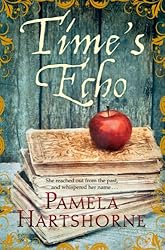
Time's Echo by Pamela Hartshorne


As I wrote in a First Chapter post  Time’s Echo mixes time as Grace Trewe is drawn into Hawise Aske’s life, four and a half centuries earlier in York, 1577. I saw this book in the library and although I hadn’t heard of Pamela Hartshorne I thought the title was interesting, and from the description on the back cover and the opening paragraphs, I thought it was worth borrowing.

It’s a good choice for Carl’s R.I.P. IX challenge, a time-slip story with an element of mystery and suspense in both time periods. Grace is staying in York to sort out the sale of her late godmother’s house when she experiences unnerving episodes in which she appears to be reliving the traumatic events in Hawise’s life beginning in 1577.  Grace likes to travel and although she survived the Boxing Day tsunami she is suppressing her memories of what happened. 

I think the suspense is somewhat diluted because right from the opening chapter it’s revealed that Hawise was drowned on All Hallows’ Eve, with her thumb tied to her toe – ie as a witch. But as Grace’s episodes continue she learns what happened in Hawise’s life to bring her to her dramatic death and this is interwoven with events in Grace’s life. It gets to the point where she dreads slipping out of current time into not only Hawise’s past but also into her own as what happened to her in the tsunami breaks through her mind.

What does add to the suspense is the unpredictability of the time-slips and the sense of malice and evil. So much so that the sceptic in me was unable to decide whether this was a question of whether Grace was suffering from post-traumatic stress disorder or was she really being “possessed” by Hawise, as she believed, feeling Hawise clamouring to be let into her mind. I found the historical sections more interesting than the modern story, which I think often happens when I read time-slip stories.

Pamela Hartshorne explains how she came to write this book in the Author’s Note at the end of the book. It grew out of her research on the wardmote-court returns of early modern York. These records dealt primarily with nuisances, things that affected the quality of life for the neighbourhood – such as noisy neighbours, blocked sewers. potholed streets etc (I note that local life hasn’t changed much over the centuries!). Some of the minor characters were real people, but this book is a work of fiction and Hartshorne is not intending this to be an accurate historical account, although she has tried to make it as convincing and as authentic as she could – I think she succeeded.

I thought the book was rather drawn out in parts, slowing the story down a bit too much for my liking. But, I like the fact that the book has a factual background, even though there are some liberties with the evidence – eg there was no plague in York in the 1570s or 1580s as featured in the book. So, on the whole I enjoyed Time’s Echo primarily because of its historical elements and I’ll look out for more books by Pamela Hartshorne. I see from her website that she has just published another time-slip book, The Memory of Midnight.

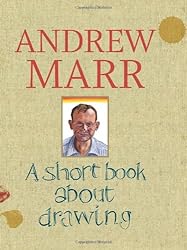
A Short Book About Drawing by Andrew Marr

I have called this a “A Short Book About Drawing” because that’s what it is. But it is also a book about being happy and the importance of drawing and making, for a happy life. I’ve written books about all sorts of things, but I have never enjoyed one as much as this. (Introduction, page 8)

Reading this book was a pleasure. I thoroughly enjoyed it – it made me happy and it encouraged me to carry on with my drawing. It’s not an instruction book, but it’s full of insight into what happens when you draw and it’s dotted throughout with personal information, such as how Marr began drawing, like most of us at school, what he drew, and how he lingered over drawings and paintings, going to exhibitions such as those at the Royal Scottish Academy.

He refers to artists and their paintings without including illustrations – the only paintings/drawings are his own!  He writes that ‘there isn’t a single drawing here I would regard as a real work of art, but I think most of them will encourage people to try for themselves.’  

He draws most days. This book was written not long before Marr suffered a stroke and it was only after he found himself drawing again – on his iPad – that he began to feel himself again. I would have liked more details about his drawings, about the medium he used –  some are obviously digital, and others are pencil sketches, but others are less obvious, maybe pen and wash?

It is a short book – just 144 pages – but there is a lot packed into those pages. Here are some more quotations that give a flavour of the book:

Chapter 2 ‘On Drawing and Happiness’:

Flow is the proposition that we are happiest when concentrating as much as possible on something that’s both quite hard  and for which we have an aptitude. … Drawing is a source of happiness and inner strength not because it is easy but because it is hard. (pages 30 -35)

Chapter 8 ‘When Did Normal People Start Drawing’. This is a very interesting chapter moving through the centuries and countries until the 1700s in London when

… the real drawing craze spreads from small numbers of enthusiasts to the new middle classes.

Marr states:

Drawing will make you a better person – not morally, necessarily, but it makes you think. It will help you see the hidden patterns all around you, and make you a discriminating lover of landscape, faces and mundane objects. It becomes an education, which changes your brain as much as learning to play the piano or to dance. It is about striving to become more fully human. (page 90)

Today we have been well educated to understand that most of us cannot draw. In the nineteenth century, foolish folk, they did not realise this, so they went off and drew anyway. (page 92)

A Short Book About Drawing is a special book. I thoroughly recommend it.

I read it because I love art, but after I finished reading I realised that it is another book, and a very different one, for the Read Scotland 2014 Challenge as

‘Andrew Marr was born in Glasgow in 1959. He studied English at the University of Cambridge and has since enjoyed a long career in political journalism, working for the Scotsman, the Independent, the Daily Express and the Observer. From 2000 to 2005 he was the BBC’s Political Editor. He has written and presented TV documentaries on history, science and politics, and presents the weekly Andrew Marr Show on Sunday mornings on BBC1 and Start the Week on Radio 4. Andrew lives in London with his family.’ (copied from the back cover)

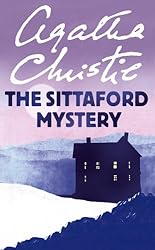
The Sittaford Mystery by Agatha Christie

The Sittaford Mystery is one of the earlier of Agatha Christie’s books, first published in the UK in 1931 and in the US as Murder at Hazelmoor. It’s not one of her Poirot or Miss Marple mysteries, but features Inspector Narracott, ably assisted, if not lead, by Emily Trefusis, a remarkably resourceful and determined young woman. I really liked Emily.

The Sittaford Mystery begins with a seance, or rather a table-turning session at Sittaford House in a tiny moorland village near Dartmoor, not very far from the prison at Princetown. Snow has been falling for four days and now Sittaford is almost completely cut off from the rest of the world. At the seance are the tenants of Sittaford House, Mrs Willett and her daughter Violet, and their neighbours. When the message of Captain Trevelyan’s death is tapped out, followed by the word M-U-R-D-E-R, his friend Major Burnaby immediately decides to see if Trevelyan has indeed been murdered, walking in the snow walking six miles to Exhampton. Of course, when he gets there, he does indeed discover that his friend is dead, probably killed at the precise time that the message was received in the seance.

Inspector Narracott is called in and a young man, James Pearson, Trevelyan’s nephew is arrested for the murder. Emily, his fiancée is convinced of his innocence. She enlists the help of the journalist, Charles Enderby and together they set out to discover the real culprit. Inspector Narracott is a quiet man, a thoughtful and efficient police officer, with a logical mind and attention to detail but Emily is determined and courageous in her search for the truth.

There are two mysteries in this book, who killed Trevelyan and why have the Willetts rented the house from him for the winter? I found it all very interesting, with plenty of clues, red herrings and suspects. Added to that is the escaped prisoner on Dartmoor, reminding me a bit of Dickens’ novel, Great Expectations, and of Conan Doyle’s The Hound of the Baskervilles, emphasised Charles Enderby’s reference to the seance as a ‘queer’ business, and thinking of getting Sir Arthur Conan Doyle’s opinion on the matter.

The setting and the characterisation are good. But although the plotting is good for most of the book, I felt the ending and the motive for the murder are rather inadequate, not least because I don’t think you could actually deduce who the murderer is – I guessed, but it was only a guess – not all of the facts are revealed until the denouement. For this reason I can’t rank The Sittaford Mystery with Agatha Christie’s best mysteries, but it is still a good read.

Note: the TV version in the Agatha Christie Marple series not only changes the identity of the killer but also inserts Miss Marple into the story!