December Prompt – Wrap Up, A Classics Challenge 2012

I’ve completed A Classics Challenge 2012, hosted by Katherine Cox at November’s Autumn. The aim was to read seven works of Classic Literature in 2012, but only three of the seven could be re-reads. I’ve really enjoyed taking part in this because it’s more than just read a book. Katherine’s monthly prompts provided a new way of thinking about the books and the authors. I’ve also enjoyed reading the views of the other participants.

Each month Katherine posted a prompt, which was general enough that no matter which Classic you were reading or how far into it you were, you would be able to answer it.

This is the final Prompt:

Link to your favorite Classic Literature post you’ve written this year, it doesn’t have to be related to this challenge. Just something you’d enjoy sharing.

Make a list of what you read for the challenge, you could compare it to your original list drawn up late 2011 when you were planning what to read, link to the posts you’ve written for the challenge, how many authors you’ve read or any little stat or detail you’d like to share.

My original list:

  • Emma by Jane Austen
  • The Woman in White by Wilkie Collins.
  • Three Men in a Boat by Jerome K Jerome
  • Wives and Daughters by Elizabeth Gaskell.
  • Kidnapped by Robert Louis Stevenson.
  • Our Mutual Friend by Charles Dickens.
  • The Voyage Out by Virginia Woolf.

What I actually read:

I think my favourite prompt was June’s prompt, which was to create a visual tour using quotes from the book you are reading; a series of images that closely represents how you see the scene or description. It doesn’t have to absolutely follow the text but it must reflect the mood. For this I used A Tale of Two Cities, in which I concentrated on London scenes – where Doctor Manette lived in Soho.

Now I look forward to next year and taking part in Katherine’s Turn of the Century Literary Salon.
November’s Crime Fiction Pick of the Month

I read seven books in November. Six were fiction, five of those being crime fiction and two were non-fiction* – two memoirs. I read two of the books on my new Kindle Fire.

  1. Murder by Yew by Suzanne Young (Kindle)
  2. The Whispers of Nemesis by Anne Zouroudi (from TBR books) (Kindle)
  3. The Warden by Anthony Trollope
  4. Standing in Another Man’s Grave by Ian Rankin
  5. Adventures of a One-Breasted Woman* by Susan Cummings (review copy)
  6. At Bertram’s Hotel by Agatha Christie
  7. Full Tilt: Dunkirk to Delhi by Bicycle* by Dervla Murphy

My Crime Fiction Pick of the Month is Standing in Another Man’s Grave by Ian Rankin. I wrote about the opening of the book in this post.

Summary from Amazon:

It’s twenty-five years since John Rebus appeared on the scene, and five years since he retired. But 2012 sees his return in STANDING IN ANOTHER MAN’S GRAVE. Not only is Rebus as stubborn and anarchic as ever, but he finds himself in trouble with Rankin’s latest creation, Malcolm Fox of Edinburgh’s internal affairs unit. Added to which, Rebus may be about to derail the career of his ex-colleague Siobhan Clarke, while himself being permanently derailed by mob boss and old adversary Big Ger Cafferty. But all Rebus wants to do is discover the truth about a series of seemingly unconnected disappearances stretching back to the millennium. The problem being, no one else wants to go there – and that includes Rebus’s fellow officers. Not that any of that is going to stop Rebus. Not even when his own life and the careers of those around him are on the line.

My view:

I’ve read all of the other Rebus books and the Fox books and so was very keen to read this latest book from Ian Rankin. I liked it – I liked it a lot. It was like meeting up again with an old acquaintance. Rebus is older and fatter but he hasn’t really changed. He still likes working best on his own, taking risks, and having a few too many drinks and a smoke. He can’t keep away from police work and is currently working for SCRU – the Serious Crime Review Unit, a Cold Case unit of retired police officers (like the TV series New Tricks).  Nina Hazlitt contacts SCRU (I like the acronym) about her daughter Sally who has been missing since 1999, convinced that it linked up with the disappearance of other young women, all in the vicinity of the A9. Rebus then links it with the current case of Annette McKie, aged 15, who has recently gone missing after getting off a bus at a petrol station in Pitlochry, also on the A9.

Rebus manages to assist in the current investigations, thanks to Siobhan Clark, who is now a Detective Inspector, although he is not a serving policeman. This involves him in travelling up and down the A9 and surrounding areas. The hardback copy of the book has coloured endpapers illustrating OS maps of the area, although if you want to follow the routes closely  it’s best to use another map as well:

I  was engrossed in the book and liked the way Rankin included characters from earlier books, such as Big Ger Caffety and in particular Malcolm Fox. Rebus does not like Fox, describing seeing him, ‘sliming his way around HQ‘ and he tells Siobhan not ‘to hang sound those scumbags.’ Fox, meanwhile, has got his eye on Rebus and the dislike is mutual, as he tells Siobhan:

John Rebus should be extinct, Clarke. Somehow the Ice Age came and went and left him still swimming while the rest of us evolved. (page 85)

I liked Fox in The Complaints and The Impossible Dead, but in this book he comes over as a changed character, vindictive and out to get Rebus. The contrast between the two characters is strong, with Fox twenty years younger, a stone and a half lighter, with a smarter appearance, looking as though he ‘could have been middle management in a plastic company of Inland Revenue.’ They meet in the police cafeteria where Fox has a banana and a glass of water, whereas Rebus has a bottle of Irn Bru and a caramel wafer, belching as he drinks, and looking a good deal scruffier. (page 73)

I don’t want to give away the plot, and will just say that I think the ending lets the rest of the book down. The identity of the killer came as a surprise to me and I thought that Rebus had maybe gone too far in acting on his own initiative, so risky! I had to re-read the book just to make sure I hadn’t missed something. Having said that, I was delighted with Standing in another Man’s Grave. I wondered, along with Rebus himself, how he would fit in with the changes:

‘The job’s changed, Siobhan.  Everything’s … ‘ He struggled to find the words. ‘It’s like with Christine Esson. Ninety percent of what she does is beyond me. The way she thinks is beyond me. (page 188)

At the beginning of the book, Rebus is considering applying  to rejoin the police force, as the retirement had recently been changed, so that those of his vintage are eligible. Whether he does, or not, is left open at the end. But I suspect that he will and that he and Fox will finally cross swords. I hope the next book will not be too long in coming.

See what others have chosen as the Pick of the Month for November.

Weekend Cooking: Cakes Please!

Yesterday was CatsPlease on my blog and today it’s CakesPlease! I used to bake cakes every week, but haven’t done so for years.

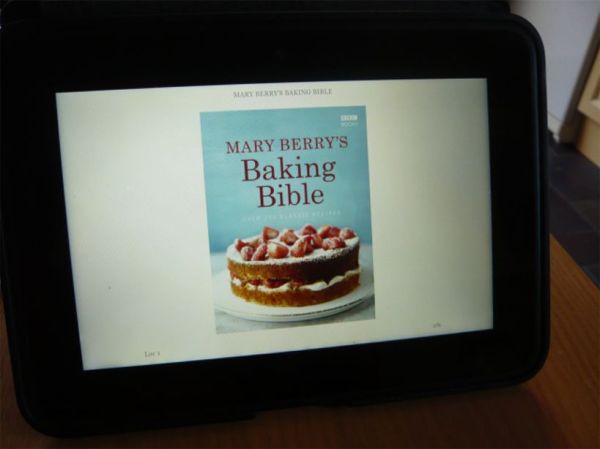
Mary Berry's Baking Bible P1080218Earlier this year I got the baking bug after watching The Great British Bake Off, and I was so taken with Mary Berry that I bought one of her books – Mary Berry’s Baking Bible. For the first time I bought a cookery book to read on my new Kindle Fire, partly because I have lots of cookery books and there’s no room for any more and also because the Kindle Fire has colour and the cover has a built-in stand so I can stand it up on the kitchen table to refer to it easily whilst cooking.

This contains a huge range of cakes, biscuits, traybakes, breads, buns, scones, hot puddings and pies, souffles and meringues and cheesecakes! Over 250 classic recipes.

Mary Berry writes:

Cakes are made to be shared so, once you have mastered a recipe, invite your friends and family to enjoy the fruits of your labour with a good pot of tea – happy baking!

So, I’m sharing the recipe for the Banana Loaf, which I made earlier this week and as I can’t physically share it here are my photos. First the ingredients:

  1. Preheat the oven to 180°C/ Fan 160°C/Gas 4. Lightly grease a 900g loaf tine then line sides and base with baking parchment.
  2. Put all ingredients into a mixing bowl and beat for 2 minutes until well blended. Spoon mixture into the loaf tine and level the surface.
  3. Bake for about 1 hour, until well risen and golden brown. Leave in the tin to cool for a few minutes then turn out, peel off the parchment and finish cooling on a wire rack.

This is what mine looked like:

It tasted delicious!

For more Weekend Cooking posts see Beth Fish Reads.

Mount TBR Reading Challenge 2013

Here’s another Reading Challenge that I can’t ignore, because it’s one that I’ve been doing quietly and slowly on my own, ever since I can remember. It’s Bev’s Mount TBR Reading Challenge 2013.

Bev plans to primarily from her own shelves next year. It might not seem to be a very challenging challenge – to read books you already have on your shelves – but faced with the almost constant temptation to borrow books from the library, buy new books, and download free ones to Kindle, it is! And whilst I can’t promise that I won’t give in to that temptation, I too would like to think that I’ll make great inroads to my ever-growing pile of TBRs.

Challenge Levels

Pike’s Peak: Read 12 books from your TBR pile/s
Mount Blanc: Read 24 books from your TBR pile/s
Mt. Vancouver: Read 36 books from your TBR pile/s
Mt. Ararat: Read 48 books from your TBR piles/s
Mt. Kilimanjaro: Read 60 books from your TBR pile/s
El Toro: Read 75 books from your TBR pile/s
Mt. Everest: Read 100 books from your TBR pile/s
Mount Olympus (Mars): Read 150+ books from your TBR pile/s

And the rules:
*Once you choose your challenge level, you are locked in for at least that many books. If you find that you’re on a mountain-climbing roll and want to tackle a taller mountain, then you are certainly welcome to upgrade.

*Challenge runs from January 1 to December 31, 2013.

This year I’ve read 25 of my TBRs, so next year I’m aiming to increase that by attempting Mount Ararat, that is, to read 48 books from my own bookshelves. I really ‘should’ go for Mount Olympus (Mars) but that is a few steps too far!

Here is my Progress Page

Scottish History

Ever since we moved to live just south of the border with Scotland I’ve been interested in learning more about its history. My knowledge was limited to the basics and mainly related to the monarchy – Robert the Bruce, Mary Queen of Scots, James VI of Scotland and I of England, the Jacobite Rebellions, and Bonnie Prince Charlie and so on.

Many books have been written on Scottish history and when I saw this little book some years ago I thought it could be a good place to start to find out more:

A Short History of Scotland by Richard Killeen is by its very nature a summary account and a basic introduction. There are 31 short chapters covering the period from Prehistoric Scotland up to the Twentieth Century – all in 69 pages, including coloured illustrations of people and places.

I found the early chapters the most interesting (maybe because it was mainly new information for me) covering the early periods – Iron Age Celts, Roman Scotland and later invaders – Anglo-Saxons, raiders from Dalriada in Ireland (Irish Celts), Picts and Vikings.

Much of the book is the history of the monarchy. Kenneth MacAlpin was the first King of Scotland (9th century) but not of all modern Scotland – he never established himself in the Borders, which was held by the Anglo-Saxon Northumbrians. Northumbria had formerly extended from the Humber right up to the Forth, and it was not until Malcolm II (1005-34) won the battle of Carham in 1018 that the land north of the Tweed became part of his kingdom.

The book traces the history of Scotland through the various battles for power and control – the Norman settlement of the lowlands founding abbeys and cathedrals, the contest for the crown between John Balliol and Robert Bruce (both members of the Norman aristocracy) and the intervention of Edward I of England in choosing John Balliol as king in 1292 and claiming formal overlordship for himself and his successors.

Scottish kings had paid feudal homage to English kings before the 1290s. As far back as 1174, William the Lion had acknowledged himself the formal vassal of Henry II. Such acts did not imply that Scotland was a dependency of England. In the first place, England and Scotland hardly existed in the modern sense. The age of centralised states with uniform laws, secure boundaries with centralised administration – all things we take completely for granted – lay well in the future. (page 28)

Edward’s actions triggered Scottish resistance, with William Wallace winning victory over the English at Stirling Bridge in 1297. Wallace was then defeated within a year at the Battle of Falkirk. Robert the Bruce gained the crown, and in 1314 defeated Edward II at the Battle of Bannockburn: ‘the battle which confirmed Scotland as an independent kingdom.’ (page 31)

Moving forward in time, Killeen describes the history of Scotland until the Reformation as ‘a guignol of intrigue, faction and murder mixed with solid achievement.’ The rest of the book includes chapters on the Stewarts, Mary Queen of Scots, the Union of Crowns (1603), the Civil War, Glencoe, the Act of Union (1707), Scottish Enlightenment, the Clearances and the Industrial Revolution.

Reading this little book has spurred me on to read more detailed histories and I’ve started with Neil Oliver’s A History of Scotland. More about that another time.

Cats: Drawing and Painting

I drew this last week, copied from a card, using pencils and pens. It’s made me keen to try painting/sketching our cat Heidi. She’s white so I’ll have to use coloured paper, or a coloured background.

I looked for help in this beautiful book:

 Cats: Drawing and Painting in Watercolour by Lesley Fotherby. This is what she has to say about drawing white cats on white paper:

You can’t paint the cat in white, so you have to paint the background and leave the cat to show up against it, ie look at the negative shape, paint that in and the positive image will appear. (page 96)

I’ve tried negative painting before and didn’t find it easy. She also suggests using pencil and paint and to illustrate the technique shows this painting:

There is so much in this book, from using different materials, paper and techniques  to showing how to depict movement and markings and composition. I’m going to study it and have a go.

Previously when I’ve posted photos of my sketches some people have commented that they wish they could draw. I can only endorse what Lesley Fotherby writes in this book:

Many people feel that being able to draw is a gift and that either you can draw or you can’t. It is true that some will find it easier than others, but in fact drawing is a skill which can be learnt like any other. As with other skills, it can only improve with practice, so do not be discouraged if your first efforts are unsatisfactory. …

Learning to draw is a bit like learning to swim: you can stand on the side of the pool and listen to a lecture, or you can jump in, wearing your lifejacket of course, and feel the element around you. Then you understand what they are all talking about. (page 8)