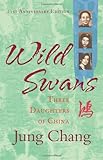
Book Beginnings: Wild Swans by Jung Chang

I’m currently reading Wild Swans by Jung Chang.

It begins:

At the age of fifteen my grandmother became the concubine of a warlord general, the police chief of a tenuous national government of China. The year was 1924 and China was in chaos. Much of it, including Manchuria, where my grandmother lived, was ruled by warlords. the liaison was arranged by her father, a police official in the provincial town of Xixian in southwest Manchuria, about a hundred miles north of the Great Wall and 250 miles northeast of Peking.

Wild Swans is a family memoir – the story of three generations of woman in Jung Chang’s family – her grandmother, mother and herself. This is the 2003 edition with an introduction by Jung Chang explaining how she came to write the book. She had always dreamed of being a writer, but growing up in Mao’s China it seemed out of the question, with most writers suffering in endless police persecutions. It was only after she had been allowed to come to Britain in 1978 to study that she had the freedom to write and to write what she wanted.

So far, I’m finding it fascinating, reading about her grandmother, who was one of the last generation of Chinese woman to suffer the practice of binding feet. I knew of this practice, but hadn’t realised just how much the little girls suffered and continued to suffer throughout their lives.

As this book is so long (over 600 pages in a small font) it’s going to take me quite a while to read it. I’l probably write a few posts on my progress.

First Chapter, First Paragraph is hosted by Diane at Bibliophile by the Sea.
What’s in a Name 6

At this time of year I often think that I won’t take part in any book challenges in the future and I was just thinking that the other day when I saw that Beth Fish Reads had posted about next year’s What’s in a Name challenge, which will run between January 1 and December 31, 2013. As I do like working through my unread books and making lists of what to read next I had to see if it would be easy to fit books to fit the challenge – of course I did! The idea is to read one book in each of the following categories:

1. A book with up or down (or equivalent) in the title: eg Deep Down True, The Girl Below, The Diva Digs up the Dirt

2. A book with something you’d find in your kitchen in the title: Loose Lips Sink Ships, The Knife of Never Letting Go, Breadcrumbs

3. A book with a party or celebration in the title: A Feast for Crows, A Wedding in Haiti, Cocktail Hour under the Tree of Forgetfulness

4. A book with fire (or equivalent) in the title: Burning for Revenge, Fireworks over Toccoa, Catching Fire

5. A book with an emotion in the title: Baltimore Blues, Say You’re Sorry, Dreams of Joy

6. A book with lost or found (or equivalent) in the title: The Book of Lost Fragrances, The World We Found, A Discovery of Witches

  • Books may be any form (audio, print, e-book).
  • Books may overlap other challenges.
  • Books may not overlap categories; you need a different book for each category.
  • Creativity for matching the categories is not only allowed but encouraged.
  • You do not have to make a list of books before hand.
  • You do not have to read through the categories in any particular order.
Here are my choices:
1. A book with up or down (or equivalent) in the title:
  • Ripley Under Water by Patricia Highsmith
  • Rise and Shine by Anna Quindlen

2. A book with something you’d find in your kitchen in the title:

  • Gem Squash Tokoloshe by Rachel Zadok
  • The Various Flavours of Coffee by Anthony Capella
  • The Olive Readers by Christine Aziz
  • Saving Fish from Drowning by Amy Tan
  • The Water Horse by Julia Gregson

3. A book with a party or celebration in the title:

  • Ralph’s Party by Lisa Jewel
  • A Time to Dance, No Time to Weep by Rumer Godden
  • The Birthday Boys by Beryl Bainbridge

4. A book with fire (or equivalent) in the title:

  • Daughters of Fire by Barbara Erskine
  • The Girl who Played with Fire by Stieg Larsson

5. A book with an emotion in the title:

  • Book of Love by Sarah Bower
  • Love in the Time of Cholera by Gabriel Garcia Marquez
  • Sword of Shame by The Medieval Murderers
  • The Pursuit of Happiness by Douglas Kennedy
  • The Soul of Kindness by Elizabeth Taylor
  • The Tenderness of Wolves by Stef Penney

6. A book with lost or found (or equivalent) in the title:

  • The Book of Lost Things by John Connolly
  • The Lost Art of Keeping Secrets by Eva rice
  • The Lost Prophecies by The  Medieval Murderers
  • The Lost Army of Cambyses by Paul Sussman
  • The Inheritance of Loss by Kiran Desai

More than enough!

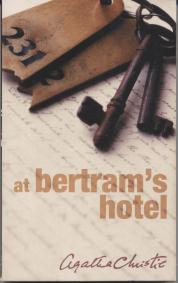
At Bertram’s Hotel by Agatha Christie

At Bertrams Hotel 001

I try to read at least one Agatha Christie book a month. This month’s book is At Bertram’s Hotel, a Miss Marple book, first published in 1965, and written when Agatha Christie was seventy five.

Synopsis (from book cover):

An old-fashioned London Hotel is not quite as reputable as it makes out’¦

When Miss Marple comes up from the country for a holiday in London, she finds what she’s looking for at Bertram’s Hotel: traditional decor, impeccable service and an unmistakable atmosphere of danger behind the highly polished veneer.

Yet, not even Miss Marple can foresee the violent chain of events set in motion when an eccentric guest makes his way to the airport on the wrong day’.

My view:

Miss Marple is now the same age as Agatha Christie was at the time she was writing At Bertram’s Hotel and some of her thoughts and reactions are most likely to be those of the author herself  – reflections on comfort for example – most appreciative of her bed, and a beautifully cooked breakfast, a real breakfast with properly poached eggs and enjoying ‘a delightful morning of shopping’ at the Army& Navy Stores.  But Miss Marple is not one of the main characters in this book, although she does play a vital role.

In some ways, Bertram’s Hotel itself is a leading ‘character’. It’s ‘dignified, unostentatious and quietly expensive‘, patronised by clergymen, ‘dowager ladies of the aristocracy up from the country’ and ‘girls on their way home from expensive finishing schools.’ It’s Miss Marple’s choice when her nephew and his wife decide to do something for ‘poor old Aunt Jane’ and pay for her week’s stay. And yet it doesn’t seem real to her, the fact that it didn’t seem to have changed over the years made her think that it ‘really seemed too good to be true.’ (page 26)

There’s a long build up to any crime being committed and It’s only towards the end of the book that a murder occurs. Scotland Yard are concerned about a crime network that is getting too big and organised:

Robbery on a big scale was increasing. Bank hold-ups, snatches of pay-rolls, thefts of consignments of jewels sent through the mail, train robberies. Hardly a month passed but some daring and stupendous coup was attempted and brought off safely. (page 49)

(I was reminded that Agatha Christie was writing this at the time of, or shortly after the ‘Great Train Robbery’ of 1963 in which a gang of robbers held up a mail train and made off with £2.6 million (equivalent to £41 million now) – later in the book a train robbery takes place in Ireland.)

A number of characters are introduced quite quickly and I had to keep reminding myself who they were and how they fitted into the story. There’s the hotel staff, including Henry the ‘perfect butler’ and the visitors, including Lady Sedgewick and a number of elderly ladies, Colonel Luscombe and other retired military gentlemen, Canon Pennyfather, a vague forgetful white-haired elderly cleric, Elvira Blake, Colonel Luscombe’s ward and the police, including Chief Inspector Davy (nicknamed ‘Father’ by his staff – a nickname that I thought irritating and out of place, probably intended to make him seem paternal and safe). There is also the mysterious Mr Robinson, who I’ve come across in some of Agatha Christie’s other books.

The novel meanders along through a number of subplots before reaching the climax, which I thought was a bit signposted. The ending is both predictable and surprising with a final twist in the last sentence that pleased me.

One of the things I like about At Bertram’s Hotel are the little insights into Miss Marple’s mind – and her past. For example she had first visited Bertram’s Hotel as a  girl of fourteen with her uncle and aunt, her Uncle Thomas had been a Canon of Ely. And I was delighted to discover that she had known romance because when she was a young woman she had had a friendship with ‘a very unsuitable young man‘ whose name she has forgotten. But her mother had firmly nipped that friendship in the bud, which later Jane realised was wise although at the time Jane Marple, ‘that pink and white eager  young girl … such a silly girl in many ways’ had ‘cried herself to sleep for at least a week.’ (page 26)

As in other books featuring Miss Marple it’s her characteristic curiosity, what she preferred to call ‘taking an interest in other people’s affairs’, that is crucial to the plot. She is very good at overhearing conversations and she’s a light sleeper. She’s also very perceptive and just a touch cynical, no longer the silly girl of her youth.

  • Paperback: 224 pages
  • Publisher: HarperCollins; Masterpiece edition edition (1 July 2008)
  • Language: English
  • ISBN-10: 0007121032
  • ISBN-13: 978-0007121038
  • Source: I bought the book
  • My Rating: 4/5

Crime Fiction Alphabet 2012 – summary

Kerrie’s Crime Fiction Alphabet came to the end last week. This is the third time I’ve taken part and as before I thoroughly enjoyed taking part. Thanks, Kerrie.

The rules of the meme are that you have to write a blog post about crime fiction related to the letter of the week and your post MUST be related to either the first letter of a book’s title, the first letter of an author’s first name, or the first letter of the author’s surname.

I had very little difficulty in finding books to fit the rules and mainly read whatever I wanted and slotted them in wherever they would fit. The exception to that was, of course, that pesky letter X and I resorted to having a title that sounded as though it began with X.

Many were books by old favourites, such as Agatha Christie (3 books) and some by new-to-me authors, such as Dana Stabenow, Michael Innes, M R Hall, Chris Pavonne and Suzanne Young.

Here’s my list – a mixture of titles and authors’ names:

I rated most of the books between 3/5 to 4/5 with two at 5/5:

and The Chalk Circle Man by Fred Vargas at 4.5

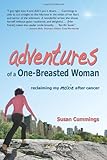
Adventures of a One-Breasted Woman by Susan Cummings

I received Susan Cumming’s book Adventures of a One-Breasted Woman: Reclaiming My Moxie After Cancer from the publisher via LibraryThing‘s Early Reviewer programme.

About the author from Goodreads:

Susan Cummings is a writer, an actress and now a 20-year breast cancer survivor. Once a newspaper reporter, she has since been published in a number of literary journals and written songs and plays. Feeling alone and vulnerable after her mastectomy for early-stage breast cancer, she looked, in vain, for a memoir of another woman’s experiences after cancer treatment. Eventually she wrote the book she had sought. She lived in New York City for many years, but is now settled in western Massachusets.

The fact that I’ve read this book shows how I’ve become more adjusted to reading about cancer than I was a few years ago. At that time I had grave misgivings about reading about breast cancer because my mother had died from it many years ago. But I was diagnosed with breast cancer a year last August and was so encouraged by how treatment has improved over the years that I’m now able to face reading about it. I haven’t had a mastectomy as Susan Cummings had but I was able to identity with some of the feelings she describes. Even so, I hesitated about reading the book as everyone has their own ways of coping and everybody’s experience is different.

Susan Cummings was diagnosed with cancer in 1992 and she chose to have a mastectomy rather than a lumpectomy followed by radiation because her surgeon said it would be a more assured cure. She didn’t move on after the operation and struggled with fear that the cancer would recur and with shame about her disfigured body.

Her book follows her thoughts and feelings over the six years after her surgery with openness. At times she was depressed, at others more optimistic and cheerful, accepting her body for what it is. I thought it was very good, easy to read and encouraging to read about someone who had not only survived but had managed to overcome her problems and face up to life with courage. Throughout the book I thought she looked realistically at the options open to her. It’s also an account of relationships and how they change, about her childhood and about different and alternative methods of healing.  I’m glad to have received and read it.

My Day in Books 2012: a meme

Today I was going to write a post about one of the books I’ve read recently but then I saw that Cornflower had posted this meme: ‘œMy Day in Books’. I did this last year and fancied doing it again with this year’s books. The task is to complete the sentences using the titles of books you have read this year.  Here’s what I came up with:

I began the day by The Secret River

before breakfasting on Red Bones (that’s all there was!)

and admiring The Victorian Chaise-Longue.

On my way to work I saw The Woman in White

and walked by The House of Silk

to avoid Our Mutual Friend

but I made sure to stop at The Village.

In the office, my boss said, Death Comes to Pemberley

and sent me to research The Murder on the Links.

At lunch with My Cousin Rachel

I noticed A Man Lay Dead

in A Room Full of Bones

greatly enjoying  A Quiet Life!!

Then on the journey home, I contemplated Endless Night

because I have A Weekend with Mr Darcy

and am drawn to Dancing Backwards.

Settling down for the evening in A Place of Greater Safety

I studied Dark Matter

by Blue Lightning

before saying goodnight to (the) Bad Boy.

I’ve written posts about most of them. Here are the links If anyone wants to to read what I thought about the books: