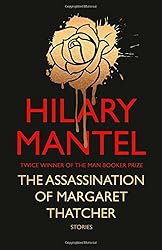
The Assassination of Margaret Thatcher and Other Stories by Hilary Mantel

When I first saw The Assassination of Margaret Thatcher I wasn’t sure I wanted to read it – not because of the controversy over the title story, but because I’m not especially keen on short stories. But Hilary Mantel is one of my favourite authors and after seeing her talk with James Runcie on The Culture Show I decided I definitely wanted to get the book.

I enjoyed this collection of stories,  which are brooding, somewhat melancholic, dark, disturbing and full of sharp and penetrating observations – brilliant! The title story is the last one in the book and is the only new story, the others having first appeared in other publications. I don’t find it easy writing about short stories, especially the very short ones, and so I’m not going to attempt to write about each of the ten stories in this book.

The first one, Sorry to Disturb, describes the dilemma of a British woman living in Jeddah in Saudi Arabia when she finds herself befriended by a young Pakistani businessman – a situation that was ‘ripe for misunderstanding‘. This is one of my favourites in the collection. It has a claustrophobic atmosphere, as feeling trapped in her flat, yet ‘always observed: overlooked, without being precisely seen, recognised’ she was unable to refuse a friendship, wondering if Jeddah had left her ‘for ever off-kilter in some way‘.

This view of life from a slightly different, skewed perspective and of being trapped is there in all these stories. The children in Comma, for example, spend their days during a long hot summer, ‘each day a sun like a child’s painted sun burned in a sky made white with heat’, drawn to watch what was happening at the Hathaways’ house, the house of the rich, built of stone, with a lofty round tower. In both this and Sorry to Disturb, there is an element of distinct class/cultural difference, of being outsiders.

Winter Break is one of the shorter stories, but complete in itself, unlike so many short stories I’ve read. A childless couple are taking a winter break, the husband trying to convince his wife she wants a child – she’s reluctant as she ‘had reached that stage in her fertile life when genetic strings got knotted and chromosomes went whizzing around and re-attaching themselves.’ A moment of anxiety on the journey to their hotel ends in horror.

How Shall I Know You is a much longer story. I often wonder what it’s like for authors going to venues and talking about their books and this story gives an insight into how it can be a dispiriting experience, staying in obscure and dingy places, feeling forlorn, exposed and generally insufficient. It has a grimly humorous side and underneath there is a darkness and bleakness. As with the other stories in this collection it is superbly written – you are there with the narrator, seeing the scenes, meeting the people and understanding their feelings and emotions.

And then the last story – The Assassination of Margaret Thatcher. Mantel sets the scene – of the ‘place where she breathed her last‘ – a ‘quiet street, sedate, shaded by old trees: a street of tall houses, their façades smooth as white icing, their brickwork the colour of honey.’  Waiting for the plumber to arrive, a woman lets a man into her flat, only to find out he has a gun and wants to shoot Margaret Thatcher from the flat window, as she leaves the hospital behind the flats. Far from being horrified or scared the woman sympathises with the gunman – her first reaction is that she should get a fee for the use of her premises. This too is a dark tale told with a dark sense of humour, and with depth of feeling.

Overall then this is a compelling book, brilliantly written, keenly observed, with the power to chill and shock me. It is one that I will re-visit.

  • Hardcover: 256 pages
  • Publisher: Fourth Estate (25 Sep 2014)
  • Language: Unknown
  • ISBN-10: 0007580975
  • ISBN-13: 978-0007580972
  • Source: I bought it

Almost Invincible by Suzanne Burdon

Almost InvincibleMary Shelley’s life and relationship with the poet Percy Bysshe Shelley was truly remarkable, a story of scandal, love and loss. And Suzanne Burdon using letters and diaries has written a remarkable novel, Almost Invincible, about her.

Mary ‘s parents were two radical writers, William Godwin and Mary Wollstonecraft, the advocate of women’s rights. At the age of sixteen she met Shelley, who was already married. They fell in love, abandoned their families and eloped, but significantly they took Mary’s step-sister, Claire with them. It was disastrous because Claire was in love with Shelley too and almost constantly in conflict with Mary.

The novel begins in Geneva in 1816 as Mary reads the opening pages of her novel, Frankenstein to Shelley, Lord Byron and their friends:

It was barely five on a summer afternoon but already eerily dark. The candles were lit and shivered in response to the wind and rain pounding against the panelled windows. Mary took up her scribbled pages and found her voice.

From then on the novel goes back to Mary’s meeting with Shelley in St Pancras churchyard in London two years earlier and follows their tempestuous lives until Shelley’s death in Italy in 1823. Mary went through so much; social outcasts they spent their time moving houses from France, England, Switzerland and Italy. She had two miscarriages and suffered the deaths of two of her children. Her father’s description of her shows her spirit:

She is singularly bold, somewhat imperious, and active of mind. Her desire of knowledge is great, and her perseverance in everything she undertakes, almost invincible.

But above all, it was her love for Shelley that sustained her. I found this a very moving book as it weaves its way through the tangled and often turbulent relationships of Mary, Shelley, Claire and their friends and acquaintances. At times Claire’s behaviour was so manipulative and destructive that Mary could not bear to be with her. Yet through all the sadness, grief, illnesses, and financial difficulties she found solace in her writing.

Suzanne Burdon has written a most impressive story. She has done extensive research, using original letters and stories in the Abinger Collection in the Bodleian Library in Oxford and the Carl Phorzheimer Collection of Shelley and His Circle in the New York Public Library. Almost Invincible is her first novel, based on fact but conveying the emotions, thoughts and feelings of her characters so convincingly. I was entranced.

  • Paperback: 340 pages
  • Publisher: Criteria Publishing
  • Language: English
  • ISBN-10: 0992354005
  • ISBN-13: 978-0992354008
  • Source: review copy from the publishers

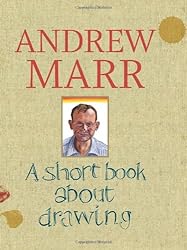
A Short Book About Drawing by Andrew Marr

I have called this a “A Short Book About Drawing” because that’s what it is. But it is also a book about being happy and the importance of drawing and making, for a happy life. I’ve written books about all sorts of things, but I have never enjoyed one as much as this. (Introduction, page 8)

Reading this book was a pleasure. I thoroughly enjoyed it – it made me happy and it encouraged me to carry on with my drawing. It’s not an instruction book, but it’s full of insight into what happens when you draw and it’s dotted throughout with personal information, such as how Marr began drawing, like most of us at school, what he drew, and how he lingered over drawings and paintings, going to exhibitions such as those at the Royal Scottish Academy.

He refers to artists and their paintings without including illustrations – the only paintings/drawings are his own!  He writes that ‘there isn’t a single drawing here I would regard as a real work of art, but I think most of them will encourage people to try for themselves.’  

He draws most days. This book was written not long before Marr suffered a stroke and it was only after he found himself drawing again – on his iPad – that he began to feel himself again. I would have liked more details about his drawings, about the medium he used –  some are obviously digital, and others are pencil sketches, but others are less obvious, maybe pen and wash?

It is a short book – just 144 pages – but there is a lot packed into those pages. Here are some more quotations that give a flavour of the book:

Chapter 2 ‘On Drawing and Happiness’:

Flow is the proposition that we are happiest when concentrating as much as possible on something that’s both quite hard  and for which we have an aptitude. … Drawing is a source of happiness and inner strength not because it is easy but because it is hard. (pages 30 -35)

Chapter 8 ‘When Did Normal People Start Drawing’. This is a very interesting chapter moving through the centuries and countries until the 1700s in London when

… the real drawing craze spreads from small numbers of enthusiasts to the new middle classes.

Marr states:

Drawing will make you a better person – not morally, necessarily, but it makes you think. It will help you see the hidden patterns all around you, and make you a discriminating lover of landscape, faces and mundane objects. It becomes an education, which changes your brain as much as learning to play the piano or to dance. It is about striving to become more fully human. (page 90)

Today we have been well educated to understand that most of us cannot draw. In the nineteenth century, foolish folk, they did not realise this, so they went off and drew anyway. (page 92)

A Short Book About Drawing is a special book. I thoroughly recommend it.

I read it because I love art, but after I finished reading I realised that it is another book, and a very different one, for the Read Scotland 2014 Challenge as

‘Andrew Marr was born in Glasgow in 1959. He studied English at the University of Cambridge and has since enjoyed a long career in political journalism, working for the Scotsman, the Independent, the Daily Express and the Observer. From 2000 to 2005 he was the BBC’s Political Editor. He has written and presented TV documentaries on history, science and politics, and presents the weekly Andrew Marr Show on Sunday mornings on BBC1 and Start the Week on Radio 4. Andrew lives in London with his family.’ (copied from the back cover)

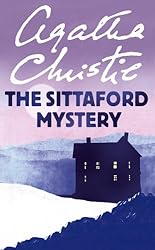
The Sittaford Mystery by Agatha Christie

The Sittaford Mystery is one of the earlier of Agatha Christie’s books, first published in the UK in 1931 and in the US as Murder at Hazelmoor. It’s not one of her Poirot or Miss Marple mysteries, but features Inspector Narracott, ably assisted, if not lead, by Emily Trefusis, a remarkably resourceful and determined young woman. I really liked Emily.

The Sittaford Mystery begins with a seance, or rather a table-turning session at Sittaford House in a tiny moorland village near Dartmoor, not very far from the prison at Princetown. Snow has been falling for four days and now Sittaford is almost completely cut off from the rest of the world. At the seance are the tenants of Sittaford House, Mrs Willett and her daughter Violet, and their neighbours. When the message of Captain Trevelyan’s death is tapped out, followed by the word M-U-R-D-E-R, his friend Major Burnaby immediately decides to see if Trevelyan has indeed been murdered, walking in the snow walking six miles to Exhampton. Of course, when he gets there, he does indeed discover that his friend is dead, probably killed at the precise time that the message was received in the seance.

Inspector Narracott is called in and a young man, James Pearson, Trevelyan’s nephew is arrested for the murder. Emily, his fiancée is convinced of his innocence. She enlists the help of the journalist, Charles Enderby and together they set out to discover the real culprit. Inspector Narracott is a quiet man, a thoughtful and efficient police officer, with a logical mind and attention to detail but Emily is determined and courageous in her search for the truth.

There are two mysteries in this book, who killed Trevelyan and why have the Willetts rented the house from him for the winter? I found it all very interesting, with plenty of clues, red herrings and suspects. Added to that is the escaped prisoner on Dartmoor, reminding me a bit of Dickens’ novel, Great Expectations, and of Conan Doyle’s The Hound of the Baskervilles, emphasised Charles Enderby’s reference to the seance as a ‘queer’ business, and thinking of getting Sir Arthur Conan Doyle’s opinion on the matter.

The setting and the characterisation are good. But although the plotting is good for most of the book, I felt the ending and the motive for the murder are rather inadequate, not least because I don’t think you could actually deduce who the murderer is – I guessed, but it was only a guess – not all of the facts are revealed until the denouement. For this reason I can’t rank The Sittaford Mystery with Agatha Christie’s best mysteries, but it is still a good read.

Note: the TV version in the Agatha Christie Marple series not only changes the identity of the killer but also inserts Miss Marple into the story!

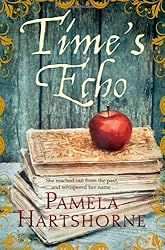
First Chapter, First Paragraph: Time's Echo

First chapterEvery Tuesday Diane at Bibliophile by the Sea hosts First Chapter First Paragraph Tuesday Intros, where you can share the first paragraph, or a few, of a book you are reading or thinking about reading soon.

My choice this week is Time’s Echo by Pamela Hartshorne, historical timeslip fiction.

It begins:

I feel no fear, not yet. I am just astounded to find myself in the air, looking down the murky rush of the river. It is as if time itself has paused, and I am somehow suspended between the sky and the wate, between the past and the present, between then and now. Between disbelief and horror.

It is All Hallows’ Eve, and I am going to die.

Time’s Echo mixes time as Grace Trewe is drawn into Hawise Aske’s life, four and a half centuries earlier in York, 1577. I saw this book in the library and although I hadn’t heard of Pamela Hartshorne I thought the title was interesting, and from the description on the back cover and the opening paragraphs, I thought it was worth borrowing.  From what I’ve read so far I’m hoping it will be an enjoyable book.

What's In A Name 7: Completed

Whats in a name 7Hosted by  by Charlie at The Worm Hole this challenge runs from January to December 2014. During this time you choose a book to read from six categories.

I’ve now completed the challenge and these are the books I read:

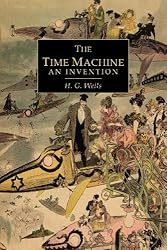
  • A reference to time €“ The Time Machine by H G Wells, first published in 1895, is a work of imagination and an early example of science fiction, but it is also a commentary on late 19th century society and a vehicle for H G Well’s views on socialism and industrialisation.

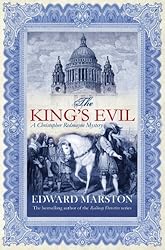
  • A position of royalty €“ The King’s Evil by Edward Marston. This is historical crime fiction set in London in September 1666, just as the Great Fire of London has begun, eventually devastating a large part of the old medieval City of London

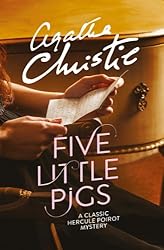
  • number written in letters – Five Little Pigs by Agatha Christie, a Poirot mystery
    first published in 1943. Caroline Crale was convicted of the murder of her husband, Amyas and died in prison. Sixteen years later, her daughter, a child of five at the time of the murder, asks Poirot to clear her mother’s name, convinced that she was innocent.
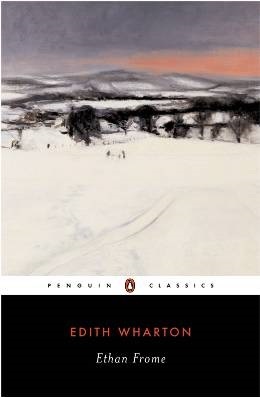
  • forename or names  Ethan Frome by Edith Wharton  a beautifully told tale €“ a tragedy, signalled right from the beginning of the book, when the unnamed narrator first saw Ethan Frome and was told he had been disfigured and crippled in a €˜smash up’, twenty four years earlier. Ethan Frome
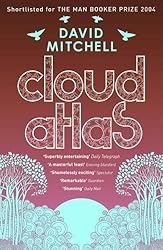
  • type or element of weather – Cloud Atlas by David Mitchell covers a time period from the 19th century to a post apocalyptic future. It’s not a book to read quickly; it requires patience, but on the whole I enjoyed it. I liked the change in style, suited to each time period, moving between straight narrative and letters and journal entries, encompassing historical fiction, thriller and sci-fi.

  • A book with a school subject in the title €“ The Brief History of the Dead by Kevin Brockmeier  fantasy fiction set some time in the future, about a place between heaven and earth, and the people who end up there after they’ve died and what happens to them. 

My favourite of these books is Ethan Frome by Edith Wharton.

Thanks to Charlie for an interesting challenge that helped me reduce my to-be-read piles.