The Shroud Maker by Kate Ellis

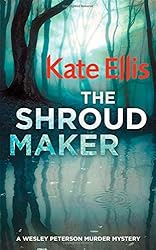
When I saw The Shroud Maker by Kate Ellis in the mobile library I thought I’d seen reviews of her books on other blogs, so I borrowed it. It is the eighteenth Wesley Peterson Mystery, but I think it reads well without knowing the background to the main characters. Although I suppose if I went back in the series I’d find that I know things that maybe I shouldn’t.

Summary:

It’s the Palkin Festival in Tradmouth, a town in Devon, when the body of a strangled women is discovered floating out to sea in a dinghy. A year earlier Jenny Bercival had disappeared from the festival and her mother returns to look for her bringing with her anonymous letters claiming she is still alive. DI Wesley Peterson and his boss DCI Gerry Heffernan are investigating the two cases. Are they connected and is there a link to a fantasy website called ‘Shipworld’ which features the 14th century mayor and privateer of Tradmouth, Palkin as a supernatural hero with a sinister, faceless nemesis called the ‘Shroud Maker’?

 When Wesley’s friend, archaeologist Neil Watson finds a skeleton on the site of Palkin’s warehouse, the question is whether an ancient crime has been uncovered, or is it Jenny’s body?

My view:

I liked the way the historical mystery intertwines with the modern one, through the archaelogical evidence, and the extracts from a 19th century biography of John Palkin written by his descendant, Josiah Palkin-Wright and letters from Josiah’s wife to her sister, worried about her marriage and that her sister does not reply. Kate Ellis’s style of writing is deceptively simple, so much so that the locations and characters came to life in my mind, whether it was Tradmouth in the past or the present.

There is plenty of mystery in this novel. I really had to concentrate to keep all the characters, red-herrings, twists and turns, and sub-plots in my mind. I thought I’d followed it as I read it, but now I’m not sure that I can give a clear account of what happened and why. However, as I do like complex mysteries I think I’ll have to look out for the first books in the Wesley Peterson series.

A note on the title:

From the title I thought that the ‘Shroud Maker’ would be a person who makes shrouds ie cloths used to wrap a body for burial, but that is not so in this book. Instead the name of ‘Shroud Maker’ is taken from a rope maker, shrouds being the ropes that support a ship’s masts. He or she is a mysterious figure, who in the Shipworld website appears as a faceless monster, wearing what looks like a white ski mask, a malevolent dark force.

The Author’s Note:

It didn’t take me long reading this book to realise that ‘Tradmouth’ is an inversion of the name of Dartmouth in Devon and Kate Ellis’s note at the end of the book clarifies that. She refers to Geoffrey Chaucer, the author of The Canterbury Tales which features a character called the Shipman, a seaman from ‘Dertemouth’, who like her own invented character, was little better than a pirate. She writes that during the 19th century people were fascinated with the medieval period, perhaps as a reaction against industrialisation and her fictional writings of Josiah Palkin-Wright reflected that interest. And coming up to the present day she reflects that fantasy fiction is as popular today as it ever was, with the influence of J R R Tolkien’s works and fantasy fiction websites.

Reading Challenges: R.I.P. Challenge, the My Kind of Mystery Challenge, and the Historical Fiction Reading Challenge.

The Brimstone Wedding by Barbara Vine

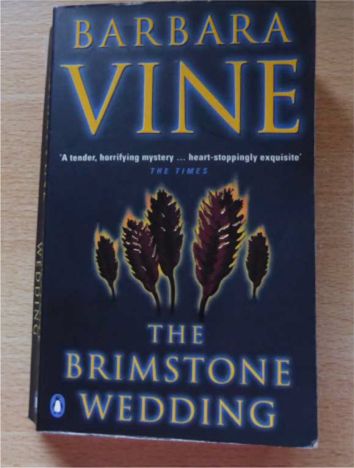
I’ve had The Brimstone Wedding by Barbara Vine sitting on my unread shelves for a while and when the R.I.P. IX Challenge came up I thought it would be a good book to include in the challenge, because the cover blurbs describe it as a ‘horrifying mystery’, ‘chilling’ and with a ‘horrible climax’.

Brimstone wedding

My copy is a second-hand paperback, which is no longer in print, but The Brimstone Wedding is available as an e-book.

Jenny Warner is a carer at a retirement home, Middleton Hall where she meets Stella Newland, who is dying of lung cancer. At first Stella never mentions her husband or her past life, but gradually she confides in Jenny, telling her things she has never said to her son and daughter – things about her life she doesn’t want them to know. 

Their stories intertwine, some narrated by Jenny and some by Stella as she records events in her life on a tape recorder which she leaves to Jenny.  They have more in common than Jenny initially thought and as Stella slowly reveals her past the tension in the book begins to mount.

The atmosphere is mysterious, a house isolated in the fens, seems to hold the key to the past. The description of the house is superb, set in an overgrown garden, with clothes still hanging in the wardrobe, food and champagne still sitting in the fridge and a red Ford Anglia locked in the garage. It’s all very subtle at first with tantalising hints about what had really happened in Stella’s past, but the full horror is left to the end, which by that time I was itching to find out if it was what I suspected it was. I was not disappointed; it’s not horrific in the overblown graphic sense, but in a sinister, psychological way that really is ‘chilling’ and inexpressibly sad.

Ruth Rendell, writing as Barbara Vine, writes beautifully and powerfully yet in a controlled manner, nothing is left out but there are no superfluous characters or sub-plots. Everything ties in well and the subtle horror of what I was reading gripped me. It is indeed a ‘chilling’ book. It’s about love, hate and indifference, about relationships between couples and families, and about obsession, deceit and betrayal.

Here are just a few quotations that I noted as I read. The opening sentences, set the scene and illustrate Jenny’s superstitious nature. Throughout the book there are numerous examples of her beliefs:

The clothes of the dead don’t wear long. They fret for the person who owned them. Stella laughed when I said that. She threw back her head and laughed in the surprisingly girlish way she had. I was telling her Edith Webster had died in the night and left cupboards full of clothes behind her, and she laughed and said she’d never known anyone as superstitious as me. (page 3)

and

When you deceive people you make fools of them. You make them act stupidly, act as if things which are aren’t and things which aren’t are. And that’s what fools do or people who are mentally disturbed and we look down on them for it or if we’re unkind we laugh at them. (page 17)

She is also aware of ill omens – a bird dying in your hand means your hands will shake for ever, it also means a death in the family and red and white flowers mixed are the worst possible omen at a funeral meaning there will be another death. I was wondering what significance the title has: Jenny has been married for thirteen years, which according to her mother is a ‘Brimstone Wedding’ anniversary. Jenny thinks:

Maybe because it’s explosive or because it’s hard and dark like a burning stone, which is what brimstone means. (page 231)

I think The Brimstone Wedding is one of the best of Barbara Vine’s books that I’ve read – nearly as good as A Dark-Adapted Eye and writing under her real name, Ruth Rendell, A Judgement in Stone. It certainly qualifies not only for the R.I.P. Challenge, but also for the Mount TBR Challenge 2014 and the My Kind of Mystery Challenge.

Catching Up

Half of September has gone! I’ve read 5 books and haven’t written about any of them (except for one and that’s for the Shiny New Books blog – more about that book later). The other four books are:

  1. The Goldfinch by Donna Tartt (on Kindle)
  2. Wycliffe and the House of Fear by W J Burley
  3. Testament of a Witch by Douglas Watt (on Kindle)
  4. The Moving Finger by Agatha Christie

It’s much easier to write about a book straight after I’ve read it, so today’s post is about the last book I’ve finished, which is The Moving Finger by Agatha Christie. I’ll try to nudge my brain into writing about the other books as soon as I can.

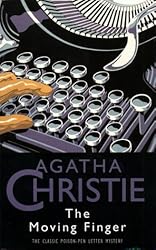
The Moving Finger is a book I’ve had for a few years now, so it’s one off my to-be-read shelves. It is described as a Miss Marple mystery, but as she doesn’t appear in the book until three-quarters of the way through and after there have been two deaths, she doesn’t have a big part, although she is instrumental in unveiling the murderer.

The story is narrated by Jerry Burton, who has recently moved into the market town of Lymstock with his sister, Joanna. His doctor had instructed him to move to the country where he can take things slowly and easily whilst he recovers from a flying accident. Lymstock seems to be a ‘peaceful backwater where nothing happens‘, but soon after the Burtons have moved in Joanna receives a very nasty anonymous poison-pen letter. They discover that other people have also received them, and soon afterwards Mrs Symmington apparently commits suicide followed by the death of her maid, Agnes, which is without doubt murder.

I liked The Moving Finger. As usual with Agatha Christie’s novels there are plenty of suspects, including Mrs Cleat, well-known as the ‘local witch’, and there are plenty of clues, with a good deal of misdirection throwing me into confusion about who could possibly be the culprit. She captures the nastiness of the anonymous letters well with their accusations of illicit sexual activities. I always think Agatha Christie excels with her dialogue. It’s all so natural and I have no difficulty following who is speaking. I was also convinced about the characters, especially Megan Hunter, Mrs Symmington’s twenty-year old daughter and her relationship with her step-father. Lymstock, itself is a place about fifty years behind the times, but by no means the ‘peaceful backwater where nothing happens‘ that Jerry Burton was seeking.

The police are eventually called in, in the person of Superintendent Nash who then requests help from an expert from London on anonymous letters – Inspector Graves. But the vicar’s wife, Mrs Dane Calthrop isn’t satisfied and brings in an expert of her own, an expert who ‘knows people‘, ‘someone who knows a great deal about wickedness‘ and that person is of course, Miss Marple.

The Moving Finger was first published in 1942 in New York and then in the United Kingdom in the spring of 1943. Along with the puzzle, Agatha Christie, speaking through her characters. makes several comments that interested me – on work/idleness for example. The local doctor’s sister, Miss Griffith, who is a Girl Guide leader, states that idleness is an unforgivable sin, and in response Jerry Burton says:

Sir Edward Grey … afterwards our foreign minister was sent down from Oxford for incorrigible idleness. The Duke of Wellington, I’ve heard, was both dull and inattentive to his books. And has it ever occurred to you, Miss Griffith, that you would probably not be able to take a good express train to London if little Georgie Stephenson had been out with his youth movement instead of lolling about, bored, in his mother’s kitchen until the curious behaviour of the kettle lid attracted the attention of his idle mind?

Another example – considering whether Providence/the Almighty/God would permit dreadful things to happen ‘to awaken us to a sense of our own shortcomings‘, Jerry Burton responds:

There’s too much tendency to attribute to God the evils that man does of his own free will. I might concede you the Devil. God doesn’t really need to punish us, Miss Barton. We’re so very busy punishing ourselves.

Re-reading at her detective novels, Agatha Christie wrote in her Autobiography:

I find that one I am really pleased with is The Moving Finger. It is a great test to re-read what one has written some seventeen or eighteen years later. One’s views change. Some do not stand the test of time, others do.

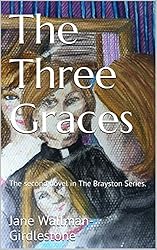
The Three Graces by Jane Wallman-Girdlestone

I’ve read a couple of novels this year that deal with mental illness – The Bell Jar by Sylvia Plath, which I found a bit confusing and disjointed and The Grass is Singing by Doris Lessing. My reaction to both books was that they are bleak and depressing, showing the breakdown of a personality and I struggled to read them. (See my thoughts on Doris Lessing’s book in this post.)

So, I was a bit hesitant about reading The Three Graces when I realised that it was a novel dealing with the subject of schizophrenia. I needn’t have been concerned as it is by no means a depressing novel. This is Jane Wallman-Girdlestone’s description of her book (taken from her website):

… Grace Hunter, the newly appointed Team Rector for the town, turns out to be nothing like people expect.  Nobody suspects that she has a guilty secret.  No one guesses that the local funeral director is the answer to the Rector’s prayers.  No one in their right mind would have thought that workaholic Grace was tormented by imaginary friends who dominated everything she did. 

My view:

Grace Hunter is trying to adjust to her new appointment as Team Rector, but her confusion grows as she begins to have hallucinations. It’s a remarkable book because although told in the third person at times I wasn’t sure that the people she sees were just in Grace’s head. I think it’s a very clever portrayal as the reader sees things through Grace’s eyes and mind whilst she is carrying on with everyday living and her job as Rector. Grace’s behaviour becomes reckless, at times divorced from reality. It clearly demonstrates how difficult/impossible it is for her to distinguish between what is real and what is not.

The Three Graces follows Grace’s life and to a lesser extent that of her family – husband Tom, Josh and Ros her step-children and her father-in-law, Charlie. They are all having to adjust to Tom and Grace’s marriage and the move to St Anthony’s, their third in five years. And they’re all feeling very unsettled. The dominant character in the novel is Grace; it all revolves around her and as her confusion grows it affects them all. It is an engrossing book, the writing is clear and concise, and the characters are clearly defined. It’s a well-structured novel, the tension and emotional atmosphere gradually rising and Grace’s feelings of despair and confusion and are all very evident. The book is certainly an enlightening read for me.

About the author (From Amazon):

Jane Wallman-Girdlestone was born and grew up in Tooting, South London. She began writing about her life experiences at eight. Jane taught briefly before working in theatre as a writer and director. She later worked as a Vicar and chaplain for some years before lecturing in Theology and Spirituality. Jane works with people who are on retreat offering creative and spiritual mentoring and as a counsellor.

Jane lives in the Highlands of Scotland in the UK, where she writes and paints. She is married and has three Newfoundland dogs and a cat.

The Three Graces is the second book in the Brayston series. Sausages and Trash is the first and the third, with the working title Sleight of Hand, will be published on Kindle in December. This will feature some of the characters from the first two books and I’ll be looking out for it.

NB:  The Three Graces is temporarily unavailable on Kindle.

Put On By Cunning by Ruth Rendell

Put On By Cunning, aka in America as Death Notes is another book off my to-be-read shelves, an enjoyable read. It was first published in 1981.

The epigraph indicates just what is to follow:

So shall you hear
Of deaths put on by cunning and forc’d cause;
Fall’n on th’inventors’ heads all this can I
Truly deliver.

Hamlet

It is a tale of great complexity, a tale of murder and conspiracy to murder. A wealthy old man, Sir Manuel Camargue, one of greatest flautists of his time is found dead. Ankle deep in snow he had lost his footing in the dark and slipped into an icy lake and became trapped. His heiress, his daughter Natalie, had only recently been reunited with him after an absence of nineteen years. Although it seems a straight forward death, Camargue’s much younger fiancée puts doubts in Chief Inspector Wexford’s mind when she tells him that Camargue had said that the woman who presented herself as Natalie was an imposter.

As is Wexford’s way he becomes obsessed with finding the truth and wonders if Camargue’s death was actually murder, despite the Chief Constable’s insistence that he forgets about it as the evidence all points to his death being an accident. Indeed, the verdict of the inquest is ‘Misadventure’. Wexford, however, is persistent in his doubts and convinced Natalie is an imposter, he is determined to investigate, which leads him to both California and France.

There is much I enjoyed in this, the eleventh Wexford book. It begins well, Ruth Rendell sets an excellent scene, and I could easily visualise the locations and characters, with beautiful descriptive passages. Inevitably, as both Wexford and Inspector Burden, begin to unravel the mystery more and more characters are implicated, until it really does seem a complex case becoming even more complicated, with too many coincidences and characters.

I thought that Wexford was keeping far too much to himself – leaving both Burden and me too much in the dark. The ending came as somewhat of an anti-climax as Wexford explained what had really happened and revealed all the false leads. Still, it kept me guessing to the end and I wondered (as I often do) just what clues I had missed along the way.

And now I’m wondering if I could attempt a ‘Ruth Rendell/Barbara Vine Reading Challenge’, along the lines of the ‘Agatha  Christie Reading Challenge’, ie to read all her books. I’ve read several already.

The Reluctant Detective by Martha Ockley

17742272I had little idea what to expect from Martha Ockley’s first Faith Morgan mysteryThe Reluctant Detective as I hadn’t come across the author before and all I had to go on was the description on LibraryThing’s Early Reviewers page last month:

‘Former cop Faith Morgan may have quit the world of crime, but crime has not let her go. Now a priest in the Church of England, she is assigned to the improbably named village of Little Worthy, and within an hour of her arrival she witnesses the sudden, shocking death of a fellow priest. To her distress, the detective assigned to the case is Ben, her former partner and former boyfriend.

As she meets her parishioners she learns some surprising details about her apparently well-loved predecessor, and starts to suspect a motive for his death. The cop may have donned a clerical collar, but the questions keep coming. How will she reconcile her present calling with her past instincts? Is she in danger herself? What should she do about Ben?’

I thought a detective who  was a priest and who used to be a policewoman sounded interesting. So, I am very pleased that The Reluctant Detective turned out to be a good read. Faith Morgan is a well-rounded character; she’s very likeable, observant, compassionate and the sort of person that people feel comfortable talking to – a bit like a young Miss Marple. Indeed, the book has an Agatha Christie feel to it – set in an apparently idyllic country village, with interesting and somewhat quirky characters and although there is one rather gruesome death, it’s not a gory thriller. In short it’s the type of murder mystery that I like, with plenty of complications that kept me guessing about the identity of the murderer for most of the book.

The church and village location are convincing. The parish church of St John is an old building dating from Saxon times, with a tower and church bells, set in the English countryside:

Faith avoided the main approach and followed a gravel path around the back of the church. A creamy cloud of ivory clematis cascaded over a grey stone wall. Beyond a solitary pony raised its chestnut head to gaze mournfully at her from a field of weeds. Some way off squatted a group of ramshackle farm buildings. (page 9)

Faith’s ex – Detective Inspector Ben Shorter, reluctantly allows Faith to contribute to the search for the murderer and the chemistry between the two of them is clearly evident even though he can’t understand why she left the police force for the church. Indeed, Faith herself wonders if she has done the right thing, cutting herself off from her old life and her old self as she realises that she likes investigating, and analyzing people, their expressions and body language and working out what makes them tick. But these are assets for a priest as well as for a police officer. And as for death:

It struck Faith how death is always startling, facing us with the greatest mystery: how the particular and the individual can vanish from this world so completely in a moment. (page 17)

The back cover reveals that Martha Ockley lives in the North East of England and has close links with the church, having grown up as the daughter of a minister. She is a full-time writer of both fiction and non-fiction. I was curious about Martha Ockley and wondered why she had given ‘special thanks to Rebecca Jenkins’ on the title page, so I searched online and discovered that ‘Martha Ockley’ is actually a pseudonym of Rebecca Jenkins, the daughter of the Rev David Jenkins, formerly the Bishop of Durham.

Thanks to LibraryThing and Lion Fiction/Kregel Publications for providing a copy for review. Based on my reading of The Reluctant Detective I shall certainly seek out more books by Martha Ockley/Rebecca Jenkins. There are two more Faith Morgan books:

  • The Advent of Murder
  • A Saintly Killing (to be published in October 2014)

And writing as Rebecca Jenkins:

The R F Jarrett books (the Regency Detective)

  • The Duke’s Agent (1997)
  • Death of a Radical (2010)

also Non Fiction:

  • Free to Believe (David Jenkins and Rebecca Jenkins (1991)
  • Fanny Kemble: a reluctant celebrity (2005)
  • The First London Olympics 1908 (2008)