Zen There Was Murder by H. R. F. Keating

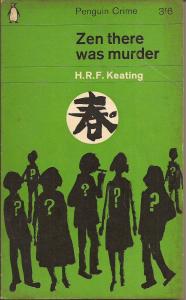
I don’t think I’ve read anything like Zen There Was Murder, a mixture of Zen Buddhism and murder. It was the second book H R F Keating wrote, first published in 1960 and then published in 1963 by Penguin Books in their green Penguin Crime series. (This cover is much more appropriate than the Bloomsbury Reader e-book cover showing guns)

It was the Zen Buddhist setting that made it difficult for me to get to grips with the murder. In fact it is practically halfway into the book before the murder actually takes place. The first half is taken up with introducing the characters, gathered together for a course on Zen Buddhism.  There is a schoolteacher, Alasdair Stuart, a clergyman, the Rev. Cyprian Applecheek, Miss Olive Rohan, Miss Flaveen Mills, Honor Brentt, a jounalist and her husband, Gerry Manvers, and Jim Henderson, an Irishman from Ulster.

None of them know anything about Zen and much time is spent with them trying to understand what it is. Mr Utamaro, the lecturer comes out with various sentences, such as ‘Books about Zen are legs on a snake‘, saying you cannot understand Zen by reading a book about it and applying the principles of logic to what you read, and tweaking Alasdair’s nose saying, ‘this is Zen‘, as well as using koans, such as ‘what is the sound of one hand clapping?‘ But they fail to understand, saying it is nonsense. Mr Utamaro agrees.

Mr Utamaro shows them a sword, locked in a glass showcase. The sword, a wakizashi, is one of pair used by samurai for hari-kiri, and on the evening of the first day Mr Utamaro discovers that the sword has been taken from the case, leaving it intact and without setting off the alarm. And then Flaveen is found dead, the sword driven into her body up to the hilt.

The clue to discovering the identity of the murderer is in solving who is telling lies  and why.  For most of the time I was completely bamboozled and kept wondering just how the two German girls employed to make the beds and do the cooking fitted into the mystery. Their conversations regularly interrupt the narrative as they comment on the characters and the events taking place.

All in all this book has a surreal feel about it. It’s not just a puzzle type of murder mystery but as Keating explained in an interview with Dale Salwek in Mystery Voices: Interviews with British Crime Writers it is also making a point about something you believed:

And the thing I believed in, one of the things that bugged me most, was the subject of telling lies, which is fine for a detective story. And that was how I came to write my second, Zen There Was Murder, which is really more about telling lies than about Zen.

When writing the second book, I thought I could say something about telling lies. At that time, too, Zen Buddhism was a fad over here, and so for the background of the book, I took Zen, which does reflect very much on lies. I found I could say things about lies by giving each of the characters a different viewpoint on telling lies – ranging from one of those people who absolutely objects to lying in any way to the sort of pathological liar. And I made the whole book turn on that. (pages 64-65)

H R F Keating (1926 – 2011) was chairman of the Crime Writers’ Association (CWA) (1970’“71), chairman of the Society of Authors (1983’“84) and president of the Detection Club (1985’“2000). He was a fellow of the Royal Society of Literature.  His most famous novels are the Inspector Ghote books (I have just one on my TBR shelves – Inspector Ghote’s Good Crusade, the second in the series).  For more information about Keating see this article by Martin Edwards.

I’ve had this book for about three years, so it qualifies for the Mount TBR Reading Challenge 2015 and it is also one of the books I listed for the 10 Books of Summer Challenge, and the TBR Pile Challenge.

The Outcast by Sadie Jones: Book and TV

The Outcast

As I wrote earlier The Outcast by Sadie Jones is a book that has sat unread on my shelves for seven years until I noticed that it was being broadcast as a TV drama. I read half the book before the first episode and finished it before the second episode was broadcast.

First of all the blurb from Goodreads:

1957, and Lewis Aldridge is travelling back to his home in the South of England. He is straight out of jail and nineteen years old. His return will trigger the implosion not just of his family, but of a whole community. A decade earlier, his father’s homecoming casts a different shape. The war is over and Gilbert has recently been demobbed. He reverts easily to suburban life – cocktails at six thirty, church on Sundays – but his wife and young son resist the stuffy routine. Lewis and his mother escape to the woods for picnics, just as they did in wartime days. Nobody is surprised that Gilbert’s wife counters convention, but they are all shocked when, after one of their jaunts, Lewis comes back without her. Not far away, Kit Carmichael keeps watch. She has always understood more than most, not least from what she has been dealt by her own father’s hand. Lewis’s grief and burgeoning rage are all too plain, and Kit makes a private vow to help. But in her attempts to set them both free, she fails to predict the painful and horrifying secrets that must first be forced into the open. As menacing as it is beautiful, The Outcast is a devastating portrait of small-town hypocrisy from an astonishing new voice.

The TV adaptation, also written by Sadie Jones is faithful to the book, so for once I could enjoy them both – although maybe enjoy isn’t quite the right word. The TV drama is, of course a condensed version and whilst the cast was good the characters didn’t, of course, match up to my mental image of them whilst reading the book. I thought the boy (Finn Elliot) playing the young Lewis was excellent, whereas the adult Lewis (George MacKay) just didn’t seem to be right physically in episode one. However, he was much more convincing in the second episode. Overall, the themes of the book and the drama are relentlessly depressing, in post-war Britain, the men all maintaining a stiff upper lip, emotions securely repressed. Lewis witnessing his mother’s drowning is unable to express his grief and things just go from bad to worse as he resorts to self-harm.

Meanwhile, the Carmichael family, not fully portrayed in episode one, have a secret, again closely guarded in a world where child abuse is just not acknowledged. In episode two the secret comes out in a dramatic scene, which I thought was really well done. Nathaniel Parker as Dicky Carmichael made a terrifying bully and Jessica Barden as the teenager, Kit was impressive.

The book is written in the passive 3rd person narrative, which I wasn’t keen on. I didn’t like most of the characters, I didn’t like what happened to them and I’m not sure the ending is believable – it left me wondering what really happened next. But the descriptive passages are good, the characters of Lewis and Kit are well-defined, emotions are racked up high and it is truly tragic.

I’m glad I read the book before watching the drama – and I’m glad I watched it, the scenery is beautiful and the repressed and yet emotional atmosphere came over better than in the book.  I did have to watch behind my fingers at some scenes, which I was able to read without visualising them completely, but when it’s there in front of you on the screen it’s not so easy to cast a blind eye. Although you get an insight into Lewis’ mind and feelings when you read a description of him cutting his arm, it’s not as real as seeing it happen.

So, a powerful story, which compelled me to read on and also to watch. This was Sadie Jones’ debut novel. She has since written Small Wars (2009), The Uninvited Guests (2012) and Fallout (2014). I have Small Wars amongst my TBRs – I must dig that one out soon.

Reading challenges: Mount TBR 2015 and the Historical Fiction Reading Challenge 2015.

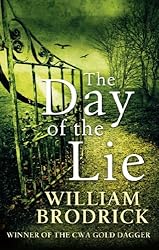
The Day of the Lie by William Brodrick

William Brodrick’s books are meaty, books that make me think. Nothing is straight forward, they’re layered books, delving into the past, uncovering secrets and revealing crimes. They are well researched, bringing the past to life.

In The Day of the Lie (the 4th Father Anselm book) the past in question is post Second World War Poland, covering  the early 1950s, the early 1980s and the present day.

Blurb from the back cover of my paperback copy:

In present day Cambridge, Father Anselm receives a visit from an old friend with a dangerous story to tell – the story of a woman in Eastern Europe in the icy grip of the Cold War. She was brave, brilliant … and betrayed by someone close to her – someone still unknown. What became of this woman and the dark secret she kept?

No one can be trusted. Nothing is as it seems. Before more blood is spilt, Anselm must peel back years of history, decades of secrets and a half-century of lies in order to expose a secret so shocking that some would rather die than see it revealed.

Father Anselm’s old friend John has asked him to investigate who had betrayed  Roza Mojeska. She had been part of an underground resistance movement, had been arrested and tortured by the secret police, in particular by Otto Brack, in order to uncover the identity of the Shoemaker, the author of a dissident newspaper, Freedom and Independence.

Never explicitly graphic, Brodrick conveys the horror of the torture chamber and as Anselm’s Prior warns him he had to enter ‘the world of Otto Brack, this frightening man who learned how to bring about evil by exploiting someone who is good, laying – in part – the evil at their door.‘ (page 75-6) It’s a world where ‘twisted people lead twisted lives and the roads they build around them are never straight and true.’

My knowledge of the period is limited, so I found the historical setting quite difficult to follow, as the narrative switches between the time periods, but once I had sorted out the relationships between the characters (or I thought I had) it became clearer. But there is also the problem of working out who is ‘good’ and who is ‘bad’, just who is telling the truth, whose recollection of the past is ‘correct’? I thought I knew, but then there was a shift and I wasn’t sure right up to the end of the book.

Looking back on the book now (I finished reading it over a week ago) I can say I did enjoy it, but it was hard work in parts.

William Brodrick became a barrister, having been an Augustinian monk for six years (the other way round from his fictional character, Father Anselm). After 10 years at the Bar, his interest in writing led him to writing the Father Anselm books.

The Father Anselm books (with links to my posts) are:

  1. The Sixth Lamentation (2003)
  2. The Gardens of the Dead (2006)
  3. A Whispered Name (2008) – the best one in my opinion
  4. The Day of the Lie (2012)
  5. The Discourtesy of Death (2013)

And the latest book has just been published:

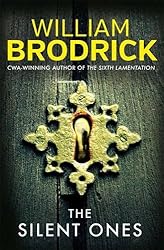
The Silent Ones by William Brodrick published 2 July 2015.

The Day of the Lie fits into the Mount TBR Challenge and is also a book I identified as one for the 10 Books of Summer Challenge.

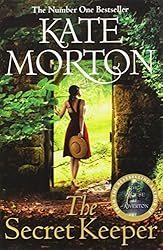
The Secret Keeper by Kate Morton

This is a book that really captured my imagination. I loved everything about it – the descriptive passages, the mystery, the secrets and the people involved. It was all real to me. It’s one of the best books, if not the best book, I’ve read this year.

The Secret Keeper by Kate Morton has been sitting unread for two years on my bookshelves, but if I’d read it earlier I wouldn’t have had the pleasure of reading it now – it was well worth the wait!

It begins on a summer’s day in 1961 in Suffolk when sixteen-year old Laurel is shocked when she sees her mother stabbing a stranger who had come to their farm. Fast forward 50 years Laurel and her three sisters and brother are coming to terms with the fact that their mother, Dorothy is moving closer to the end of her life. Laurel realises that there is so much she doesn’t know about Dorothy’s life and when they find a photograph of Dorothy and a friend, Vivien, in a book of the play Peter Pan, it arouses old and ugly memories for Laurel – images of her mother’s frightened face as she confronted the stranger. Who was Vivien and who was the stranger? Why was Dorothy so scared? Laurel is determined to find out.

It’s a story moving between time periods from 2011, back to the 1960s and also to the 1940s when Dorothy first met and fell in love with Jimmy, a war photographer, and also became friends with the wealthy and beautiful Vivien, married to a successful novelist.  Laurel, with the help of her brother, Gerry, tracks down records throwing light on Dorothy’s and Vivian’s past, back to war-time England and pre-war Australia.

It’s not a straight forward story. By that I don’t mean it’s difficult to read, because each time period is clearly headed and the characters are clearly defined. But there are so many twists and turns – I thought several times I’d got things clear and knew where the story was heading only a bit later on to realise that not all the clues had been revealed and I had to revise my thoughts. It’s so cleverly written and so well plotted that it was only near the end that I had an inkling of Dorothy’s relationship with Vivien and what had really happened to them all. It really is a book I didn’t want to put down and also a book I wanted to enjoy as long as possible. By the end, though, I couldn’t turn the pages fast enough!

Kate Morton’s next book, The Lake House is due to be published in October 2015. I’m looking forward to reading it.

Note: as well as being my 17th book for the Mount TBR Challenge 2015 this is my 3rd book for the TBR Pile Challenge 2015. And the 9th book for the Historical Fiction Reading Challenge 2015.

A Game For All the Family by Sophie Hannah

I’ve recently finished reading A Game For All the Family by Sophie Hannah, a standalone book, described as ‘ a literary puzzle to unlock the dark side of the mind.’

Publishers’ blurb:

Justine thought she knew who she was, until an anonymous caller seemed to know better…

After escaping London and a career that nearly destroyed her, Justine plans to spend her days doing as little as possible in her beautiful home in Devon.

But soon after the move, her daughter Ellen starts to withdraw when her new best friend, George, is unfairly expelled from school. Justine begs the head teacher to reconsider, only to be told that nobody’s been expelled – there is, and was, no George.

Then the anonymous calls start: a stranger, making threats that suggest she and Justine share a traumatic past and a guilty secret – yet Justine doesn’t recognise her voice. When the caller starts to talk about three graves – two big and one small, to fit a child – Justine fears for her family’s safety.

If the police can’t help, she’ll have to eliminate the danger herself, but first she must work out who she’s supposed to be…

Practically from the start I had my doubts about Justine. Was she an unreliable narrator? Could I believe her story, told in the third person but revealing what was going through her mind? Or was her daughter Ellen right when she told her mother that she was a ‘nutter‘? That sense of distrust pervaded my reading. Obviously something had happened to make Justine give up her job in TV drama production and want to ‘do Nothing’, something traumatic and life-changing – had it affected her mental stability or had it happened because she was mentally unstable? I couldn’t decide.

What I can say is that it’s a book about the truth – just who is telling the truth, just who is who they purport to be, and most of all about identity. Who is real, who is making it all up (well Sophie Hannah, obviously).

It is described as a ‘chilling ‘ novel, but I didn’t find it spine tingling, or scary, because it came over to me as artificial, and contrived. It’s also long-winded and mostly completely unbelievable, which made it lose any sense of tension or suspense. But it is a cleverly complicated plot, with stories within stories, – it’s just not chilling.

As well as the anonymous threatening phone calls, and the head teacher’s denial that George had not been expelled and indeed her insistence that he had never even been at the school, Justine is also puzzled by the story that Ellen is writing for her creative writing homework – a story set in their house about a strange family who had lived there in the past and a murder that had taken place there. Where did Ellen get this story, is it based on fact? Ellen simply won’t tell her. Are the phone calls connected to this story and to George?

Maybe it’s too complicated, because at times I just wished the endless questions that went through Justine’s mind would come to an end. They did of course and by the time I did get to the end I still couldn’t decide whether Ellen was right – is Justine a nutter and as I suspect an unreliable narrator, or not?

I didn’t love this book, but it certainly filled my mind and made me think both whilst I was reading it and for days afterwards – and I like that about a book. If Justine is a reliable narrator and was telling the truth all along then she is still a nutter, because if what she described actually happened at the end of the story it was terrible and she was mentally ill and in that case, definitely a chilling ending. I just can’t decide! It is an extraordinary and weird book.

My thanks to Lovereading for sending me an uncorrected proof copy of this book that has had me puzzling for days. A Game For All the Family is due to be published on 13 August 2015 by Hodder & Stoughton.

Sad Cypress by Agatha Christie

Sad Cypress, first published in 1940, is a most satisfying mystery, in which Hercule Poirot discovers that almost everyone he talks to is lying. Only the doctor, Peter Lord, believes that Elinor Carlisle did not kill Mary Gerrard, her rival in love, despite the fact that it seems that only Elinor had the motive, the opportunity and the means to poison Mary with morphine hydrochloride. Peter, who is in love with Elinor, appeals to Poirot to prove that she is innocent.

Sad Cypress has a clever and most complicated plot, as is usual in an Agatha Christie book, and it kept me guessing right to the end. Her portrayal of Elinor is excellent – on the surface a calm, almost detached character underneath she is in turmoil, full of repressed passion and unrequited love as it becomes obvious to her that Roddy, her fiancé does not in fact love her and this leads her into actions that seem to point to her guilt.

Then there are the social and cultural themes that always interest me in Agatha Christie’s books. There is the clear distinction between the classes, knowing one’s place in society shown in the relationships between Elinor and Mary, and the almost comic depiction of the two nurses, Nurse O’Brien and Nurse Hopkins, with their gossip over cups of tea. Other themes are the nature of love, and the basis for a happy marriage, the damage caused by family secrets, the ethics of euthanasia, and the difference between thinking about murder and actually committing murder.

This book, if not the best of Agatha Christie’s books, is easily one of my favourites.  I quoted the opening paragraph of Sad Cypress in My Friday Post earlier this month.

The cover photo shown above is my own copy. Details of the latest edition are:

  • Paperback: 288 pages
  • Publisher: HarperCollins (21 May 2015)
  • Language: English
  • ISBN-10: 0008129576
  • ISBN-13: 978-0008129576

This is the first of my books for the 10 Books of Summer 2015 Challenge.