The Dancer at the Gai-Moulin by Georges Simenon

The Dancer at the Gai-Moulin (Maigret #10)

Penguin is publishing the entire series of Maigret novels in new translations. This novel has been published in a previous translation as Maigret at the “Gai-Moulin”.

The Dancer at the Gai-Moulin by Georges Simenon, translated by Siân Reynolds is one of the early Maigret books, first published in 1931. Two teenage boys, Delfosse and Chabot, attempt to burgle Le Gai-Moulin, a nightclub in Liege in Belgium, but on finding a body they panic and leave, fearing they’ll be suspected of murder. The next day, to the boys’ amazement, the corpse is found in the Botanical Gardens in a large laundry basket in the middle of a lawn. Who was he, who killed him, why was he killed and who had moved the body from the nightclub to the Botanical Gardens?

This short book is mainly concerned with Delfosse and Chabot and their subsequent actions that set them at odds with each other and land them in police custody. It’s an unusual Maigret book in that Detective Chief Inspector Maigret is not immediately involved in the police investigation – that is carried out by Chief Inspector Delvigne of the Belgian police and part of the mystery is why Maigret is even in Liege. Adèle is the dancer referred to in the title but she doesn’t play a major role in the book, although the two teenagers are obsessed with her. It’s quite a puzzle and Maigret doesn’t reveal his thoughts, or his reasoning until the end, much to the annoyance of Delvigne.

The plot is unconvincing and Maigret’s actions seem quite implausible, but that didn’t spoil my enjoyment of this book. It’s not really the crime that is in focus, as Simenon is skilled at setting the scene and drawing convincing characters in a few paragraphs. In this novel the two boys and Adèle stand out:

She wasn’t beautiful, especially now, lounging about in her mules and shabby peignoir. But perhaps, in the familiarity of this intimacy, she held even more allure for him.

How old was she, twenty five, thirty? She’d certainly seen life. She often talked about Paris, Berlin, Ostend. She mentioned the names of famous nightclubs.

But without any excitement or pride, without showing off. On the contrary. Her main characteristic seemed to be weariness, as could be guessed from the expression in her green eyes, from the casual way she held a cigarette in her mouth, from all her movements and smiles. Weariness with a smile. (page 28)

I knew that Simenon was a prolific author, writing seventy five novels and twenty eight short stories featuring Maigret, but I was surprised to find that The Dancer at the Gai-Moulin was the 10th book that he published in 1931. By the end of 1931 his books had been translated into 18 languages.

  • Paperback: 160 pages
  • Publisher: Penguin Classics (7 Aug. 2014)
  • Language: English
  • ISBN-10: 0141393521
  • ISBN-13: 978-0141393520
  • Source: my own copy – thanks to Sarah’s Giveaway at Crimepieces blog
  • My rating: 3.5*

This book slots into the only reading challenge I’m doing this year – What’s in a Name 2018. It fits into the category of a book with the word ‘the‘ used twice in the title. It is also one of my TBR books (a book I’ve owned prior to 1 January 2018) and also a book on my Classics Club list.
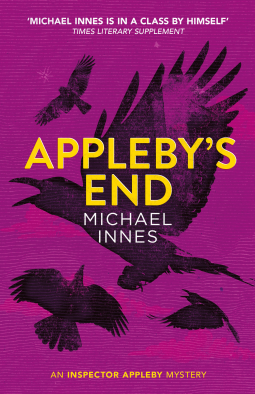
Appleby’s End by Michael Innes

3*

Appleby’s End was first published in 1945.

Description

The Way of All Flesh by Ambrose Parry

Edinburgh, 1847. City of Medicine, Money, Murder

Canongate Books|30 August 2018|417 pages|Review copy|5*

The Way of All Flesh is the debut novel from Ambrose Parry: co-written by best-selling crime writer Chris Brookmyre and consultant anaesthetist Dr Marisa Haetzman.

I knew as soon as I began reading The Way of All Flesh that I was going to enjoy it – it’s historical crime fiction at its very best.

Full of atmosphere and historical detail, I could easily believe I was there in Edinburgh in 1847 as Dr James Young Simpson, a professor of midwifery, discovered the anaesthetic properties of chloroform. It combines fact and fiction most successfully, the social scene, historical and medical facts slotting perfectly into the plot.

It begins with the death of Evie, a prostitute in Edinburgh’s Old Town, found by Will Raven, a young medical student about to start his apprenticeship with Dr Simpson. Will, Evie’s friend is suspicious, the place was reeking of drink and Evie’s body was in a state of contortion. He flees the scene, not wanting to be implicated in her death. There is a mystery surrounding Will – he has a past that he wants to conceal, and he is in trouble with a couple of villains who beat him, slashing his face when he is unable to repay his debt to a moneylender.

Will is anxious to fit in with the more genteel society of the New Town, where Dr Simpson has his surgery, a place where people from all levels of society congregated – the poor who attended his clinics, the wealthy who also wanted treatment, and the medical students and colleagues experimenting with new drugs and medical techniques. When Will comes across similar deaths during his work with Dr Simpson he is determined to find out who is responsible  – was it the same person who had killed Evie?

Sarah, Dr Simpson’s housemaid is an ambitious and enterprising young woman who would love to have a career in medicine just like the male medical students. Initially she dislikes Will, but eventually they join forces to uncover the killer in the depths of Edinburgh’s dark underworld . Through Sarah’s eyes we see the frustrations and limitations that all women experienced and through Will’s eyes we see the grim realities and danger that women at all levels of society faced with childbirth and unwanted pregnancies, and the brutally primitive state of the medicine of the period. The medical scenes are indeed gruesome and the attitudes of some of the clergy with their opposition to the use of anaesthetics is deplorable. The authors have combined their specialities to provide a compelling murder mystery interwoven with the exciting discovery of chloroform and how it transformed surgery.

This is without doubt an impressive and well written book that gripped me throughout – definitely one of the best books that I’ve read so far this year.

And I am so pleased that this is not the end of Will as Chris and his wife, Marisa are planning more novels revealing the development of medicine and the part that the Simpson household played. Also, I see that Benedict Cumberbatch’s SunnyMarch production company has secured the TV rights to The Way of All Flesh.

Thank you to Canongate Books and NetGalley for my copy of this book for review.

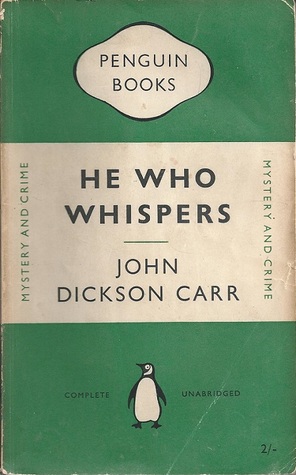
He Who Whispers by John Dickson Carr

He Who Whispers by John Dickson Carr was my Classics Club Spin book for August. It was first published in 1946. Carr (1906 – 1977) was an American writer who also wrote under the pseudonym of Carter Dickson and Carr Dickson. In 1936 he was elected to the Detection Club in London. He Who Whispers is one of his ‘locked room’  mysteries/impossible crimes, featuring Dr Gideon Fell, an amateur sleuth.

He Who Whispers by John Dickson Carr

I really didn’t know what to expect so I was pleased to find that I thoroughly enjoyed this book. It’s well written, set in 1945 just after the end of the Second World War when Miles Hammond is finding it hard to getting used to peacetime. London is still showing the scars of the war and he feels that his life is unreal. He has been discharged from the Army after being in hospital suffering from diesel-oil poisoning.

Then, gasping out to the end like a gauleiter swallowing poison, the war is over. You come out of hospital – a little shakily, your discharge papers in your pocket – into a London still pinched by shortages; a London of long queues, erratic buses, dry pubs; a London where they turn on the street-lights and immediately turn them off again to save fuel; but a place free at last from the intolerable weight of threats.

People didn’t celebrate that victory hysterically, as for some reason or other the newspapers liked to make out. What the newsreels showed was only a bubble on the huge surface of the town. Like himself, Miles Hammond thought, most people were a little apathetic because they could not yet think of it as real. (page 6)

His friend, Dr Gideon Fell, has invited him to dinner as a guest at the Murder Club, their first meeting in five years, where the speaker is Professor Rigaud. But when he arrives he finds none of the members of the Club have turned up. The only other people there are the Professor, and a beautiful blonde called Barbara Morell. Rigaud, however, tells them the story he had prepared for the Club – a tale of an impossible murder on the top of a ruined tower, that had once been part of a French chateau burnt down by the Hugeunots in the 16th century, and a mysterious woman, Miss Fay Seton.

The body of Howard Brooke was found lying on the parapet of the tower by two children between 10 minutes to 4 and 5 minutes past 4. He had been stabbed through his body with a sword-stick and yet the evidence showed conclusively that during this time not a living soul came near him. Rigaud points out the difficulties of scaling the wall of the tower, leading Miles to suspect he is alluding to ‘some sort of supernatural being that could float in the air‘ – in other words, a vampire.

Now, six years later Miles, Rigaud and Barbara together with Dr Fell set about trying to solve the mystery. I was fascinated by Dr Fell, supposedly based upon G. K. Chesterton (author of the Father Brown stories), in his appearance and personality. He’s immensely tall and fat, with a big mop of grey-streaked hair, and wearing a long, dark cape. He strides along ‘with a rolling motion like an emperor, and the sound of his throat-clearing preceded him like a war-cry‘.

I thought the characterisation was excellent and there is a great sense of location. The book is full of tension and there is a real sense of approaching danger and disaster as the characters struggle to uncover the truth. It is only due to Dr Fell’s ingenuity that their fears are calmed and he produces a rational explanation and reveals the truth. I too was puzzled and the book had kept me guessing right to the end. Even then when I knew what had happened I was so involved with the characters that  I was left wondering –  what happened next? 

Now, I’m keen to read more of John Dickson Carr’s books. There are a lot of them – see the list at Fantastic Fiction.

  • Paperback: 206 pages
  • Publisher: Penguin Books in association with H.Hamilton (1953)
  • Source: I bought my copy
  • Rating: 4*

The Story Keeper by Anna Mazzola


The Story Keeper

4*

The Story Keeper is historical fiction set on the Isle of Skye in 1857 where Audrey Hart has been employed by Miss Buchanan to collect the folklore and fairy tales of the local community. The Highland Clearances have left their mark on the crofters leaving them suspicious and fearful, unwilling to talk to Audrey as both the clergy and schoolmasters have condemned their practice of the old traditions – the stories are being lost.

The novel stresses the importance of folk tales – stories that have been told to make sense of the world and reflect people’s strengths, flaws, hopes and fears. Such stories are interspersed throughout the book. When one by one young girls go missing from their homes  the locals believe they have been taken by the spirits of the unforgiven dead. For these are not tales of good fairies, but of malign spirits that torment the girls they have stolen, sometimes returning them, ‘sorely changed’.

This is a novel full of family secrets and unfulfilled desires. There is a mystery about Audrey, her background and why she wanted to come to Skye. At first she believes there is a rational explanation to the girls’ disappearance but gradually she comes to fear that there may be something more supernatural behind it – linked maybe to the mystery of her mother’s disappearance years earlier on Skye.

It is beautifully written with vivid descriptions of the island, the flocks of black birds that whirl above the house that stands like an enchanted castle or a fortress on the coast. From a slow start the pace of the book rises to a crescendo in a dramatic and horrific ending combining the supernatural with reality, and tales of cruel fairies with the brutality of human beings. I loved the setting, the characterisation and the mix of history with folklore and fairy stories.

Thank you to the publisher, Tinder Press for my copy of this book for review.

By Sword and Storm by Margaret Skea

By Sword and Storm (The Munro Scottish Saga Book 3)

Two of the best historical fiction books I’ve read in recent years are Margaret Skea’s Munro Scottish Sagas, Turn of the Tide,  and A House Divided, both of which transported me  back in time to 16th century Scotland and France, specifically to the world of the feuding clans of Cunninghame and Montgomerie.

By Sword and Storm is the third book in the Munro Saga. It stands well on its own but I recommend reading the earlier books to get the whole picture of what happened in the years before. It is now 1598 and the Munro family, Adam, his wife, Kate, and children, Robbie, Maggie and Ellie  are living in France. Adam and Robbie are in the Scots Gardes, serving Henri IV of France: Adam is a colonel  and Robbie is a sergeant.  The Scots Gardes were an elite Scottish regiment whose duties included the provision of a personal bodyguard to the French King.

The story is well grounded in research and based on historical facts, seamlessly interweaving fact and fiction. It is  complex novel with several plot lines, locations and characters, some based on real historical figures and others fictitious, such as the Munro family. There’s a useful list of the main characters and a map at the start of the book and a glossary and historical note at the end.

As the story begins the French Wars of Religion are drawing to an end and the Edict of Nantes has established religious freedom, placating the Catholics whilst making concessions to the Huguenots – but not in Paris or at the French court, where Protestants are still banned from openly practising their religion. When Adam saves Henri’s life as a shot is fired from the crowd, he and his family are summoned to live at the French court, despite their religious beliefs. Life in Paris holds many dangers for the Munros, especially for Robbie when he falls in love with a girl from a Huguenot family.

Back in Scotland some members of the Cunninghame and Montgomerie factions are still feuding, notably Hugh Montgomerie, the Laird of Braidstane and William, the son of the head of the Cunninghame clan, whilst other clan members try to maintain the peace.  James VI has banned duelling but that doesn’t deter Hugh and William. Meanwhile, Hugh’s wife, Elizabeth, pregnant and left on her own in the depths of winter with only her children and a servant for company, faces her own dangers.

There is so much to enjoy in this book – first of all the story itself, expertly narrated, full of tension and surprise, and also the characters. But I also loved the personal touches, revealing what life was like in the 16th century,  how both ordinary people and royalty lived, and the dangers that faced them in their daily lives, particularly for women in childbirth and sickness and for those who dissented from the established religion.

I loved all the details about the French court, in particular about Henri’s mistress and the relationship between her and Kate. As in the earlier books Margaret Skea writes such beautifully descriptive passages, bringing to life the details of the French court and of the landscape in both Scotland and France as well as the dangers of travelling by sea.

This is ostensibly the end of the Munro saga – but Margaret Skea has revealed on her blog that she is hoping to revisit the Munro story at a later date. I hope she does, but if not this is an excellent end to the series.

  • Format: Kindle Edition – also available in paperback
  • File Size: 1339 KB
  • Publisher: Corazon Books (Historical/Saga) (11 July 2018)
  • Source: Advance copy from the publisher
  • My rating 4*