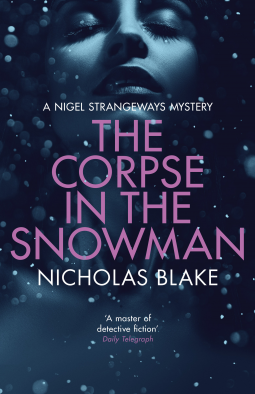
The Corpse in the Snowman by Nicholas Blake

A Golden Age Mystery

Publication date 2017, Ipso Books, 305p. First published as The Case of the Abominable Snowman in 1941 by Collins UK (The Crime Club)

Review copy from the publishers, Ipso Books, via NetGalley

My rating: 3 stars

I enjoyed The Corpse in the Snowman by Nicholas Blake* a vintage murder mystery with a complicated plot. There’s a death and a body hidden in a snowman that is only discovered when a thaw sets in. It is set in 1940 in an isolated country house with a closed cast of characters and an amateur detective, Nigel Strangeways, helping the police and eventually solving the mystery. There are numerous twists and turns and red herrings before the murderer is revealed.

Easterham Manor in Essex, the home of the Restorick family is cut off from the neighbouring village by snow. Strange things have been going on. On Christmas Eve the family and their guests had gathered in what was said to be a haunted room waiting to see if the ghost would appear when  Scribbles, the family cat  sprang at a corner of the room and repeatedly struck her head against the wall and turned herself into a whirling dervish.

Some weeks later Nigel Strangeways and his wife Georgia  have been invited by Georgia’s cousin, Clarissa to stay at the Manor’s Dower House to investigate the cat incident. The next morning Elizabeth Restorick is found hanged and naked in her room, a hint of a smile playing on her painted lips. Was it suicide, or a murder made to look like suicide? Nigel is convinced it was murder and finds there are plenty of suspects. Elizabeth was a drug addict – so, was she killed by the doctor who was treating her addiction, or by Will Dykes, a romantic novelist in love with Elizabeth, or her friend Miss Ainsley, described as a ‘nondescript sort of fribble‘ -a frivolous or foolish person – or by one of the family?

The title and the first chapter give away a vital element of the plot – the snowman, built by the Restorick children, twins John and Priscilla, melts to reveal a corpse hidden inside. But at this point the identity of the corpse is unknown and as I was reading the rest of the book I kept trying to work out who it could be. It wasn’t too difficult, but it did detract a little from the mystery and I didn’t enjoy it as much as his earlier book Malice in Wonderland.

*Nicholas Blake was the pseudonym of Poet Laureate Cecil Day-Lewis (1904 – 1972), one of the leading British poets of the 1930s. He began writing mysteries in 1935 to supplement his income from poetry and published his first Nigel Strangeways detective novel, A Question of Proof in 1935. The Corpse in the Snowman aka The Case of the Abominable Snowman is the 2nd in the series.

My thanks to the publishers for a review copy via NetGalley.

The TBR Book Tag 2017

I saw this tag on FictionFan’s blog and thought I’d do it too. it’s time I got to grips with my ever-expanding piles of books to read, particularly as right now I’m not at all sure how many TBRs I have.

How do you keep track of your TBR pile?

In 2007 I  began using LibraryThing to catalogue my books – it’s still not complete and I don’t always remember to add new books to it. I don’t include e-books on LibraryThing.

When I first got a Kindle I began to sort my e-books into collections but that didn’t last very long and I soon had no idea what I’d downloaded – it was like sending the books into a black hole. So, because I decided to do this tag I decided it was time I was more organised and I’ve been busy sorting out an e-book TBR collection on my Kindle.

Is your TBR mostly print or e-book?

It’s mostly print books, although my e-book collection is  growing rapidly thanks especially this year, to NetGalley. For a while I bought quite a lot of the 99p Kindle Daily Deals books and also added a number of free e-books including e-book versions of the classics.

How do you determine which book from your TBR to read next?

It’s a bit of a juggling game, trying to fit in reading books I’ve had for years, with review copies. Recently the old TBRs have been left in preference to reading new books. But often it’s down to whichever book appeals most – I like to read whatever I fancy when I fancy. I like to browse my bookshelves and sometimes just pick a book at random. And I have to fit in library books too!

A book that’s been on your TBR the longest?

It could be The Agony and the Ecstasy by Irving Stone, which I bought for 50p over 20 years (no idea exactly when or where I bought it). It’s falling to pieces now, the pages are brown and the font is so small. I did start reading it once – there’s a book mark between pages 43-43.

Agony & Ecstasy

A book you recently added to your TBR?

I recently added eight books – this is one of them, The Shadow Sister by Lucinda Riley, the third book in Lucinda Riley’s series, loosely based on the mythology of the Seven Sisters star cluster.

The Shadow Sister

Blurb:

Star D’Aplièse is at a crossroads in her life after the sudden death of her beloved father – the elusive billionaire, named Pa Salt by his six daughters, all adopted by him from the four corners of the world. He has left each of them a clue to their true heritage, but Star – the most enigmatic of the sisters – is hesitant to step out of the safety of the close relationship she shares with her sister CeCe. In desperation, she decides to follow the first clue she has been left, which leads her to an antiquarian bookshop in London, and the start of a whole new world . . .

A hundred years earlier, headstrong and independent Flora MacNichol vows she will never marry. She is happy and secure in her home in the Lake District, living close to her idol, Beatrix Potter, when machinations outside of her control lead her to London, and the home of one of Edwardian society’s most notorious players, Alice Keppel. Flora is pulled between passionate love and duty to her family, but finds herself a pawn in a game – the rules of which are only known to others, until a meeting with a mysterious gentleman unveils the answers that Flora has been searching for her whole life . . .

As Star learns more of Flora’s incredible journey, she too goes on a voyage of discovery, finally stepping out of the shadow of her sister and opening herself up to the possibility of love.

A book on your TBR strictly because of its beautiful cover?

I don’t think I’ve ever chosen a book based on its cover. Having said that I think this book cover of The Brontës by Juliet Barker is just lovely.

The Brontës

A book on your TBR that you never plan on reading?

No – but there have been books that when I’ve looked at them I’ve wondered why I wanted to read them in the first place – and I’ve decided not to read them. So, every now and then I go through the list and get rid of any that no longer appeal. Ulysses by James Joyce is on my list but I’m not sure I’ll ever get round to reading it. Ditto – Moby Dick!

As for e-books at the same time that I made a collection for my e-book TBRs I realised that I’d got into the bad habit of downloading samples and then forgetting all about them – so I’ve deleted all the samples and I’m also going through the rest of my e-books and deleting those that no longer appeal.

An unpublished book on your TBR that you’re excited for?

Ian Rankin has announced that there will be new novel featuring John Rebus in autumn 2018. The novel will be published by the Orion Publishing Group in hardback, e-book and audiobook, with a paperback to follow in 2019. There are no details yet about the book’s title or plot, but as I’ve read all his other Rebus books I’m eagerly looking forward to this next one.

A book on your TBR that everyone has read but you?

It’s probably Charles Dickens’ Oliver Twist – I know the story – it’s one of the stories that everyone knows  – but I’ve not read it yet.

Image result for Oliver Twist

A book on your TBR that everyone recommends to you?

The Dry by Jane Harper – it’s had a lot of acclaim. When a book receives so much praise I’m sometimes sceptical and will avoid it for a while at least. But it sounds so good that I think I’ll read it sooner rather than later.

Blurb:

Amid the worst drought to ravage Australia in a century, it hasn’t rained in small country town Kiewarra for two years. Tensions in the community become unbearable when three members of the Hadler family are brutally murdered. Everyone thinks Luke Hadler, who committed suicide after slaughtering his wife and six-year-old son, is guilty.

Policeman Aaron Falk returns to the town of his youth for the funeral of his childhood best friend, and is unwillingly drawn into the investigation. 

The Dry

A book on your TBR that you’re dying to read?

So many, but as I have to pick just one it’s Moriarty by Anthony Horowitz as I enjoyed his earlier Sherlock Holmes book, The House of Silk.

Blurb:

Days after Holmes and Moriarty disappear into the waterfall’s churning depths, Frederick Chase, a senior investigator at New York’s infamous Pinkerton Detective Agency, arrives in Switzerland. Chase brings with him a dire warning: Moriarty’s death has left a convenient vacancy in London’s criminal underworld. There is no shortage of candidates to take his place—including one particularly fiendish criminal mastermind.

Moriarty (Sherlock Holmes, #2)

How many books are on your Goodreads TBR shelf?

My Goodreads TBR shelf is just for books I’ve read or am currently reading. I use my LibraryThing catalogue to keep track of my physical TBRs. At the moment the number stands at 320 but as I said above that might not be completely accurate. And I’m still going through my e-book TBRs weeding out the ones I don’t want to read.
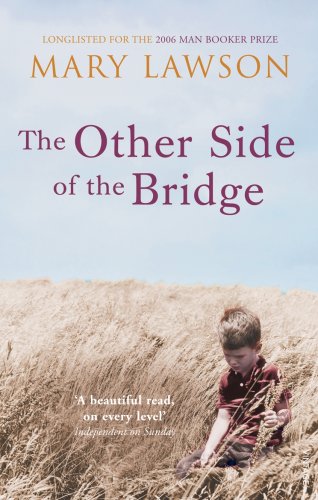
 

The Other Side of the Bridge by Mary Lawson

The Other Side of the Bridge

The Other Side of the Bridge is a beautiful book set in  in Northern Canada about two brothers, Arthur and Jake Dunn who grow up on a small farm near Struan (a fictional town) in the 1930s. The brothers are poles apart in nature. Arthur is older, shy but reliable and hardworking, whereas Jake, the younger brother is handsome, reckless, unreliable and a troublemaker. Their story spans the 1930s and 1940s as they grow up through the Depression years and the Second World War, up to the early 1960s.

It’s also the story of Ian, Dr Christopherson’s son, beginning in the late 1950s when he became infatuated with Arthur’s wife Laura. I think the dual time frame works well, moving almost seamlessly between the years, and the characterisation is excellent. I was totally engrossed in the story and able to visualise the scenery, including the Ojibway reserve where Ian’s school friend Pete lived:

He [Ian] cycled down Main Street to the outskirts of Struan, which took all of three minutes, and then out along the road to the Ojibway reserve, which took a further five. The reserve was spread along the shore of a bay, with a point of land jutting out into the lake between it and Struan, a symbolic barrier as well as a geographic one. The road ran out of pavement half a mile before it reached the reserve, and the land itself was so low it would grow nothing but bulrushes and bugs – black flies by the million in early summer then mosquitoes big enough to pick you up and carry you away. The reserve store, though where Peter Corbiere lived, was situated right down by the lake, which meant it got the benefit of the wind and was less buggy than the rest. Pete’s grandfather was sitting on the steps when Ian arrived, smoking and staring off into the woods. He had scars on his fingers from letting cigarettes burn down too far. (page 18)

There is much joy in this book mixed in with immense sorrow and pain. The title of the book refers to the time before and after a shocking incident on the bridge  – a roughly made bridge across the river that separated the Dunns’ and their neighbours, the Lintz’s farms. It was a shortcut that saved more than a mile. The River Crow was fifteen feet below the bridge as it boiled its way over rocks. That incident changed not only Arthur’s and Jake’s lives but its effect lingered on the their community the rest of their lives.

The Other Side of the Bridge is Mary Lawson’s second novel. I loved her first, Crow Lake (which I read ten years ago) and I love this one just as much. It’s one of the best books I’ve read this year. It was longlisted for the Man Booker Prize in 2006, which was won by Kiran Desai’s The Inheritance of Loss.

Reading Challenge: the 21st book I’ve read this year for Bev’s Mount TBR 2017 – a book I’ve had for 10 years.

The Classics Club Spin Result

The spin number in The Classics Club Spin was announced yesterday. It’s number …

4

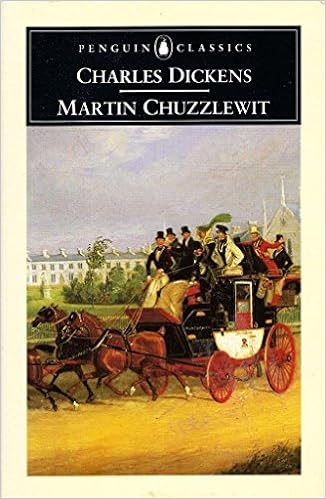
which for me is Martin Chuzzlewit by Charles Dickens. The rules of the Spin are that this is the book for me to read by December 31, 2017.

I’m pleased with the result as I’ve been meaning to read this book ever since I saw a TV version. I’ve just checked and it was shown in 1994 with Paul Scholfield as Old Martin Chuzzlewit – that’s 23 years ago! It really is time I read it.

Here’s the blurb from Goodreads:

While writing Martin Chuzzlewit – his sixth novel – Dickens declared it ‘immeasurably the best of my stories.’ He was already famous as the author of The Pickwick Papers and Oliver Twist . Set partly in America, which Dickens had visited in 1842, the novel includes a searing satire on the United States. Martin Chuzzlewit is the story of two Chuzzlewits, Martin and Jonas, who have inherited the characteristic Chuzzlewit selfishness. It contrasts their diverse fates of moral redemption and worldly success for one, with increasingly desperate crime for the other. This powerful black comedy involves hypocrisy, greed and blackmail, as well as the most famous of Dickens’s grotesques, Mrs Gamp. 

Did you take part in the Classics Spin? What will you be reading?

My Friday Post: Call the Dying by Andrew Taylor

Book Beginnings Button

Every Friday Book Beginnings on Friday is hosted by Gillion at Rose City Reader where you can share the first sentence (or so) of the book you are reading, along with your initial thoughts about the sentence, impressions of the book, or anything else the opener inspires.

This week’s first paragraph is from Call the Dying by Andrew Taylor, crime fiction set in the 1950,  the seventh in Taylor’s Lydmouth series.

Call the Dying (Lydmouth, #7)

It begins:


I saw a ghost today. It was very foggy, I know, but I’m sure I wasn’t mistaken. He was coming through the door of Butter’s, and he looked like a ghost because of the fog. But he really was a ghost from a time that’s dead and gone.

Also every Friday there is The Friday 56, hosted by Freda at Freda’s Voice. These are the rules:

  1. Grab a book, any book.
  2. Turn to page 56, or 56% on your eReader.
  3. Find any sentence (or a few, just don’t spoil it) that grabs you.
  4. Post it.
  5. Add the URL to your post in the link on Freda’s most recent Friday 56 post.

Page 55 (page 56 is blank)

I’ve done nothing wrong. Not really. So it’s not fair. It’s as if everyone’s ganging up against me.

Or is it just me? Am I going mad? did I really see him?

I’m afraid. I’m lonely, too. Keep busy that’s the answer. Make my self tired. You don’t have time to feel afraid when you’re deadbeat, you just sleep instead.

I like the thought of sleeping. I can’t remember when I last had an unbroken night.

From the back cover:

Love and need make unexpected bedfellows, and both are blind. As the grip of a long hard winter tightens on Lydmouth, a dead woman calls the dying in a seance behind net curtains. Two provincial newspapers are in the throes of a bitter circulation war. A lorry-driver broods, and an office boy loses his heart.

Britain is basking in the warm glow of post-war tranquillity, but in the quiet town of Lydmouth, darker forces are at play. The rats are fed on bread and milk, a gentleman’s yellow kid glove is mislaid on a train, and something disgusting is happening at Mr Prout’s toyshop.

Returning to a town shrouded in intrigue and suspicion, Jill Francis becomes acting editor of the Gazette. Meanwhile, there’s no pleasure left in the life of Detective Chief Inspector Richard Thornhill. Only a corpse, a television set and the promise of trouble to come.

I bought this book a couple of years ago, keen to read it as I’d enjoyed Taylor’s Roth trilogy so much.

My Week in Books: 15 November 2017

This Week in Books is a weekly round-up hosted by Lypsyy Lost & Found, about what I’ve been reading Now, Then & Next.

IMG_1384-0

A similar meme,  WWW Wednesday is run by Taking on a World of Words.

Now:

Victoria: A Life

I’m still reading Victoria: a Life by A N Wilson and have just finished Part One, ending with the death of William IV at 2.20 on the morning of 20 June 1837. Victoria is woken to the news that she is now Queen.

The Skeleton Road

I’ve also started The Skeleton Road by Val McDermid, the third  of her DCI Karen Pirie novels.  So far I’m finding it a bit slow going with rather a bewildering number of characters introduced one after the other. When a skeleton with a bullet hole in its skull is found at the top of a crumbling, gothic building in Edinburgh Karen and her Historic Cases Unit is called in to identify the body and investigate how long it has been there.

Then:

I’ve just finished The Corpse in the Snowman by Nicholas Blake, first published in 1941 as The Case of the Abominable Snowman. This is a manor house murder mystery  in which it first appears that Elizabeth Restorick has committed suicide. Or was it murder? Nigel Strangeways and Inspector Blount investigate.

Next:

Call the Dying (Lydmouth, #7)

I’m not sure, but Andrew Taylor’s Call the Dying caught my eye this morning when I passed the bookshelves in the hall. It’s set in the 1950s in the grip of a long, hard winter when dark forces are at play – a dead woman calls the dying in a seance, in a town shrouded in intrigue and suspicion. This is the seventh in Taylor’s Lydmouth series. I haven’t read any of the earlier books and I’m hoping that won’t matter.

Have you read any of these books?  Do any of them tempt you?