Top Ten Tuesday: Books Set in the 1950s

Top Ten Tuesday is a weekly meme created by The Broke and the Bookish and now hosted by Jana at That Artsy Reader Girl. For the rules see her blog

Today the topic is a Freebie and I’ve chosen books Books Set in the 1950s.
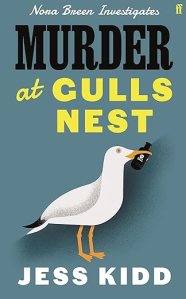
Murder at Gulls Nest by Jess Kidd. The first in a sparkling new 1950s seaside mystery series, featuring sharp-eyed former nun Nora Breen.

After thirty years in a convent, Nora Breen has thrown off her habit and set her sights on the seaside town of Gore-on-Sea. Why there? Why now? Instinct tells her it’s better not to reveal her reasons straight away. She takes a room at Gulls Nest guest house and settles in to watch and listen.

I enjoyed this. It’s quirky with some odd characters. At times it feels like a cosy crime mystery, but it’s also rather dark and foreboding, whereas at other times there’s some humour and also a hint of a romance. The setting is good in a fictional 1950s British seaside town.
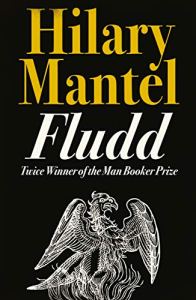
 Fludd by Hilary Mantel. I enjoyed this immensely – partly about religion and superstition, but also a fantasy, a fairy tale, told with wit and humour and with brilliant characterisation. It’s one of her earlier novels, set in Fetherhoughton, a drab, dreary town somewhere in a magical, half-real 1950s north England, a preserve of ignorance and superstition. The story centres on Fludd, a young priest who comes to the Church of St Thomas Aquinas to help Father Angwin, a cynical priest who has lost his faith. The Bishop, a modern man, is concerned about Father Angwin and wants to bring him and the Catholic community up to date – so the statues in the church have to go. This has a most disturbing effect on all concerned – not just the church and Father Angwin, but also the the nuns in the convent, and the school, both under the stern eye of Mother Perpetua.
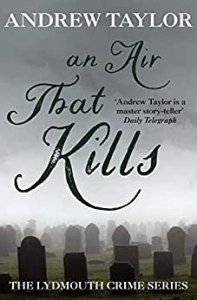
An Air That Kills by Andrew Taylor, the first book in his Lydmouth crime series. The setting is Lydmouth, a small market town on the Welsh/English border in the early 1950s, just after the end of the Second World War. It begins as journalist, Jill Francis arrives to stay with her friends, Philip and Charlotte in Lydmouth, to recover from a bad experience.  Also new to the town is Inspector Richard Thornhill, who is finding it difficult to adjust to working in the local police force. Workmen digging out a drain discover a wooden box containing baby’s bones, an old brooch and some scraps of yellowed newspaper. When Major Harcutt, the local historian is consulted he found that there could be a connection to an old murder trial. 
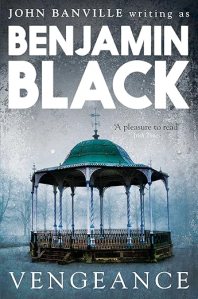
Vengeance by Benjamin Black (a pseudonym used by John Banville), number five in Black’s Quirke Mysteries series set in Ireland in the 1950s. It begins with a suicide, that of Victor Delahaye, a business man who takes his boat out to sea and shoots himself. He had taken his partner’s son, Davy Clancy out to sea with him. The Delahayes and Clancys are interviewed – Mona Delahaye, the dead man’s young and very beautiful wife; James and Jonas Delahaye, his identical twin sons; Marguerite his sister; Jack Clancy, his ambitious, womanizing partner and Sylvia, Jack’s long-suffering wife. Then there is a second death. Why did Victor kill himself and who is the murderer, wreaking vengeance on the families?

The setting is excellent, both in location and time, with the characters wreathed in cigarette smoke, and having to find public telephones for example. 
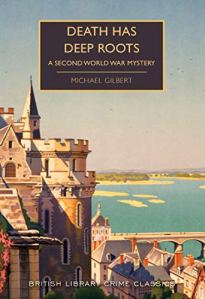
 Death Has Deep Roots: a Second World War Mystery by Michael Gilbert. Set in 1950 it’s a mix of courtroom drama, spy novel and an adventure thriller. Victoria Lamartine, a hotel worker, and an ex-French Resistance fighter is on trial for the murder of Major Eric Thoseby, her supposed lover, and alleged father of her dead child. She is the obvious suspect – she was found standing over Thoseby’s dead body in his room at the Family Hotel in Soho, a room that was only accessed by one staircase – making this a variation on a locked room murder mystery. It was written not long after the end of the Second World War and it conveys a vivid impression of what life was like in both France and England, with memories of the war still fresh on people’s minds.
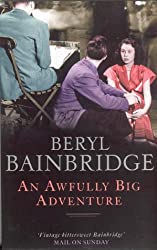
An Awfully Big Adventure, a semi-autobiographical novel set in 1950, based on Beryl Bainbridge’s own experience as an assistant stage manager in a Liverpool. A Liverpool repertory theatre company are rehearsing its Christmas production of Peter Pan. The story centres around Stella, the assistant stage manager. On the face of it this is a straight forward story of the theatre company but underneath it’s packed with emotion, pathos and drama. And it’s firmly grounded in a grim post-war 1950s England, food rationing still in operation and bombed buildings still in ruins overgrown with weeds.
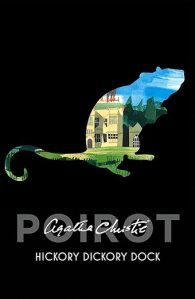
Hickory Dickory Dock by Agatha Christie, a Poirot mystery, first published in 1955. It’s set in a crowded London house, owned by Mrs Nicolstis, a Greek and full of a mixed group of young students from a variety of backgrounds and cultures – from America, West Africa and India as well as an assortment from the British Isles.Items have gone missing and then one of the students commits suicide – or is it murder? And more deaths follow.

Agatha Christie reveals contemporary attitudes (1950s) to race and politics, as the characters’ prejudices come out in their discussions. There are some interesting reflections on crime and the psychology of behaviour. 
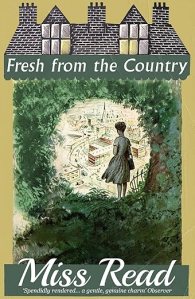
Fresh from the Country by Miss Read, set in the 1950s, this is a stand-alone novel telling the story of Anna Lacey, a newly qualified teacher, as she spends her first year teaching in Elm Hill, a new suburb in London. It highlights the differences between life in the country and the suburbs, which transported me back to the 1950s, when children were taught in large classes and the pace of life was slower than today. It was a bit disconcerting to read that Anna enjoyed smoking, but then the dangers of cigarettes were not emphasised in those days and many people did smoke.
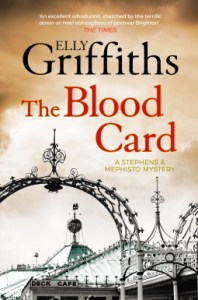
The Blood Card by Elly Griffiths, the third book in the DI Stephens and Max Mephisto series. Known as the ‘Magic Men’ they had been part of a top-secret espionage unit during the War. This book captures the atmosphere of 1953 – a time of great change and optimism. Britain is looking forward with eager anticipation to the new Queen’s coronation. The newspapers and newsreels are full of it and more than half the homes in the country have bought a television in order to watch the coronation live- it was the first British coronation to be broadcast on television, a momentous occasion. But there are fears that an anarchist group is plotting to disrupt the coronation.

I enjoyed the insight into the history of television as Max is sceptical about performing magic on TV thinking the ‘smug grey box’ will be the death of the days of music hall, that magic tricks needed to be performed on stage not in close up with a camera over his shoulder. But he is persuaded to take part in a new show after the coronation.
Top Ten Tuesday: Genre freebie

Top Ten Tuesday is a weekly meme created by The Broke and the Bookish and now hosted by Jana at That Artsy Reader Girl. For the rules see her blog

The topic today is a Genre freebie (Pick any genre you’d like and build a list around it. You can even narrow the topic if you’d like, such as: thrillers with unreliable narrators, fantasy romance with fae characters, or historical romance with suspense elements.)

I decided to list ten of my favourite historical fiction books:

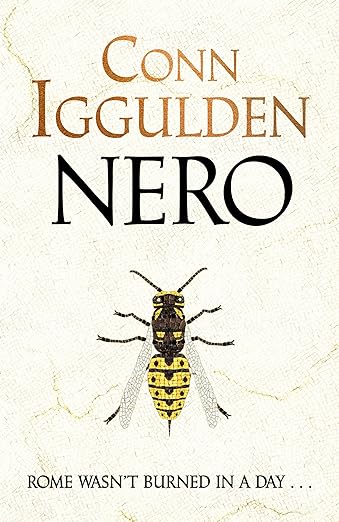
  1. Nero by Conn Iggulden. Ancient Rome (beginning in AD37)
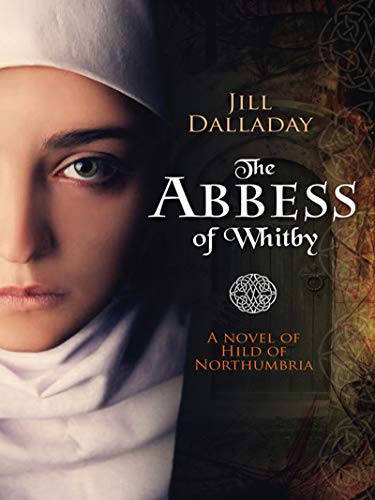
  2. The Abbess of Whitby: a Novel of Hild of Northumbria by Jill Dalladay (7th century Britain)
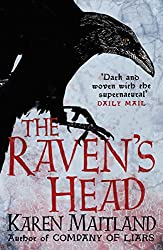
  3. The Raven’s Head by Karen Maitland  (13th century England)
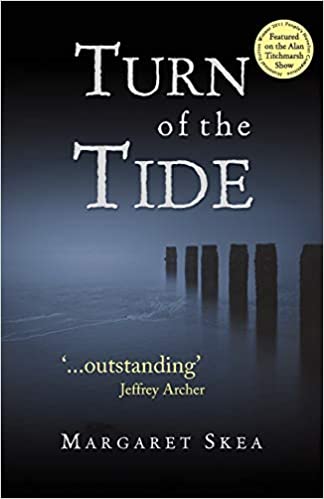
  4. Turn of the Tide by Margaret Skea (16th century Scotland)
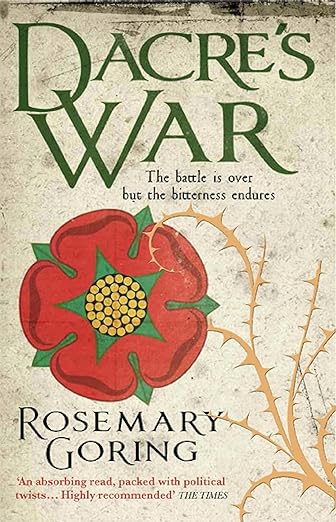
  5. Dacre’s War by Rosemary Goring (16th century Scotland and England)
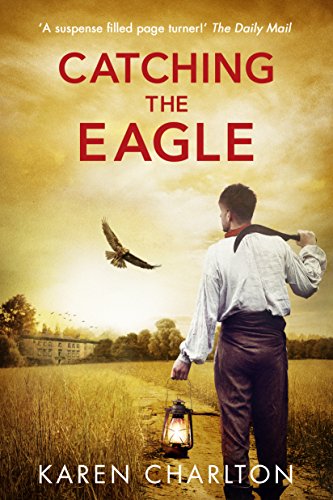
  6. Catching the Eagle by Karen Charlton (1809 -1811 Northumberland)
  7. The Potter’s Hand by A N Wilson (the Wedgewood family 1785 – 1805)
  8. Silver Lies by Ann Parker (1880s USA)
  9. A Medal for Murder by Frances Brody (1922 England and 1899 South Africa – the Boer War)
  10. A Climate of Change by Hilary Mantel (1950s Africa and 1980s England)

Top Five Tuesday: Books with a Direction in the Title

Top 5 Tuesday was created by Shanah at Bionic Book Worm, and it is now being hosted by Meeghan at Meeghan Reads. You can see the Top 5 Tuesday topics for the whole of 2025 here

Today the topic is Books with a Direction in the Title. I’ve chosen books with north, south, east, up and down in their titles:

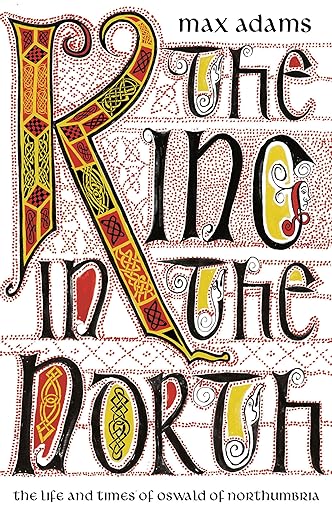
  1. The King in the North by Max Adams – Oswald of Northumbria was the first great English monarch, yet today this legendary figure is all but forgotten. In this panoramic portrait of Dark Age Britain, archaeologist and biographer Max Adams returns the king in the North to his rightful place in history.
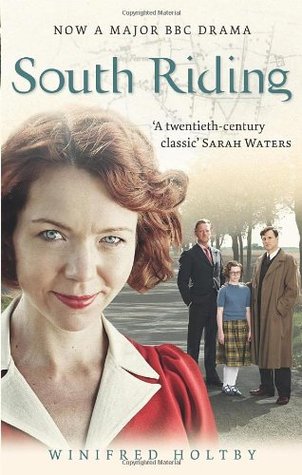
  2. South Riding by Winifred Holtby – portraying life in the 1930s, one of the main characters is Sarah Burton, the new headmistress of Kiplington High School for Girls, a fiercely passionate and dedicated teacher.
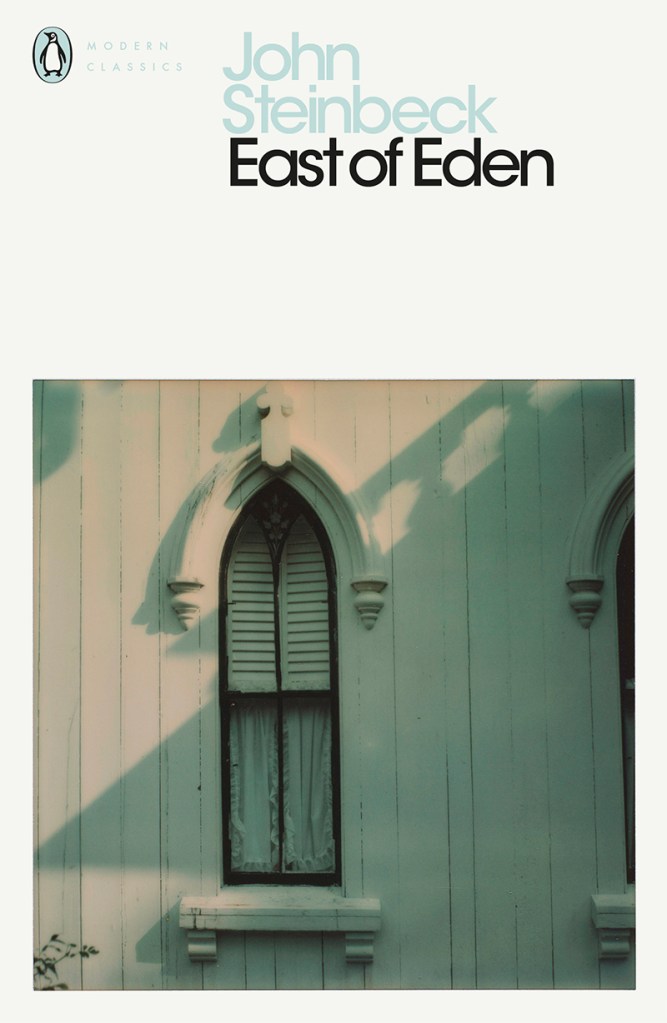
  3. East of Eden by John Steinbeck – the story of two families—the Trasks and the Hamiltons—whose generations helplessly re-enact the fall of Adam and Eve and the poisonous rivalry of Cain and Abel.
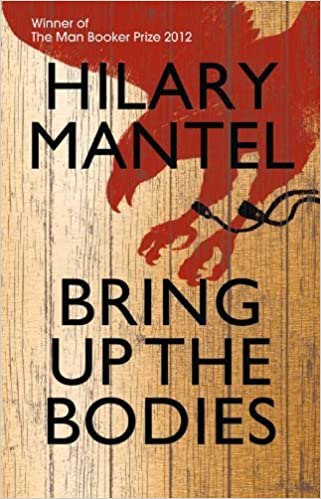
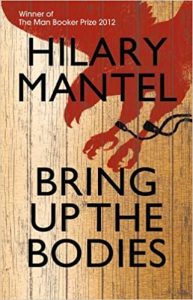
  4. Bring Up the Bodies by Hilary Mantel – the sequel to Wolf Hall. It’s 1535, Thomas Cromwell is Chief Minister to Henry VIII, Anne Boleyn is the king’s new wife. But she has failed to give the king an heir and Henry falls for plain Jane Seymour. Cromwell must find a solution that will satisfy Henry, safeguard the nation and secure his own career. But neither minister nor king will emerge unscathed from the bloody theatre of Anne’s final days.
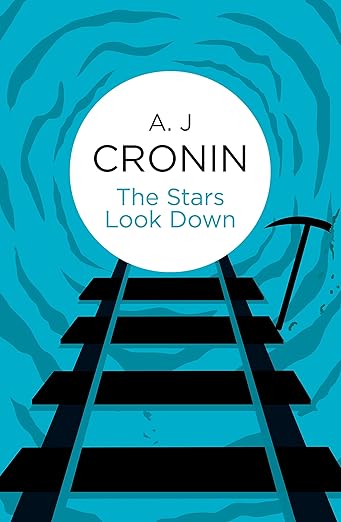
  5. The Stars Look Down by A J Cronin – a family saga chronicling the lives of a number of interconnected families over a period of thirty years.The story starts in 1903 in a North Country mining town, Sleescale, as its inhabitants experienced social and political upheaval. It ends in 1933. It highlights the terrible conditions in the coal mines, the lack of workers’ rights and the need for change in the relationship between the coal miners and the mine owners.

Six Degrees of Separation from  Knife by Salman Rushdie to The Likeness

It’s time again for Six Degrees of Separation, a monthly link-up hosted by Kate at Books Are My Favourite and Best. Each month a book is chosen as a starting point and linked to six other books to form a chain. A book doesn’t need to be connected to all the other books on the list, only to the one next to it in the chain.

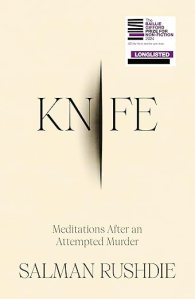
This month we start with Knife: Meditations After an Attempted Murder by Salman Rushdie, a searing, deeply personal account of enduring—and surviving—an attempt on his life thirty years after the fatwa that was ordered against him.

My first link is The Subtle Knife by Philip Pullman, the second book in the His Dark Materials trilogy. Taken together the books form a grand epic, encompassing parallel universes and their inhabitants. It’s a fabulous story, featuring armoured bears who talk, witches, spectres, angels, and tiny hand sized creatures who fly on the backs of dragonflies.

In The Subtle Knife the action takes place in several universes and Will becomes the bearer of the Subtle Knife, which enables him to cut windows from one universe into a parallel one. In one of these worlds he meets Lyra and they join forces.

My second link is Bring Up the Bodies by Hilary Mantel, the second book in her Wolf Hall trilogy. I didn’t enjoy it as much as the first book Wolf Hall and I had just a little feeling of anti-climax about it, but then the novelty of Wolf Hall for me was the way Hilary Mantel not only brought the Tudor world alive but also how she overturned my ideas of both Thomas Cromwell and Sir Thomas More. As there is no denying that I knew that Anne Boleyn was not going to make a go of her marriage to Henry VIII, there was little drama there for me. I didn’t even want her to escape her fate.

And yet, Bring Up the Bodies is still a brilliant book. It’s beautifully written, full of colour and detail so that there is no doubt that this is 16th century England, with vivid descriptions of the people, buildings, fabrics, and landscapes of both town and countryside.

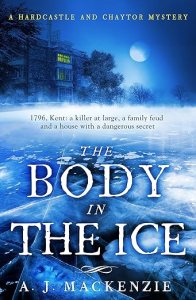
My third link is a book with just one body, The Body in the Ice by A J MacKenzie, the 2nd Hardcastle and Chaytor Mystery set in Romney Marsh and the surrounding countryside in 1796-7. This is the period after the end of the American War of Independence, so Britain and America are at peace, but Britain and revolutionary France are at war with the constant threat of a French invasion. A J Mackenzie is the pseudonym of Marilyn Livingstone and Morgen Witzel, an Anglo-Canadian husband-and-wife team of writers and historians.

Version 1.0.0

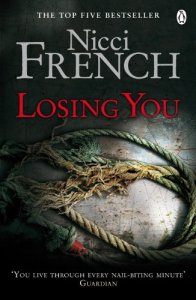
My fourth link is Losing You by Nicci French, a fast paced, take-your-breath-away book about Nina whose teenage daughter, Charlie goes missing. I read it at break-neck speed, switching between being completely engrossed, and desperate for her to find her daughter before it’s too late and being annoyed by her attitude to the police. It’s set on Sandling Island (a fictional place based on Mersea Island, Essex) off the east coast of England and the feelings of isolation and oppression fill the book. ‘Nicci French’ is the pseudonym of wife and husband Nicci Gerard and Sean French.

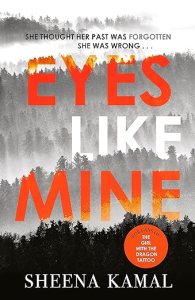
My fifth link is to another missing teenage daughter in Eyes Like Mine by Sheena Kamal, her debut novel. Everything about this book fascinated me from the characters and in particular the main character, Nora Watts, the gripping storylines that kept me racing through the book, to the atmospheric, gloomy setting in Vancouver and in beautiful British Columbia with its snow, mountains and plush ski resorts.

The plot is intricate, complicated and fast moving, highlighting various issues such as mixed race inheritance and differences in treatment based on skin colour, homelessness, and environmental issues. These never overpower the story, but form part of the book as a whole.

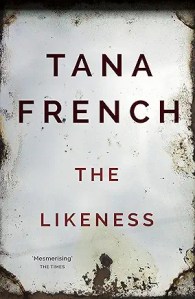
My final link is the word like in the title – The Likeness by Tana French, which I read recently for Reading Ireland Month 2025. It’s a gripping fast paced book, set in Ireland, with well drawn characters, including a group of five friends living in a large house in the countryside. French portrays each of these friends in detail, and as the story progresses their backgrounds and relationships are revealed. The book begins as one of the friends, Lexie Madison is murdered.

Astonished by the fact that Lexie is her double, Detective Cassie Maddox, who played a small role in In the Woods, is persuaded to go undercover at the house, and assume the dead women’s identity, the police having told her friends she wasn’t killed, but was merely wounded. Far-fetched, yes, but it didn’t take me long before I found myself accepting this was feasible. 

My chain goes from Rushdie’s Knife to another book with the word ‘knife‘ in the title, then to two books that are second books in trilogies, two books with a body/bodies in the titles, to two books featuring missing teenagers and finally to two books with ‘like‘ in the titles. It travels from New York, through parallel universities, Tudor England, Romney Marsh, Sandling Island, Vancouver and British Columbia and Ireland.

What is in your chain, I wonder?

Next month (May 3 , 2025), we’ll start with an historical novel longlisted for the 2025 Stella Prize, Rapture by Emily Maguire.

Six Degrees of Separation from  After Story by Larissa Behrendt to The Butterfly Room by Lucinda Riley

It’s time again for Six Degrees of Separation, a monthly link-up hosted by Kate at Books Are My Favourite and Best. Each month a book is chosen as a starting point and linked to six other books to form a chain. A book doesn’t need to be connected to all the other books on the list, only to the one next to it in the chain.

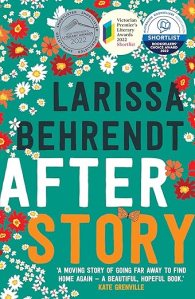
This month starts  After Story by Larissa Behrendt. This is the description on Amazon UK:

When Indigenous lawyer Jasmine decides to take her mother, Della, on a tour of England’s most revered literary sites, Jasmine hopes it will bring them closer together and help them reconcile the past. Twenty-five years earlier the disappearance of Jasmine’s older sister devastated their tight-knit community. This tragedy returns to haunt Jasmine and Della when another child mysteriously goes missing on Hampstead Heath. As Jasmine immerses herself in the world of her literary idols – including Jane Austen, the Brontë sisters and Virginia Woolf – Della is inspired to rediscover the wisdom of her own culture and storytelling. But sometimes the stories that are not told can become too great to bear. Ambitious and engrossing, After Story celebrates the extraordinary power of words and the quiet spaces between. We can be ready to listen, but are we ready to hear?

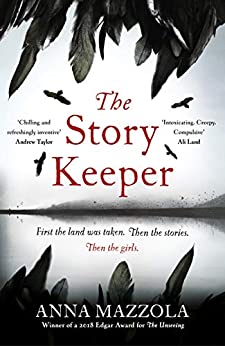
My first link is using the word Story, in the title, and it’s also a book about storytelling – The Story Keeper, set on the Isle of Skye in 1857, by Anna Mazzola. It stresses the importance of folk tales – stories that have been told to make sense of the world and reflect people’s strengths, flaws, hopes and fears. 

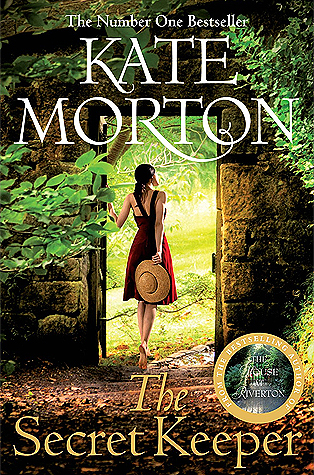
My second link is The Secret Keeper by Kate Morton, a story moving between time periods from 2011, back to the 1960s and also to the 1940s. It begins in 1961 in Suffolk when sixteen-year old Laurel is shocked when she sees her mother stabbing a stranger who had come to their farm. 

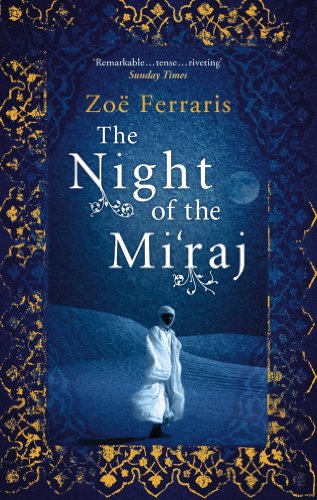
In my third link another sixteen year old girl, Nouf ash-Shrawi, disappears from her home in Jeddah, in The Night of the Mi’raj by Zoë Ferraris, just before her arranged marriage. Her body is eventually found in a desert wadi. It appears that her death was an accident and that she died by drowning in the wadi after a sudden storm.

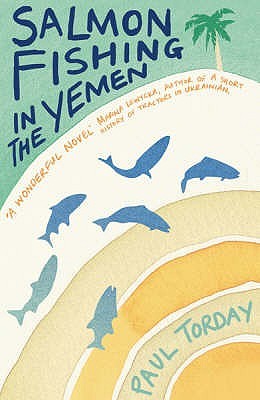
My fourth link is Salmon Fishing in the Yemen by Paul Torday about a project to introduce salmon fishing in the waters of the Wadi Aleyn in the heart of the mountains of Heraz, in Yemen.

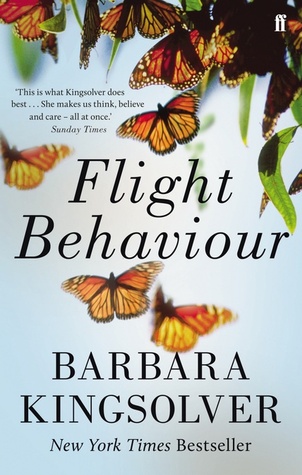
My fifth link takes the chain from the mountains of Heraz to the Appalachian Mountains in Flight Behaviour by Barbara Kingsolver in which a young mother discovers a beautiful and terrible marvel of nature: the monarch butterflies have not migrated south for the winter that year.

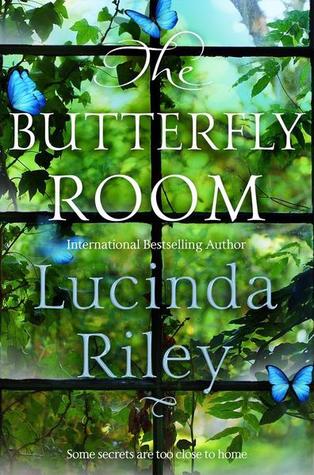
My final link is to The Butterfly Room by Lucinda Riley. The story revolves around Posy Montague and her family home, Admiral House in the Suffolk countryside. Her father encouraged her to draw plants and showed her how to catch butterflies. As a child Posy thought The Butterfly Room in the Folly in the grounds of Admiral House  looked like a fairy-tale castle with its turret made of yellow sandy brick. But the Folly was not the wonderful place she imagined – and there is a dark secret hidden behind its locked door.

The books in my chain are all fiction including historical fiction, mysteries and crime fiction. The chain travels through Australia, the UK, Saudi Arabia, Yemen and the USA,
Next month (October 5, 2024), we’ll start with Colm Tóibín’s Long Island.

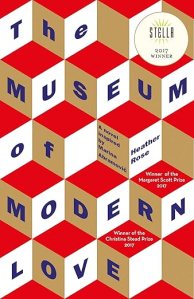
Six Degrees of Separation from The Museum of Modern Love to:

It’s time again for Six Degrees of Separation, a monthly link-up hosted by Kate at Books Are My Favourite and Best. Each month a book is chosen as a starting point and linked to six other books to form a chain. A book doesn’t need to be connected to all the other books on the list, only to the one next to it in the chain.

This month starts with The Museum of Modern Love by by Heather Rose (Kate’s pick was inspired by Sue’s recent post about writers and artists). I haven’t read this, but I would like to. This is the description on Amazon UK:

Arky Levin, a film composer in New York, has promised his wife that he will not visit her in hospital, where she is suffering in the final stages of a terminal illness. She wants to spare him a burden that would curtail his creativity, but the promise is tearing him apart. One day he finds his way to MOMA and sees Mariana Abramovic in The Artist is Present. The performance continues for seventy-five days and, as it unfolds, so does Arky. As he watches and meets other people drawn to the exhibit, he slowly starts to understand what might be missing in his life and what he must do.

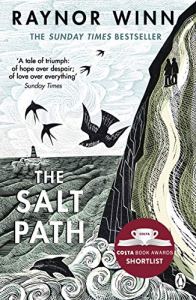
My first link is via a terminal illness to The Salt Path, Raynor Winn’s memoir about walking the South Coast Path when Moth her husband was diagnosed with a terminal illness. They were homeless, with no means of income except for £48 pounds a week. They had lost their home, business and livelihood, after investing in one of a friend’s companies that had failed. It is about the determination to live life, about overcoming pain and hardship, and the healing power of nature. It is about homelessness and the different reactions and attitudes of the people they met when they told them they were homeless.

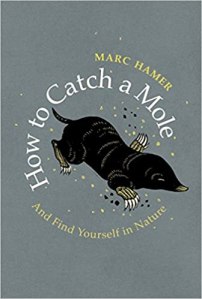
My second link is How to Catch a Mole by Marc Hamer, part memoir, part a nature study of the British countryside, part poetry, and, of course, about moles. After leaving school Marc Hamer was homeless for a while. He has worked in art galleries, marketing, graphic design and taught creative writing in a prison before becoming a gardener. And before writing this book he had been a traditional molecatcher for years.

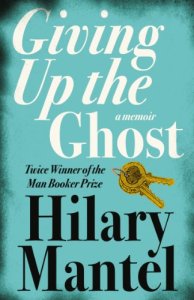
My third link is Hilary Mantel’s Giving Up the Ghost, a remarkable memoir. It came across to me as being clear, honest and very moving. She thought it was because of her that her parents were not happy and that without her they would have had a chance in life. It didn’t get any better when her father left home and she was left to live with two younger brothers, their mother and her mother’s lover. Home was a place where secrets were kept and opinions were not voiced. Her experience of ghosts at the age of 7 was horrifying as she felt as though something came inside her, ‘some formless, borderless evil’.

My fourth link is The Girl Who Died by Ragnar Jonasson, Icelandic noir, a mix of horror and psychological thriller, with a strong sense of place. Skálar is a close-knit community that doesn’t welcome newcomers, keeping its secrets well hidden. The only person who welcomes Una, to the village is Salka, the mother of Edda, one of the two girls Una is to teach. Her house is said to be haunted by the ghost of a young girl who had died fifty years earlier,

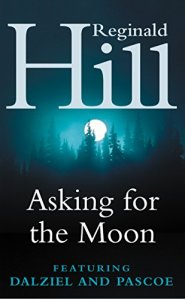
My fifth link is Asking for the Moon by Reginald Kill, a collection of four novellas. Two of them feature ghosts, Pascoe’s Ghost and Dalziel’s Ghost. But I think that the best one is the first story, The Last National Service Man which tells how Dalziel and Pascoe first met. Neither of them are impressed by the other. Dalziel thinks Pascoe is everything he dislikes – a graduate, well spoken, and a Southerner from south of Sheffield. Pascoe thinks Dalziel is an archetypical bruiser who got results by kicking down doors and beating out questions in Morse code on a suspect’s head.

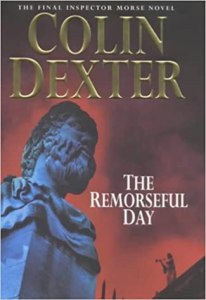
My final link is to the final Inspector Morse novel, The Remorseful Day by Colin Dexter. The plot is detailed, complex and as usual, with Morse, a puzzle type murder mystery with plenty of challenging clues. Sergeant Lewis is left to investigate the murder of nurse Yvonne Harrison that had remained unsolved for a year. When Morse phones to say he is feeling unwell Lewis is most concerned – Morse seldom mentioned his health, what is wrong with him?

The main focus of the book is on Morse and how he copes with his illness and his drinking habits. It becomes obvious just how alone he is in the world and how devastating his situation is to Lewis.

The first three books in my chain are memoirs and the other three are crime fiction/psychological thriller novels. Beginning in America it travels to the UK, then to Iceland, before ending back in the UK.

Next month (September 7, 2024), we’ll start with  After Story by Larissa Behrendt.