Six Degrees of Separation from Rapture to Persuasion

It’s time again for Six Degrees of Separation, a monthly link-up hosted by Kate at Books Are My Favourite and Best. Each month a book is chosen as a starting point and linked to six other books to form a chain. A book doesn’t need to be connected to all the other books on the list, only to the one next to it in the chain.
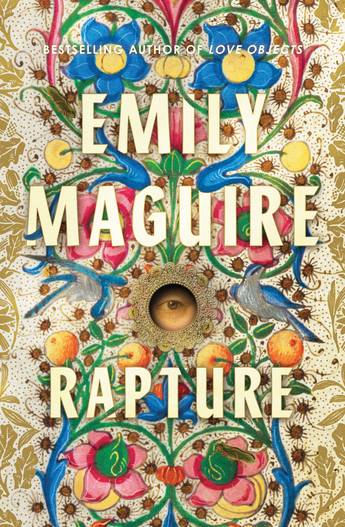
This month we start with Rapture by Emily Maguire. The motherless child of an English priest living in ninth-century Mainz, Agnes is a wild and brilliant girl with a deep, visceral love of God. At eighteen, to avoid a future as a wife or nun, Agnes enlists the help of a lovesick Benedictine monk to disguise herself as a man and secure a place at the revered Fulda monastery.

I haven’t read it and hadn’t heard of the author. According to a review in The Guardian she writes fiction and nonfiction and was shortlisted for the Stella prize, the Miles Franklin and book of the year at the Australian Book Industry awards for An Isolated Incident her 2016 novel. ‘In Rapture, her seventh novel, she turns her hand to historical fiction. Drawing inspiration from the life of Pope Joan, the woman who (according to legend) disguised herself as a man and served as pope for two years during the middle ages, Maguire examines questions of faith using the language of the body.’

I’ve had several false starts with this month’s chain, none of which I could complete. In the end I decided to start with another book about a pope, especially as the Roman Catholic Cardinals will start the procedure to elect a new pope on May 7.
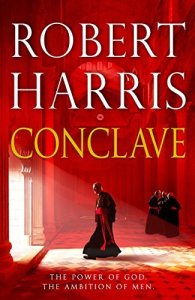
It’s Conclave by Robert Harris. I always learn a lot from reading Harris’s books. In this one he describes the procedure to elect a new pope. Cardinal Lomeli, the Dean of the College of Cardinals leads the 118 Cardinals through the voting stages. I felt as though I was a fly on the wall watching it throughout as the Cardinals are locked inside the Sistine Chapel, isolated from contact with the outside world. Harris has thoroughly researched the subject and seamlessly woven the facts into the novel. He visited the locations used during a Conclave that are permanently closed to the public and interviewed a number of prominent Catholics including a cardinal who had taken part in a Conclave, as well as consulting many reports and books.

The next book is another one by Robert Harris The Fear Index , a fast-paced story set in the world of high finance and computer technology, which is way out of my comfort zone. It’s about scientist Dr Alex Hoffman, who together with his partner Hugo Quarry, an investment banker, runs a hedge fund based in Geneva, that makes billions. Alex has developed a revolutionary form of artificial intelligence that tracks human emotions, enabling it to predict movements in the financial markets. It’s built around the standard measure of market volatility: the VIX or ‘Fear Index’. But I learnt a bit about hedge funds and how they operate, although I got lost in the computer technology details. 
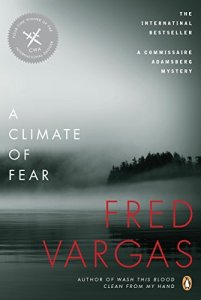
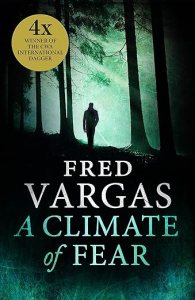
My third link is A Climate of Fear by Fred Vargas, 9th Commissaire Adamsberg book. I like Adamsberg; he’s original, a thinker, who doesn’t like to express his feelings, but mulls things over. He’s an expert at untangling mysteries, an invaluable skill in this, one of the most complicated and intricate mysteries I’ve read, involving a woman found bleeding to death in her bath, having apparently committed suicide, a strange symbol that appears at subsequent death scenes, and a secretive society studying and re-enacting scenes from the French Revolution.
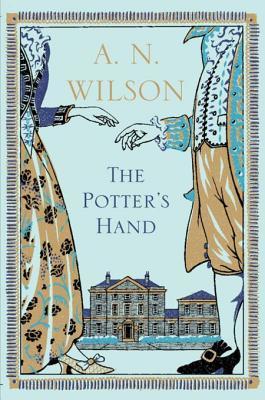
My fourth link is The Potter’s Hand by A N Wilson. it begins in 1768 and roughly follows the fortunes of the Wedgwood family until 1805, 10 years after the death of Josiah Wedgwood, an English potter and the founder of the Wedgwood company. For me it really did convey what it must have been like to live in that period – whilst the American War of Independence, and the French Revolution, were taking place. It’s full of ideas about colonialism, the abolition of slavery, working conditions, and women’s rights. There are many characters who come in and out of the narrative along the way, both fictional and historical, including Voltaire, George Stubbs (who painted the Wedgwood family portrait) and Samuel Taylor Coleridge.
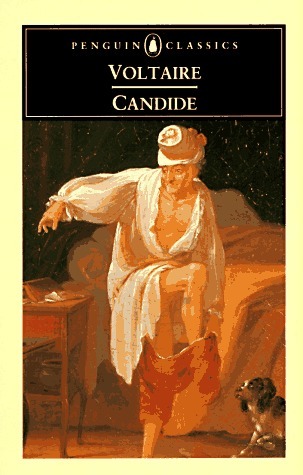
My fifth link is Voltaire’s Candide or Optimism, a small book I read many years ago. Candide was the most brilliant challenge to the idea endemic in Voltaire’s day, that ‘all is for the best in the best possible worlds‘.In Candide he whisks his young hero and friends through a ludicrious variety of tortures, tragedies and reversals of fortune, in the company of Pangloss, a ‘matapysico-theologo-cosmolo-nigologist’ of unflinching optimism. The result is one of the glories of the eighteenth-century satire. (Taken from the description on the back cover.)
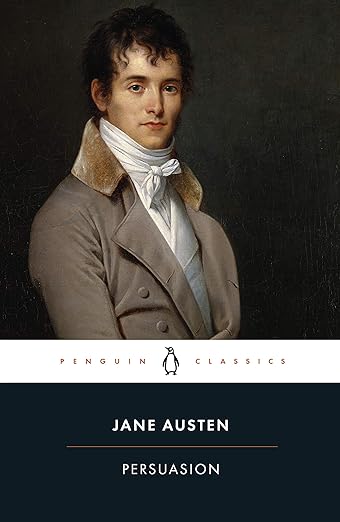
And my final link is Persuasion by Jane Austen. I read this first at school, when I was 17 for A Level GCE. It’s her last novel of missed opportunities and second chances centred on Anne Elliot, no longer young and with few romantic prospects. Eight years earlier, she was persuaded by others to break off her engagement to poor, handsome naval Captain Frederick Wentworth. ‘Set in the fashionable societies of Lyme Regis and Bath, Persuasion is a brilliant satire of vanity and pretension, and a mature, tender love story tinged with heartache.’ (Amazon) I’ll be re-reading it later in the year taking part with Brona at This Reading Life in her Austen 2025 project to reread her books, along with the Classics Club’s Sync Read (or readalong).

I certainly never thought I’d end my chain with Persuasion – but here it is! From Rapture to Persuasion in six moves. The links are the pope, books by Robert Harris, fear, the French Revolution, Voltaire and satire.

What is in your chain, I wonder?

Next month (June 7, 2025), we’ll start with Kate’s pick the 2025 Women’s Prize for Fiction All Fours by Miranda July.

Top Five Tuesday:Top 5 books with an emotion in the title

Top 5 Tuesday was created by Shanah at Bionic Book Worm, and it is now being hosted by Meeghan at Meeghan Reads. For details of all of the latest prompts for January to March, see Meeghan’s post here.

Today the topic is Top 5 books with an emotion in the title. Whether it’s happy or sad, anger or excitement, any emotion is fine!

These are all books I’ve read with links to my reviews.

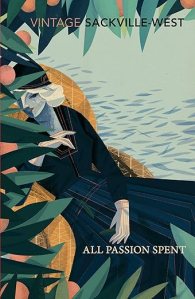
All Passion Spent by Vita Sackville-West. Lady Slane is an ageing British aristocrat. Her husband has recently died at the age of 94, leaving his family with the problem of ‘What was to be done about Mother?’ The family are four sons and two daughters. Lady Slane at 88 is still a beautiful woman and quickly but quietly asserts her independence. She ignores her children and decides to live, with her maid Genoux, in a house in Hampstead that she had first seen thirty years previously. This is a novel of contrasts, beautifully written, and expressing so many emotions in a quiet unassuming manner.

A Climate of Fear by Fred Vargas, a Commissaire Adamsberg murder mystery. I like Adamsberg; he’s original, a thinker, who doesn’t like to express his feelings, but mulls things over. He’s an expert at untangling mysteries, an invaluable skill in this, one of the most complicated and intricate mysteries I’ve read. He’d compared the investigation right from the start to a huge tangled knot of seaweed. A woman is found bleeding to death in her bath, having apparently committed suicide, there’s a secretive society studying and re-enacting scenes from the French Revolution, and two deaths ten years earlier on an isolated island off the coast of Iceland, where the afturganga, the demon who owns the island summons people to their death.

The Grapes of Wrath by John Steinbeck. Steinbeck’s writing conjures up such vivid pictures and together with his use of dialect I really felt I was there in America in the 1930s travelling with the Joad family on their epic journey from Oklahoma to California. What a long, hard journey with such high hopes of a better life and what a tragedy when they arrived to find their dreams were shattered, their illusions destroyed and their hopes denied. Throughout the book, Steinbeck shows the inhumanity of man to man and also the dignity and compassion, the essential goodness and perseverance of individuals against such appalling conditions and inhumane treatment. 

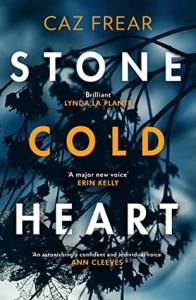
Stone Cold Heart by Caz Frear, a police procedural written in the first person present tense narrated by DC Cat Kinsella who is part of the Murder Investigation Team 4. Naomi Lockhart, a young Australian woman was murdered and at first it looked as though her flatmate had killed her. It’s a most convoluted and tangled tale, filled with secrets and lies, most of which are complete red herrings.  Alongside the murder mystery, the book follows the story of DC Cat Kinsella’s family and the mystery surrounding Maryanne Doyle that was told in Sweet Little Lies – you really do need to read that book first to understand what is going on in her family life in this book. Cat is a conflicted character to say the least and although other readers have found her a warm and likeable character I found her one of the most irritating fictional detectives in crime fiction.

Cruel Acts by Jane Casey. A year ago, Leo Stone was convicted of murdering two women and sentenced to life in prison. Now he’s been freed on a technicality, and he’s protesting his innocence. DS Maeve Kerrigan and DI Josh Derwent are determined to put Stone back behind bars where he belongs, but the more Maeve digs, the less convinced she is that he did it. Then another woman disappears in similar circumstances. Is there a copycat killer, or have they been wrong about Stone from the start?

Throwback Thursday: An Uncertain Place by Fred Vargas

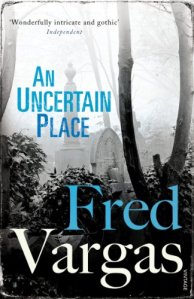
Today I’m looking back at my post on An Uncertain Place by Fred Vargas. I first reviewed it on June 10, 2017.

My review begins:

I loved An Uncertain Place, a clever and also a confusing book. It’s the sixth in Fred Vargas’ Commissaire Adamsberg series in which he investigates a macabre murder. I say confusing because I got a bit lost in the middle of the book, and looking back I think it’s because Adamsberg is not your normal detective – he works by intuition and I simply hadn’t followed his train of thought. With a bit of concentration I was back on track and caught up with him.

Click here to read my full review

~~~

Fred Vargas was born in Paris in 1957. As well as being a best-selling author in France, she is an historian and archaeologist.

She worked at the French National Centre for Scientific Research (CNRS), which she joined in 1988. She later joined the Institut Pasteur, as a eukaryotic archaeologist.

She mostly writes police thrillers (policiers). They take place in Paris and feature the adventures of Chief Inspector Adamsberg and his team. Her interest in the Middle Ages is manifest in many of her novels, especially through the person of Marc Vandoosler, a young specialist in the period. Seeking Whom He May Devour was shortlisted by the British Crime Writers’ Association for the last Gold Dagger award for best crime novel of the year, and the following year The Three Evangelists won the inaugural Duncan Lawrie International Dagger. She also won the award for the second year-running with Wash This Blood Clean From My Hand.

~~~

The next Throwback Thursday post is scheduled for June 30, 2022.

Book Beginnings & The Friday 56: This Poison Will Remain by Fred Vargas

Every Friday Book Beginnings on Friday is hosted by Gillion at Rose City Reader where you can share the first sentence (or so) of the book you are reading. You can also share from a book you want to highlight just because it caught your fancy.

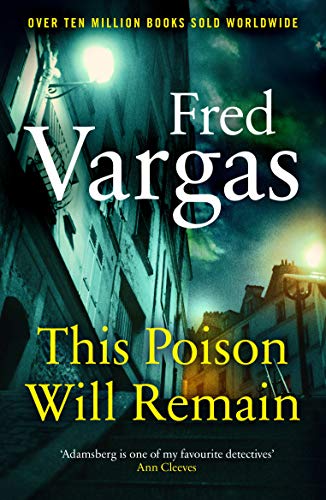
This week’s extracts are from This Poison Will Remain by Fred Vargas. This is the 9th in the Commissaire Adamsberg series. When three elderly men are poisoned by spider venom, everyone assumes that the deaths are tragic accidents. But at police headquarters in Paris, Inspector Adamsberg begins to suspect that the case is far more complex than first appears.

Jean-Baptiste Adamsberg, sitting on a rock at the quayside, watched the Grimsey fishermen return with their daily catch, as they moored their boats and hauled up their nests. Here, on this tiny island off the coast of Iceland, people called him simply ‘Berg’.

Also every Friday there is The Friday 56, hosted by Freda at Freda’s Voice. *Grab a book, any book. *Turn to Page 56 or 56% on your  ereader . If you have to improvise, that is okay. *Find a snippet, short and sweet, but no spoilers!

These are the rules:

  1. Grab a book, any book.
  2. Turn to page 56, or 56% on your eReader. If you have to improvise, that is okay.
  3. Find any sentence (or a few, just don’t spoil it) that grabs you.
  4. Post it.
  5. Add the URL to your post in the link on Freda’s most recent Friday 56 post.

Page 56:

And that very day, a local newspaper reported that a woman, Jeanne Beaujeu, who had just returned from three weeks’ holiday and heard about the deaths, had gone to hospital in Nimes, asking to have her own wound, now healing, to be examined. She stated that she had been bitten by a spider on 8 May, but since the bite had not spread beyond a slight irritation, she had merely taken the medicine prescribed by her doctor. She was forty-five.

Adamsberg stood up and went to gaze at the lime tree outside his window. So it wasn’t just old people.

I’ve read 5 of Fred Vargas’ books. They’re quirky and original and I like Adamsberg, an expert at untangling mysteries, a thinker, who doesn’t like to express his feelings, but mulls things over. I bought this book a couple of years ago and fully intended to read it at that time – but it got buried in my Kindle!

The Accordionist by Fred Vargas

The Accordionist (Three Evangelists 3)

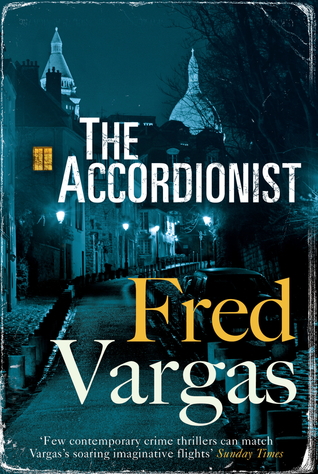
The Accordionist by Fred Vargas and translated by SianReynolds is the third book in the Three Evangelists series and it’s probably the most puzzling of the three. They are quirky crime fiction novels, with eccentric characters and intricate plots. The three ‘Evangelists’ are thirty-something historians, Mathias, Marc and Lucien, all specialists in three different periods of history, who live in a rambling house in Paris. Together with ex-special investigator Louis Kehlweiler, retired from the Ministry of the Interior, they find themselves involved in murder mysteries, mainly because Louis just can’t resist trying to solve particularly difficult crimes.

In this third book a simple-minded young man, Clément Vauquer, who plays the accordion, is the prime suspect for the murders of two Parisian women as he was seen watching both of their apartments before their murders. Desperate to prove his innocence he appeals to Marthe, who had looked after him as a child, for help.

Louis is supposed to be translating a biography of Bismark, but the newspaper reports of the two murdered women have distracted him so when his old friend Marthe tells him that Clément, who is like a son to her, is innocent and being used as a scapegoat he agrees to investigate and find the real culprit. He in turn, enlists the help of the three evangelists and Marc’s uncle, a retired policeman and they take Clément into their house to protect him whilst they dig deeper into the mystery.

I found this book the most baffling of the trilogy and really had no idea of how they managed to unravel all the strands of this murder mystery which has its roots in the past. They worked on instincts and by deciphering Clément’s muddled thoughts and memories, and with the help of a poem by the nineteenth century poet, Gerard de Nerval, finally uncover the killer’s identity. It’s the eccentric characters and the complicated plots that make Fred Vargas’ books stand out for me.

Fred Vargas is the pseudonym of of the French historian, archaeologist and writer Frédérique Audoin-Rouzeau. She has won three International Dagger Awards from the Crime Writers Association, for three successive novels: in 2006, 2008 and 2009. I’ve also enjoyed her Commissaire Adamsberg books, probably more even than the Three Evangelists, and I still have a few of that series left to read including the tenth and latest book in the series, This Poison will Remain, due to be published in August this year.

  • Format: Paperback
  • File Size: 783 KB
  • Print Length: 370 pages
  • Page Numbers Source ISBN: 0099548364
  • Source: Library book
  • My Rating: 4*

My Friday Post: The Accordionist by Fred Vargas

Book Beginnings Button

Every Friday Book Beginnings on Friday is hosted by Gillion at Rose City Reader where you can share the first sentence (or so) of the book you are reading, along with your initial thoughts about the sentence, impressions of the book, or anything else the opener inspires.

The book I’m featuring this week is The Accordionist by Fred Vargas, a book I reserved at the library and collected yesterday. It’s the third book in her Three Evangelists series.

The Accordionist (Three Evangelists)

It begins:

Paris, July, 1997

‘PARIS KILLER STRIKES AGAIN! SEE PAGE 6.’

Louis Kehlweiler threw the newspaper down on the table. He’d seen enough and felt no urge to turn to page 6. Later maybe, when the whole business had calmed down, he’d cut out the article and file it.

Also every Friday there is The Friday 56, hosted by Freda at Freda’s Voice.

30879-friday2b56These are the rules:

  1. Grab a book, any book.
  2. Turn to page 56, or 56% on your eReader.
  3. Find any sentence (or a few, just don’t spoil it) that grabs you.
  4. Post it.
  5. Add the URL to your post in the link on Freda’s most recent Friday 56 post.

Page 56:

‘I want to know what the cops think about these two murders, what lines they’re following, and how far they’ve got.’

Description (Amazon)

When two Parisian women are murdered in their homes, the police suspect young accordionist Clément Vauquer. As he was seen outside both of the apartments in question, it seems like an open-and-shut case.

Desperate for a chance to prove his innocence, Clément disappears. He seeks refuge with old Marthe, the only mother figure he has ever known, who calls in ex-special investigator Louis Kehlweiler.

Louis is soon faced with his most complex case yet and he calls on some unconventional friends to help him. He must show that Clément is not responsible and solve a fiendish riddle to find the killer…

~~~

I’ve been looking forward to reading The Accordionist since I finished Dog Will Have His Day, the second book in Fred Vargas’ Three Evangelists series. I love her books. She writes such quirky crime fiction, with eccentric characters and intricate plots that I love and find so difficult to solve.

What about you? Does it tempt you or would you stop reading?