Underworld by Reginald Hill

Rating: 5 out of 5.

Deadheads is the 10th Dalziel and Pascoe novel first published in 1988, set in the small mining town of Burrthorpe (a fictional town) in Yorkshire. The setting is excellent and Hill paints a compelling account of the mining community and gives a convincing insight into the period a few years after the Miners’ Strike of 1984. The majority of the book is about the miners, their families, their hatred of the bosses, and their distrust and dislike of the police.

There are two mysteries facing Dalziel and Pascoe. One is current and the other is a case that had appeared to have been resolved several years earlier, when Tracy Pedley, a young girl disappeared. Her body was never discovered and some of the residents believed that Billy Farr, who was the last person to see her alive, was responsible for her death. But then Donald Pickford committed suicide leaving a letter confessing to killing several young girls in the area and although he hadn’t mentioned Tracy by name, she was counted as a probable victim. Even so, some people still thought Billy was guilty and their suspicions were confirmed when later on it appeared that he committed suicide when he fell to his death in an abandoned mineshaft.

Matters are brought to boiling point when the local newspaper serialises the memoirs of ex-Deputy Chief Constable Neville Whatmough, who had been in charge of the Pickford case. This incenses Colin Farr, Billy’s son. And then another man is found dead in the mine …

Dalziel has just a minor role as Pascoe leads the investigation. Ellie, Pascoe’s wife, also plays a major role. Her involvement comes about when she tutors some of the miners as part of the union-sponsored day release courses and meets Colin Farr, Billy’s son. He is an angry young man and Ellie is attracted both to his intelligence and his physical masculinity, despite the strength of her feminist views. She really is an irritating character, an angry young woman and for most of the book it looked as though the Pascoes’ marriage was about to come to an end. It’s left to Dalziel to bring a touch of humour to the book and his down to earth approach to the miners gets more results than Pascoe’s middle class attempts to understand them.

I thoroughly enjoyed Underworld.

Note:

The title appears as ‘Under World‘ in some editions and as ‘Underworld‘ on others. On the front cover of the paperback I read it is ‘Under World‘ but on the title page it is one word -‘Underworld‘. The Underworld or Hades in ancient Greek and Roman Mythology was where the souls of the dead resided. Hill divides Underworld into three parts and begins each part with verses from Dante’s The Divine Comedy, thus equating the mine with hell.

Book Beginnings & The Friday 56: A Death in Tuscany by Michele Giuttari, translated by Howard Curtis

Every Friday Book Beginnings on Friday is hosted by Gillion at Rose City Reader where you can share the first sentence (or so) of the book you are reading. You can also share from a book you want to highlight just because it caught your fancy.

One of the books I’m currently reading is A Death in Tuscany by Michele Giuttari. I’ve not read anything by him before and am really enjoying it.

My Book Beginning:

Florence, 2001

The girl, little more than a child, was found on the edge of a wood on the road above Scandicci, scantily dressed, without papers, and dying of an overdose, at dawn on Sunday 29 July, and was taken to the Ospedale Nupvo. But it wasn’t until almost a week later that Chief Superintendent Michele Ferrara, head of the Florence Squadra Mobile, really became involved with the case.

Also every Friday there is The Friday 56, hosted by Freda at Freda’s Voice, where you grab a book and turn to page 56 (or 56% of an eBook), find one or more interesting sentences (no spoilers), and post them.

Page 56:

Worse still: the whole weekend would be ruined. But Ferrara realised that Anna was making an exception for him, and he couldn’t refuse. Especially as it had something to do with the investigation into the dead girl, which he was taking increasingly to heart.

From the back cover:

In the picturesque Tuscan hill town of Scandicci, the body of a girl is discovered. Scantily dressed, she is lying by the edge of the woods. Chief Superintendent Michele Ferrara, head of Florence’s elite Squadra Mobile, takes on the case. Because toxins were discovered in the girl’s body, many assume that she dies of a drug overdose. But Ferrara quickly realises that the truth is darker than that: he believes the girl was murdered.

And when he delves deeper, there are many aspects to the case that convince Ferrara that the girl’s death is part of a sinister conspiracy – a conspiracy that has its roots in the very foundations of Tuscan society.

Written by former Florence police chief Michele Giuttari, it gives a unique insight into life and police work in Tuscany.

This is a detailed police procedural and, although it is fast-paced, it is not a book you can read quickly.

What do you think, does it appeal to you? What are you currently reading?

Top Ten Tuesday: Debut Books I’ve Enjoyed the Most

Top Ten Tuesday is a weekly meme created by The Broke and the Bookish and now hosted by Jana at That Artsy Reader Girl. For the rules see her blog.

The topic this week is 2023 Debut Books I’m Excited About but, although I did try to find which of the new books coming out soon would be debuts I decided that it was too time consuming, so instead I’ve looked back in my blog to find debut novels I’ve read that I enjoyed the most.

Here are ten – in no particular order.

The Doll Factory by Elizabeth Macneal, historical fiction set in the 1850s when the Great Exhibition was being constructed and then opened to the public. It tells the story of Iris, the young woman who worked painting dolls in Mrs Salter’s Dolls Emporium, but who dreamed of being an artist. It also tells of her involvement with the Pre-Raphaelite Brotherhood, a group of artists first formed in the summer of 1848. They were challenging the art world with their vivid paintings, at once both stylised and naturalistic. The descriptions took me straight into London of the early 1850s with all its sights and smells, its squalor and bustling crowds as people go about their daily lives.

The Second Sight of Zachary Cloudsley by Sean Lusk, a mixture of historical fact and fantasy set in the 18th century, in London and in Constantinople. In 1754, renowned maker of clocks and automata Abel Cloudesley must raise his new-born son Zachary when his wife dies in childbirth. Zachary is intensely curious, ferociously intelligent, unwittingly funny and always honest—perhaps too honest. But when a fateful accident leaves six-year-old Zachary nearly blinded, he is plagued by visions that reveal the hearts and minds of those around him.

Sometimes I Lie by Alice Feeney. I like complicated plots with believable characters and with twists and turns to keep me glued to the book. This book has all this and more. I was puzzled, stunned and amazed at the cleverness of the plot structure and how I’d had the wool pulled over my eyes. It’s narrated by Amber Reynolds as she lies in hospital in a coma. She can’t move or speak, but she can hear and gradually she begins to remember who she is and what happened to her.

Saving Missy by Beth Morrey. Missy (Millicent) Carmichael is seventy nine, living on her own in a large house, left with sad memories of what her life used to be, a wife, mother and grandmother, but now she is alone. Her husband, Leo is no longer with her, her son and his family are in Australia and she and her daughter are estranged after a big row. And there is something else too, for Missy has a guilty secret that is gnawing away at her. This really is a special book, full of wonderful characters, ordinary people drawn from life, about everyday events, pleasures and difficulties.

Hotel on the Corner of Bitter and Sweet by Jamie Ford. In 1942 in Seattle Henry Lee, a 12 year old Chinese American boy meets Keiko Okabe, a Japanese American girl and they become great friends, even though Henry’s father is against the Japanese because of the enmity between China and Japan. As the war progressed the persecution of Japanese Americans intensified and they were removed from their homes and interned. Keiko and her family are moved to Camp Harmony, a temporary relocation centre at the Puyallup Fairgrounds, and not allowed to take their belongings with them. Many Japanese families, including Keiko’s, manage to store some in the basement of the Panama Hotel. Henry is devastated, certain he won’t see her again, especially when the families are moved to a permanent relocation centre, Minidoka in Idaho. 

The Legacy of Elizabeth Pringle by Kirsty Wark, a story centred on the lives of two women – Elizabeth Pringle and Martha Morrison. Elizabeth has lived all her life on the Isle of Arran and knowing that she is dying and has no living relatives, leaves her house, Holmlea in Lamlash, to Anna Morrison, a woman, who is all but a stranger, someone she had seen years before, pushing her daughter’s pram down the road outside. It’s about family, relationships, especially mother/daughter/sister relationships, about happiness, love and heartbreak, old age, memories and the contrast between life in the early part of the twentieth century and the present.

The Unquiet Dead by Ausma Zehanat Khan, the harrowing account of the atrocities of Srebrenica in 1995 and the search for justice forms the basis of this intriguing novel. Extracts from statements and reports from survivors of the massacre head each chapter, giving voice to the ‘unquiet dead‘. Alongside that is the investigation by detectives Esa Khattak and Rachel Getty into the death of Christopher Drayton who fell from the heights of the Scarborough Bluffs. Was it suicide, or an accident? Or was he pushed -and if so, who pushed him and why?

Everything But the Truth by Gillian McAllister set in both Newcastle and Oban, with clearly defined and believable characters, a complex plot with plenty of twists and turns, and a dark secret. It is up to date about social media and information about the internet and how to find hidden information (which as I’m not that computer savvy I had to Google to see if it was genuine – it is). The atmosphere in this book is tense and increasingly dark and claustrophobic.

Eyes Like Mine by Sheena Kamal.

The main focus of the book is Nora, her traumatic background and her search for her daughter, Bonnie, now a teenager, who she gave away as a new-born baby. Nora is shocked by her reaction when she sees a photo of Bonnie – there is no doubt that she is her daughter, with her dark hair and golden skin. But it is her eyes that clinch it for Nora; Bonnie has the same eyes, dark and fathomless. And Nora feels as though she is in a nightmare.

In Bitter Chill by Sarah Ward

In January 1978 two eight-year old girls, Rachel Jones and Sophie Jenkins were walking to school together when a strange woman offered them a lift in her car. Rachel is later found in Truscott Woods but Sophie was never found.  Move forward 30 years when Sophie’s mother commits suicide. Troubled by Yvonne Jenkin’s suicide, the police reopen the case – Superintendent Llewellyn who was on the original team asks DI Francis Sadler and his team, DC Connie Childs and DS Damian Palmer to see if there was anything that had been missed in 1978.

Six Degrees of Separation from Trust to The Betrayal of Trust

It’s time again for Six Degrees of Separation, a monthly link-up hosted by Kate at Books Are My Favourite and Best. Each month a book is chosen as a starting point and linked to six other books to form a chain. A book doesn’t need to be connected to all the other books on the list, only to the one next to it in the chain.

The starting book this month is Trust by Hernan Diaz, described as a sweeping, unpredictable novel about power, wealth and truth, told by four unique, interlocking voices and set against the backdrop of turbulent 1920s New York. I haven’t read this but it does appeal to me.

My First link is to another book set in the 1920s, The Winding Road by Cynthia Harrod-Eagles, a big hardback of 662 pages, that I bought in a library book sale. There are 35 books in the Morland Dynasty series and I haven’t read any of them. This is the 34th book in the series, so I am hoping it will read well as a standalone. The Jazz Age is in full swing in New York, the General Strike is underway in London, the shadows are gathering over Europe and the Wall Street Crash brings the decade to an end.

My Second Link is also a book I bought in a library book sale, Dark Matter by Philip Kerr, subtitled The Private Life of Sir Isaac Newton. This is historical crime fiction, set in 1696 when Newton was the Warden of the Royal Mint at the Tower of London hunting down counterfeiters during the period of the Recoinage of the currency, when fake gold coins were being forged. 

My Third Link is to The Redemption of Alezander Seaton by S G Mclean another book set in the 17th century, not in London, but in Scotland, mainly in the town of Banff. It’s a story of murder and cruelty, but also of love and the power of good over evil, as Alexander Seaton, a schoolteacher, sets out to prove the innocence of his friend Charles Thom, accused of murder.

The author originally wrote under her name – Shona Maclean, but now her books are published under the truncated name, S G MacLean. Another author who has also changed her published name, but the other way round, going from a truncated name to her full first name is Sharon Bolton who formerly wrote as S J Bolton.

And so my Fourth Link is to Sharon Bolton’s Blood Harvest, which was originally published under the name S J Bolton. It’s a dark, scary book and one that I found disturbing, but thoroughly absorbing, It’s a modern Gothic tale about the Fletchers who have just moved into a new house, but someone seems to be trying to drive them away – at first with silly pranks but then with threats that become increasingly dangerous. It’s full of tension, terror and suspense and I was in several minds before the end as to what it was all about.

I read Blood Harvest in September 2011. My Fifth Link is another book I read that month, Taken at the Flood by Agatha Christie. It’s a baffling case for Poirot when he is asked to investigate the death of Enoch Arden, found dead in his room at the local inn. There isn’t a flood in this book – the title is from Shakespeare, as Poirot explains:  “There is a tide in the affairs of men which taken at its flood leads on to fortune …” Someone acted on that, Superintendent. To seize opportunity and turn it to one’s own ends – and that has been triumphantly accomplished…’

But there is a flood in my Sixth Link, The Betrayal of Trust by Susan Hill, the 6th in the Simon Serrailler series. Simon investigates a cold case, that of a teenager missing for 16 years. After flooding causes a landslip on the Moor her body comes to the surface together with that of an unknown female found in a shallow grave nearby. But the police investigations are not the main subject of this book. It focuses on the problems of ageing, hospice care, Motor Neurone Disease, assisted suicide, Parkinson’s Disease and Alzheimer’s Disease. A lot to cope with all at once and at times I found The Betrayal of Trust a deeply depressing book.

My chain is a full circle that going from Trust to The Betrayal of Trust and from the 1920s, passing through the 17th century to the 20th century, and from historical fiction to crime fiction.

Next month (4, March 2023), we’ll start with a book that was a best-selling self-help title in the seventies – Passages by Gail Sheehy. I have never heard of this book before.

Throwback Thursday: When Will There Be Good News? by Kate Atkinson

Today I’m linking up with Davida @ The Chocolate Lady’s Book Review Blog for Throwback Thursday. It takes place on the Thursday before the first Saturday of every month (i.e., the Thursday before the monthly #6Degrees post). The idea is to highlight one of your previously published book reviews and then link back to Davida’s blog.

When Will There Be Good News by Kate Atkinson is probably my favourite of her books. I first reviewed it on February 18, 2009. I’d borrowed it from the library and at the time was thinking of re-reading it but I had to return the book before I had time to read it again. It’s the third novel in her Jackson Brodie series. I still haven’t read it again – I’d love to though.

My review begins:

Complex but so very satisfying!  This has had very mixed reviews on Amazon which just goes to show that you have to make up your own mind about a book. I read it very quickly because I loved it. I know I missed bits – just when did Jackson lose his jacket? I’ve tried to track it down but I can’t spot it, so I’m thinking of reading it again before I have to take it back to the library.

Click here to read my full review

The next ThrowbackThursday post is scheduled for March 1, 2023.

Books Read in January

I read 8 books in January, enjoying some much more than others. I am hoping to write about the three books I haven’t reviewed but in case I don’t get round to it I’ve written a few words about them here.

1. The Stroke of Winter by Wendy Webb 2.5*

2. The Girl Who Died by Ragnar Jonasson 3*

3. Ghost Walk by Alanna Knight 3*

4. Aftermath by Peter Robinson 3*

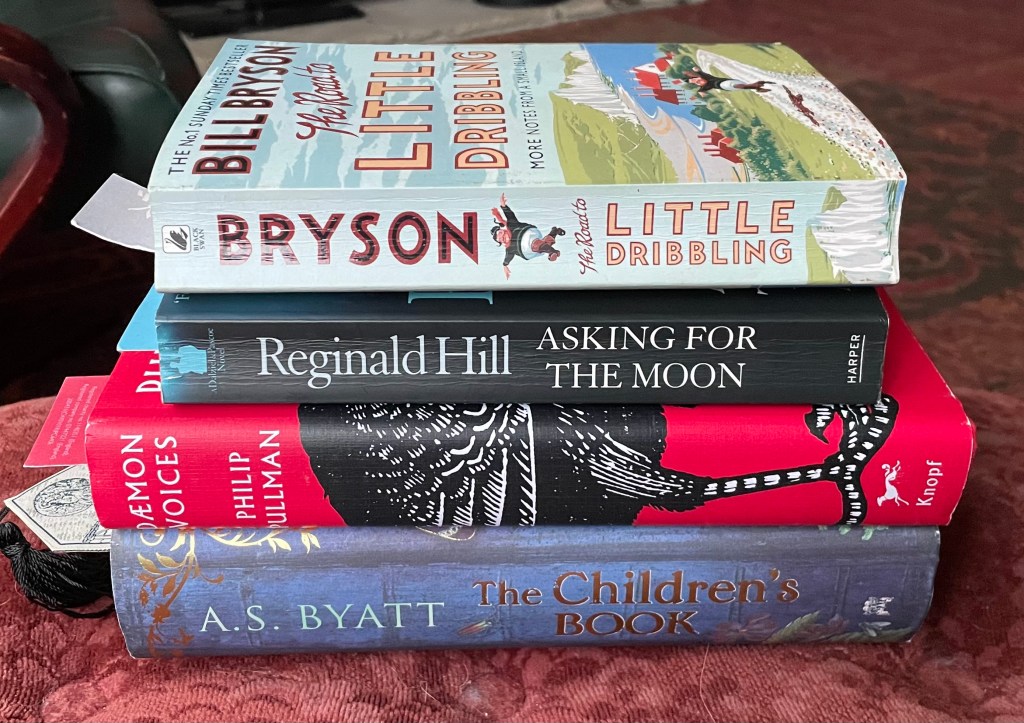
5. Underworld by Reginald Hill 5* – the 10th Dalziel and Pascoe crime fiction novel, set in the Yorkshire mining town of Burrthorpe in 1986, two years after the Miners’ Strike. I thoroughly enjoyed this. For now I’ve copied the summary from Fantastic Fiction because this is a complex book that needs more description than just a few lines:

When young Tracey Pedley vanished in the woods around Burrthorpe, the close-knit community had their own ideas about what had happened, but Deputy Chief Constable Watmough has it down as the work of a child-killer who has since committed suicide — though others wondered about the last man to see her alive and his fatal plunge into the disused mine shaft. Returning to a town he left in anger, Colin Farr’s homecoming is ready for trouble, and when a university course brings him into contact with Ellie Pascoe, trouble starts… Meanwhile Andy Daziel mutters imprecations on the sidelines, until a murder in Burrthorpe mine forces him to take action that brings him up against a hostile and frightened community…

6. Lion by Conn Iggulden 4*

7. The Last Rose of Shanghai by Weina Dai Randel 3* – historical fiction set Japanese-occupied Shanghai, this is a World War Two romance, the story of Aiyi Shao, a young heiress and the owner of a glamorous Shanghai nightclub and Ernest Reismann, a penniless Jewish refugee who had fled from Germany. I loved the beginning of this book but the rest of the book was not so good – too much ‘telling’ and I’d have liked less focus on the romance, which to me was barely believable So, 5* for the first 40%, 2* for the rest, so 3* overall. But plenty of other readers love this book.

8. Shroud of Darkness by E C F Lorac 4* – a Golden Age crime fiction beginning with five passengers on a train from Cornwall to London. When it arrives at Paddington Station in thick fog, one of the passengers is brutally attacked and left for dead. Chief Inspector MacDonald first has to identify the victim, whose pockets had been rifled and then discover why he was attacked and who did it. Another book I really enjoyed, trying to work out what had happened and failed – I was completely baffled, as much in the dark as the fog-bound passengers.