TBR Challenge Update

I see that Emily and others have written progress updates on her Attacking the TBR Tome challenge.

This was my original list – I’ve only read two so far.

  1. The Day Gone By, by Richard Adams (autobiography)
  2. One Good Turn by Kate Atkinson
  3. The Children’s Book by A S Byatt
  4. The Country Life by Rachel Cusk
  5. Helen of Troy: a novel by Margaret George
  6. The Rose Labyrinth by Titania Hardie
  7. Ghost by Robert Harris
  8. Slipstream: a memoir by Elizabeth Jane Howard
  9. Rivers by Griff Rhys Jones
  10. The Girl with the Dragon Tattoo by Stieg Larsson
  11. The Girl Who Played with Fire by Stieg Larsson
  12. Mollie Fox’s Birthday by Deirdrie Madden
  13. Wolf Hall by Hilary Mantel €“ read
  14. Love in the Time of Cholera by Gabriel Garcia Marquez
  15. Eden’s Outcasts: the story of Louisa May Alcott and Her Father by J Matteson
  16. Be Near Me by Andrew O’Hagan €“ read
  17. Map Addict by Mike Parker
  18. Resistance by Owens Sheers
  19. Corvus: a Life with Birds by Esther Woolfson
  20. Being Shelley: The Poet’s Search for Himself by Anne Wroe

I still want to read these books and the reasons I haven’t yet is that I keep coming across other books that I want to read too, my mood has changed since I made the list, books in the library have caught my eye or others have written about books that sound so good I’ve read those instead. The other reason is that as soon as I add a book to a list it becomes an ‘ought to read book’ and no longer so appealing. It seems that putting a book on a list often means that is where it stays – on the list.

But I did give myself the option of reading other books from my TBR piles and have done quite well with that, reading another 12 books, all of which I owned before December 1st 2009:

  1. Drood by Dan Simmons
  2. Let it Bleed by Ian Rankin
  3. Black and Blue by Ian Rankin
  4. The Pale Horse by Agatha Christie
  5. Can Any Mother Help Me? by Jenna Bailey €“ see also here
  6. The Hanging Garden by Ian Rankin
  7. The Warrior’s Princess by Barbara Erskine
  8. Dead Souls by Ian Rankin
  9. The Franchise Affair by Josephine Tey
  10. Why Didn’t They Ask Evans? by Agatha Christie
  11. Hearts and Minds by Amanda Craig
  12. Faithful Unto Death by Caroline Graham

So a total of 14 books in all, so I think I’m not doing too badly really and I do intend to read more off the original list before the end of the year.

Emily’s challenge was not to buy any books until you’ve read 20 TBR books and I knew I couldn’t do that.  I have bought some books, and I have been totally unable to not borrow books from the library – more than half the books I’ve read this year have been library books.

Library Loot

It’s been a while since I did a Library Loot post. This is my latest haul from the Mobile Library that called round this morning (as usual click on the photo to enlarge):

I really appreciate the mobile library service, the van stops just along the road from our house and has a varied, if small selection of books. I chose:

  • The Lighthouse by P D James, an Adam Dalgleish mystery, set in an imaginary, remote island off the Cornish coast.  It’s been a few years since I read one of P D James’s books – I hope it won’t disappoint.
  • Have Mercy On Us All by Fred Vargas. I haven’t read any of his books before. According to the blurb on the back cover this is ‘an unusual and eccentric thriller’  and Adamsberg is ‘one of the most fetchingly weird detectives … a bit like Morse, but much more French.’ That’s odd as Morse isn’t a bit French!  I’m not sure I’ll like it, but that’s the beauty of library books – I don’t mind giving up on them. On the other hand, if I buy a book that’s very disappointing.
  • The Scent of the Night by Andrea Camilleri, an Inspector Montalbano Mystery. I’ve read one of his before which I enjoyed, so I have high hopes for this one.

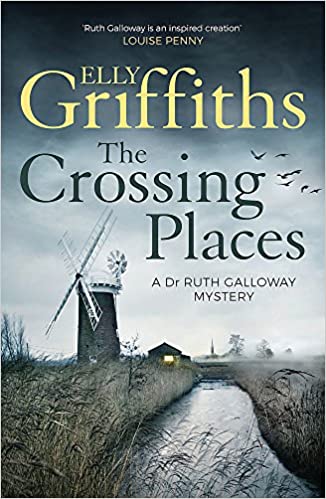
The Crossing Places by Elly Griffiths: Book Review

When I started reading The Crossing Places by Elly Griffiths I nearly didn’t bother carrying on because it’s written in the present tense, but I’m glad I did because I did enjoy it and at times didn’t even notice the tense. This is a debut crime fiction novel, even though it’s not the author’s first book.

Set in Norfolk it’s an interesting mix of investigations into a cold case – the disappearance of Lucy, a five year old girl ten years earlier and a current case of another missing four year old girl. Are they connected and just how does the discovery of a child’s bones from the Iron Age fit in? The police ask Dr Ruth Galloway, who lectures in archaeology at the local university and lives near the finds in a remote cottage at Saltmarsh overlooking the North Sea, to date the bones. She becomes more involved when DI Harry Nelson asks her to look at the anonymous letters the police have received ever since Lucy disappeared – strange letters full of archaeological, biblical and literary references, taunting the police about Lucy’s whereabouts and details of ritual sacrifice.

There’s a satisfying amount of information about Ruth’s earlier life and just enough about the archaeological digs to whet my appetite, plus some whacky characters like Cathbad who lives in a decrepit caravan on the beach. I liked Harry Nelson, a gruff northerner obsessed by Lucy’s disappearance and I became very fond of Ruth, an overweight woman nearing forty who lives on her own with two cats. I found the setting in Norfolk  in winter with its immense skies was very atmospheric – its remoteness, treacherous mud flats, marshlands and driving rain made feel as though I was there. In fact there were parts of the story involving quicksand that reminded me of Wilkie Collins’s The Moonstone, in which Rosanna Spearman drowns in quicksand on the marshes and there is a remarkable similarity between the names of Sergeant Cuff (in The Moonstone) and Sergeant Clough (in The Crossing Places).

The mystery isn’t too difficult to solve and I’d guessed the culprit quite early on in the book, so the ending wasn’t a surprise. I thought there were maybe just one too many coincidences in the connections between the characters, but none of this spoilt the book for me and I’m adding the next Ruth Galloway book, The Janus Stone to my list of books to look out for.

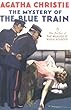
The Mystery of the Blue Train by Agatha Christie: Book Review

Agatha Christie didn’t enjoy writing The Mystery of the Blue Train (first published in 1928). In her autobiography she wrote that it had not been easy writing it and that she had always “hated” it:

To begin with I had no joy in writing, no élan. I had worked out the plot – a conventional plot, partly adapted from one of my other stories. I knew, as one might say, where I was going, but I could not see the scene in my mind’s eye, and the people would not come alive. I was driven on by the desire, indeed the necessity, to write another book and make some money.

That was the moment when I changed from being an amateur to a professional. I assumed the burden of a profession, which is to write even when you don’t want to, don’t much like what you are writing and aren’t writing particularly well. (pages 368-9)

As she was writing this book at the time of her disappearance and divorce from her first husband, Archibald Christie it’s hardly surprising. It may not be her best book, but it’s still a good read. Ruth Kettering, the daughter of millionaire Rufus Van Aldin, is married to Derek, against her father’s advice. Agatha’s views on divorce are clear when Van Aldin tells Ruth she should divorce Derek, who he thinks is no good, rotten through and through and had only married her for her money, saying:

Have you got the grit to admit to all the world that you’ve made a mistake. There’s only one way out of this mess, Ruthie. Cut your losses and start afresh. (page 20)

Later Ruth is found strangled in her compartment in the Paris-Nice train, known as the train bleu, on its arrival in Nice and the fabulous ruby, the Heart of Fire that Van Aldin had given her, has been stolen. Fortunately Hercule Poirot is also travelling on the train and he of course unravels the mystery. There are a number of suspects ranging from Derek and his mistress, the dancer Mirelle, who had both the motive and the opportunity, to Ruth’s lover, the Comte de la Roche, suspected of stealing the jewels.

I liked the reflections on detective novels through a conversation Poirot has with another passenger on the train, Katherine Grey, from St Mary Mead who has inherited money from her employer. She is reading a roman policier when they meet at dinner and Poirot comments that they always sell well. She replies that may be because they give ‘the illusion of living an exciting life’ and that ‘nothing of that kind ever happens to me.‘ From then on however, she is drawn into the mystery along with Poirot, that

 small man, distinctly foreign in appearance, with a rigidly waxed moustache and an egg-shaped head which he carried rather on one side. (page 80)

It may be that Poirot is a bit of a caricature in this book, but the characters are in the main believable and the book certainly has a 1920s feel to it.

The Sunday Salon – Books I’d like to Read Right Now

Currently I’m reading The Right Attitude to Rain, the third Isabel Dalhousie novel  by Alexander McCall Smith. It’s the sort of book that makes me pause whilst I’m reading it and think about what I’ve read. It’s not a book to rush through at top speed to find out what happens, but rather a book to savour for its characters and settings, for its interaction bewteen the characters and the images it evokes.

It’s also the sort of book that reminds me of other books I’d like to read and this morning when I read Isabel’s and Tom’s discussion about Mary Queen of Scots I began to think of a couple of books I’ve been meaning to read and wanting to read them right now. These are:

I also want to read these books I’ve borrowed recently from the library:

  • The Man Who Planted Trees by Jean Giono, the story of an imaginary shepherd hoping to plant thousands of trees. I saw this reviewed on Simon’s blog and thought it looked good. It’s only52 pages, so I could read that right now.
  • The Crow Trap by Ann Cleeves, crime fiction set in the Pennines featuring DI Vera Stanhope. This is yet another long book (over 500 pages)
  • and, bringing me back to Alexander McCall Smith, the fifth Isabel Dalhousie novel, The Comfort of Saturdays.

I have to settle for the fact that I can only read one book at a time, so it’s back to The Right Attitude to Rain – right now, along with a cup of tea.