Six Degrees of Separation from Where Am I Now? to The Book of Illusions

I love doing Six Degrees of Separation, a monthly link-up hosted by Kate at Books Are My Favourite and Best. Each month a book is chosen as a starting point and linked to six other books to form a chain. A book doesn’t need to be connected to all the other books on the list, only to the one next to it in the chain.

This month the chain begins with with Where Am I Now? by Mara Wilson, subtitled True Stories of Girlhood and Accidental Fame. Mara Wilson is a former child actress best known for her starring roles in Matilda and Mrs. Doubtfire. I haven’t read this book which tells the story of one young woman’s journey from accidental fame to relative (but happy) obscurity. 

Where Am I Now?

As the title of Mara Wilson’s book is a question my first link is to another book with a question in the title. When Will there Be Good News? by Kate Atkinson. A tale of disasters beginning when six year old Joanna witnessed the murder of her mother, older sister and baby brother. It’s the third in her Jackson Brodie series. I raced through this very quickly as I was so keen to find out what happened. I know I missed the clues and I’d love to re-read it sometime!

When Will There Be Good News? (Jackson Brodie, #3)One Good Turn (Jackson Brodie #2)Three Act Tragedy (Hercule Poirot, #11)

The second link is to another book by Kate Atkinson, One Good Turn. This is the second  Jackson Brodie book, a cleverly constructed and complicated murder mystery. It’s a puzzle and like the Russian dolls within dolls (which also feature in this book), there is a thread connecting it all together. I didn’t think it was quite as good as When Will There Be Good News?, but still enjoyed it.

Another book with a number in the title is Agatha Christie’s  Three Act Tragedy, also a book containing lots of puzzles to be solved. Poirot plays a secondary role, preferring to think rather than act and it is Mr Satterthwaite and Sir Charles who investigate the deaths of two of the guests at Sir Charles Cartwright’s party. This is one of Christie’s earlier books (1935) and I really enjoyed it.

Mr Satterthwaite, along with Mr Harley Quin, also features in Agatha Christie’s short story collection The Mysterious Mr Quin, first published in 1930 . This is my favourite of her collections, containing some of her very best short stories.

The Mysterious Mr. Quin (Harley Quin, #1)The Breaking Point: Short StoriesThe Book Of Illusions

My fifth link is to another collection of short stories: The Breaking Point by Daphne du Maurier. These stories are dark, difficult, perturbing – and sometimes shocking, telling of double lives, split personalities, paranoia and conflict, each one with a ‘breaking point’. One of the stories is The Menace about a silent movie star, a heart-throb until the advent of the ‘feelies’ when it is discovered that his magnetism is almost non-existent.

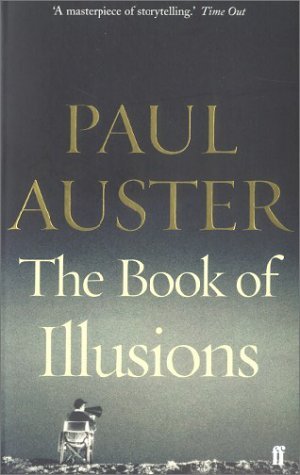
One of the characters in The Book of Illusions by Paul Auster is a silent movie star – Hector Mann. There are many layers to this novel; it’s a detective story with gothic overtones, a love story and a novel about the passing of the 20th century, ending as the last weeks of the century approach. It’s a circular story as well, ending with the hope that it ‘will start all over again.’

And this completes my chain beginning and ending with books about movie stars, passing through murder mysteries and short story collections, and moving from the US to the UK and back to the US, linked by the titles, authors and characters.

Next month (October 6, 2018), we’ll begin with a book I haven’t read (or heard of before) – a story of teenage rebellion, The Outsiders by S. E. Hinton.
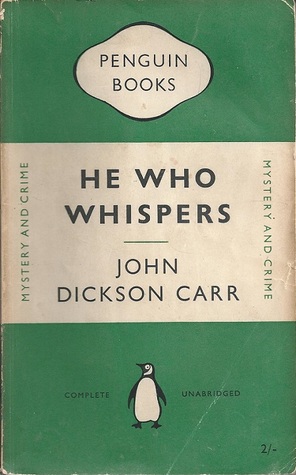
He Who Whispers by John Dickson Carr

He Who Whispers by John Dickson Carr was my Classics Club Spin book for August. It was first published in 1946. Carr (1906 – 1977) was an American writer who also wrote under the pseudonym of Carter Dickson and Carr Dickson. In 1936 he was elected to the Detection Club in London. He Who Whispers is one of his ‘locked room’  mysteries/impossible crimes, featuring Dr Gideon Fell, an amateur sleuth.

He Who Whispers by John Dickson Carr

I really didn’t know what to expect so I was pleased to find that I thoroughly enjoyed this book. It’s well written, set in 1945 just after the end of the Second World War when Miles Hammond is finding it hard to getting used to peacetime. London is still showing the scars of the war and he feels that his life is unreal. He has been discharged from the Army after being in hospital suffering from diesel-oil poisoning.

Then, gasping out to the end like a gauleiter swallowing poison, the war is over. You come out of hospital – a little shakily, your discharge papers in your pocket – into a London still pinched by shortages; a London of long queues, erratic buses, dry pubs; a London where they turn on the street-lights and immediately turn them off again to save fuel; but a place free at last from the intolerable weight of threats.

People didn’t celebrate that victory hysterically, as for some reason or other the newspapers liked to make out. What the newsreels showed was only a bubble on the huge surface of the town. Like himself, Miles Hammond thought, most people were a little apathetic because they could not yet think of it as real. (page 6)

His friend, Dr Gideon Fell, has invited him to dinner as a guest at the Murder Club, their first meeting in five years, where the speaker is Professor Rigaud. But when he arrives he finds none of the members of the Club have turned up. The only other people there are the Professor, and a beautiful blonde called Barbara Morell. Rigaud, however, tells them the story he had prepared for the Club – a tale of an impossible murder on the top of a ruined tower, that had once been part of a French chateau burnt down by the Hugeunots in the 16th century, and a mysterious woman, Miss Fay Seton.

The body of Howard Brooke was found lying on the parapet of the tower by two children between 10 minutes to 4 and 5 minutes past 4. He had been stabbed through his body with a sword-stick and yet the evidence showed conclusively that during this time not a living soul came near him. Rigaud points out the difficulties of scaling the wall of the tower, leading Miles to suspect he is alluding to ‘some sort of supernatural being that could float in the air‘ – in other words, a vampire.

Now, six years later Miles, Rigaud and Barbara together with Dr Fell set about trying to solve the mystery. I was fascinated by Dr Fell, supposedly based upon G. K. Chesterton (author of the Father Brown stories), in his appearance and personality. He’s immensely tall and fat, with a big mop of grey-streaked hair, and wearing a long, dark cape. He strides along ‘with a rolling motion like an emperor, and the sound of his throat-clearing preceded him like a war-cry‘.

I thought the characterisation was excellent and there is a great sense of location. The book is full of tension and there is a real sense of approaching danger and disaster as the characters struggle to uncover the truth. It is only due to Dr Fell’s ingenuity that their fears are calmed and he produces a rational explanation and reveals the truth. I too was puzzled and the book had kept me guessing right to the end. Even then when I knew what had happened I was so involved with the characters that  I was left wondering –  what happened next? 

Now, I’m keen to read more of John Dickson Carr’s books. There are a lot of them – see the list at Fantastic Fiction.

  • Paperback: 206 pages
  • Publisher: Penguin Books in association with H.Hamilton (1953)
  • Source: I bought my copy
  • Rating: 4*

New-to-Me Books from Barter Books

Yesterday I went to my favourite bookshop Barter Books, one of the largest secondhand bookshops in Britain. This is where you can ‘swap’ books for credit that you can then use to get more books from the Barter Books shelves.

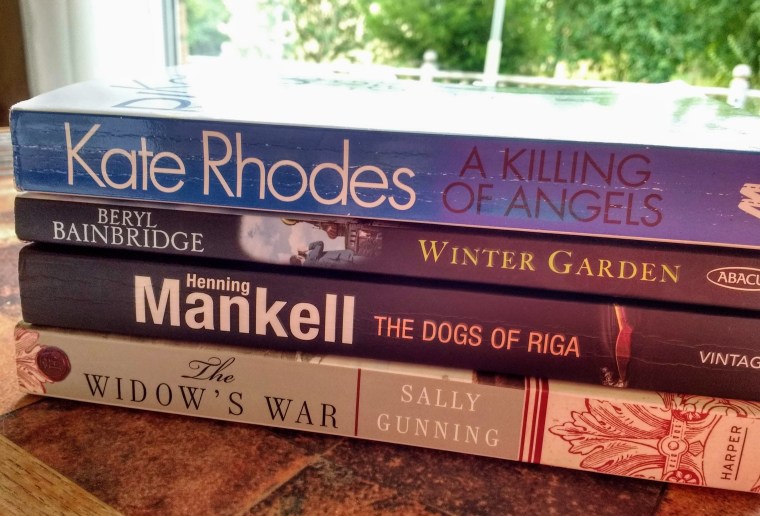
These are the books I brought home:

img_20180829_073215012_hdr


A Killing of Angels by Kate Rhodes (a new-to-me author) – the second book in her Alice Quentin series. I haven’t read the first book but I thought this looks good – it’s a psychological thriller. At the height of a summer heatwave, a killer stalks the City of London.The avenging angel leaves behind a scattering of feathers with each body – but why these victims? What were their sins?

Winter Garden by Beryl Bainbridge – described on the back cover as ‘surreal’ (TLS) and ‘very funny as well as a frightening book’ (Guardian), I’m not sure what I’ll make of this book about a womaniser who begins an extra-marital affair, but I’ve liked other books by Beryl Bainbridge.

The Dogs of Riga by Henning Mankell. I’ve enjoyed a couple of his books before, so this Inspector Wallander book caught my eye. A little raft is washed ashore on a beach in Sweden. It contains two men, shot dead. They’re identified as criminals, victims of a gangland hit. Wallander’s investigation takes him to Latvia.

The Widow’s War by Sally Gunning – another new-to-me author. This is historical fiction set in 1761 about a whaler’s wife in the Cape Cod village of Satucket in Massachusetts, living with the daily uncertainty that her husband Edward will simply not return. And when her worst fear is realised, she finds herself doubly cursed.

Have you read any of these? Do they tempt you too?

The Story Keeper by Anna Mazzola


The Story Keeper

4*

The Story Keeper is historical fiction set on the Isle of Skye in 1857 where Audrey Hart has been employed by Miss Buchanan to collect the folklore and fairy tales of the local community. The Highland Clearances have left their mark on the crofters leaving them suspicious and fearful, unwilling to talk to Audrey as both the clergy and schoolmasters have condemned their practice of the old traditions – the stories are being lost.

The novel stresses the importance of folk tales – stories that have been told to make sense of the world and reflect people’s strengths, flaws, hopes and fears. Such stories are interspersed throughout the book. When one by one young girls go missing from their homes  the locals believe they have been taken by the spirits of the unforgiven dead. For these are not tales of good fairies, but of malign spirits that torment the girls they have stolen, sometimes returning them, ‘sorely changed’.

This is a novel full of family secrets and unfulfilled desires. There is a mystery about Audrey, her background and why she wanted to come to Skye. At first she believes there is a rational explanation to the girls’ disappearance but gradually she comes to fear that there may be something more supernatural behind it – linked maybe to the mystery of her mother’s disappearance years earlier on Skye.

It is beautifully written with vivid descriptions of the island, the flocks of black birds that whirl above the house that stands like an enchanted castle or a fortress on the coast. From a slow start the pace of the book rises to a crescendo in a dramatic and horrific ending combining the supernatural with reality, and tales of cruel fairies with the brutality of human beings. I loved the setting, the characterisation and the mix of history with folklore and fairy stories.

Thank you to the publisher, Tinder Press for my copy of this book for review.

10 Books of Summer – Update

I’m taking part in Cathy’s summer reading challenge and opted for the 10 book version, starting on 1 June 2018 and running until 3 September 2018. One of the joys of this challenge is that you can change your list at any time!

With just over a week left this is my revised list, showing the books I’ve read so far, with links to my posts:

  1. On Beulah Height by Reginald Hill 
  2. Darkside by Belinda Bauer 
  3. Ruined Stones by Eric Reed
  4. Camino Island by John Grisham  – review to follow
  5. The Woman in Cabin 10 by Ruth Ware
  6. Absent in the Spring by Agatha Christie
  7. Appleby’s End by Michael Innes
  8. Cecile is Dead by Georges Simenon
  9. Don’t Look Now and other stories by Daphne du Maurier – I’ve read the first story
  10. Coffin Road by Peter May


My Friday Post: The House Between Tides by Sarah Maine

Book Beginnings Button

Every Friday Book Beginnings on Friday is hosted by Gillion at Rose City Reader where you can share the first sentence (or so) of the book you are reading, along with your initial thoughts about the sentence, impressions of the book, or anything else the opener inspires.

The book I’m featuring this week is The House Between Tides by Sarah Maine, a book I’m planning to read soon. It’s the story of a crumbling estate in the wilds of Scotland, set in 1910 and 2010.

The House Between Tides


It begins:

2010

The  first bone he had dismissed as dead sheep. There’d been others – ribs decaying amidst rabbit droppings and debris from the collapsing ceilings, or bleached vertebrae. But the next one was a long bone, and he held it, considering a moment, then rocked back on his heels.

This was no sheep.

Also every Friday there is The Friday 56, hosted by Freda at Freda’s Voice.

30879-friday2b56These are the rules:

  1. Grab a book, any book.
  2. Turn to page 56, or 56% on your eReader.
  3. Find any sentence (or a few, just don’t spoil it) that grabs you.
  4. Post it.
  5. Add the URL to your post in the link on Freda’s most recent Friday 56 post.

Page 56:

And she had been drawn to a painting which hung in a corner, away from the others, a painting she now recognised as the view from the foreshore in front of the house. It showed two ill-defined figures walking across the strand, through contrasting patches of light, shadow and mist, walking in parallel, slightly apart from each other, and somehow clearly a man and a woman. But were they coming together or drifting apart?

Description (Amazon)

Following the death of her last living relative, Hetty Deveraux leaves London and her strained relationship behind for Muirlan, her ancestral home in Scotland – now in ruins. As Hetty dives headfirst into the repairs, she discovers a shocking secret protected by the house for a hundred years.

With only whispered rumours circulating among the local villagers and a handful of leads to guide her, Hetty finds the power of the past is still affecting her present in startling ways.

~~~

Sarah Maine is a new-to-me author, so I’m not sure what to expect, but The House Between Tides is described by Kirkus Reviews as ‘ A compelling debut which deftly blends classic suspense with modern themes.’ The reviewer in the Independent is quoted on the front cover – ‘An echo of Daphne du Maurier‘, so I’m hoping I’ll like it.

What about you? Does it tempt you or would you stop reading?