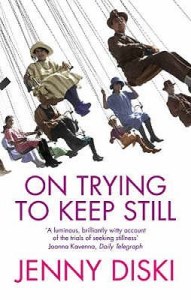
Today I’m looking back at my post on On Trying to Keep Still by Jenny Diski which I first reviewed on June 8, 2007.
Here are the first two paragraphs::
This book captivated me. I have read some good books this year, but this one outshines the rest. When I wasn’t reading it I was thinking and talking about it. It’s about experiencing an experience, becoming aware of experiencing the experience and so losing the experience.
I have had the experience of experiencing Jenny Diski’s travels during a year when she visited New Zealand, spent three months in a cottage in Somerset and went to sample the life of the Sami people of Swedish Lapland. No need to go those places myself now. Really, I could be tempted by a trip to New Zealand, but that is only a pipe dream. Now, a cottage in Somerset – that is a real possibility.
This is the first week of Novellas in November, hosted by Bookish Beck and Cathy at 746 Books, and like Susan and Annabelle, I’m looking back at some of the novellas I’ve previously read.
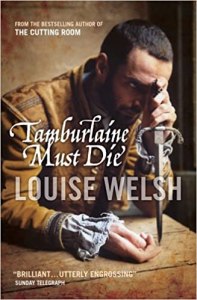
Tamburlaine Must Die by Louise Welsh – set in May 1593, it’s a tense, dramatic story of the last days of Christopher Marlowe, playwright, poet and spy. Accused of heresy and atheism, his death is a mystery, although conjecture and rumours abound. Louise Welsh has used several sources in writing this novella and it has an immediacy, that drew me in to the late Elizabethan world. It conveys the claustrophobic atmosphere of danger surrounding Marlowe; who can he trust, and who is behind the pseudonym of ‘Tamburlaine’, who posted a libellous handbill referencing Marlowe’s plays? He has just three days to find the murderous Tamburlaine, a killer escaped from the pages of his most violent play, Tamburlaine.
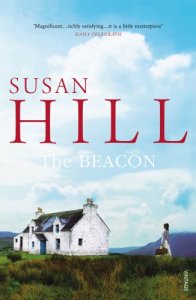
The Beaconby Susan Hill – a compelling story, drawing a picture of a family, four children and their parents living in the Beacon, an old North Country farmhouse. It’s also full of tension, of unspoken feelings and emotions as each child, Colin, May, Frank and Berenice grow up and leave home. Except that May came back after a year at university in London, unable to cope with ‘the terrors’ that began to assail her. As the years pass, May is left at home caring for her widowed mother, after she suffered a stroke. It’s a powerful book about truth and memory, about the ordinary everyday outer lives we live and the inner turmoil and tensions within us. It’s also about what we make of our lives, how we express ourselves and about how other people see us.
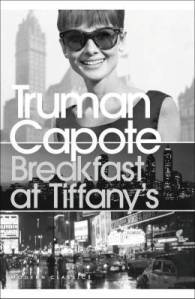
Breakfast at Tiffany’s by Truman Capote is a quick read and very entertaining. The narrator is not named, although Holly Golightly calls him ‘Fred’ after her brother. He’s a writer and at the beginning of the book he is reminiscing about Holly with Joe Bell, who ran a bar around the corner on Lexington Avenue. They hadn’t seen or heard from Holly for over two years. She used to live in the apartment below Fred’s in a brownstone in the East Seventies in New York. Her past is almost as unknown as her present whereabouts. Holly is a free spirit, charming and carefree, but craves attention. She has a cat, plays the guitar and likes to live as though she’s about to leave – all her belongings still in suitcases and crates – and has a great many friends who she entertains with numerous parties. But her life is really a mystery and not all is as it appears on the surface, longing for something wonderful to happen.
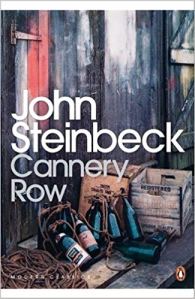
Cannery Rowby John Steinbeck – I love this book. Steinbeck’s style is perfect for me, I could see Cannery Row itself, a strip of Monterey’s Ocean View Avenue, where the Monterey sardines were caught and canned or reduced to oil or fishmeal, along with all the characters – no, it was more than that -I was there in the thick of it, transported in my mind, whilst I was reading and even afterwards as I thought about the novel. There is humour and tragedy, meanness and generosity, life and death all within Cannery Row‘s 148 pages, full of fascinating characters including a group of down and outs, lead by Mack, the shop keeper, Lee Chong, who also owns the Palace Flophouse where he lets Mack and the boys live, Dora, a woman with flaming red hair, the madam who runs the Bear Flag Restaurant, Doc who lives and works at the Western Biological Laboratory and Henri the painter who is building and never finishing a boat.
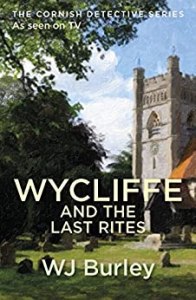
Wycliffe and the Last Rites by W J Burley – set in Cornwall a bizarre murder shakes the village of Moresk. Arriving at church on Easter morning the vicar discovers the body of a woman sprawled across the chancel steps. To add to the horror, the church is filled with the discordant sound of an organ chord, the notes apparently chosen at random and wedged down.Detective Chief Superintendent Wycliffe’s problem in finding the murderer is that all the possible leads pointed to a limited range of possible suspects but none of them matched his specification for the criminal. It seemed he had to believe the impossible. It’s a tightly plotted book, concisely and precisely written and I enjoyed it very much
Week 1: (November 1-5) – Your Year in Nonfiction with Rennie at What’s Nonfiction: Take a look back at your year of nonfiction and reflect on the following questions – What was your favorite nonfiction read of the year? Do you have a particular topic you’ve been attracted to more this year? What nonfiction book have you recommended the most? What are you hoping to get out of participating in Nonfiction November?
So far this year I’ve read 15 nonfiction books, more than in previous years, but I haven’t managed to write reviews of all of them. The links shown take you to my posts, where they do exist.
I read it in February and gave it 5*. I thought then it would be one of the best books I’d read this year and I still think that. Rebanks’ farm is in the Lake District hills. It was part of an ancient agricultural landscape: a patchwork of crops and meadows, of pastures grazed with livestock, and hedgerows teeming with wildlife. And yet, by the time James inherited the farm, it was barely recognisable. The men and women had vanished from the fields; the old stone barns had crumbled; the skies had emptied of birds and their wind-blown song.
It is inspirational as well as informative and it is beautifully written. I enjoyed his account of his childhood and his nostalgia at looking back at how his grandfather farmed the land. And I was enlightened about current farming practices and the effects they have on the land, depleting the soil of nutrients.
But all is not doom and gloom as Rebanks explains what can be done to put things right, how we can achieve a balance of farmed and wild landscapes, by limiting use of some of the technological tools we’ve used over the last 50 years so that methods based on mixed farming and rotation can be re-established. By encouraging more diverse farm habitats, rotational grazing and other practices that mimic natural processes we can transform rural Britain.
I can highly recommend reading English Pastoral. I loved it and came away with much to think about and also hope for the future.
~~~
I like to vary my reading but tend to lean towards reading memoirs, biographies and history. This year I’ve also been interested in climate change, politics and in learning more about Covid-19 and how it’s been managed. Taking part in Nonfiction November in previous years has given me an incentive to read more nonfiction and I’m sure it will again this year. I’m looking forward to seeing what others have been reading!
I won’t be able to finish reading any more books this month, but it’s been a bumper month of reading, with a total of 8 books. Five of them are nonfiction (including one audiobook) which is probably the first time I’ve read more nonfiction than fiction during one month. But I’ve only written posts about 2 of them! I’ve definitely spent more time reading than writing this month.
These are books I’ve reviewed with links to my posts:
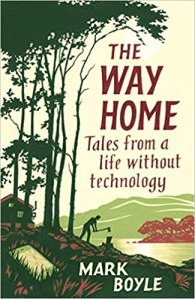
The Way Home: Tales from a life without technology by Mark Boyle 4* – This is not a ‘how to’ book, nor is it a guide to living without technology. It’s an account of what it was like for him, living in a wooden cabin he built on a smallholding in Ireland. He has no running water, no car, no electricity or any of the things it powers: the internet, phone, washing machine, radio or light bulb. He writes about the loneliness he experienced, the lack of contact with his parents and friends, and the damage to his relationships. The book follows the seasons of the year and is a collection of tales about his experiences and his observations about attempting to live a technology-free life.
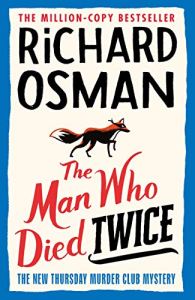
The Man Who Died Twice by Richard Osman 1* – light, easy to read crime fiction, this is a follow up to The Thursday Murder Club. Many people have written glowing reviews of this book, but Richard Osmond’s style of humour differs from mine, so I didn’t find it very funny. I don’t like being so negative about a book but I think the characters are rather stereotypical and the plot is over complicated and unconvincing. In addition it’s written in the present tense which usually irritates me – and it did.
And here are a few notes about 2 of the remaining 6 books with links to Amazon:
The Library of the Dead by T L Huchu 4* – I loved this fantasy novel, set in a future or alternative Edinburgh, with a wealth of dark secrets in its underground. Teenager Ropa, has dropped out of school to become a ghost talker and when a child goes missing in Edinburgh’s darkest streets, Ropa investigates his disappearance. It’s a dark story, but with flashes of humour to lighten the darkness, and is a mix of Zimbabwean and Scottish magic and culture. If you enjoy Ben Aaronvitch’s Rivers of London novels, you’d enjoy this book.
I Love the Bones of You by Christopher Eccleston 5* an audiobook read by actor, Christopher Eccleston, who has played many roles. He is probably my favourite Doctor Who and I especially loved his portrayal of Maurice Scott in the BBC drama The A Word. Maurice is an eccentric and lovable man who has an autistic grandson. I Love the Bones of you is not the usual celebrity autobiography that is just all about him and his work. This is a really vivid portrait of his relationship with his family and particularly with his father who had dementia at the end of his life. He talks about his lack of confidence in his acting ability together with his experiences with anorexia, depression and breakdowns and talks honestly about his struggles with mental health..
~~~
Part Two of Books Read in October 2021 will follow shortly.
Every Friday Book Beginnings on Friday is hosted by Gillion at Rose City Readerwhere you can share the first sentence (or so) of the book you are reading. You can also share from a book you want to highlight just because it caught your fancy.
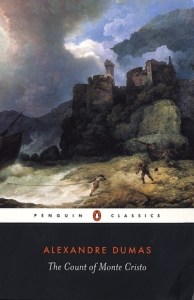
There are just two books left on my Classics Club book list and so, I’ve decided it’s time for me to read one of them, The Count of Monte Cristo by Alexandre Dumas. It is particularly daunting as it is so long, depending on which edition you read. The Penguin Classics edition is 1313 pages long.
The Book Begins:
On the 24th of February 1810, the look-out at Notre Dame de la Garde signalled the three-master, the Pharaon from Smyrna, Trieste, and Naples.
As usual, a pilot put off immediately, and rounding the Chateau d’If, got on board the vessel between Cape Morgion and Rion Island.
Also every Friday there is The Friday 56, hosted by Freda at Freda’s Voice. *Grab a book, any book. *Turn to Page 56 or 56% on your ereader . If you have to improvise, that is okay. *Find a snippet, short and sweet, but no spoilers!
These are the rules:
Grab a book, any book.
Turn to page 56, or 56% on your eReader. If you have to improvise, that is okay.
Find any sentence (or a few, just don’t spoil it) that grabs you.
Post it.
Add the URL to your post in the link on Freda’s most recent Friday 56 post.
Page 56:
‘I do not know what M. de Villefort promised you,’ said the gendarme, ‘but I know we are taking you to the Chateau d’If’.
By a rapid movement, which the gendarme’s practiced eye had perceived, Dantes sprang forward to precipitate himself into the sea; but four vigorous arms seized him as his feet quitted the bottom of the boat. He fell back cursing with rage.
Summary:
Thrown in prison for a crime he has not committed, Edmond Dantes is confined to the grim fortress of If. There he learns of a great hoard of treasure hidden on the Isle of Monte Cristo and he becomes determined not only to escape, but also to unearth the treasure and use it to plot the destruction of the three men responsible for his incarceration. Dumas’ epic tale of suffering and retribution, inspired by a real-life case of wrongful imprisonment, was a huge popular success when it was first serialized in the 1840s.
Top Ten Tuesday is a weekly meme created by The Broke and the Bookish and now hosted by Jana at That Artsy Reader Girl. For the rules see her blog.
This week’s topic is a Hallowe’en Freebie. I’m a reluctant reader of scary stories but I have read these books, some are more scary than others.
Dracula by Bram Stoker. knew the story of Dracula from film and TV versions – with most notably Christopher Lee and later Louis Jourdan as Dracula, but steered clear of reading Bram Stoker’s book – well, it’s not like the film versions I’ve seen. The opening surprised me a little, so matter-of-fact and such attention to detail. And the narrative continues composed of letters, journal entries, newspaper articles and transcripts of phonograph diary entries, from several characters, so the story is told from several different viewpoints It’s a very scenic novel, and I could easily imagine the locations and it’s also a very sensual and melodramatic novel, full of religious references; plus it’s an adventure story with a final chase scene and a love story – and not a bit like I expected from the film versions!
Frankensteinby Mary Shelley is not like the film version with Boris Karloff as the monster created by Victor Frankenstein. It’s not scary, but it is an improbable story with some interesting ideas about what it is to be human. It is a gothic tale about a scientist whose laboratory experiments produced fantastical results. The ‘monster’ learns by observation what it is to be human, but because of the reactions of the people he meets he is spurred on to take revenge on his creator.
The Strange Case of Dr Jekyll and Mr Hydeby Robert Louis Stevenson – a novella together with Other Tales of Terror. The case of Jekyll and Hyde is well known through film and TV versions, but I think the book is much scarier. It reads at first like a mystery story as Dr Jekyll is trying to discover the identity of the evil Mr Hyde – it is only later than he discovers the truth.
The Turn of the Screw by Henry James, a dark and melodramatic tale about good and evil. There’s a story within a story, told as a ghost story to a group of people as they sit gathered round a fire in an old house. It tells of two children and their governess. She has been employed by their uncle who wants nothing to do with them. Their previous governess had died under mysterious circumstances (was it in childbirth?). There’s a dark foreboding of menace within the house where creepy, disturbing things are going on. in this dark and melodramatic tale.
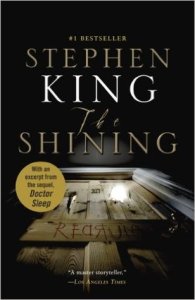
The Shining by Stephen King. I saw the film with Jack Nicolson, which is terrifying before I read the book. I remember his crazed face as he rampaged through the hotel, the sense of evil and terror, and I decided that was enough – I wouldn’t read the book. But later on I did – I don’t know why. It tells the story of Jack Torrance and his family as they move into the Overlook Hotel in the Colorada Rockies. The Overlook is closed for the winter and Jack, a recovering alcoholic is the caretaker. Just what impels him towards murder is horrifyingly revealed as the winter weather closes in on the hotel and they are cut off from the rest of the world. Having read the book there is no way I’ll ever watch the film again,
As you can see from the cover of The Shining it contains an except from the sequel,Dr Sleep. It tells what happened to Danny Torrance (Jack’s son) later on in his life, when he worked in a hospice. He was known as “Doctor Sleep” by secretly using his special abilities to comfort the dying and prepare them for the afterlife. Truly terrifying, even the cover is enough to give me nightmares – that demonic looking cat!
By the Pricking of My Thumbs by Agatha Christie, a Tommy and Tuppence story. As you would imagine from the title of the book (taken from Shakespeare’s Macbeth), ‘something wicked’ is afoot, there is evil about and Tuppence’s life is in danger. A dark and sinister tale.
The Hunger by Alma Katsu, a story about the Donner Party, comprising pioneers, people who were looking for a better life in the American West. Interwoven with hints of the supernatural and Indian myths it becomes a thrilling, spine tingling horrific tale. Many of them died of starvation, and some of them resorted to eating their animals and it is supposed, the deceased members of the group. It is a tense, menacing tale full of hope and also of desperation.
The Chalk Pit by Elly Griffiths. Something evil is waiting in the dark tunnels under Norwich, where boiled human bones have been found. The boiling might have been just a medieval curiosity – now it suggests a much more sinister purpose. The bones are found during the excavations when an underground restaurant in one of the tunnels is proposed. A homeless women, Barbara, disappears and there are rumours that she has ‘gone underground‘. Just what is the gruesome secret lurking in the tunnels?
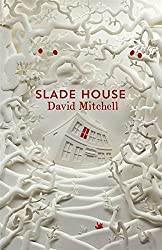
Slade House by David Mitchell, a mixture of a ghost story, science fiction and horror. Something nasty happens every nine years at the end of October at Slade House. It’s down Slade Alley, which doesn’t normally exist and it only appears to those who have been invited, or are drawn to it. There is a door set into the right hand wall of the alley, a small black iron door with no handle or keyhole, that opens if you’re meant to enter. There you meet a stranger, are invited into the House, and find yourself in a strange and dangerous situation, and there is no way out – eventually you find yourself in a long attic at the top of the stairs – where something terrible happens to you.










 BooksPlease