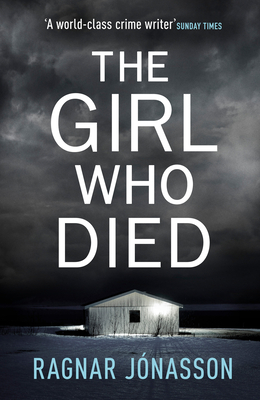
The Girl Who Died by Ragnar Jonasson, translated from the Icelandic by Victoria Cribb

Penguin| 3 June 2021| 328 pages| Review Copy| 3*

‘TEACHER WANTED AT THE EDGE OF THE WORLD . . .’

After the loss of her father, Una sees a chance to escape Reykjavík to tutor two girls in the tiny village of Skálar – population just ten – on Iceland’s storm-battered north coast.

But city life hasn’t prepared her for the unforgiving weather nor inhospitable village life. Worse, the creaky old house where she lives is playing on her already fragile mind when she’s convinced she hears the ghostly sound of singing.

Then, at midwinter, a young girl is found dead.

And one of the villagers must have blood on their hands . . .

The Girl Who Died is Icelandic noir, a mix of horror and psychological thriller, with a strong sense of place. Skálar is a close-knit community that doesn’t welcome newcomers, keeping its secrets well hidden. The only person who welcomes Una, to the village is Salka, the mother of Edda, one of the two girls Una is to teach. But even her welcome is short lived.

When Una arrived she had the feeling that it was like being a folk tale, an ominous supernatural tale set in a vague shifting world where nothing was solid or real, almost like a ghost town. The feeling grows stronger when she sees a little girl with long, pale hair in the window of Salka’s house – but Salka tells her that Edda was in bed. Later she discovers that the ghost of a young girl who had died fifty years earlier was said to haunt the house.

The supernatural elements of the story and the dark brooding atmosphere add to the mystery, but it is not quite as creepy or chilling as I’d thought it would be, mainly because of the slow plodding pace. Also I’m in two minds about Una as I really didn’t find her a very interesting character. And I began to care less and less about what was happening to her. Overall I found it a bit disappointing, and I found the ending puzzling.

However, the Author’s Note is interesting. Jonasson explains that Skálar is a real place. But it was abandoned in the mid 1950s, so the setting is real, but the buildings and the characters are fictitious. However, he has tried to give an accurate representation of the history of Skálar that describes in the book. He has also used the folk tales in Sigfús Sigfússon’s collections of Icelandic tales and legends.

My thanks to the publishers for a review copy via NetGalley.

Ghost Walk by Alanna Knight

The 4th book in Alanna Knight’s Rose McQuinn historical crime fiction series, Ghost Walk is set in 1897 mainly in Eildon, a village in the Scottish Borders.

Three years have passed since Rose McQuinn’s husband, Danny, disappeared in Arizona, whilst working for Pinkerton’s Detective Agency. During that time she has become a Lady Investigator and is about to marry her lover, Detective Inspector Jack Macmerry of the Edinburgh Police. But when a nun from the local convent claims to have received a letter from Danny she is anxious to find out if he is still alive. Rose hopes Danny’s older relative, Father McQuinn, a priest living in the village of Eildon in the Scottish Borders will be able to tell her more.

Rose lives in Solomon’s Tower, a (fictional) tower at the foot of Arthur’s Seat, an old volcano in Edinburgh. A mysterious deerhound, Thane lives somewhere on Arthur’s Seat and often accompanies her. There is a deep bond between the two of them and he often seems to read her mind and understand when she is in danger. As the novel begins Rose and Thane go to Eildon, to meet her future in-laws, just before the wedding, which will also give her an opportunity to talk to Father McQuinn. However, before she can ask him about Danny, he dies under mysterious circumstances and Rose becomes convinced that both his death and that of his housekeeper are in fact murders.

But the main focus of this book is not the murder mystery, nor the suspicions about a Fenian plot to assassinate Queen Victoria during the Jubilee celebrations, but the relationships between Rose and Jack, who has to stay in Edinburgh to testify at a trial, and also between Rose and Jack’s parents, particularly his mother who refuses to acknowledge that Rose is a widow. It also highlights the position of women in a country village during that period. I wanted to know more about Thane, particularly his role at the end of the book – how did he escape with his life?

I liked Rose for her determination to discover the truth and her persistence in being a Lady Detective, despite much opposition. There are nine books in the Rose McQuinn series. I’ve read the first one as well as Ghost Walk and hope to read the others to find out more about her.

  • Publisher ‏ : ‎ Allison & Busby (6 Sept. 2012)
  • File size ‏ : ‎ 537 KB
  • Print length ‏ : ‎ 288 pages
  • My own copy
  • Rating: 3*

Wanderlust Bingo 2023/4

FictionFan is doing another Wanderlust Bingo card for 2023/4 – it’s a two year challenge. It took me two years to complete the first card and I’m looking forward to this new challenge. There are some slight changes from the original card but the idea is still the same – any type of book will count – crime, fiction, science fiction, non-fiction. A country can only appear once and a book can only fill one box. For further details see this post.

I’ve made a good start, as I realised that the first three books I’ve read this year fill three of the boxes:

North America (USA) – The Stroke of Winter by Wendy Webb

Nordic (Iceland) – The Girl Who Died by Ragnar Jonasson

Scotland (Edinburgh and the Scottish Borders) – Ghost Walk by Alanna Knight

I’ll be writing reviews as soon as I can.

Wanderlust Bingo Challenge

I have completed reading the books for this challenge, although there are four that I haven’t reviewed. It has taken me two years and I’ve read 25 books, some of which I wouldn’t have thought of reading if it hadn’t been for this challenge. I travelled round the world and ventured into Outer Space in Ray Bradbury’s Leviathan ’99 and into the realms of fantasy in J R R Tolkien’s The Lord of the Ring Trilogy.

I enjoyed all of them, especially the 5 star books marked with an asterisk *.

Here’s the final list with links to my reviews (where they exist):

North America (USAInland by Téa Obreht

Small Town ( CanadaA Town Called Solace by Mary Lawson*

Island (CreteGreece) The Island by Victoria Hislop

Train (travelling from Ostend to Constantinople, via Cologne, Vienna and Belgrade) Stamboul Train by Graham Greene

Far East (Hong Kong, CambodiaThe Honourable Schoolboy by John le Carré*

Indian Sub-Continent (India) Last Man in Tower by Aravind Adiga*

Village (IrelandThe Wonder by Emma Donoghue *

Oceania (AustraliaA Room Made of Leaves by Kate Grenville

Forest (GermanyWhite Rose, Black Forest by Eoin Dempsey

Space (The Universe) Leviathan ’99

Mountain (Spain and other countries ) The Moon Sister by Lucinda Riley

South America (based on Peru) Bel Canto by Ann Patchett*

Free Square (Middle Earth) The Fellowship of the Ring by J R R Tolkien*

River (Rio Negro in BrazilState of Wonder by Ann Patchett*

Polar Regions (The South Pole, Antarctica)– Ice Bound by Jerri Nielsen* (nonfiction)

Desert (Saudi Arabia) The Night of the Mi’raj by Zoë Ferraris

Walk (Malaya) A Town Like Alice by Nevil Shute

Southeast Asia (Vietnam) The Quiet American by Graham Greene

Africa (Belgian Congo) Heart of Darkness by Joseph Conrad

Beach (England) The Night Hawks by Elly Griffiths

Road (ScotlandCoffin Road by Peter May*

Europe (Belgium) Ashes by Christopher de Vinck

Sea (in the Gulf Stream off the coast of Cuba) The Old Man and the Sea by Ernest Hemingway

Middle East (present-day Iraq, Kuwait, and parts of Iran, Syria, and Turkey) Murder in Mesopotamia by Agatha Christie

City (FranceThe Paris Library by Janet Skeslien Charles

~~~

My thanks to FictionFan who devised this challenge – I’m looking to seeing what she comes up with next.

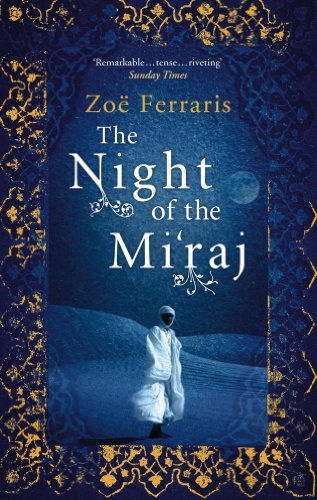
The Night of the Mi’raj by Zoë Ferraris

Abacus| 16 August 2012 | 360 pages| e-book edition| My own copy| 4*

The Night of the Mi’raj (published as Finding Nouf in the USA) is the first book in Zoë Ferraris’  Katya Hijazi series, set in modern day Saudi Arabia, featuring Nayir al-Sharqi, a desert guide and a laboratory technician Katya Hijazi. When sixteen year old Nouf ash-Shrawi disappears from her home in Jeddah, just before her arranged marriage, her brother, Othman, asks his friend, Nayir to find her. After searching the desert for ten days, Nayir fails to find her, but then Nouf’s body is found in a desert wadi. It appears that her death was an accident and that she died by drowning in the wadi after a sudden storm.

Nayir is puzzled. Why did Nouf run away to the desert, leaving behind her fiance and a luxurious life with her wealthy family? He’d never failed before to find a lost traveller and he assumed if she had run away it was because she didn’t want to be found. Her family accept the verdict of accidental death, but when Katya tells Nayir she has found evidence that Nouf was murdered he feels compelled to uncover the truth about her death. The more the two of them discover the more problems and challenges arise.

What is most fascinating in this book for me is not the mystery, but the developing relationship between Nayir and Katya and the description of life in Saudi Arabia. Nayir is not a Bedouin or a Saudi, he’s a Palestinian. But the Bedouin had taught him about the desert:

From here he had a sprawling view of the desert valley, crisp and flat, surrounded by low dunes that undulated in the golden colour of sunset. … The wind picked up and stroked the desert floor, begging a few grains of sand the better to flaunt its elegance, while the earth shed its skin with a ripple and seemed to take flight. The bodies of the dunes changed endlessly with the winds. They rose to peaks or slithered like snake trails. The Bedouin had taught him how to interpret the shapes to determine the chance of a sandstorm or the direction of tomorrow’s wind. Some Bedouin believed that the forms held prophetic meanings too. Right now, the land directly ahead of him formed a series of crescents, graceful half-moons that rolled towards the horizon. Crescents meant change was in the air.

I was puzzled by the title of the UK publication – The Night of the Mi’raj, so I was pleased that Zoë Ferraris explained why she chose it in her Author’s Note. The mi’raj is both a physical journey and a spiritual climax, a moment of revelation for Mohammed. She states that; ‘In this book Nayir’s journey to learning the truth behind Nouf’s death is, for him, both a physical and a spiritual discovery too.’

There are two more books in the Katya Hijazi series: City of Veils and Kingdom of Strangers.

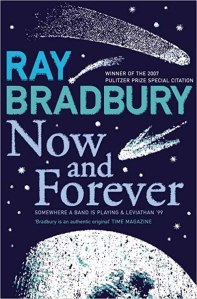
Two Novellas in Now and Forever by Ray Bradbury:#NovNov22

HarperVoyager| 25 June 2012| 240 page| e-book| 4*

Now and Forever is the first book by Ray Bradbury that I’ve read. It contains two novellas – Somewhere a Band is Playing, in which a young writer discovers that all is not as it seems in a nostalgic community, and Leviathan ’99, a retelling of Moby Dick set in space. Two very different stories, each one fascinating, and both with a long history, as Bradbury wrote each one over several decades. They contrast both in style and content. I enjoyed both, but Leviathan ’99 is my favourite.

In the first, Somewhere a Band is Playing, (102 pages) a reporter James Cardiff arrives in Summerton, a small town in the middle of Arizona, a town which seems perfect, a quiet peaceful place. He can hear in the air the quiet sound of a band playing. But the more he explores the more mysterious Summerton becomes. For one thing there are no children and no hospitals or doctors because no one gets ill and even stranger the graves in the cemetery are empty. The story has a nostalgic feel, a sense of melancholy and myth as James, under the guidance of a beautiful young woman, Nefertiti, discovers the truth about Summerton.

Bradbury’s introduction to Somewhere a Band is Playing explains that he begun writing a screenplay and short story about a small town somewhere in the desert and how he had kept encountering Katharine Hepburn either in person or on the screen and was attracted by the fact that she remained youthful throughout the years. Then in 1956 she had made the film Summertime and this had led him to put her at the centre of a story and so Somewhere a Band is Playing slowly evolved. Another element of the story came when he saw the film, The Wind and the Lion and was so taken with the score that he wrote a long poem based on the enchanting music. He then put these elements together to produce this novella, which he dedicated to Anne Hardin, who had encouraged his work and to Katharine Hepburn.

Leviathan ’99’ (101 pages) is dedicated to Herman Melville because after spending a year writing the screenplay for John Huston’s Moby Dick he’d fallen under the spell of Melville and his ‘leviathan whale’. Bradbury then wrote his first script of Leviathan ’99’, which was eventually produced by BBC Radio in London, then as a longer version as a play in 1972. Finally thirty years later he finished writing it as a novella as his ‘final effort to focus and revitalize what began as a radio dream.’

I haven’t read Moby Dick, but I enjoyed this story about spaceships instead of sailing ships, mad astronaut captains instead of seafaring captains and the blind white comet instead of the great white whale. It’s set in 2099 and begins as Ishmael, an astronaut joins the Cetus 7, the largest interstellar ship ever built. The spaceship is on a mission, travelling beyond the stars. His cubicle roommate is Quell, a seven feet tall, green spider who is a telepath. The captain is mad, obsessed with finding the comet, Leviathan, the largest comet in history that had blinded him thirty years earlier. As Quell described it ‘the universe set off a light-year of immensity of photographic flash. God blinked and bleached the captain to this colour of sleeplessness and terror.’

It is an incredible achievement transposing Melville’s 19th century epic into a hundred page novella set in the future.