The Classics Club Spin Result

The spin number in The Classics Club Spin was announced yesterday. It’s number …

12

which for me is Wives and Daughters by Elizabeth Gaskell. The rules of the Spin are that this is the book for me to read by May 1, 2017.

Wives and DaughtersI’m pleased with the result as it will give me the push to get round to reading more of Elizabeth Gaskell’s novels.

Here’s the blurb from Amazon:

Gaskell’s last novel, widely considered her masterpiece, follows the fortunes of two families in nineteenth century rural England.  At its core are family relationships ‘“ father, daughter and step-mother, father and sons, father and step-daughter ‘“ all tested and strained by the romantic entanglements that ensue.

Despite its underlying seriousness, the prevailing tone is one of comedy.  Gaskell vividly portrays the world of the late 1820s and the forces of change within it, and her vision is always humane and progressive.

The story is full of acute observation and sympathetic character-study:  the feudal squire clinging to old values, his naturalist son welcoming the new world of science, the local doctor and his scheming second wife, the two girls brought together by their parent’s marriage’¦

The Classics Club Spin Result

The result of the Classics Club Spin is No. 1 which for me is Silas Marner by George Eliot. I am so pleased – I wanted a short book and lo and behold this is a short book!

Although the shortest of George Eliot’s novels, Silas Marner is one of her most admired and loved works. It tells the sad story of the unjustly exiled Silas Marner – a handloom linen weaver of Raveloe in the agricultural heartland of England – and how he is restored to life by the unlikely means of the orphan child Eppie.

Silas Marner is a tender and moving tale of sin and repentance set in a vanished rural world and holds the reader’s attention until the last page as Eppie’s bonds of affection for Silas are put to the test.

First published in 1861 as Silas Marner: the Weaver of Raveloe, George Eliot described it as ‘a story of old-fashioned English life’.

Classics Club Spin

The Classics Club

I was just thinking another Classics Club Spin would be nice and it appeared!

The Spin rules:

  •  List any twenty books you have left to read from your Classics Club list.
  • Number them from 1 to 20.
  • On Monday the Classics Club will announce a number.
  • This is the book to read by 1 December 2016.

I decided to organise my list in page number order from short to enormous.  I want to read all of them at some time but right now as I have a backlog of other books that I want to read before December, I hope that one of the shorter books (that is numbers 1 – 4) is chosen!

  1. Silas Marner by George Eliot – 176 pages
  2. All Quiet on the Western Front by Erich Maria Remarque
  3. Sweet Thursday by John Steinbeck
  4. Orlando by Virginia Woolf
  5. North and South by Elizabeth Gaskell
  6. The Black Robe by Wilkie Collins
  7. Love in the Time of Cholera by Gabriel Garcia Marquez
  8. The Forsyte Saga (The Man of  Property) by John Galsworthy
  9. Oliver Twist by Charles Dickens
  10. The Return of the Native by Thomas Hardy
  11. Far from the Madding Crowd by Thomas Hardy
  12. One Hundred Years of Solitude by Gabriel Garcia Marquez
  13. Framley Parsonage (Barsetshire Chronicles, #4) by Anthony Trollope
  14. Mary Barton by Elizabeth Gaskell
  15. Wives and Daughters by Elizabeth Gaskell
  16. Lorna Doone: A Romance of Exmoor by R D Blackmore
  17. Martin Chuzzlewit by Charles Dickens
  18. Nicholas Nickleby by Charles Dickens
  19. Little Dorrit by Charles Dickens
  20. Parade’s End by Ford Maddox Ford – 914 pages


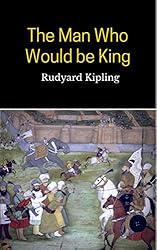
The Man Who Would Be King by Rudyard Kipling

For me the book chosen for the current Classics Club Spin is The Man Who Would Be King by Rudyard Kipling. It’s a novella, just 60 pages, which first appeared in The Phantom Rickshaw and other Eerie Tales, published in 1888.

Set in India and narrated by a journalist this is a story of two ruffianly-looking adventurers, wanderers and vagabonds, Daniel Dravot and Peachey Carnehan, who announce that they are off to Kafiristan in the mountains of Afghanistan to make themselves Kings. They tell the journalist that when they have got their kingdom ‘in going order’ they will let him know and that he can then come and help them govern it.

But some two years later, on a hot summer’s night, what was left of Carnehan crept into the journalist’s office,

He was bent into a circle, his head was sunk between his shoulders, and he moved his feet one over the other like a bear. I could hardly see whether he walked or crawled- this rag-wrapped, whining cripple who addressed me by name, crying that he was come back. (page 24)

And he had a sorry tale to tell.

I was a bit disappointed with it, mainly because for a novella it took such a long time to set the scene and the opening section was confusing, with references I didn’t understand. After the slow beginning the story picks up when it gets to relating what happened to Dravot and Carnehan. The Kipling Society website (where you can read the story, which is also free on Amazon) has some notes that helped me understand more – Masonic, Biblical and other references and details about the places and people mentioned.

The Kipling Society also gives details of the background to the story and some critical responses to it. Overall the responses are good – that it is a memorable, fantastic tale, some believing it to be a masterpiece, but Kingley Amis stated it was a ‘grossly overrated long tale‘. I was also interested that Edmund Wilson is quoted as stating that the story is “…surely a parable of what might happen to the English if they should forfeit their moral authority.”[Edmund Wilson ‘The Kipling that Nobody Read’, in Kipling’s Mind and Art ed. Andrew Rutherford, Oliver & Boyd, 1964.]

There was a film adaptation in 1975, starring Sean Connery as Dravot and Michael Caine as Carnehan with Christopher Plummer as Kipling, which according to some is much better than the story itself.

Rudyard Kipling was born in Bombay in 1865 and lived there until he was five when he was taken to live in England, returning to India in 1882, where he worked as a journalist. As well as short stories he also wrote poems, including If, and novels, and was awarded the Nobel Prize in Literature in 1907.

My copy is an e-book, which I’ve had for several years, so it counts towards my Mount TBR Reading Challenge.

Classics Club Spin: the Result

and it is … number 15, which for me is

The Man Who Would Be King by Rudyard Kipling, a novella. That’s fine – I should be able to slot that into my Summer reading without any difficulties before 1 August.

I’ve read some of Kipling’s books before, including The Just So Stories, Kim (I thought I’d read this but I haven’t), Rikki-Tikki-Tavi and his poem If. Then there is, of course, The Jungle Book (seen the film and may have read the book).

My copy is an e-book, which I’ve had for several years, so it will also count towards my Mount TBR Reading Challenge too.

Classics Club Spin

The Classics ClubIt’s time for another Classics Club Spin. I probably shouldn’t be doing this as I’ve plenty to read for the 20 Books of Summer Challenge without adding another book and most of the books on the following list are quite long.

The Spin rules:

  •  List any twenty books you have left to read from your Classics Club list.
  • Number them from 1 to 20.
  • On Monday the Classics Club will announce a number.
  • This is the book to read by 1 August 2016.

My List

  1. Lorna Doone: A Romance of Exmoor by R D Blackmore
  2. The Black Robe by Wilkie Collins
  3. Moll Flanders by Daniel Defoe
  4. Nicholas Nickleby by Charles Dickens
  5. Little Dorrit by Charles Dickens
  6. Martin Chuzzlewit by Charles Dickens
  7. Silas Marner by George Eliot
  8. Parade’s End by Ford Maddox Ford
  9. The Forsyte Saga (1) by John Galsworthy
  10. Mary Barton by Elizabeth Gaskell
  11. North and South by Elizabeth Gaskell
  12. Wives and Daughters by Elizabeth Gaskell
  13. Far from the Madding Crowd by Thomas Hardy
  14. The Return of the Native by Thomas Hardy
  15. The Man Who Would Be King by Rudyard Kipling
  16. Love in the Time of Cholera by Gabriel Garcia Marquez
  17. One Hundred Years of Solitude by Gabriel Garcia Marquez
  18. Framley Parsonage by Anthony Trollope
  19. The Age of Innocence by Edith Wharton
  20. Orlando by Virginia Woolf

If it’s Orlando, that will be just fine – it’s also on my 20 Books of Summer list!