Classics Club Spin

The Classics Club

I was just thinking another Classics Club Spin would be nice and it appeared!

The Spin rules:

  •  List any twenty books you have left to read from your Classics Club list.
  • Number them from 1 to 20.
  • On Monday the Classics Club will announce a number.
  • This is the book to read by 1 December 2016.

I decided to organise my list in page number order from short to enormous.  I want to read all of them at some time but right now as I have a backlog of other books that I want to read before December, I hope that one of the shorter books (that is numbers 1 – 4) is chosen!

  1. Silas Marner by George Eliot – 176 pages
  2. All Quiet on the Western Front by Erich Maria Remarque
  3. Sweet Thursday by John Steinbeck
  4. Orlando by Virginia Woolf
  5. North and South by Elizabeth Gaskell
  6. The Black Robe by Wilkie Collins
  7. Love in the Time of Cholera by Gabriel Garcia Marquez
  8. The Forsyte Saga (The Man of  Property) by John Galsworthy
  9. Oliver Twist by Charles Dickens
  10. The Return of the Native by Thomas Hardy
  11. Far from the Madding Crowd by Thomas Hardy
  12. One Hundred Years of Solitude by Gabriel Garcia Marquez
  13. Framley Parsonage (Barsetshire Chronicles, #4) by Anthony Trollope
  14. Mary Barton by Elizabeth Gaskell
  15. Wives and Daughters by Elizabeth Gaskell
  16. Lorna Doone: A Romance of Exmoor by R D Blackmore
  17. Martin Chuzzlewit by Charles Dickens
  18. Nicholas Nickleby by Charles Dickens
  19. Little Dorrit by Charles Dickens
  20. Parade’s End by Ford Maddox Ford – 914 pages


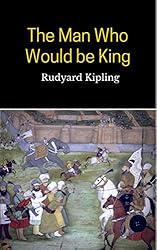
The Man Who Would Be King by Rudyard Kipling

For me the book chosen for the current Classics Club Spin is The Man Who Would Be King by Rudyard Kipling. It’s a novella, just 60 pages, which first appeared in The Phantom Rickshaw and other Eerie Tales, published in 1888.

Set in India and narrated by a journalist this is a story of two ruffianly-looking adventurers, wanderers and vagabonds, Daniel Dravot and Peachey Carnehan, who announce that they are off to Kafiristan in the mountains of Afghanistan to make themselves Kings. They tell the journalist that when they have got their kingdom ‘in going order’ they will let him know and that he can then come and help them govern it.

But some two years later, on a hot summer’s night, what was left of Carnehan crept into the journalist’s office,

He was bent into a circle, his head was sunk between his shoulders, and he moved his feet one over the other like a bear. I could hardly see whether he walked or crawled- this rag-wrapped, whining cripple who addressed me by name, crying that he was come back. (page 24)

And he had a sorry tale to tell.

I was a bit disappointed with it, mainly because for a novella it took such a long time to set the scene and the opening section was confusing, with references I didn’t understand. After the slow beginning the story picks up when it gets to relating what happened to Dravot and Carnehan. The Kipling Society website (where you can read the story, which is also free on Amazon) has some notes that helped me understand more – Masonic, Biblical and other references and details about the places and people mentioned.

The Kipling Society also gives details of the background to the story and some critical responses to it. Overall the responses are good – that it is a memorable, fantastic tale, some believing it to be a masterpiece, but Kingley Amis stated it was a ‘grossly overrated long tale‘. I was also interested that Edmund Wilson is quoted as stating that the story is “…surely a parable of what might happen to the English if they should forfeit their moral authority.”[Edmund Wilson ‘The Kipling that Nobody Read’, in Kipling’s Mind and Art ed. Andrew Rutherford, Oliver & Boyd, 1964.]

There was a film adaptation in 1975, starring Sean Connery as Dravot and Michael Caine as Carnehan with Christopher Plummer as Kipling, which according to some is much better than the story itself.

Rudyard Kipling was born in Bombay in 1865 and lived there until he was five when he was taken to live in England, returning to India in 1882, where he worked as a journalist. As well as short stories he also wrote poems, including If, and novels, and was awarded the Nobel Prize in Literature in 1907.

My copy is an e-book, which I’ve had for several years, so it counts towards my Mount TBR Reading Challenge.

Classics Club Spin: the Result

and it is … number 15, which for me is

The Man Who Would Be King by Rudyard Kipling, a novella. That’s fine – I should be able to slot that into my Summer reading without any difficulties before 1 August.

I’ve read some of Kipling’s books before, including The Just So Stories, Kim (I thought I’d read this but I haven’t), Rikki-Tikki-Tavi and his poem If. Then there is, of course, The Jungle Book (seen the film and may have read the book).

My copy is an e-book, which I’ve had for several years, so it will also count towards my Mount TBR Reading Challenge too.

Classics Club Spin

The Classics ClubIt’s time for another Classics Club Spin. I probably shouldn’t be doing this as I’ve plenty to read for the 20 Books of Summer Challenge without adding another book and most of the books on the following list are quite long.

The Spin rules:

  •  List any twenty books you have left to read from your Classics Club list.
  • Number them from 1 to 20.
  • On Monday the Classics Club will announce a number.
  • This is the book to read by 1 August 2016.

My List

  1. Lorna Doone: A Romance of Exmoor by R D Blackmore
  2. The Black Robe by Wilkie Collins
  3. Moll Flanders by Daniel Defoe
  4. Nicholas Nickleby by Charles Dickens
  5. Little Dorrit by Charles Dickens
  6. Martin Chuzzlewit by Charles Dickens
  7. Silas Marner by George Eliot
  8. Parade’s End by Ford Maddox Ford
  9. The Forsyte Saga (1) by John Galsworthy
  10. Mary Barton by Elizabeth Gaskell
  11. North and South by Elizabeth Gaskell
  12. Wives and Daughters by Elizabeth Gaskell
  13. Far from the Madding Crowd by Thomas Hardy
  14. The Return of the Native by Thomas Hardy
  15. The Man Who Would Be King by Rudyard Kipling
  16. Love in the Time of Cholera by Gabriel Garcia Marquez
  17. One Hundred Years of Solitude by Gabriel Garcia Marquez
  18. Framley Parsonage by Anthony Trollope
  19. The Age of Innocence by Edith Wharton
  20. Orlando by Virginia Woolf

If it’s Orlando, that will be just fine – it’s also on my 20 Books of Summer list!

The Mill on the Floss by George Eliot

I was pleased when the Classics Club Spin number came up as 8, because for me that was The Mill on the Floss, a book I’ve had for years, so it was time I read it. I think one of the reasons I hadn’t read it is the size of the font – it’s small. But then I realised that there is a free e-book, so I read it on my Kindle as I could increase the font size.
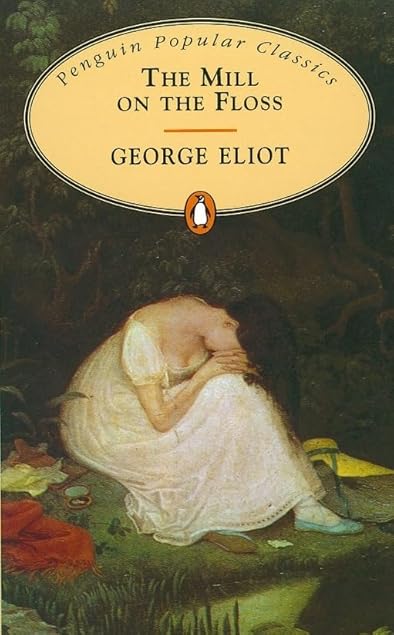
Description (from my paperback copy of the Penguin Popular Classics 1994 edition, shown above):

George Eliot drew on her own anguished childhood when she depicted the stormy relationship between Maggie and Tom Tulliver. Maggie’s often tormented battle to do her duty and belong on the one hand, and to be  herself, wild and natural, on the other, propels her from one crisis to another. As the Tulliver fortunes decline and fall, the rift between Maggie and her family becomes almost irreconcilable. But Maggie’s biggest mistake of all is to fall in love with Stephen Guest who is engaged to another woman.

Both a sharp and observant picture of English rural life and a profoundly convincing analysis of a woman’s psychology, The Mill on the Floss is a novel that tackles the complexities of morality versus desire.

My thoughts:

The Mill on the Floss was first published in 1860. The story begins in the late 1820s, when Maggie, who is ‘big for her age, gone nine‘ and her brother, Tom aged about twelve are living at Dorlcote Mill on the banks of the river Floss near the town of St Oggs. Their father is anxious that Tom should have a good education so that he can go into business – he does not want him to be a miller. But it is Maggie who is the keen reader, enjoying books like The History of the Devil by Daniel Defoe, Aesop’s Fables and the Pilgrim’s Progress.

I enjoyed parts of the book more than other parts. The first part of this book, covering Maggie and Tom’s childhood for example is fascinating and a study of early 19th century rural life and education. Tom goes away from home to study under a tutor, Mr Stelling and meets Philip Wakem, whose father is a lawyer, Mr Tulliver’s opponent in a lawsuit. Maggie and Tom’s relationship is difficult, although she professes she ‘loves him better than anyone else in the world’, even when he rebukes her. Meanwhile Maggie becomes more friendly with Philip than Tom and her family like.

There are some lovely scenes, for example Maggie’s escapade when she leaves home to live with the gypsies. And I liked all the scenes with Mrs Tulliver’s sisters, who look down on her for marrying a miller and criticise Maggie’s appearance and behaviour, for Maggie is full of high spirits and energy. The sisters also provide comic relief, at times being miserly and self-centred, with a strong sense of their own importance. But things go from bad to worse for the Tullivers, when Mr Tulliver loses the lawsuit and eventually loses the mill.

In other places, between scenes there are long, rambling passages, that I found too wordy and philosophical and I waited impatiently to get back to the story. But overall I liked the book, more than I liked Adam Bede, but not as much as I remember liking Middlemarch, which I read long before I began this blog.

The Mill on the Floss is an epic novel encompassing various themes such as love, marriage, family loyalty, the social conventions of the times, and the struggle to survive. Feminism, education, and the role of women in society are to the fore, as Maggie is torn between two men who love her and is judged harshly for her behaviour.

It is a character driven plot; the river Floss plays a major part in the story, running through a wide plain, hurrying on to the sea, laden with ships. It’s a noisy place with Dorlcote Mill is on its banks near a stone bridge and the rush of the water is deafening, along with the ‘thunder of the huge covered wagon coming home with sacks of grain‘.

And it is the Floss that provides the huge climax which took me by surprise. It’s a dramatic ending and yet I found it rather unsatisfactory, not sure that I could believe what I had read, and shocked by such a sad ending. Looking back after I finished the book I realised that it had been foreshadowed almost from the start and I had missed it.

Reading Challenges: Mount TBR 2016 and The Classics Club.

Classics Club Check-In April 2016

Classics Club check inIt’s time for a Classics Club Check-In. Three years ago (next week) I joined The Classics Club, signing up to read and write about at least 50 classic books in at most five years. This is the first time I’ve taken part in a Check-In, although I have joined in with the Classics Club Spins, which I enjoy.

The list is not a fixed list and I have changed it since I started in 2013.This is my current list. I’ve listed the books in a-z author order. I’ve read 18 books, shown in bold, so I’m behind if I’m going to meet my target in the next two years. Currently I’m reading The Mill on the Floss by George Eliot (my current Spin book).

It’s hard to pick a favourite. These books stand out in my mind – Ethan Frome by Edith Wharton, To Kill a Mockingbird by Harper Lee and The Old Curiosity Shop by Charles Dickens.

  1. Lady Susan, The Watsons, Sanditon by Jane Austen ‘“ finished 24 August 2015
  2. Mansfield Park by Jane Austen ‘“ finished 29 June 2014
  3. The Old Wives Tale by Arnold Bennett
  4. Lorna Doone: A Romance of Exmoor by R D Blackmore
  5. Jane Eyre by Charlotte Bronte (a re-read) ‘“ read in November 2014
  6. The Thirty Nine Steps by John Buchan ‘“ finished 21 February 2014
  7. My Antonia by Willa Cather ‘“ finished 26 September 2013
  8. Don Quixote by Miguel de Cervantes Saavedra
  9. The Dead Secret by Wilkie Collins ‘“ finished 30 September 2015
  10. No Name by Wilkie Collins
  11. Lord Jim by Joseph Conrad
  12. Moll Flanders by Daniel Defoe
  13. Barnaby Rudge by Charles Dickens ‘“ finished 29 June 2013
  14. Nicholas Nickleby by Charles Dickens
  15. Little Dorrit by Charles Dickens
  16. Martin Chuzzlewit by Charles Dickens
  17. The Old Curiosity Shop by Charles Dickens ‘“ finished 10 October 2015
  18. Oliver Twist by Charles Dickens
  19. The Adventures of Sherlock Holmes by Arthur Conan Doyle
  20. The Count of Monte Cristo by Alexandre Dumas
  21. Adam Bede by George Eliot ‘“ finished 18 September 2015
  22. The Mill on the Floss by George Eliot
  23. Romola by George Eliot
  24. Silas Marner by George Eliot
  25. Parade’s End by Ford Maddox Ford
  26. The Forsyte Saga (1-3) by John Galsworthy
  27. Mary Barton by Elizabeth Gaskell
  28. North and South by Elizabeth Gaskell
  29. Wives and Daughters by Elizabeth Gaskell
  30. Far from the Madding Crowd by Thomas Hardy
  31. The Return of the Native by Thomas Hardy
  32. Washington Square by Henry James ‘“ finished 17 December 2013
  33. The Man Who Would Be King by Rudyard Kipling
  34. To Kill a Mockingbird by Harper Lee ‘“ finished 16 July 2013
  35. The Call of the Wild by Jack London ‘“ finished 10 December 2014
  36. Love in the Time of Cholera by Gabriel Garcia Marquez
  37. One Hundred Years of Solitude by Gabriel Garcia Marquez
  38. Gone with the Wind by Margaret Mitchell ‘“ finished 20 November 2013
  39. Of Mice and Men by John Steinbeck ‘“ finished 20 September 2015
  40. Travels with a Donkey in the Cevennes by Robert Louis Stevenson
  41. Gulliver’s Travels by Jonathan Swift
  42. Barchester Towers (Barsetshire Chronicles, #2) by Anthony Trollope ‘“ finished 22 February 2015
  43. Doctor Thorne (Barsetshire Chronicles, #3) by Anthony Trollope ‘“ finished 3 March 2016
  44. Framley Parsonage (Barsetshire Chronicles, #4) by Anthony Trollope
  45.  The Small House at Allington (Barsetshire Chronicles, #5) by Anthony Trollope
  46. The Last Chronicle of Barset (Barsetshire Chronicles, #6) by Anthony Trollope
  47. The Time Machine by H G Wells ‘“ finished 29 March 2014
  48. The Age of Innocence by Edith Wharton
  49. Ethan Frome by Edith Wharton ‘“ finished 22 February 2014
  50. The Voyage Out by Virginia Woolf