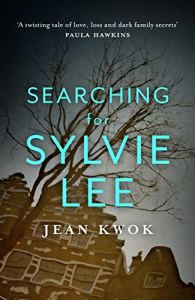
Searching for Sylvie Lee by Jean Kwok

Searching for Sylvie Lee

John Murray|17 October 2019|341 pages|e-book via NetGalley|Review copy|4*

Description extracted from the publishers’ blurb:

It begins with a mystery. Sylvie, the beautiful, brilliant, successful older daughter of the Lee family, flies to the Netherlands for one final visit with her dying grandmother – and then vanishes.

Amy, the sheltered baby of the Lee family, is too young to remember a time when her parents were newly immigrated and too poor to keep Sylvie. Seven years older, Sylvie was raised by a distant relative in a faraway, foreign place, and didn’t rejoin her family in America until age nine. Timid and shy, Amy has always looked up to her sister, the fierce and fearless protector who showered her with unconditional love.

But what happened to Sylvie? Amy and her parents are distraught and desperate for answers. Sylvie has always looked out for them. Now, it’s Amy’s turn to help. 

My thoughts:

I loved Searching For Sylvie Lee by Jean Kwok.  I enjoyed reading its beautiful descriptive language and the mystery of what had happened to Sylvie. I think the characterisation is very good, the three main characters, Sylvie, her younger sister Amy and their mother Ma are each clearly recognisable by the way they speak. The story alternates between the two sisters and their mother’s perspectives, as the details of what happened to Sylvie are revealed.

Sylvie had left her home in the USA to visit her dying grandmother in the Netherlands where she had lived until she was nine. After the funeral she was supposed to return home, but she never arrived. Amy and her parents are distraught and she flies to the Netherlands to find out what had happened to her.

This is a mystery full of suspense and it is also a story about family relationships, about secrets and the barriers that language can raise – Amy’s dominant language is English, whereas her mother and father, Chinese immigrants living in America, have just a basic grasp of English and still speak Chinese. Sylvie also speaks Dutch as until the age of nine she had lived with the Tan family, Chinese immigrants living in the Netherlands. It’s not just the language but also the different cultures and the racism they experienced that separated the characters.

I had realised quite early on what the family secret was and what had happened to Sylvie, but that didn’t spoil my enjoyment of the book. My only criticism is that in the latter part of the book, particularly as Sylvie describes her visit to Venice I thought that the book veered offline. Although the episode is essential to the plot the detailed description took away the momentum of the mystery and my attention wandered a bit. But the ending made up for that!

The Author:

I would like to read more of Jean Kwok’s books. She is trilingual, fluent in Dutch, Chinese, and English, and studied Latin for seven years. Jean immigrated from Hong Kong to Brooklyn when she was five and worked in a Chinatown clothing factory for much of her childhood. She received her bachelor’s degree from Harvard and completed an MFA in fiction at Columbia University. She currently lives in the Netherlands. Her work has been published in twenty countries and taught in universities, colleges, and high schools across the world.  

My thanks to the publishers for my review copy via NetGalley.

Top Ten Tuesday: Books on my Winter 2019-2020 To-Read List

TTT christmas

Top Ten Tuesday is a weekly meme created by The Broke and the Bookish and now hosted by Jana at That Artsy Reader Girl. For the rules see her blog.

Here are some of the books I’d like to read this winter. Realistically I know it’ll take me longer than that (some are long) and that there’ll be some I won’t get round to and others that I’ll read instead.

  • Winter by Ali Smith – 4 four people, family and strangers spend Christmas in a fifteen-bedroom house in Cornwall but will there be enough room for them all? This is a library book, so I’ll probably read this first.
  • The John Lennon Letters edited by Hunter Davies. This is a long book and one that I’ll take my time reading.
  • Peterloo: the English Uprising by Robert Poole about the rally of around 50,000 people held in St Peter’s Field in Manchester on 16th August, 1819, to demand greater representation in Parliament. They were attacked by armed cavalry and 18 people were killed and some 700 injured. This is another long-term read as it looks so detailed and comprehensive.
  • The Dressmaker of Dachau by Mary Chamberlain, a WW2 novel about a young English seamstress who is taken prisoner and sent to Germany as slave labour. I really must read this one soon as a friend lent me this book months ago.
  • The Lady of the Ravens by Joanna Hickson, historical fiction set in the late 15th century, set in the Tower of London. Joan Veaux is lady in waiting to Elizabeth of York, who is married to Henry VII. She is the Lady Of The Ravens, who cares for and protects the famous ravens. Due to be published in January this is one of my NetGalley books.
  • Hitler’s Secrets by Rory Clements, another NetGalley book to be published in January. This is historical fiction and a spy thriller, featuring American Cambridge don Tom Wilde, beginning in autumn 1941 when the war is going badly for Britain and its allies.
  • Giant’s Bread by Agatha Christie writing as Mary Westmacott. This is not one of her crime fiction novels. Last year I enjoyed Absent in the Spring another book she wrote as Mary Westmacott.
  • The Butcher’s Hook by Janet Ellis, historical fiction set in Georgian London in the summer of 1763. Anne Jaccob, the elder daughter of well-to-do parents, meets Fub the butcher’s apprentice and is awakened to the possibilities of joy and passion.
  • A Killing Kindness by Reginald Hill, the 6th Dalziel and Pascoe novel. I’m currently reading the Dalziel and Pascoe novels in the order of publication and have nearly finished the 5th book.
  • Smallbone Deceased by Michael Gilbert or whichever book comes up for me in the Classics Club Spin. I hope it’ll be this one but will have to wait and see … if it isn’t I’ll definitely be reading it some time next year.

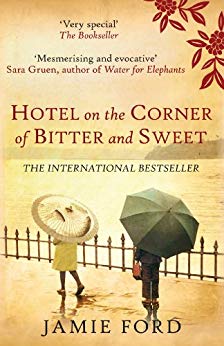
Hotel on the Corner of Bitter and Sweet by Jamie Ford

‘He’d do what he always did, find the sweet among the bitter.’

Hotel on the Corner of Bitter and Sweet

Allison & Busby|2013 paperback edition| 396 pages| 5*

It’s not that often that a book brings tears to my eyes, but reading the ending of Hotel on the Corner of Bitter and Sweet did just that. It is a beautiful book moving between two time periods, the early 1940s and 1986, mainly in Seattle.

Synopsis (Amazon):

1986, The Panama Hotel

The old Seattle landmark has been boarded up for decades, but now the new owner has made a startling discovery in the basement: personal belongings stored away by Japanese families sent to interment camps during the Second World War. Among the fascinated crowd gathering outside the hotel, stands Henry Lee, and, as the owner unfurls a distinctive parasol, he is flooded by memories of his childhood. He wonders if by some miracle, in amongst the boxes of dusty treasures, lies a link to the Okabe family, and the girl he lost his young heart to, so many years ago.

My thoughts:

I had little idea when I began reading this book how much I would enjoy it and how much I would learn from it. It moves at a much slower pace than I would like but this means that I could absorb the detail easily and follow the story without puzzling out the sequence of events. I had no problem at all in moving between the two time periods, as I have in some other books, the characters come across as real people with real lives and real problems. The settings are remarkable, even though I have never been to Seattle, and knew nothing about its history – its Chinatown and the Japan town, Nihonmachi – it came to life as I read on.

In 1942 in Seattle Henry Lee, a 12 year old Chinese American boy meets Keiko Okabe, a Japanese American girl and they become great friends, even though Henry’s father is against the Japanese because of the enmity between China and Japan. He makes Henry wear a badge “I am Chinese” so that people won’t think he is Japanese.

As the war progressed the persecution of Japanese Americans intensified and they were removed from their homes and interned. I knew this had happened after Pearl Harbour, but this book brings home the reality of the situation, of how their lives were uprooted and the prejudice and the terrible conditions that they experienced. Keiko and her family are moved to Camp Harmony, a temporary relocation centre at the Puyallup Fairgrounds, and not allowed to take their belongings with them. Many Japanese families, including Keiko’s, manage to store some in the basement of the Panama Hotel. Henry is devastated, certain he won’t see her again, especially when the families are moved to a permanent relocation centre, Minidoka in Idaho. But his search for Keiko didn’t end there and with the help of his friend Sheldon, a black jazz musician he continued to look for her.

The book is not just about Henry and Keiko it’s also about family relationships, about the importance of communication, of talking and sharing experiences and feelings and about friendships. And it’s a love story – of both a love lost and a love found as Henry and Keiko grow into adulthood. It is a bitter sweet story of commitment and enduring hope and one that I loved.

About the author:

Jamie Ford grew up in Seattle’s Chinatown and Hotel on the Corner of Bitter and Sweet was his debut novel. His second novel, Songs of Willow Frost was published in September 2013. Love and Other Consolation Prizes, was published in September 12, 2017 and is also set in Seattle, inspired by a true story, about a half-Chinese orphan boy whose life is transformed at Seattle’s 1909 World’s Fair. And so one book leads on to yet more books to read …

Two Crime Fiction Titles

I’m behind with reviewing the books I’ve read, so here are short reviews of two crime fiction novels I’ve read recently:

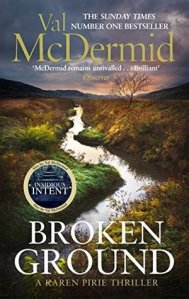
Broken ground

Broken Ground by Val McDermid, the 5th Karen Pirie book. 4*

This begins in 1944 when two men bury a couple of wooden crates in a peat bog in Wester Ross in the Scottish Highlands. Seventy four years later Alice and her husband Will are on a treasure hunt, following a map Alice’s grandfather had left her. But they are astonished when discover the body of a man in the peat bog together with one of the crates. Perfectly preserved it appeared at first that this was a case for Karen’s friend Dr River Wilde, the forensic anthropologist. But the fact that the man was wearing a pair of Nikes, dating the body back to the 1990s ruled out that idea, which made it a case for Karen Pirie and her Historic Cases Unit.

This is a very readable book, moving swiftly along, that I really enjoyed. Karen has to cope with the unwelcome addition to her team of DS Gerry Mcartney. The ACC, Ann Markle and Karen just don’t get on and Karen suspects Markle is using McCartney to keep tabs on her and find a way to close the Unit down. It is a complicated case as attention switches back to events in 1944, the 1990s and the present day, although the actual murder mystery isn’t that difficult to work out.

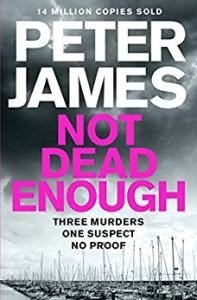
Not Dead EnoughNot Dead Enough by Peter James, the 3rd Detective Superintendent Roy Grace book. 4*

It’s set in Brighton and begins with the murder of Katie Bishop. The immediate suspect is her husband Brian, but it appears that he couldn’t be the murderer unless he could have been in two places at once. Then Sophie Harrington is killed. She had been having an affair with Brian thus intensifying the police investigation into his movements and background.

Grace’s wife, Sandy, had disappeared nine years earlier and he is still wondering what happened to her even though he is now involved with Cleo Morey, the Chief Mortician and he takes a quick trip over to Munich when his friends tell him they had seen her there.

This is a re-read. I first read it in January 2014 and it was only when I reached the part about Sandy that I realised I had read it before. I think that this is because the two murders are particularly gruesome and either I’d scan read them before or had blocked them out of my mind. Apart from the gruesome murders I enjoyed this book and intend to carry on reading the Roy Grace books.

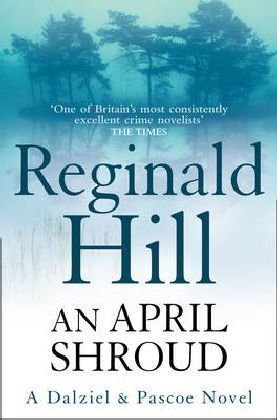
An April Shroud by Reginald Hill

April Shroud

HarperCollins|2011|326 pages|Paperback|my own copy| 3* 

An April Shroud is Reginald Hill’s fourth Dalziel and Pascoe novel, first published in 1975, in which Dalziel is on holiday and Pascoe is on his honeymoon.

From the back cover:

Inspector Pascoe may take holidays but Death never does – and neither, it seems, does Superintendent Dalziel. A watery accident on a solitary country holiday leads to the Fat Man drying off in Lake House, a nearby mansion well past its prime.

The same cannot be said for its owner, the fulsome Mrs Fielding. She has only recently buried her husband, but seems more concerned with her future. Dalziel’s curiosity is aroused – purely professionally of course – and by the time Pascoe’s honeymoon is over, there have been several more deaths and Dalziel might have compromised himself beyond redemption …

Whereas in the previous book, Ruling Passion Dalziel’s character was more of a caricature, on An April Shroud Hill develops his character more fully, in fact I think the book is primarily a superb character study of Dalziel.  He is rude, coarse and insensitive, but his capacity for getting to the bottom of a mystery is shown to be immense.

Although on holiday he cannot help but ferret out what really happened to Conrad Fielding, when he meets the Fielding family on their way back home after Conrad’s funeral. He was rescued by them when his journey south was brought to an abrupt end by floods. The police had decided that Conrad’s death had been an accident – he had fallen off a ladder onto the drill he had been using and it had pierced his heart. Mrs Fielding invites Dalziel to stay at their home, Lake House, where it soon becomes apparent to him that the family have plenty of secrets they would rather he didn’t discover.

I couldn’t easily distinguish who was who in the family, except to realise that they were all rather odd. The plot seemed over complicated and in parts I thought I was reading a farce as more bodies turned up dead. I had little idea who was guilty and the identity of the culprits took me by surprise. Dalziel’s ‘interlude’ with the widow, Bonny Fielding, was entertaining as well as revealing about Dalziel’s personal life – he is sensitive and vulnerable beneath his boorish exterior. 

Overall, I enjoyed the book, although for me it was far from Hill’s best Dalziel and Pascoe book and I’m looking forward to reading book 5, A Pinch of Snuff, as I know that the later books are much better. Reginald Hill wrote 24 Dalziel and Pascoe novels. I’ve read some of them and currently I’m reading my way through the rest.

These are the Dalziel and Pascoe books I’ve read so far:

1. A Clubbable Woman (1970) 
2. An Advancement of Learning (1971)
3. Ruling Passion (1973)
4. An April Shroud (1975) 
8. Exit Lines (1984)
11. Bones and Silence (1990) 
14. Pictures of Perfection (1993) – read, no post
17.On Beulah Height (1998) 
20. Death’s Jest Book (2002) 
21. The Death of Dalziel (2007)

Reading Challenges: Mount TBR 2019 (a book I’ve owned for four years) and the Calendar of Crime 2019 challenge (for the month of April – a book with the month in the title).

Latest Additions at BooksPlease

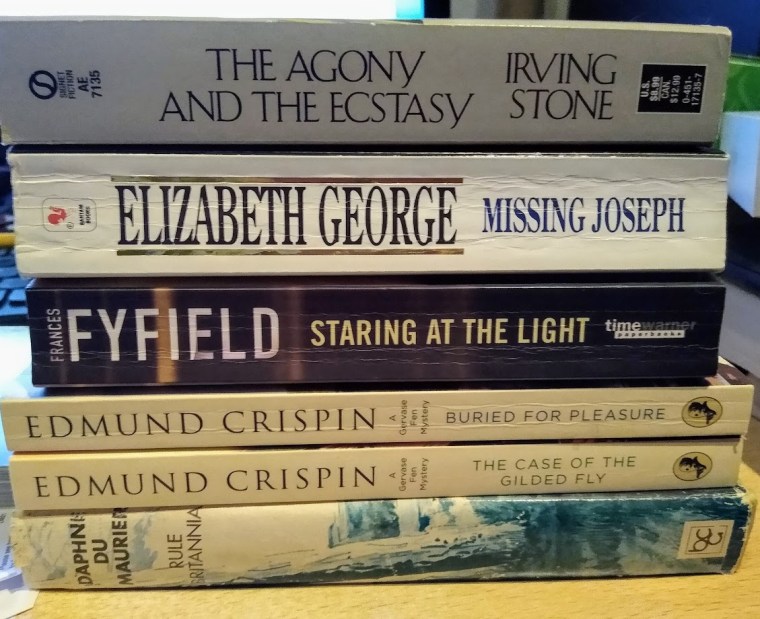
Yesterday I brought this little pile of books home from Barter Books in Alnwick, my favourite bookshop. (This is where you can ‘swap’ books for credit that you can then use to get more books from the Barter Books shelves.)

Barter Bks Nov 2019

From top to bottom they are:

The Agony and the Ecstasy by Irving Stone, a biographical novel of Michelangelo. I was delighted to find this almost pristine copy on the Barter Book shelves to replace my old tatty copy that is falling to pieces (you can see it in this post). There’s not a crease on the spine – I don’t think it’s ever been read!

Missing Joseph: An Inspector Lynley Novel by Elizabeth George. I haven’t read any of the Inspector Lynley novels, although I’ve watched the TV adaptations. This is the sixth in the series. I’m wondering if the book will be as good as the TV version. An Anglican priest is found dead – from accidental poisoning. But his death is far from straight forward.

Staring at the Light by Frances Fyfield. I’ve read just one of her books before, which I enjoyed. John Smith’s twin has disappeared. Cannon, a gifted artist, goes into hiding to avoid John’s destructive behaviour. Attorney Sarah Fortune shields Cannon, and more importantly, his wife, the real target. But is Cannon really telling the truth about John? Val McDermid is quoted on the back cover: ‘I doubt I will read a better book this year.’

Next two books by Edmund Crispin. I’ve read reviews of his books, so when I saw these two I decided to see for myself what they are like. The Case of the Gilded Fly, Crispin’s first novel, contains the first appearance of eccentric amateur detective Gervase Fen, Professor of English Language and Literature in the University of Oxford. It’s a locked-room mystery, written while Crispin was an undergraduate at Oxford and first published in the UK in 1944.

And Buried for Pleasure, in which Gervase Fen is running for parliament and he finds himself ‘in a tangled tale of lost heirs, eccentric psychiatrists, beautiful women and vengeful poisoners.’

And last but not least I found this hardback copy of a Daphne du Maurier novel – Rule Britannia. First published in 1972 in this novel the UK has withdrawn from the Common Market (as it was then called) and has formed an alliance with the United States – supposed to be an equal partnership but it looks to some people like a takeover bid. Rather prescient of Daphne du Maurier, I wonder …