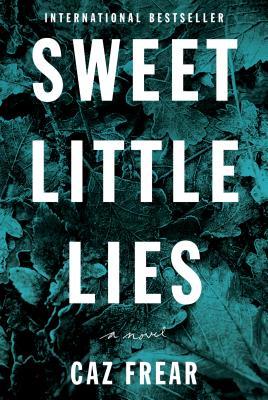
Sweet Little Lies by Caz Frear


Sweet Little Lies

3*

Sweet Little Lies is one of my TBRs. When it was first published nearly three years ago I kept seeing rave reviews of Caz Frear’s debut novel and wondered whether I would like it. It begins very slowly and I was beginning to think I wasn’t going to bother finishing it. It was only at about the halfway mark that it picked up pace. What I didn’t like about it is that it’s written in the first person present tense and apart from that I didn’t like the style of writing – very wordy, with much that adds very little to the plot. Once it finally got going this is mainly a police procedural set in the present day in London with flashbacks to Ireland in 1998. Whilst I found the plot a  touch over complicated and relying too much on coincidence I think the characters are well defined, and the dialogue is convincing.

When DC Cat Kinsella was a child of eight, visiting family in Ireland, teenager Maryanne Doyle went missing and Cat suspected her father had something to do with Maryanne’s disappearance because of something she had seen. But she kept it to herself and that had affected her relationship with her father ever since. So she is a complex and conflicted character who has changed her name, from McBride, distancing herself from her family and in particular from her father, whom she both loves and hates.  Her secret means that when the body of a woman, who turns out to be Maryanne Doyle, has been found strangled, not far from the pub that Cat’s father runs in Islington she is in a quandary – should she tell her boss that she had known Maryanne in the past?  But she is desperate to know the truth – and that is what kept me turning the pages to the end of the book.

Amazon UK link
Amazon US link

Reading challenges: Mount TBR challenge and Calendar of Crime – the main action takes place in December.

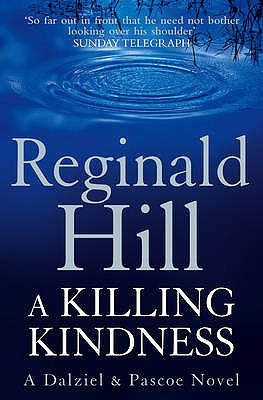
A Killing Kindness by Reginald Hill

A killing kindness

HarperCollins | 2013 | 372 pages | Paperback | my own copy | 5*

A Killing Kindness is Reginald Hill’s sixth Dalziel and Pascoe novel, first published in November 1980 and was televised in 1997 with the actors Warren Clarke and Colin Buchanan in the lead roles.

I wrote about the opening and quoted a short extract from page 56 in a My Friday post in January. I enjoyed it very much. For completeness I’m including the opening paragraph and the extract from page 56 in this post too:

The opening paragraph

… it was green, all green, all over me, choking, the water, then boiling at first, and roaring, and seething, till all settled down, cooling, clearing, and my sight up drifting with the last few bubbles, till through the glassy water I see the sky clearly, and the sun bright as a lemon, and birds with wings wide as a windmill’s sails slowly drifting round it, and over the bank’s rim small dark faces peering, timid as beasts at their watering, nostrils sniffing danger and shy eyes bright and wary, till a current turns me over, and I drift, and am still drifting …

What the hell’s going on here! Stop it! This is sick …

Page 56:

… all over me, choking, the water all boiling at first, and roaring, and seething …. Pascoe shook the medium’s taped words out of his mind and went on with his reading.

There was a degree of lividity down the left side which was unusual for a corpse taken from the water, but could be explained by the fact that the body seemed to have been wedged in the debris by the canal bank rather than rolling free in the current.

With each book getting better and better, I think this is the best of the early Dalziel and Pascoe novels. The main characters are now clearly established and moving on with their lives. Dalziel continues to be a boorish, angry man, not afraid to speak his mind and most definitely politically incorrect in all aspects. Pascoe and Ellie are expecting their first child, and D S Wield’s personal life is not going well.

The plot is nicely convoluted and tricky to solve, as it looks as though the police are faced with a serial killer. Three women have been found dead, strangled and a mysterious caller phones the local paper with a quotation from Hamlet. As more murders follow,  the killer is soon known as the Choker and it seems as if his motive for the murders is  compassion:

… ‘this man’s motivation does not seem to be based so much on hate as on compassion.’

‘Compassion? You mean he kills women because he’s sorry for them?’ asked Pascoe with interest.

‘In a way, yes. There’s good case-law here. The impulse to euthanasia is a strong one in all advanced civilisations.’ (p, 145)

Dalziel is angry when he finds out that Wield had involved a clairvoyant to help and Pascoe was talking to linguistic specialists and psychiatrists to help identify the killer. There are a lot of characters for the police to consider – Ellie’s feminist friends in the Women’s Rights Action Group, the members of the Aero Club, the fairground people and the local gypsies. By the time I got near the end of the book I had little idea of the identity of the murderer, but then with one sentence all was made clear. I just needed Pascoe, helped by Wield to work it out for me.

The 7th book in the series is Deadheads and I shall be reading that very soon, I hope.

These are the Dalziel and Pascoe books I’ve read so far:

1. A Clubbable Woman (1970) 
2. An Advancement of Learning (1971)
3. Ruling Passion (1973)
4. An April Shroud (1975)
5. A Pinch of Snuff (1978)
8. Exit Lines (1984)
11. Bones and Silence (1990) 
14. Pictures of Perfection (1993) – read, no post
17.On Beulah Height (1998) 
20. Death’s Jest Book(2002) 
21. The Death of Dalziel (2007)

Latest Additions at BooksPlease

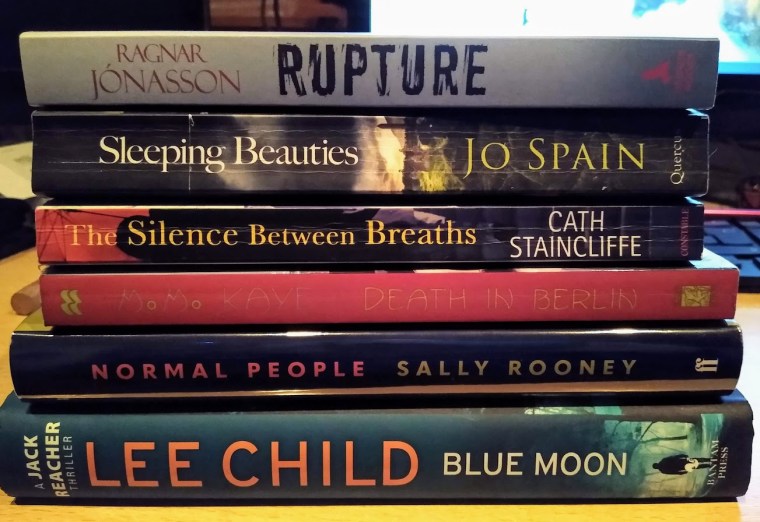
Yesterday I brought this little pile of books home from Barter Books in Alnwick, my favourite bookshop. (This is where you can ‘swap’ books for credit that you can then use to get more books from the Barter Books shelves.)

BB bks Jan 2020

From top to bottom they are:

Rupture by Ragnar Jónasson, the fourth book in the Dark Iceland series. Two young couples move to the uninhabited, isolated fjord of Hedinsfjordur. Their stay ends abruptly when one of the women meets her death in mysterious circumstances. I’ve read one of his Hidden Iceland series, The Island which I thoroughly enjoyed.

Sleeping Beauties by Jo Spain, who is one of my favourite authors. It’s the third book in the Inspector Tom Reynolds Mystery series. A young woman, Fiona Holland, has gone missing from a small Irish village. A search is mounted, but there are whispers. Fiona had a wild reputation. Was she abducted, or has she run away?

The Silence Between Breaths by Cath Staincliffe. I’ve seen some of her books reviewed on other book blogs and thought I’d look for one of hers. It’s set on a train travelling from Manchester to London, where one of the passengers is carrying a deadly rucksack. Cath Staincliffe is a Manchester based crime writer, the creator and scriptwriter of ITV’s police series, Blue Murder and writes the Scott & Bailey books, based on the ITV1 police series.

Death in Berlin by M M Kaye. Years ago I read The Far Pavilions and it is only in recent years that I discovered she wrote the Death in … series. This is the 2nd book in the series first published in 1955. A murder mystery set in post-war Berlin.

The last two books are hardbacks that look brand new – Normal People by Sally Rooney. This is a not the usual type of book that I read, and a bit out of my comfort zone. It’s described on the dust jacket as a story of mutual fascination, friendship and love in which a couple try to stay apart but find they can’t.

And finally  – Blue Moon by Lee Child, a Jack Reacher thriller. I’m not sure this one is my cup of tea either, as two rival gangs are competing for control in the city – maybe too violent for me.

Have you read any of these books?  Do any of them tempt you? 

My Friday Post: A Killing Kindness by Reginald Hill

Book Beginnings Button

Every Friday Book Beginnings on Friday is hosted by Gillion at Rose City Reader where you can share the first sentence (or so) of the book you are reading, along with your initial thoughts about the sentence, impressions of the book, or anything else the opener inspires.

A Killing Kindness by Reginald Hill is one of the books I’m thinking I’ll read next. It’s the 6th Dalziel and Pascoe novel

A killing kindness


… it was green, all green, all over me, choking, the water, then boiling at first, and roaring, and seething, till all settled down, cooling, clearing, and my sight up drifting with the last few bubbles, till through the glassy water I see the sky clearly, and the sun bright as a lemon, and birds with wings wide as a windmill’s sails slowly drifting round it, and over the bank’s rim small dark faces peering, timid as beasts at their watering, nostrils sniffing danger and shy eyes bright and wary, till a current turns me over, and I drift, and am still drifting …

What the hell’s going on here! Stop it! This is sick …

I wasn’t sure what was going on either …

Also every Friday there is The Friday 56, hosted by Freda at Freda’s Voice.

30879-friday2b56These are the rules:

  1. Grab a book, any book.
  2. Turn to page 56, or 56% on your eReader. If you have to improvise, that is okay.
  3. Find any sentence (or a few, just don’t spoil it) that grabs you.
  4. Post it.
  5. Add the URL to your post in the link on Freda’s most recent Friday 56 post.

Page 56: it’s becoming clearer now what was going on –

… all over me, choking, the water all boiling at first, and roaring, and seething …. Pascoe shook the medium’s taped words out of his mind and went on with his reading.

There was a degree of lividity down the left side which was unusual for a corpse taken from the water, but could be explained by the fact that the body seemed to have been wedged in the debris by the canal bank rather than rolling free in the current.

Blurb:

When Mary Dinwoodie is found choked in a ditch following a night out with her boyfriend, a mysterious caller phones the local paper with a quotation from Hamlet. The career of the Yorkshire Choker is underway.

If Superintendent Dalziel is unimpressed by the literary phone calls, he is downright angry when Sergeant Wield calls in a clairvoyant.

Linguists, psychiatrists, mediums – it’s all a load of nonsense as far as he is concerned, designed to make a fool of him.

And meanwhile the Choker strikes again – and again…

~~~

Have you read this book? What did you think?

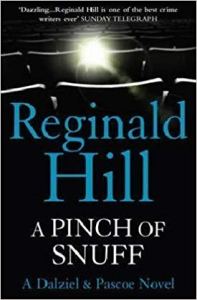
A Pinch of Snuff by Reginald Hill

A Pinch of Snuff

HarperCollins|2003|362 pages|Paperback|my own copy|4* 

A Pinch of Snuff is Reginald Hill’s fifth Dalziel and Pascoe novel, first published in 1978. It was televised in 1994 by Yorkshire Television, two years before the BBC series began. The characters of Dalziel and Pascoe were played by comedians Gareth Hale and Norman Pace, with Christopher Fairbank as Sergeant Edgar Wield. It was not a success and Reginald Hill was said to have been unhappy with the series. Subsequently the Dalziel and Pascoe books were adapted for BBC television from 1996 to 2007 with the actors Warren Clarke and Colin Buchanan in the lead roles.

I finished reading A Pinch of Snuff just before Christmas and didn’t have time to review it then, so these are just a few notes of what I thought about it. It is better than the earlier books, almost as good as the later books and I enjoyed it very much. It begins as Jack Shorter, Pascoe’s dentist, tells him that he thinks that in one of the blue movies shown at the Calliope Club, an actress wasn’t acting but that she really was beaten up and that her teeth were actually broken. However, when Pascoe begins to investigate his dentist’s allegations it seems that the dentist’s fears were unfounded as the actress in question assures Pascoe that she was acting and certainly wasn’t hurt. But then the cinema is wrecked and its owner killed. Shorter, meanwhile, is accused of molesting an underage patient and is allegedly responsible for getting her pregnant.

All in all, this is a complicated book involving child abuse, pornography, violence towards women and snuff films. It starts slowly, but as the various twists and turns crop up the pace quickens. The events are shown through Pascoe’s eyes and we see his relationships with Dalziel and Sergeant Wield develop.  Elly, Pascoe’s wife, still doesn’t get on with Dalziel, and her feminism comes to the fore in her antagonism against him. 

The 6th book in the series is A Killing Kindness and I shall be reading that very soon.

These are the Dalziel and Pascoe books I’ve read so far:

1. A Clubbable Woman (1970) 
2. An Advancement of Learning (1971)
3. Ruling Passion (1973)
4. An April Shroud (1975) 
8. Exit Lines (1984)
11. Bones and Silence (1990) 
14. Pictures of Perfection (1993) – read, no post
17.On Beulah Height (1998) 
20. Death’s Jest Book (2002) 
21. The Death of Dalziel (2007)

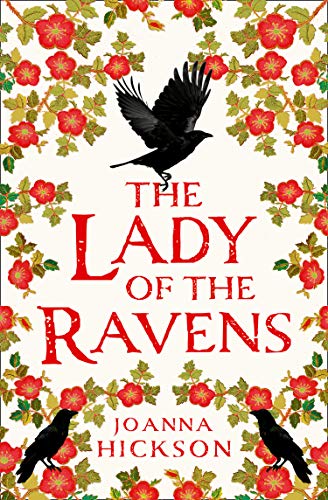
The Lady of the Ravens by Joanna Hickson

Lady of the ravens

Harper Collins|9 January 2020|400 pages|e-book via NetGalley|Review copy|5*

Publishers’ Description:

Elizabeth of York, her life already tainted by dishonour and tragedy, now queen to the first Tudor king, Henry the VII.

Joan Vaux, servant of the court, straining against marriage and motherhood and privy to the deepest and darkest secrets of her queen. Like the ravens, Joan must use her eyes and her senses, as conspiracy whispers through the dark corridors of the Tower.

Through Joan’s eyes, The Lady of the Ravens inhabits the squalid streets of Tudor London, the imposing walls of its most fearsome fortress and the glamorous court of a kingdom in crisis.

My thoughts:

The Lady of the Ravens opens in 1485 just weeks after Henry Tudor had taken the throne to become King Henry VII of England and Lord of Ireland. This is historical fiction about the early years of Henry’s reign as seen through the eyes of Joan Vaux, a lady in waiting to Elizabeth of York, whose marriage in 1486 to Henry united the Houses of Lancaster and York after the end of the Wars of the Roses.

Henry comes across as a competent king, which is really all I knew of his reign before reading this book. I’ve read Joanna Hickson’s earlier book about him, The Tudor Crown, which is about his early life and how he gained the English throne. Joan Vaux also features in a small way in this book. In The Lady of the Ravens he is shown to be determined to hold on to his throne, dealing with several Yorkists’ claims to the throne, in particular those of Lambert Simnel, who claimed to be Edward Plantagenet, 17th Earl of Warwick, Elizabeth’s cousin, and Perkin Warbeck, who claimed to be Richard of Shrewsbury, Duke of York, who was the second son of Edward IV, Elizabeth’s brother, one of the so-called Princes in the Tower. It is also about his family life – his marriage to Elizabeth,,the births of their children (three of them died in childhood), and his concern for his subjects – for example both he and Elizabeth were present at Joan’s wedding and we also see him enjoying dancing at court.

Joan Vaux is also a real historical character – her mother, Katherine was French and had been a lady-in-waiting to the former queen Margaret of Anjou (the wife of Henry VI).. Joan had served Elizabeth as a woman of her bedchamber before Elizabeth’s marriage to Henry and, after her own marriage to Sir Richard Guildford, as a lady-in-waiting. And before that she had been brought up in the household of Lady Margaret Beaufort, Henry’s mother. Joan became a good friend and confidante of Elizabeth, even after her marriage and the birth of her son Henry, known as Hal, who also became a good friend to the young Prince Henry.

The fictional element is in the story of Joan’s fascination for and care of the ravens of the Tower of London firmly believing in the legend that should the ravens leave the Tower for good then the crown will fall and ruin will return to the nation. I came to really like Joan, a warm and caring woman. Joanna Hickson goes into detail describing the traumatic birth of her son and the lives of ordinary people outside the royal court. It is a rich and vibrant novel, full of action and political unrest.

I particularly like the glimpses we see of the ill-fated Prince Arthur and his bride, Katherine of Aragon. And I was especially delighted by the portrait of Prince Henry (who later became Henry VIII) as a young charismatic child of nearly three. His father was  furious about the imposters’ claims to the throne and had decided the best response was to invest his younger son as the trueborn and genuine Duke of York. Little Henry, with his bright red Tudor hair, was mounted on a gleaming black warhorse strapped into a specially made high-backed jousting saddle and escorted by his great-uncles, the Yeoman of the Guard and the King’s Archers as they processed around the streets of London to Westminster.  He was in his element, waving to the crowd who cheered and threw flowers as he went by.

This novel is beautifully written, grounded in its historical context, full of colour and life. I loved all the descriptions of the various settings, especially the Tower of London, and the ravens. My grasp of English history in this period was very hazy and I learned a lot reading this book, especially as the characters came to life on the pages, but most of all I loved the portrayal of Joan Vaux, Lady Guildford. And I see from the Author’s Note at the end of the book that there is more to come about her, including a mystery, her second marriage and her close relationship with Katherine of Aragon and the early years of Henry VIII’s reign. I’m looking forward to reading that!

The Author:

Joanna Hickson became fascinated with history when she studied Shakespeare’s history plays at school. However, having taken a degree in Politics and English she took up a career in broadcast journalism with the BBC, presenting and producing news, current affairs and arts programmes on both television and radio. Now she writes full time. The Lady of the Ravens is her sixth novel. 

My thanks to the publishers for my review copy via NetGalley.