The Silent Wife by Karin Slaughter

Description

The gripping No. 1 Sunday Times crime thriller She runs

A woman runs alone in the woods. She convinces herself she’s safe. He watches

But a predator is watching from the shadows. Waiting for the perfect moment to attack.He waits

They thought they caught him. But another victim has just been found.

The hunt has only just begun. And the killer is ready to strike again…

I hadn’t read any of Karin Slaughter’s books, but I thought I’d try this one when I saw it on NetGalley, as I know they are very popular. But for a number of reasons I did not enjoy The Silent Wife at all! First of all I hadn’t realised this was part of a series until I started reading it, but once I did I hoped it would read well as a standalone – but it doesn’t. Then it’s a serial killer story and I’m never keen on that.

But the main reason is that it is very graphic, very dark, extremely disturbing with rapes and murders described in great detail, and just far too gruesome for me. I was really struggling to make myself read it – so I gave up and didn’t finish it!

Thanks to NetGalley for my review copy, anyway.

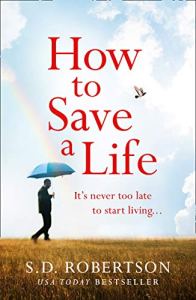
How to Save a Life by S D Robertson

Description

You can’t have a rainbow, without a little rain…

When a stranger saves Luke’s life, he knows he’s been given a second chance. He’s going to make it count – and, determined to live each day to its fullest, he starts by saying yes to everything life has to offer.

Slowly but surely, Luke learns that a little bit of blue-sky thinking can go a long way, and things start to look up.

But when Luke’s new resolve is tested, will he return to his old ways? Or can one fateful moment truly save a life.

A life-affirming story about a man who is given a second chance, perfect for fans of Mike Gayle and Imogen Clark.

How to Save a Life is one of the oldest books on my NetGalley shelf. It has sat there far too long, since 2020. It’s the second book I’ve read by S D Robertson (the first was If Ever I Fall), which is why I requested it. It’s an emotional story, character driven, narrated solely by Luke, a barber, with a pessimistic outlook on life. His parents died in a tragic accident, then just a fortnight before Christmas his wife told him she’d been having an affair and left him. He is wallowing in misery, living alone with his cat, Alfred. Until he meets Iris. They were both sheltering from a sudden storm under scaffolding when a violent gust brought the building and scaffolding down on them – Luke survived, but Iris didn’t. She had saved his life, pushing him out of the way as the scaffolding collapsed.

Iris’s death has a powerful effect on Luke, especially when he learns what a wonderful person she was – a doctor who was passionate about volunteering her services for a charity scheme in Africa. He felt guilty that he had survived and vowed to change his outlook and his life, trying to be more like Iris.

This book is not my usual choice of genre, but I think it is an interesting book that did give me food for thought. I liked the setting in Manchester’s Northern Quarter, and I could easily visualise Luke’s barber’s shop and its surroundings. However, it is repetitive as Luke analyses his feelings and actions over and over again, and it’s slow paced because of that. He has several setbacks as things don’t all turn out how he had hoped, but it is a heart-warming story, if a little predictable.

My thanks to Avon, the publishers for a review copy via NetGalley.

  • ASIN: ‎ B07Z4BBBF9
  • Publisher ‏: ‎ Avon (11 Jun. 2020)
  • Print length: 397 pages
  • Review copy
  • My rating : 3*

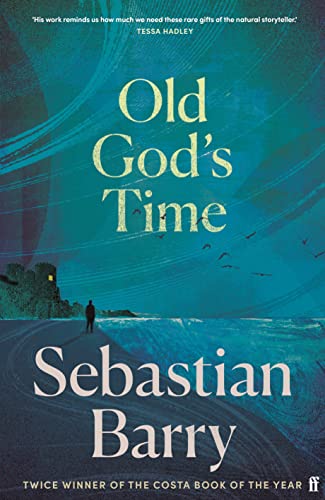
Old God’s Time by Sebastian Barry

Rating: 4 out of 5.

Faber and Faber Ltd| 2 March 2023 | 228 pages|e-book |Review copy|4*

Synopsis:

Have you ever been the custodian of a story no one else believed?’
‘Oh yes,’ he said.
‘You have?’
‘Yes,’ he said.
‘Then I can tell you.’

Recently retired policeman Tom Kettle is settling into the quiet of his new home, a lean-to annexed to a Victorian castle overlooking the Irish Sea. For months he has barely seen a soul, catching only glimpses of his eccentric landlord and a nervous young mother who has moved in next door. Occasionally, fond memories return, of his family, his beloved wife June and their two children.

But when two former colleagues turn up at his door with questions about a decades-old case, one which Tom never quite came to terms with, he finds himself pulled into the darkest currents of his past.

A beautiful, haunting novel, in which nothing is quite as it seems, Old God’s Time is about what we live through, what we live with, and what may survive of us.

My thoughts:

I’ve enjoyed all Sebastian Barry’s books and Old God’s Time is no exception. It’s set in Dalkey, a small coastal town south of Dublin, where Tom, a recently retired policeman is living in a tiny flat annexed to a Victorian castle. One afternoon he was sitting in a sun-faded wicker chair, enjoying a cigarillo, listening to the sound of the sea below. He was quite content to just gaze out, watching the cormorants on the rocks to the left of Dalkey Island, when two of his former colleagues disturbed his peaceful afternoon, asking for his help on a cold case he had worked on. He doesn’t want to, knowing it will open up painful memories he would rather forget.

So this appears to be a detective story, but the main focus is Tom, himself as the narrative reveals in streams of consciousness. It soon becomes clear that his memories are unreliable and for a while I was confused, not knowing what was going on, whether Tom was remembering, or imagining what had happened in his life. It is beautifully written, showing the beauties of the landscape. It takes us right inside Tom’s mind, highlighting the horrors that Tom had experienced both in his childhood and family life as well as in his professional life. The past had not been kind to him. But now it was as though enough time had gone by and it was as if it had never happened; it had receded away into ‘old God’s time’, and Tom didn’t want to reach back into those memories. They were locked away, preserved in the long-ago.

It is a tragic story, not shying away from describing the horrific details of child abuse, nor the despair and sadness as the details of Tom’s family life are gradually revealed. It is a harrowing book, made even more so as I had to read it slowly making sure I fully understood what I was reading, even going back to re-read some passages. It is bleak, but Tom’s story is also one of love and immeasurable happiness, of strength and goodness, alongside grief and pain.

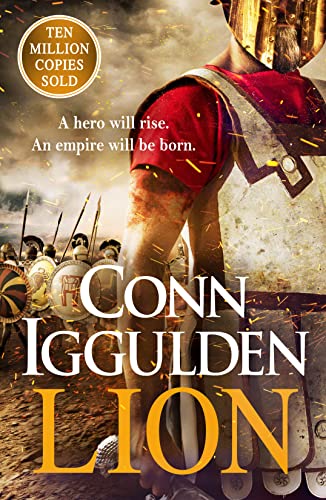
Lion by Conn Iggulden – the First in The Golden Age series

Penguin| 26 May 2022| 416 pages| Review Copy| 4*

Ancient Greece, 5th century BC

The age of myths and legends has given way to the world of men. In the front rank stands Pericles, Lion of Athens.
Behind Pericles lies the greatest city of the ancient world. Before him, on land and at sea, stands the merciless Persian army. Both sides are spoiling for war.

Though still a young man, Pericles knows one thing: to fight a war you must first win the peace

It’s time for a hero to rise.

For his enemies to tremble.

And for Athens, a city of wisdom and warriors, to shine with glory . . .

I was so pleased when I started reading Lion as I realised straight away I was going to enjoy it. It’s been a long time since I read anything set in Ancient Greece, so a lot was new to me, including the characters as well as the historical setting. This is the first book in Conn Iggulden’s Golden Age series set in the 5th century BCE. I thoroughly enjoyed it which surprised me as generally speaking I’m not keen on reading battle scenes and the book starts and ends with battles. But I had no problem with following the action of the battles between the Greeks and the Persians, and was able to visualise what was going on without any difficulty. The characters’ names took me a little while to get clear in my mind but I soon got used to them.

The two main characters are both young men, Cimon the older of the two has more authority than Pericles, the younger man. Lion is the story of their early careers. Iggulden covers the capture of Eion under Cimon’s leadership of the Delian League, an alliance of Greek states, and of Scyros where Cimon found the bones of Theseus and returned them to Athens. He then captured Cyprus and destroyed a Persian fleet on the Eurymedon River. Below the age of thirty little is known of Pericles’ life, but the likelihood is that he was with Cimon for these events.

The middle section of Lion forms an interlude between the battles and is about Pericles’ marriage to Thetis, and his involvement in the theatre in Athens and the Festival of Dionysus. Pericles was the ‘choregos’ (producer) of Aeschylus’ plays made up of three tragedies and a ‘satyr’ play. I found this part of the book just as fascinating as the battle scenes.

Iggulden adds a useful historical note and recommends reading Pericles: a Biography in Context by Thomas R Martin for more information.

The next book in the Golden Age series is Empire, which will be released on May 25, 2023.

My thanks to the publishers for a review copy via NetGalley.

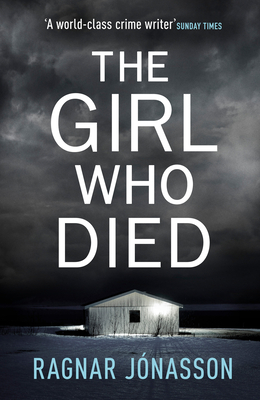
The Girl Who Died by Ragnar Jonasson, translated from the Icelandic by Victoria Cribb

Penguin| 3 June 2021| 328 pages| Review Copy| 3*

‘TEACHER WANTED AT THE EDGE OF THE WORLD . . .’

After the loss of her father, Una sees a chance to escape Reykjavík to tutor two girls in the tiny village of Skálar – population just ten – on Iceland’s storm-battered north coast.

But city life hasn’t prepared her for the unforgiving weather nor inhospitable village life. Worse, the creaky old house where she lives is playing on her already fragile mind when she’s convinced she hears the ghostly sound of singing.

Then, at midwinter, a young girl is found dead.

And one of the villagers must have blood on their hands . . .

The Girl Who Died is Icelandic noir, a mix of horror and psychological thriller, with a strong sense of place. Skálar is a close-knit community that doesn’t welcome newcomers, keeping its secrets well hidden. The only person who welcomes Una, to the village is Salka, the mother of Edda, one of the two girls Una is to teach. But even her welcome is short lived.

When Una arrived she had the feeling that it was like being a folk tale, an ominous supernatural tale set in a vague shifting world where nothing was solid or real, almost like a ghost town. The feeling grows stronger when she sees a little girl with long, pale hair in the window of Salka’s house – but Salka tells her that Edda was in bed. Later she discovers that the ghost of a young girl who had died fifty years earlier was said to haunt the house.

The supernatural elements of the story and the dark brooding atmosphere add to the mystery, but it is not quite as creepy or chilling as I’d thought it would be, mainly because of the slow plodding pace. Also I’m in two minds about Una as I really didn’t find her a very interesting character. And I began to care less and less about what was happening to her. Overall I found it a bit disappointing, and I found the ending puzzling.

However, the Author’s Note is interesting. Jonasson explains that Skálar is a real place. But it was abandoned in the mid 1950s, so the setting is real, but the buildings and the characters are fictitious. However, he has tried to give an accurate representation of the history of Skálar that describes in the book. He has also used the folk tales in Sigfús Sigfússon’s collections of Icelandic tales and legends.

My thanks to the publishers for a review copy via NetGalley.

The Darkness Manifesto by Johan Eklöf, translated by Elizabeth DeNoma

Virgin| 3 Novmber 2022| 205 pages| Review Copy| 3.5*

How much light is too much light? The Darkness Manifesto urges us to cherish natural darkness for the sake of the environment, our own wellbeing, and all life on earth.

The world’s flora and fauna have evolved to operate in the natural cycle of day and night. But constant illumination has made light pollution a major issue. From space, our planet glows brightly, 24/7. By extending our day, we have forced out the inhabitants of the night and disrupted the circadian rhythms necessary to sustain all living things. Our cities’ streetlamps and neon signs are altering entire ecosystems.

Johan Eklöf encourages us to appreciate natural darkness and its unique benefits. He also writes passionately about the domino effect of damage we inflict by keeping the lights on: insects failing to reproduce; birds blinded and bewildered; bats starving as they wait in vain for insects that only come out in the dark. And humans can find that our hormones, weight and mental well-being are all impacted.

Johan Eklöf, PhD, is a Swedish bat scientist and writer, most known for his work on microbat vision and more recently, light pollution. He lives in the west of Sweden, where he works as a conservationist and copywriter. The Darkness Manifesto is his first book to be translated into English.

~~~

Until I read The Darkness Manifesto: How Light Pollution Threatens the Ancient Rhythms of Life all I knew about light pollution was its effect on the night sky, how artificial light impairs our view of the sky, the stars and the planets. But I hadn’t realised just how much it adversely affects our environment, wildlife and our own health. This book is full of fascinating facts about the impact that darkness and the night have on all living creatures, including ourselves.

Artificial lighting today makes up a tenth of our total energy usage but most of it is of little benefit to us, spilling out into the sky. Animals cannot distinguish between artificial light and natural daylight which means their circadian rhythms are disrupted, sending body clocks awry, disrupting our sleep.

There is, of course, the need for safety and security, and Eklöf cites several examples of places around the world that have projects that promote darkness, and have established light pollution laws, such as France where there are regulations to limit how much light, and what kind of light, can be emitted into the atmosphere. The light needs to be adapted to suit the needs of both animals and humans.

Eklöf ends his book with his Darkness Manifesto, urging us to become aware of the darkness, to protect and preserve it individually by turning off lights when not in a room, and letting your garden rest in darkness at night; to discover nocturnal life; to observe the different phases of twilight and how the sun gives way to the moon and stars; and to learn more about the darkness and its importance for the survival of animals and plants. He also asks us to inform local authorities about the dangers of light pollution. To my mind the current energy crisis is another reason to reduce our use of lighting and electricity.

My thanks to the publishers for a review copy via NetGalley.