The Bone Chests by Cat Jarman

A history of the making of England as a nation, told through six bone chests, stored for over a thousand years in Winchester Cathedral.

William Collins| 14 September 2023| 400 pages| Review copy| 4*

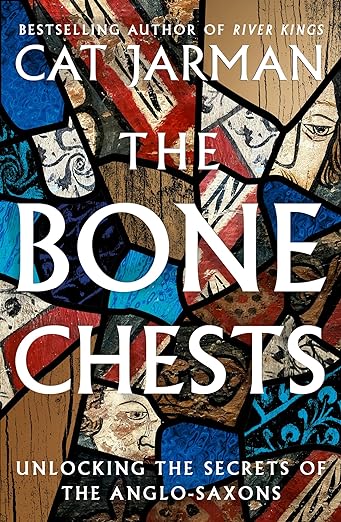
The front cover shows a section of the Great West Window of Winchester Cathedral, made up of mosaics created after 1660 from the glass that had been smashed during the Civil War in 1642. I think it is just beautiful.

Description:

In December 1642, during the Civil War, Parliamentarian troops stormed the magnificent cathedral, intent on destruction. Reaching the presbytery, its beating heart, the soldiers searched out ten beautifully decorated wooden chests resting high up on the stone screens.

Those chests contained some of England’s most venerated, ancient remains: the bones of eight kings, including William Rufus and Cnut the Great – the only Scandinavian king to rule England and a North Sea empire; three bishops ; and a formidable queen, Emma of Normandy. These remains belong to the very people who witnessed and orchestrated the creation of the kingdom of Wessex in the seventh century, who lived through the creation of England as a unified country in response to the Viking threat, and who were part and parcel of the Norman conquest.

On that day, the soldiers smashed several chests to the ground, using the bones as missiles to shatter the cathedral’s stained glass windows. Afterwards, the clergy scrambled to collect the scattered remains.

In 2012, the six remaining chests were reopened. Using the latest scientific methods, a team of forensic archaeologists attempted to identify the contents: they discovered an elaborate jumble of bones, including the remains of two forgotten princes. In The Bone Chests, Cat Jarman builds on this evidence to untangle the stories of the people within. It is an extraordinary and sometimes tragic tale, and one of transformation. Why these bones? Why there? Can we ever really identify them? In a palimpsest narrative that runs through more than a millennium of British history, it tells the story of both the seekers and the sought, of those who protected the bones and those who spurned them; and of the methods used to investigate.

My knowledge of the Anglo-Saxons from school history lessons is very basic – little more than Alfred the Great on the run from the Vikings and letting the cakes burn, and King Canute, sitting in his throne placed at the water’s edge and trying unsuccessfully to forbid the waves from advancing and wetting his feet.

So I was looking forward to learning more in The Bone Chests: Unlocking the Secrets of the Anglo-Saxons. In her Author’s Note Cat Jarman clarifies that her intention with this book is to tell the stories of the chests, and of the tumultuous times that they and the people interred in them, lived through. She has concentrated on the south and south-west of England to consider why Wessex and Winchester took on such significance in the history of England in the early medieval period. So, the main emphasis in this book is on the history, on the kings and politics of the period rather than on the forensic archaeology and the modern scientific techniques.

Having said that there is enough about the use of DNA and isotopic analysis of teeth to investigate the diet and origins of the owners of the bones for me as a non scientist to understand. I found it all fascinating even though in places I was left wondering what century I was in, having moved from the 11th to the 21st century (when Richard III’s remains were discovered under a Leicester car park), via various Viking raids and the 17th century. At times I had to keep reminding myself which chest was being described.

The mortuary, or bone chests, themselves, are most interesting and I would love to visit Winchester Cathedral to see them for myself. There are six chests, painted wooden caskets which are displayed high on stone screen walls on either side of the high altar area. The bones are the remains of many kings and bishops who were originally buried in the Anglo-Saxon cathedral known as Old Minster, north of the present cathedral.

Jarman describes the chests in, vaguely, chronological order and has relied on the Mortuary Chests Project, a research project led by archaeologists from Bristol University in collaboration with Winchester Cathedral that began in 2012. She is not involved in the Project but has incorporated details of the team’s partial results released in May 2019 in her book.

The book is very detailed and well researched and I learned so much, bringing the medieval period to life as I read. I had never heard of Queen Emma and the details about her life stand out for me. She was the daughter of Richard I, Duke of Normandy, wife of two Anglo- Saxon kings – Æthelred the Unready and Cnut (Canute) – and the mother of Edward the Confessor and Harthacnut of Denmark. She was given the name Ælfgifu and in 1017 she married Cnut. I was fascinated to read that the Project team has put together a set of bones that they confidently determine to be a female that could be the body of Emma. (See – details of an exhibition at Winchester Cathedral, Kings and Scribes: the birth of a nation. This includes a 3D model of the female skeleton thought to be Queen Emma).

The last section of the book is made up of Notes of the sources used, an extensive Bibliography, and an Index. There is also a List of Illustrations; the illustrations were not included in my review copy.

Many thanks to the publishers for a review copy via NetGalley.

Dr Cat Jarman is a bioarchaeologist and field archaeologist specialising in the Viking Age, Viking women, and Rapa Nui. She uses forensic techniques like isotope analysis, carbon dating, and DNA analysis on human remains to untangle the experiences of past people from broader historical narratives. Dr Jarman has contributed to numerous TV documentaries as both an on-screen expert and historical consultant, including programmes for the BBC, Channel 4, History, Discovery, and more.
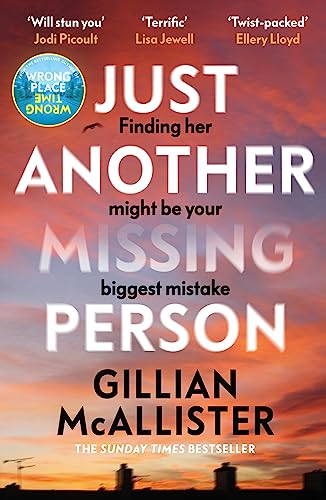
Just Another Missing Person by Gillian McAllister

Penguin Michael Joseph| 3 August 2023| 369 pages| Review copy| 5*

OLIVIA.
22 years old.
Last seen on CCTV, entering a dead-end alley.
And not coming back out again.
Missing for one day and counting . . .

Julia is the detective heading up the case. She knows what to expect. A desperate family, a ticking clock, and long hours away from her husband and daughter. But Julia has no idea how close to home it’s going to get. Because there’s a man out there. And his weapon isn’t a gun, or a knife: it’s a secret. Her worst one. He tells her that her family’s safety depends on one thing: Julia must NOT find out what happened to Olivia – and must frame somebody else for her murder . . .

Just Another Missing Person is the fifth book by Gillian McAllister that I’ve read. They have all been excellent books, tense, tightly plotted and completely compelling reading. But this one surpasses them all.

Needless to say but I was totally gripped and baffled – how could Olivia just disappear from a dead-end alley without being seen coming back out? The investigating police officer is DCI Julia Day, a detective with a passion for solving things, piecing things together and helping people to get to the truth. But she has come up against what seems to be an impossible crime and to make matters worse she has her hands tied because she has a secret. And one person knows what she did and is threatening to reveal it unless she frames someone for Olivia’s disappearance.

It’s very readable and well written, with clearly defined and believable characters, and a complex plot with plenty of twists and turns. There are two major twists – the first one that shocked me and took me completely by surprise, whilst the second one, also surprising, I’d figured out but only just before it happened. The pace is quite slow to start off, but soon ratchets up as the tension rises. It really is a book that keeps you on your toes. You need to concentrate, paying close attention to details. It’s told mainly from Julia’s perspective with further insight from the other characters’ points of view.

Just Another Missing Person is simply excellent, written with assurance and with great insight into human nature. It is without doubt one of the best books I’ve read this year.

Many thanks to the publishers for a review copy via NetGalley.

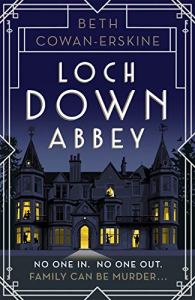
Loch Down Abbey by Beth Cowan-Erskine

Hodder & Stoughton| April 2021| 300 pages| ebook| Review copy| 4*

Description

It’s the 1930s and a mysterious illness is spreading over Scotland. But the noble and ancient family of Inverkillen, residents of Loch Down Abbey, are much more concerned with dwindling toilet roll supplies and who will look after the children now that Nanny has regretfully (and most inconveniently) departed this life.

Then Lord Inverkillen, Earl and head of the family, is found dead in mysterious circumstances. The inspector declares it an accident but Mrs MacBain, the head housekeeper, isn’t so convinced. As no one is allowed in or out because of the illness, the residents of the house – both upstairs and downstairs – are the only suspects. With the Earl’s own family too busy doing what can only be described as nothing, she decides to do some digging – in between chores, of course – and in doing so uncovers a whole host of long-hidden secrets, lies and betrayals that will alter the dynamics of the household for ever.

Loch Down Abbey is a light, quick and easy read that kept me entertained. The pun in the title suggested to me that it would be an amusing novel and the publishers describe it as a playful, humorous novel set in 1930s Scotland. I think it’s quite like a cross between a P G Wodehouse novel and a country house mystery, with elements of farce.

Loch Down Abbey, is a large rambling house with 125 rooms, not including the servants’ quarters, and 5 thousand acres of land on the shores of Loch Down. It has been the home of the Ogilvy-Sinclair Clan for six centuries. I found it quite bewildering at first as there are so many characters. I had to keep going back to the List of Characters to remind myself who they all were.

It’s partly a cozy, historical murder mystery, but mostly a family saga. Lord Hamish Inverkillen is found dead, and at first it looks like an accident, but the housekeeper Mrs MacBain thinks it could be murder. It becomes clear that the Abbey, as well as their whisky distillery is in debt, so much so that the only way they can survive is to sell the house, the distillery and land. There’s a mysterious illness known as Virulent Pernicious Mauvaise spreading around the country. Loch Down Abbey has to go into lockdown! Most of the servants catch the disease and have to be isolated away from the family, meaning that the family have to make their own breakfasts, light the fires in the bedrooms and make their own beds – unheard of for aristocrats! And as Nanny has died the children run wild causing all sorts of mayhem.

As Mrs MacBain and Inspector Jarvis investigate Hamish’s death, lots of secrets and scandals are revealed. I really liked the descriptions of the Abbey itself complete with secret passages, reminding me of Enid Blyton’s novels and I thought the ending, though a bit unbelievable, was inevitable.

My thanks to the publishers for a review copy via NetGalley.

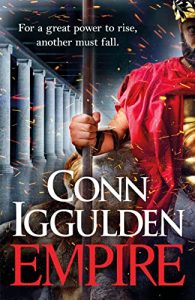
Empire by Conn Iggulden

Penguin| May 2023| 409 pages| ebook| Review Book| 5*

Pericles is more than a hero. He’s the leader of Athens. The empire’s beacon of light.

But even during times of peace, the threat of Sparta – Athens’s legendary rival – looms large on the horizon. When a sudden catastrophe brings Sparta to its knees, Pericles sees a golden opportunity to forever shift the balance of power in his city’s favour.

For sometimes, the only way to win lasting peace is to wage war. Sparta may be weak, but their power is far from extinguished. Soon a ruthless young boy steps forward to lead the Spartans back to greatness.

As the drums of battle draw closer, can Pericles rise once more?

Or will the world’s greatest empire fall under his watch?

My thoughts

Empire is the second in the Golden Age series, continuing the story told in Lion. Pericles is the main character, now the leader of Athens, appointed as a strategos (a military general). Iggulden brings the period to life as he details the continuing struggle for power between Athens and Sparta. The earthquake that struck around 464 BC destroyed most of the city of Sparta. After the Spartans rejected the Athenians’ offer of help Pericles realised that war between them was inevitable and he decided to rebuild the walls around the city to keep it safe. When the Spartans heard that the walls were rising they demanded they be taken down. The Athenians ignored this demand which, of course, led to war, with the Spartans laying siege to Athens.

Lion is an action packed and a gripping story. Iggulden tells the story, seamlessly incorporating his research into the narrative so that this doesn’t read like a textbook but as a fascinating and gripping epic tale of war and death between the states of Athens and Sparta. It’s an amazing tale of political intrigue and bloodthirsty battles. Equally as fascinating as the story is Iggulden’s Historical Note, in which he expands on the background and detail of the historical record. He also explains how he has compressed some of the years and has omitted some ‘actions, skirmishes, insults and general breakdown of good relations between the two states and their allies.’

I think it’s an entertaining and very readable book and I thoroughly enjoyed it.

My thanks to the publishers for a review copy via NetGalley.

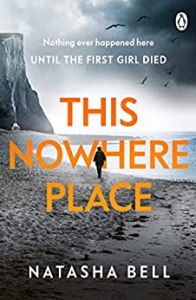
This Nowhere Place by Natasha Bell

Mo, Cali, Jude.

Three teenagers befriend each other on the white cliffs, thinking they’ll save each other.

Within months, two of them are dead and the third is scarred for life.

Ten years later, documentary-maker Tarek Zayat and his film crew are in town, asking difficult questions, looking for secrets in the silence around that fateful summer.

Because in the shadow of the white cliffs it’s easy for stories, histories and people to get lost. And in a small town, the truth is something that must be carefully unburied – in case it buries you.

I was really expecting to like this book, attracted by the synopsis, but unfortunately I didn’t enjoy it. It’s one of the books that has been on my NetGalley shelf for too long because I made several attempts to start it. I found it difficult to follow at the beginning and didn’t like the format with extracts from a TV/film Tarek is making. This made the beginning disjointed, switching between different characters. So I was in two minds about reading the book, and put it aside whilst I read other books. But there was enough mystery about what was going on to make me want to keep reading and I started it again recently, this time finishing it.

The narrative moves between 2016 and 2026, which usually doesn’t bother me but in this case I did have difficulty for a while sorting out the time line and what all the characters were doing – and when and how they were connected. This Nowhere Place covers a number of difficult issues – racism, immigrants, suicide, drugs and mental health problems. It also explores family relationships, and friendships. After a slow start the pace didn’t pick up for most of the book. The mystery element wasn’t too puzzling to work out despite all the twists and turns and the fact that most of the characters are lying or withholding information. I was relieved when I reached the ending with yet another twist, which I had suspected for a while.

On the plus side I think it’s well researched and the author recommends a list of books for further reading. The Dover setting is also well described, which has made me interested to find out more about the locations of the Western Heights fortifications, the Grand Shaft with its triple staircase, and the White Cliffs, in particular, the Shakespeare Cliff.

My thanks to Penguin, the publishers for a review copy via NetGalley.

  • ASIN: ‎ B08C793RMB
  • Publisher ‏: ‎ Penguin (18 March 2021)
  • Print length: 367 pages
  • Review copy
  • My rating : 3*

The Shadows of London by Andrew Taylor

Harper Collins| 2 March 2023 | 454 pages|e-book |Review copy|5*

London 1671
The damage caused by the Great Fire still overshadows the capital. When a man’s brutally disfigured body is discovered in the ruins of an ancient almshouse, architect Cat Hakesby is ordered to stop restoration work. It is obvious he has been murdered, and Whitehall secretary James Marwood is ordered to investigate.

It’s possible the victim could be one of two local men who have vanished – the first, a feckless French tutor connected to the almshouse’s owner;
the second, a possibly treacherous employee of the Council of Foreign Plantations.

The pressure on Marwood mounts as Charles II’s most influential courtiers, Lord Arlington and the Duke of Buckingham, show an interest in his activities – and Marwood soon begins to suspect the murder trail may lead right to the heart of government.

Meanwhile, a young, impoverished Frenchwoman has caught the eye of the king, a quiet affair that will have monumental consequences…

My thoughts

The Shadows of London by Andrew Taylor is historical crime fiction, the 6th book in his James Marwood and Cat Lovett Restoration series. I’ve read all of the previous books, set in 17th century England, during the reign of Charles II, and thoroughly enjoyed each one So I was delighted to find that this one is just as good, maybe even better. Although it does work as a stand-alone book I do think it’s best to read them in sequence to get the full background of the Restoration period and the relationship between James Marwood and Cat Hakesbury (formerly Lovett).

At the beginning of the book there is a list of the main characters, which I find very useful. It includes where they live and their professions and relationships with each other, including the real historical characters. There is also a Historical Note at the end of the book in which Taylor explains that the origins of the novel had germinated over a number of years following the Harvey Weinstein and Jeffrey Epstein cases, whilst the catalyst came when he read Dr Linda Porter’s Mistresses: Sex and Scandal at the Court of Charles II. In one chapter Dr Porter focuses on the career of Louise de Keroualle, who became Charles II’s chief mistress during the second half of his reign. In The Shadows of London the story of Louise’s seduction with its political implications, based on fact, is interwoven with the mystery of the murder of the man found dead, brutally killed, in the grounds of a ruined almshouse that Cat’s workman were restoring.

The murder mystery is complicated first of all because the victim had no face, and nothing by which he could be identified. Both the characters and the settings are well described and the mixture of fact and fiction works well. It is fast paced, full of action and intrigue. The narrative is told from both Cat’s and James’s viewpoints switching from one to the other throughout the book. Their relationship continues to develop as they work together to find the culprit and it reaches a turning point in this book. I hope that there will be a 7th book as I really want to know what happens next …

One of the things that I really enjoyed in this book is the picture it paints of John Evelyn, the writer and diarist, bibliophile and horticulturalist. He was a contemporary of Samuel Pepys. His diary covers the years from 1640 to 1706 when he died. And now I want to find out more about him.

Andrew Taylor is a bestselling crime and historical novelist, and the winner of the Diamond Dagger of the Crime Writers Association, the Gold Crown of the Historical Writers Association and many other awards. He’s written nearly fifty books,  listed here, three of which have been televised. I’d leave to see the Marwood and Lovett series adapted for television!

My thanks to the publishers and NetGalley for my review copy.