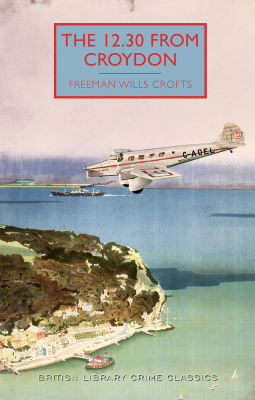
The 12.30 from Croydon by Freeman Wills Crofts

This is the second book by Freeman Wills Crofts that I’ve read. The first was Mystery in the Channel, which is a complicated murder mystery with plenty of red herrings and I had no idea about the identity of the killer. The 12.30 from Croydon couldn’t be more different – it begins with a murder but the identity of the murderer is known before he even thought of committing the crime.

The result is there is little mystery, as Charles Swinburne sets about murdering his uncle, Andrew Crowther, in order to inherit his fortune. It’s set in the early 1930s when the country is suffering the effects of the ‘slump’ and Charles’ business is on the edge of bankruptcy, and he is unable to raise the money to keep it going.

The major part of the book is taken up with describing how Charles became convinced that the only way out of his dilemma and the only way he could convince Una, a mercenary rich young woman, to marry him, was to kill Andrew. Consequently Andrew died on the 12.30 plane from Croydon. From that point onwards we see how Charles devised a plan and created an alibi that he thought would be perfect – and how it went wrong and how he was drawn into committing yet another murder.

Inspector French appears later on in the book to explain Charles’ thoughts and actions, and how he broke his alibi, just as Poirot sums up his thoughts and methods of deduction in Agatha Christie’s books.

The 12.30 from Croydon focuses on the psychology of the murderer and from that point of view I think it works well.  Charles’ personality is thoroughly explored, showing his ingenuity, efficiency, and the ways he overcame his scruples about murder were in the main convincing. But the in-depth detail of the planning means that it is hardly riveting reading. So whilst the plotting is clever my interest in the outcome flagged as the only thing to work out is would Charles get caught out, and would Inspector French break his alibi. But I did want to know how it would end.

What I found more interesting is the description of the thrill of the early passenger flights. In the opening chapter Rose Morley, Andrew’s young granddaughter flies to France with him and her father, Peter, because her mother had been knocked down and seriously injured by a taxi in Paris. Rose thinks the plane looks like a huge dragonfly. From her seat her view through the window was of the lower wing with its criss-cross struts connecting it to the upper wing. She was delighted by the whole process the increasing speed and the roar of the motors as the plane miraculously left the ground. Peter remarks that it was a wonderful improvement on the early machines when you had to stuff cotton wool in your ears. Rose loved the whole experience.

I also like the setting Crofts created for the novel – the enormous pressure that drove Charles to take such drastic action due to the financial disasters of the period in the 1930s is well presented. I liked the book but as I enjoy trying to work out the why and the how for me it needed more mystery, and more red herrings.

 My thanks to Netgalley and Poisoned Pen Press for a review copy of The 12.30 From Croydon. It was first published in 1934; this edition with an introduction by Martin Edwards was published in 2016 by Poisoned Pen Press in association with the British Library.

Amazon UK link

Amazon US link

This is my first book for the What’s in a Name 2017 in the category of ‘a number in numbers’.

The Buttonmaker’s Daughter by Merryn Allingham

The Buttonmaker's Daughter by [Allingham, Merryn]

Historical fiction is one of my favourite genres, so I was pleased when I was offered a review copy of The Buttonmaker’s  Daughter by Merryn Allingham. It will be published on 12 January. I hadn’t come across any of the author’s books before, but this is the 5th book she has written under the name of Merryn Allingham. She has also written a Regency series under the name Isobel Goddard.

Blurb:

As events in Europe and news of the impending threat of war trickle through, this is a novel that looks at the personal dramas that took place in a society already navigating huge social and political change. Born to an industry-owning father and an aristocratic mother, Elizabeth must juggle her own dreams of independence, her parents’ wishes for her ‘˜good marriage’, and the responsibility of reuniting her feuding family. Housemaid Ivy is desperate to marry before her love is pulled away to war, William is struggling with his own feelings towards his schoolboy friend, and Elizabeth is drawn to the promise a new life with a charming young architect. Everyone’s life hangs on the brink of change, and if war is declared, will there even be a future for the Summerhayes estate?

My thoughts:

The Buttonmaker’s Daughter is set in Sussex in the summer of 1914 just before the start of the First World War, a summer of sweltering heat and of rising tension not only nationally and internationally but also personally for Elizabeth Summer and her family. The novel covers just a few months, but those few months contain so much tension and heartbreak as the feud in the Summers family comes to a climax over the question of who Elizabeth should marry and war on the continent becomes inevitable.

Alice, Elizabeth’s mother was brought up on the Amberley estate which her brother, Henry inherited. But she had made a ‘marriage of convenience’ with industrialist Joshua Summer which had brought the much needed money to save Amberley and at the same time had triggered Henry’s enmity. So when Elizabeth falls in love with Aiden Kellaway, an architect’s assistant working on the landscaping of the Summerhayes gardens both her parents and uncle appear united in finding her a ‘suitable’ husband, one with the proper connections.

The Buttonmaker’s Daughter is a beautiful book. I was completely immersed in the story as the relationship between the two families deteriorates and Elizabeth becomes increasingly aware of the danger both to herself and her younger brother William. The setting is idyllic, the characters are clearly drawn and the sense of life in the immediate pre-war period made me feel I was there in the midst of it all, experiencing the social conventions and class distinctions.

I hope Merryn Allingham will write a sequel as I would like to know more about what happened to them all during the war.

  • Paperback: 384 pages
  • Publisher: HQ; First edition edition (12 Jan. 2017)
  • Language: English
  • ISBN-10: 0008193835
  • ISBN-13: 978-0008193836
  • Source: review copy

The Bone Field by Simon Kernick

The Bone Field (The Bone Field Series, #1)

I read The Bone Field by Simon Kernick in December and thoroughly enjoyed it. It’s due to be published on 12 January.

It’s the first of his books that I’ve read, but it won’t be the last. Kitty Sinn disappeared in 1990 whilst she was on holiday in Thailand with her boyfriend, Henry Forbes. There was no record that she ever left Thailand, but 26 years later her bones were discovered during building work on land that had formerly belonged to Medmenham College in Buckinghamshire. And then the bones of a schoolgirl who had gone missing in 1989 are found buried in the same field.

There’s plenty of fast paced action moving the plot swiftly along, told through different characters’ viewpoints, mainly from DI Ray Mason, who is nearly killed when he goes to question Henry and then finds himself under investigation as a suspect. From then on he acts very much on his own, with the help of PI Tina Boyd, an ex-police detective. Both find themselves in danger as they are confronted by a gang of ruthless killers, ritualistic murderers and people traffickers.

The Bone Field is the first in a new series of books, featuring Ray Mason and Tina Boyd, both of whom are the most developed and convincing of the characters and, I understand, are both characters from Kernick’s earlier books. I read the book quickly, drawn by all the twists and turns to the dramatic ending. However instead of tying up all the loose ends, the last sentence raises a new mystery, a partial cliff-hanger that, I assume, will lead on to the next book in the series.

My thanks to Lovereading who sent me a copy of this book for review.

  • Hardcover: 400 pages
  • Publisher: Century (12 Jan. 2017)
  • Language: English
  • ISBN-10: 1780894538
  • ISBN-13: 978-1780894539

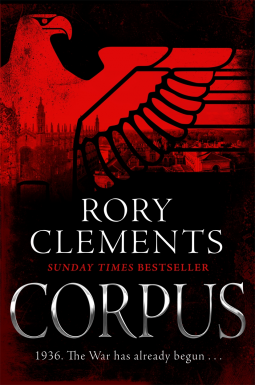
Corpus by Rory Clements

Rory Clements is best known for his John Shakespeare series, but Corpus is the first of his books I’ve read, so I was unsure that I would like it when I received an ARC from NetGalley. It is due to be published on 26 January 2017. (I read Corpus in December 2016.)

Blurb

1936.

Europe is in turmoil.

The Nazis have marched into the Rhineland.

In Russia, Stalin has unleashed his Great Terror.

Spain has erupted in civil war.

In Berlin, a young Englishwoman evades the Gestapo to deliver vital papers to a Jewish scientist. Within weeks, she is found dead in her Cambridge bedroom, a silver syringe clutched in her fingers.

In a London club, three senior members of the British establishment light the touch paper on a conspiracy that will threaten the very heart of government. Even the ancient colleges of Cambridge are not immune to political division. Dons and students must choose a side: right or left, where do you stand?

When a renowned member of the county set and his wife are found horribly murdered, a maverick history professor finds himself dragged into a world of espionage which, until now, he has only read about in books. But the deeper Thomas Wilde delves, the more he wonders whether the murders are linked to the death of the girl with the silver syringe – and, just as worryingly, to the scandal surrounding King Edward VIII and his mistress Wallis Simpson…

Set against the drumbeat of war and moving from Berlin to Cambridge, from Whitehall to the Kent countryside, and from the Fens to the Aragon Front in Spain, this big canvas international thriller marks the beginning of a major new series from bestselling author Rory Clements.

My thoughts:

The setting in 1936 is well done, a time when Europe was once more on the brink of war. Civil war has broken out in Spain, in Britain some people are openly supporting the Nazis in Germany and politicians are torn between wanting Edward VIII to abdicate the throne or give up his relationship with Wallis Simpson. Against this background Corpus focusses on Tom Wilde’s investigations first into Nancy’s death, aided by her friend Lydia, who is convinced that Nancy was murdered, and then into yet more murders.

I was totally convinced by the characters, in particular Tom Wilde, a professor of history who is writing a biography of Sir Robert Cecil, the Elizabethan and Jacobean statesman, the successor to Sir Francis Walsingham as the Queen’s spymaster (a nod to his earlier series, I thought). And I was immersed in the mysteries, with spies, communists and Nazis, Spanish Gold, Soviet conspirators, politicians and academics all intricately woven into the plot. It’s pacy, full of action, violence and double-cross – a most satisfying and compelling thriller.

I loved Corpus and I shall certainly look out for Rory Clements’ other books.

  • Hardcover: 384 pages
  • Publisher: Zaffre (26 Jan. 2017)
  • Language: English
  • ISBN-10: 1785762613
  • ISBN-13: 978-1785762611
  • Source: review copy via NetGalley

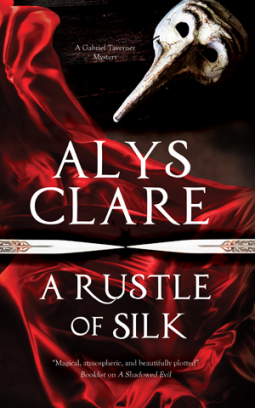
A Rustle of Silk by Alys Clare


Alys Clare is a new-to-me author and I don’t know why I’ve never come across her books before now. She writes historical mysteries. Her latest book, A Rustle of Silk, published today, is the first in a new series featuring Dr Gabriel Taverner, set in the early years of 17th century England.

It begins in April 1603 at the beginning of James I’s reign. Former ship’s surgeon Gabriel Taverner has settled in Devon near his family and he is trying to set up a new practice as a physician. But it is not easy to gain the locals’ trust and someone is leaving gruesome little gifts on his doorstep. However, the local coroner, Theophilus Davey asks him to examine a partially decomposed body found beside the river. At first it looks as though it was suicide, but on realising that it’s his brother-in-law, Jeromy, Gabriel and Theophilus are convinced that he was murdered.

Jeromy was employed by a silk merchant and moved in the world of the rich and influential, often away from home and his wife Celia. Outwardly they have a happy marriage, but as Gabriel finds out more disturbing secrets begin to emerge. The silk trade is a dangerous business and Gabriel finds his own life is threatened.

There are several things that I loved about this book. It’s a convincing view of the 17th century and I was fascinated most of all by the detail of medical practices, and how Gabriel interacted with the local women (‘witches’) who treated the poor and was willing to take note of their knowledge, particularly concerning women – as a ship’s surgeon he had no experience of treating women. It also shows what life was like at that time for the ordinary people, the position of women in society, and the consequences of committing suicide.

I also liked the mystery, with plenty of red herrings and intrigue. It kept me interested, anxious to know the outcome. I guessed who the murderer was about half-way through the book, which was satisfying, but it was the historical aspect that captivated me.

My thanks to the publishers via NetGalley for my copy of this book.

  • Format: Kindle Edition
  • File Size: 1795 KB
  • Print Length: 244 pages
  • Publisher: Severn House Digital (20 Dec. 2016)

Worth Killing For by Ed James

Set in East London, Worth Killing For by Ed James is the second DI Fenchurch novel. It’s a bang up to date police procedural full of action, street talk and social and political commentary. I haven’t read the first book in the series, but that doesn’t matter as this book reads well as a standalone. It starts off at full tilt as Fenchurch witnesses a murder as a woman is attacked by a young hoodie on a bike, who snatches her mobile and handbag. He sets off in pursuit and after losing sight of him a couple of times he catches him, finding he has several smartphones in his possession, but not the victim’s. The young man claims he hadn’t attacked the woman, who is identified as a journalist, Saskia Bennett. Is it a case of mistaken identity, or as Fenchurch maintains the young man is lying? Is Saskia the victim of a phone-theft gang, run by the mysterious Kamal, or was she killed because of the stories she was investigating?

This reminded me so much of ‘Oliver Twist’, young boys recruited by Fagan to ‘pick-a pocket-or two’ and I was fascinated by the intricacies of the plot. I got a bit lost in the descriptions of the bike chases – there is more than one – but they certainly provide plenty of tension. And the scene in the underground is terrific. It is fast-packed action and you have to concentrate to keep up. Fenchurch is an interesting character and there is enough back story about his missing daughter, Chloe, to explain why he ignores procedure in his obsession to get to the truth.

I had no idea who was responsible, and at times the street talk and police jargon left me puzzled, but after I’d read more of the book it became clearer. I liked the way Ed James bamboozles the reader with all the twists and turns in the plot and the way he has brought politics, both local and national into the story. It really is right up-to-date.

In an Afterword Ed James explained how he came to write this book – his iphone was nicked, by a kid on a bike, in London. He poured out all his anger, hatred and fear into his writing.

I read this book courtesy of NetGalley. I’ll certainly read the first book now and any later DI Fenchurch books – will he find out what happened to Chloe?

  • Format: Kindle Edition
  • File Size: 2661 KB
  • Print Length: 414 pages
  • Page Numbers Source ISBN: 1503938220
  • Publisher: Thomas & Mercer (11 Oct. 2016)
  • Source: Review copy via NetGalley

About the Author

Ed James writes crime fiction novels, predominantly the Scott Cullen series of police procedurals set in Edinburgh and the surrounding Lothians. He lives in the East Lothian countryside, 25 miles east of Edinburgh, with his girlfriend, six rescue moggies, two retired greyhounds, a flock of ex-battery chickens and rescue ducks across two breeds and two genders (though the boys don’t lay eggs). While working in IT for a living, Ed wrote mainly on public transport but now writes full time. (From his website)