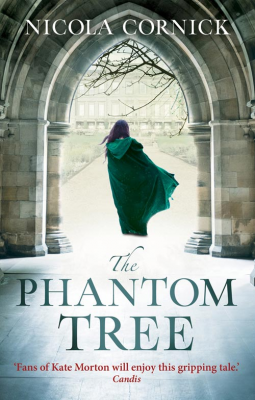
The Phantom Tree by Nicola Cornick

Last year I loved Nicola Cornick’s time-slip novel, House of Shadows. Her latest book is The Phantom Tree, due to be published on 29 December, another time-slip novel and I loved this one too.

Blurb:

‘My name is Mary Seymour and I am the daughter of one queen and the niece of another.’

Browsing antiques shops in Wiltshire, Alison Bannister stumbles across a delicate old portrait ‘“ supposedly of Anne Boleyn. Except Alison knows better’¦ The woman is Mary Seymour, the daughter of Katherine Parr who was taken to Wolf Hall in 1557 as an unwanted orphan and presumed dead after going missing as a child.

The painting is more than just a beautiful object from Alison’s past ‘“ it holds the key to her future, unlocking the mystery surrounding Mary’s disappearance, and the enigma of Alison’s son.

But Alison’s quest soon takes a dark and foreboding turn, as a meeting place called the Phantom Tree harbours secrets in its shadows’¦

My thoughts

The plot of The Phantom Tree alternates between the Tudor period and the present day following the life of Alison Banestre (known as Bannister in the present day) as she moves between the centuries trying to find out what happened to Mary Seymour. It is a mystery, based on the true story of Mary Seymour, the daughter of Katherine Parr (Henry VIII’s sixth wife) and Thomas Seymour, who she married after Henry’s death.

It’s a fascinating book, as little is known about Mary’s life. What is recorded is that she was born in 1548, her mother died after the birth and her father was executed a year later for treason against Edward VI. She disappeared from the records around about 1550, although there has been speculation that she lived until adulthood. In The Phantom Tree Nicola Cornick has provided another speculation on Mary’s life. As she states at the beginning of her book it is ‘entirely a work of fiction. The names, characters and incidents portrayed in it are the work of the author’s imagination.’

Having read Hilary Mantel’s, Wolf Hall, I was very interested in the setting of Wolf Hall where Mary and Alison, her cousin, went to live in 1557, the fourth year of the reign of Mary I. Mary Seymour was then ten years old and had a reputation for witchcraft. Wolf Hall, a rambling, run down manor house was owned by the Seymour family where Mary and other Seymour children went sent to live.

The time travel element of the book works well. I liked the way the traces of history in the present day are handled and are seen as layers of reality. Alison moves between the centuries, both forwards and backwards in time but then she found the gateway to the past had closed and she was trapped in the present day. She has to find another gateway where the past and the present meet, or some other means of connecting to the past.

I preferred the sixteenth century setting, with its belief in witchcraft slotting so well into the storyline. Mary has visions which are viewed with fear and superstition. Alison, in the future doesn’t know what happens to Mary, or to her son, Arthur, who was taken from her after his birth. She had helped Mary escape from Wolf Hall and in return Mary had promised to help her find Arthur. I think the characterisation is done well – Alison comes across as a rather unlikeable person, in contrast to Mary who is younger and has a gentler nature, although at first they didn’t get on together. I also liked the way the clues in the portrait helped Alison to discover what happened to Mary and Arthur.

My thanks to the publishers via NetGalley for a review copy of The Phantom Tree.  It is a book that seamlessly incorporates mystery and elements of the supernatural into the historical detail as the past and present meet. A most enjoyable book.

  • Paperback: 448 pages
  • Publisher: HQ (29 Dec. 2016)
  • Language: English
  • ISBN-10: 1848455046
  • ISBN-13: 978-1848455047

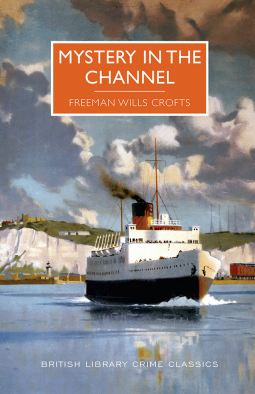
Mystery in the Channel by Freeman Wills Crofts

I’m still catching up with writing about books I read in November. First published in 1931 Mystery in the Channel by Freeman Wills Crofts is a classic crime fiction novel written during the Golden Age of detective fiction between the two world wars. The cross-channel steamer, Chichester comes across  an abandoned small pleasure yacht, the Nymph, lying motionless in the English Channel. Two men are on board, both of whom have been shot. Inspector French of Scotland Yard is in charge of the investigations into their murder.

There is no sign of a murder weapon, or the murderer. The two dead men are identified as the chairman and vice-chairman of a large financial company that is apparently on the the verge of a crash. It was thought that the two men were trying to flee the country with £1.5 million pounds in cash that was missing from the company’s strong room.

What follows is a complicated investigation into the details of nautical calculations and timetables, and of the numbers and whereabouts of the missing notes, all of  which I admit were a bit beyond me. I had absolutely no idea about the identity of the murderer but I enjoyed trying to work out the clues and avoid all the red herrings as Inspector French travelled between London (called Town), Newhaven and Dieppe  in the course of his investigations. Apart from Inspector French the characterisation is sketchy – it is the puzzle of the murder and the missing money that is the focus of the book.

I thought the comments on the effect of the company’s crash on ordinary people is still as relevant today as it was in the 1930s and the Assistant Police Commissioner’s views on crime and punishment showing a surprising sympathy with the criminal are interesting. He deplored the punishment of the out-of-work or poorly paid thief who had stolen to provide for his family’s’ needs. And he had ‘the most profound enmity and contempt’ for the wealthy thief who stole through the manipulation of stocks and shares or by other financial methods, whether those means were within or without the limits of the law.

This edition of Murder in the Channel is one of a series of classic crime novels published in September 2016 by British Library Publishing and has an introduction by Martin Edwards. My copy is courtesy of NetGalley.

It qualifies for Bev’s Golden Age Vintage Cover Scavenger Hunt in the category of a book with a ‘Boat’ on the cover.

The Marriage Lie by Kimberly Belle

When I read the publishers’ blurb I thought I’d like The Marriage Lie by Kimberly Belle:

Iris and Will have been married for seven years, have bought their dream house and have begun trying for a family.  But on the morning Will flies out for a business trip to Florida, Iris’s perfect life comes crashing down around her: another plane headed for Seattle has crashed into a field, killing everyone on board and, according to the airline, Will was one of the passengers.

Grief stricken and confused, Iris is convinced it all must be a huge misunderstanding. Why did Will lie about where he was going? And what else has he lied about? As she sets off on a desperate quest to uncover what her husband was keeping from her, she begins to unravel a hidden identity behind the man she thought she knew better than herself, and the truth shocks her to the core.

It exceeded my expectations and I loved it. The Marriage Lie is one of those books that gripped me and kept me guessing all the way through. Once I began reading I just didn’t want to put the book down and I raced through it, anxious to know what happened next. And plenty did happen in one of the most convoluted and complex plots I’ve read in a while. The pace is terrific and the tension just builds and builds in this psychological thriller.

Iris thought she had the perfect marriage, with the perfect husband. But the more she tries to discover why he was on a plane to Seattle when he’d told her her was going to Orlando, the more lies she uncovers. Grief-stricken and terrified she doesn’t know who she can trust and she is devastated as the truth is finally uncovered.

I don’t want to give away any spoilers, so all I can say is that through all the twists and turns of this novel, the characters are convincing and although I’d partly anticipated the outcome I was taken by surprise at the final twist as the book reaches its dramatic climax!

My thanks to the publishers for a review copy of The Marriage Lie. It’s due to be published on 29 December 2016.

  • Paperback: 384 pages
  • Publisher: HQ (29 Dec. 2016)
  • Language: English
  • ISBN-10: 1848456646
  • ISBN-13: 978-1848456648

Where Dead Men Meet by Mark Mills

I’ve been reading books so quickly this month that I am now far behind with writing about them, so this is just a short post about an excellent new book by Mark Mills, published on 17 November.

I’ve been meaning to read more of Mark Mills’ books ever since I read The Savage Garden in 2008, a book I enjoyed very much, so I was keen to read his latest book, Where Dead Men Meet. It is historical fiction set in 1937 in pre-Second World War Europe, with a fast-moving plot as Luke Hamilton, an intelligence officer at the British Embassy in Paris, tries to discover why someone wants him dead, why Sister Agnes, the nun who had been his mentor and guide at the orphanage for the first seven years of his life had been bludgeoned to death, and who his real parents were.

Although the war in Europe is imminent it is by no means the main focus of this book, but forms an excellent backdrop as the action moves from Paris across the continent. At first he assumes that the assassin has mistaken him for someone else, but the tension builds as Luke realises that he is not the victim of a mistaken identity, but that someone is determined to kill him. He finds himself on the run, helped by a number of people, including the first man who tried to kill him. It seems the answers lie in his past. It is a complicated story that had me unsure of who Luke could trust and whether he would ever escape, or find out about his real family.

I thoroughly enjoyed this brilliant book with its interesting characters and a convincing plot full of mystery and intrigue. I shall now look out for more books by Mark Mills.

I received a copy of this book from the publisher, via NetGalley, for review.

  • Format: Kindle Edition
  • File Size: 972 KB
  • Print Length: 448 pages
  • Publisher: Review (17 Nov. 2016)

The Spy by Paulo Coelho


The Spy

Synopsis:

When Mata Hari arrived in Paris she was penniless.

Soon she was feted as the most elegant woman in the city.

A dancer who shocked and delighted audiences; a confidant and courtesan who bewitched the era’s richest and most powerful men.

But as paranoia consumed a country at war, Mata Hari’s lifestyle brought her under suspicion. Until, in 1917 she was arrested in her hotel room on the Champs Elysees and accused of espionage.

Told through Mata’s final letter, THE SPY tells the unforgettable story of a woman who dared to break the conventions of her time, and paid the price.

My thoughts:

Before I read this book I didn’t know much about Mata Hari, beyond the facts that she was an exotic dancer and that she was executed as a spy during the First World War, so I was interested to know more.

The Spy is a gripping tale and one I read quickly, fascinated by the story of Mata Hari, whose real name was Margaretha Zella, a name she detested. The book begins with a prologue describing the execution of Mata Hari in Paris on 15 October 1917. It is quite remarkable; she was calm, taking care with dressing herself and with her appearance and choosing to face the firing squad neither bound nor blindfolded.

It continues with her life story told through letters and news clippings and illustrated with photographs. She was accused of being a double agent, but claimed she was innocent and the evidence against her was indeed flimsy. The whole procedure was based on deductions, extrapolations and assumptions. Whatever the truth about her innocence, she comes across as a strong-minded, independent and arrogant woman, who believed she could use her beauty and charm to allure any man to get what she wanted.

I always like to know when I’m reading fictionalised biographies how much is based on fact and what has been fictionalised, so I appreciated the author’s explanatory note at the end of the book. Coelho writes that he had based his novel on facts, but he had created some dialogue, merged certain scenes, changed the order of a few events and left out anything he thought wasn’t relative to the narrative. His opening pages, for example are from a report for the International News Service by Henry G Wales in Paris and dated October 15, 1917 and he has borrowed some verbatim language from the report. He has used various sources such as the British Intelligence Service file on Mata Hari.

  • Format: Kindle Edition
  • File Size: 3598 KB
  • Print Length: 220 pages
  • Page Numbers Source ISBN: 1524732060
  • Publisher: Cornerstone Digital; 01 edition (22 Nov. 2016)

Many thanks to NetGalley for a review copy of this book.

Another Day Gone by Eliza Graham


Another Day Gone

In 2007 I read Eliza Graham’s debut novel, Playing with the Moon and loved it. I fully intended to read more of her books, but although I have her fifth book, The One I Was, I somehow missed the other three! So when I saw her latest book, Another Day Gone was available I was delighted to receive an advance copy through NetGalley.

I wasn’t disappointed – in fact I think it’s amongst the best books I’ve read this year.

It’s historical fiction, one of my favourite genres, beginning in 1939 just before the outbreak of the Second World War when a bomb went off in Coventry, killing some people and injuring many others. One of those injured was a girl who had seen a man prop a bicycle outside a store just before the bomb exploded. Her description led to his conviction and execution.

The action then moves forward to 1992 with Sara and her older sister Polly living in their family home in Oxfordshire on the banks of the Thames, with their grandfather and housekeeper (formerly their childhood nanny). The sisters’ parents had been killed in a car crash when they were very young. Polly is eighteen and is just about to leave home for university. All is not well and Polly hints that she knows a secret that she is not telling Sara – and then goes away with Michael, Bridie’s nephew, without saying where they are going or for how long.

Years later, in 2005 Sara returns to her family home, taking refuge from the London 7/7 bombings. Polly has now been missing for 13 years, their grandfather has died and Bridie is in a care home. The family secrets are still buried – until Polly returns!

Another Day Gone is a book about families, relationships and realising and living with the consequences of your actions. I loved the structure of this book with its different strands and time periods and all the twists and turns that kept me guessing about the nature of the secret that had remained hidden for so many years. I particularly liked the way it is only revealed drip by drip that meant I had changed my mind about what it was several times until fairly near the end of the book. The characters are so well drawn and sympathetically portrayed that I felt I knew them as people. It’s the type of book that I can get so involved with and whilst wanting to discover its secrets I just don’t want it to end.

  • Format: Kindle Edition
  • File Size: 2182 KB
  • Print Length: 322 pages
  • Page Numbers Source ISBN: 1503940039
  • Publisher: Lake Union Publishing (22 Nov. 2016)
  • Source: review copy via NetGalley