Bookworm: A Memoir of Childhood Reading by Lucy Mangan

Square Peg, Random House UK|1 March 2018|336 p|Review copy|4*

Bookworm: A Memoir of Childhood Reading by Lucy Mangan will appeal to all bookworms, but it’s more than an account of what Lucy read, it’s also a history of children’s books, details of their authors and a memoir of Lucy’s childhood. I loved it – it’s full of the joy and love of books, the intensity of reading and the ‘instant and complete absorption in a book‘. She writes with verve and humour, in a chatty style that makes it so readable. Reading her book is like being in conversation with a friend.

As I am older than Lucy, inevitably she mentions books I didn’t read as I was growing up (but have read some of them in later life) , especially in the later sections of her book, books she read as a teenager, but I was quite surprised and pleased to find that our reading in early childhood was so similar, and just like her, books have made me the person I am – why else would I be writing a blog called ‘BooksPlease‘.

As long as I can remember I have loved books and I can’t remember a time when I couldn’t read. So I was delighted to find that she too loved Teddy Robinson by Joan L Robinson.  This is the first book I remember borrowing from the library. I loved it so much I was dreadfully upset that I had to return it. Teddy Robinson was owned by a little girl named Deborah and I am so envious that Lucy Mangan has actually met Deborah, who showed her the original drawings for the books her mother wrote.

And then there are some of my most loved books when I was young such as Milly-Molly-Mandy, Alice’s Adventures in Wonderland, the Katy books, Little Women, Good Wives and Jo’s Boys, The Borrowers, the Narnia books, Ballet Shoes, and The Secret Garden. I re-read them many times over.

There’s a whole section on Enid BlytonThe Blyton Interregnum. I was very interested to see her view of this writer whose books I too adored. Blyton wrote around 760 books during her fifty-year writing career! Despite the criticism of her books as mediocre material, formulaic books with fantastical plots Lucy considers, correctly I think, that they are books that provided comfort reading during and in the aftermath of the Second World War. Not only that, they are satisfying stories that lay down a base for future reading, providing books that are fun to read and opening up the ‘pleasure-filled world of reading’. Then there are the questions about prejudice, sexism, class snobbery and racism, in Blyton’s books, which Lucy (and I) missed completely whilst reading as children.

She writes about re-reading the books as an adult as a ‘discombobulating experience‘ – stories that once wholly enraptured you no longer have that same magic, and about her disappointment in returning to Enid Blyton’s books and finding them unreadable. It’s the main reason I don’t go back to the books I loved as a child – I really don’t want to lose the magic they held for me then.

There is so much in this book I could write about, it’s packed with the magic of books and reading it has given me hours of nostalgic pleasure – but the best thing I think is to leave you to read this lovely book for yourself.

Many thanks to Random House UK for a review copy via NetGalley.

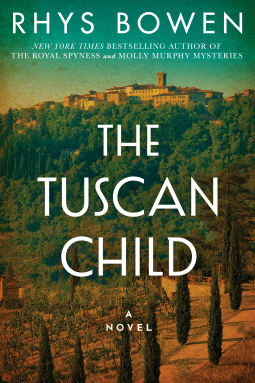
The Tuscan Child by Rhys Bowen

Lake Union| 20 February 2018|352 p|Review copy|3*

In 1944, British bomber pilot Hugo Langley parachuted from his stricken plane into the verdant fields of German-occupied Tuscany. Badly wounded, he found refuge in a ruined monastery and in the arms of Sofia Bartoli. But the love that kindled between them was shaken by an irreversible betrayal.

Nearly thirty years later, Hugo’s estranged daughter, Joanna, has returned home to the English countryside to arrange her father’s funeral. Among his personal effects is an unopened letter addressed to Sofia. In it is a startling revelation.

Still dealing with the emotional wounds of her own personal trauma, Joanna embarks on a healing journey to Tuscany to understand her father’s history—and maybe come to understand herself as well. Joanna soon discovers that some would prefer the past be left undisturbed, but she has come too far to let go of her father’s secrets now… 

I enjoyed The Tuscan Child up to a point. I liked the historical setting of 1944 and the descriptions of Tuscany and Italian food are beautiful. It’s easy reading and the dialogue gives a good impression of people speaking in a foreign language in which they are not fluent. Although I love Italian food I did begin to groan when yet another meal was being prepared and described in detail.

But the split narrative between Hugo and Joanna didn’t work too well for me. I liked Hugo’s story more than Joanna’s and I wanted to know what happened to him which kept me reading. But I thought the book was more of a romance than a historical mystery. And I thought the mystery element wasn’t too difficult to work out with rather too many convenient events that revealed what had happened to Hugo.

My thanks to Lake Union for a review copy via NetGalley.

Amazon UK link
Amazon US link

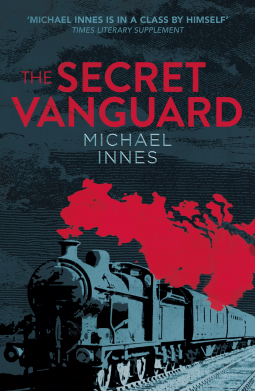
The Secret Vanguard by Michael Innes

A Golden Age Mystery

Ipso Books| 3 Oct. 2017|228 p|Review copy|4*

Nobody, she said to herself, is necessarily what he appears to be; nobody.

I enjoyed The Secret Vanguard very much. It’s the fifth in Michael Innes’ Inspector Appleby series and is very different from the first one Death at the President’s Lodging, which I read several years ago, a book that had little action, much description and a lot of analysis.  Set in 1939 on the edge of war, The Secret Adversary is full of action, a story of spies, kidnapping and a race through the Scottish Highlands to save a scientist. It reminded me in the Highlands section of John Buchan’s The Thirty-Nine Steps.

It begins with the murder of poet, Philip Ploss at his home in the Chilterns and Appleby is mystified wondering why anyone would have wanted to kill him. He had been shot in the middle of his forehead whilst in a gazebo with a magnificent view of the surrounding countryside.

It then moves to Sheila Grant, travelling by train to Scotland when she overhears a conversation about poetry as one of the passengers quotes from a poem by Swinburne. She thinks it is odd that he had added in four lines of his own and realises that the words were a sort of code that he was passing on. And, indeed this discovery leads her into danger but before she can alert anyone else she is captured and held prisoner, eventually escaping in a desperate search for assistance.

I liked all the twists and turns in this somewhat improbable story as Sheila, with much courage and luck scrapes through several dangerous escapades until Appleby comes to the rescue. I enjoyed the descriptions both of London and the Highlands as I raced through this book. I also really like Innes’ writing style, detailed, formal and scattered with frequent literary allusions and quotations. He has packed a lot into The Secret Vanguard.

My thanks to Ipso Books for a review copy via NetGalley.

Amazon UK link
Amazon US link

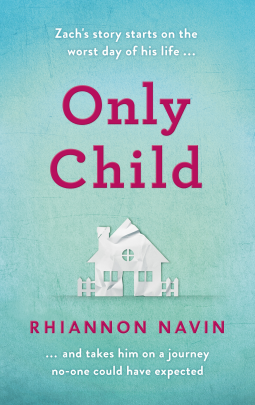
Only Child by Rhiannon Navin

Publication date 8 February 2018, Mantle

Review copy from the publishers, via NetGalley

My rating:  5 stars 

Blurb:

My thoughts:

This must be one of the most powerful books I’ve read for ages. In fact I don’t remember reading anything quite like it. It’s emotional, moving and absolutely compelling – I loved it. One of the things I loved most about it is the narrative voice – that of seven-year old Zach. Everything is shown through his perspective, as he sees and hears what happens – so, for example the shooting, the sounds ‘pop’, ‘pop’, ‘pop’ are described as Zach hears the gunshots. There are no gory or violent scenes.

But that is just the start of the book. The main part shows how he deals with what happens next, with the death of his ten-year old brother, Andy, and how he tries to make sense of his parents’ reactions and his own. I think Rhiannon Navin portrays him well. He comes across as a child who observes the adults around him  and tries to understand his own feelings. The scenes in his secret hideout are beautiful as he records his feelings as colours to help him separate them and deal with them. He also reads the Magic Treehouse books about finding the secrets of happiness.

Zach’s mother falls to pieces, wanting the gunman’s parents to take responsibility and looking for justice/revenge, his father becomes increasingly distant and although both Zach’s grandmothers and aunty are around for support he retreats into himself and then becomes angry, which bewilders and frightens him. He tries to explain to his parents how he is feeling and although his father listens and tries to helps him, his mother is totally absorbed in her own feelings. When his father decides to leave the family Zach is devastated. It is a heart-wrenching book, that brought tears to my eyes. All of which makes me admire Rhiannon Navin’s portrayal of the characters in this, her debut novel.

It is such a sad book, but ultimately it is uplifting.

Many thanks to the publishers for a review copy via NetGalley.

Amazon UK link
Amazon US link

The Toymakers by Robert Dinsdale

Do you remember when you believed in magic?

Publication date 8 February 2018, Penguin Random House UK, Ebury Publishing

Review copy from the publishers, via NetGalley

My rating:  5 stars 

Blurb:

It is 1917, and while war wages across Europe, in the heart of London, there is a place of hope and enchantment.

The Emporium sells toys that capture the imagination of children and adults alike: patchwork dogs that seem alive, toy boxes that are bigger on the inside, soldiers that can fight battles of their own. Into this family business comes young Cathy Wray, running away from a shameful past. The Emporium takes her in, makes her one of its own.

But Cathy is about to discover that the Emporium has secrets of its own…

My thoughts:

I loved this book. As a child I loved stories about magic, stories that transported me to another world, but The Toymakers is not a children’s story. It is an extraordinary, magical and wonderful book that captivated me, a book set mainly in 1917 whilst the First World War was taking its toll of humanity, leaving despair and tragedy in its wake. It’s a blend of historical fiction and magic realism.This is a story of love, and family relationships, as well as of the devastating effects of rivalry and war.

Papa Jack’s Emporium in London is a toyshop extraordinaire. It opens with the first frost of winter each year and closes when the first snowdrop blooms. And the toys it sells aren’t ordinary toys – they seem alive, from patchwork dogs, to flying pegasi, Russian dolls that climb out of one another, runnerless rocking horses, whales that devour ships, fire-breathing dragons and many others to the toy soldiers that wage war on each other.

The story begins in 1906 and ends in 1953, following the lives of Papa Jack Godman, his sons, Kaspar and Emil and Cathy Wray, who aged 15 and pregnant had run away from home. Cathy finds sanctuary at the Emporium, and Papa Jack tells her how he came to live in London and founded the Emporium, how he had found in making toys a kind of magic, a way of reaching a man’s soul.

At first Cathy lived in the Wendy House, which like the Tardis is larger on the inside than the outside, with Sirius the patchwork dog. It was where her daughter, Martha was born. Kasper and Emil are caught up in a battle for control of the Emporium, and they both fall in love with Cathy, but it is Kasper that she marries. The years pass, the First World War breaks out, Kasper joins up, but Emil’s application is refused, so he stays at home, developing his toy soldiers. I was struck by the irony and pathos of a world at war mirrored in the battles fought by Emil’s toys soldiers. And things come a head when Kasper returns a damaged man and retreats into his mind. What happens next changes their lives for ever.

The Toymakers is a wonderful book, one that will stay with me, not just about the horrors of war and rivalry, but above all about the power of love, the magic of childhood and the effect of toys – when you are young you play with toys to feel grown up, imagining what it will be like to be an adult. But when you are an adult what you want from toys is to feel that you are young again. They remind you that the world was once as filled with magic as your imagination will allow.

Many thanks to the publishers for a review copy via NetGalley.

Amazon UK link
Amazon US link

The Wicked Cometh by Laura Carlin

‘We have no need to protect ourselves from the bad sort 
because we ARE the bad sort . . .’

Publication date 1 February 2018, Hodder and Stoughton

Review copy from the publishers, via NetGalley

My rating:  3 stars 

The Wicked Cometh is Laura Carlin’s debut novel.

The title of this book comes from Proverbs XVIII, 3: When the wicked cometh, then cometh also contempt, and with ignominy reproach.

The opening chapter sets the scene as The Morning Herald reports on the growing numbers of missing people in London in September 1831. So, you know straight away that this is a tale of wickedness and evil. It begins well, setting the scene with detailed descriptive writing full of vivid imagery, evoking the sights, smells, and sounds of life in the darkest and foulest corners of London in the 1830s.

It’s narrated in the present tense by Hester White, a young woman of eighteen. She grew up in a parsonage in Lincolnshire but she was orphaned at the age of 12 and went to live in London with Jacob, formerly her father’s gardener, and his wife Meg in a slum dwelling, just one room with a brick and dirt floor. I liked Hester, who originally came from a reasonably well-off family and was educated. She lives in hope of leaving London and escaping from her miserable life.

A way out presents itself when she is knocked down and injured by Dr Calder Brock’s carriage and whisked away to stay at his family’s country house, Waterford Hall near Stratford. Calder intends to use her as an experiment, to build up her physical health, and to give her the chance of improving her life he persuades his sister Rebekah to educate her. He wishes to prove that even those from the gutter can be educated and Hester exaggerates her ignorance in order to escape being sent to the London Society for the Suppression of Mendicity, a place of shame feared by the poor. Known as the ‘Dicity’ it was one step on the downward path either to transportation in the hulks or to the poorhouse.

So far, so good but the first part of the book moves very slowly and my attention began to wander as I thought the wicked were a long time in coming. But come they did in abundance in the latter part of the book and as the relationship between Hester and Rebekah develops they begin to uncover the sinister secrets of what is behind the mystery of the missing people. And it is a dark, gruesome and grim secret.

Overall, I’m rather torn about this book – parts of it I really enjoyed, even though it’s written in the present tense, which I don’t like. The characters are well-drawn and the settings are superb, but the slow pace failed to provide enough tension especially in the middle section. The suspense and drama increased rapidly towards the end, but the final twist seemed contrived and not very convincing. But I can see from Goodreads that other readers enjoyed this book far more than I did.

My thanks to the publishers for a review copy via NetGalley.

Amazon UK link
Amazon US link