The Vanished Bride by Bella Ellis

Vanished Bride

Hodder & Stoughton|12 September 2019|352 pages|e-book|Review copy|5*

From the Sunday Times-bestselling author of The Memory Book, Rowan Coleman, comes a special new series featuring the Brontë sisters, written under the name Bella Ellis

Yorkshire, 1845

A young woman has gone missing from her home, Chester Grange, leaving no trace, save a large pool of blood in her bedroom and a slew of dark rumours about her marriage. A few miles away across the moors, the daughters of a humble parson, Charlotte, Emily, and Anne Brontë are horrified, yet intrigued.

Desperate to find out more, the sisters visit Chester Grange, where they notice several unsettling details about the crime scene: not least the absence of an investigation. Together, the young women realise that their resourcefulness, energy and boundless imaginations could help solve the mystery – and that if they don’t attempt to find out what happened to Elizabeth Chester, no one else will.

The path to the truth is not an easy one, especially in a society which believes a woman’s place to be in the home, not wandering the countryside looking for clues. But nothing will stop the sisters from discovering what happened to the vanished bride, even as they find their own lives are in great peril…

My thoughts:

When I first came across this book I wasn’t at all sure I wanted to read it, as I’m never very keen on books about famous authors solving crimes. However, the Brontë sisters books have been amongst my favourites for years and I was curious find out what this book was all about. So, I was delighted to find that I thoroughly enjoyed The Vanished Brideand that it is not all a flight of fancy, although of course the story of how they became ‘detectors’, or amateur sleuths, is pure imagination.

‘Bella Ellis’ is the Brontë inspired pen name for the author Rowan Coleman, who has been a Brontë devotee for most of her life. I haven’t read any of her other books but I’ll be looking out for them now. The Vanished Bride is historical fiction that brings the period (1845) and the setting vividly to life, Charlotte, Emily and Anne and their brother, Branwell becoming real people before my eyes in their home in the Parsonage at Howarth.

I think it helps that is not all pure fiction – in the Author’s Note she explains that it is based on biological facts or inspired by them. The book begins with a short passage in 1851 when Charlotte is alone in the Parsonage her sisters, brother and father had all died and she looks back to the year 1845 when they were all together. That is fact – and in the following September they began to consider writing for their living.

The mystery whilst it is well plotted is not to difficult to solve and I had predicted the basics of it quite early on in the book, although  I didn’t guess the full detail until much later on. But the real joy of the book is in the historical detail and the depiction of the characters and the insights given to their personalities through their conversation. The story is told through each of the sisters eyes, each one clearly distinctive, whilst Emily is the standout character. All three are clearly individuals, women caught in a society dominated by men and each wanting to lead independent lives. 

The book ends as a letter arrives for the sisters presenting a new case for them to investigate. Their curiosity is immediately ‘taking flight’ – and so is mine!

My thanks to Hodder & Stoughton for an e-book review copy via NetGalley

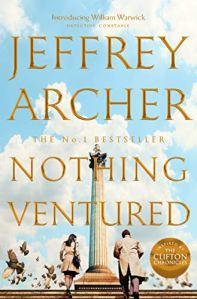
Nothing Ventured by Jeffrey Archer

‘This is not a detective story, this is a story about a detective’

Nothing ventured

Macmillan|5 September 2019|337 pages|e-book|Review copy|3*

Years ago I enjoyed reading a few of Jeffrey Archer’s books, including Not a Penny More, Not a Penny Less and Kane and Able. Archer is a prolific author, but I haven’t read any of his later books or his diaries about his time in prison. But I was interested when I saw that he had started a new series about William Warwick – Nothing Ventured. It is the first in the series of books following William’s progress from detective constable to the commissioner of the Metropolitan Police.

It is indeed, a story about a detective, rather than a detective story and as such it is rather episodic, following William Warwick’s career.

William joins the Metropolitan Police force, against his father’s wishes. Sir Julian Warwick QC, had hoped his son would join him in chambers and train to be a barrister, like his sister Grace. He works on the beat in Lambeth before transferring to the Art and Antiques Squad at Scotland Yard, where he becomes involved in a number of cases of fraud and theft, including tracing the whereabouts of a phial of the moon dust brought back from the Apollo 11 mission by Neil Armstrong, and arresting an old man who had forges the signatures of famous authors in first editions. Whilst investigating the theft of a Rembrandt painting, the Syndics of the Cloth Makers Guild, from the Fitzmolean Museum in Kensington, he meets Beth Rainsford, a research assistant at the gallery and they fall in love almost at first sight – but Beth has a secret that she keeps from him. 

The premise is promising, but it’s written in a very straight-forward and factual style and my overall impression, despite the crime elements, is that this is a rather mundane and bland novel. William does this, does that, goes here, goes there, often at a break-neck pace that gives impetus. But the characters are drawn very sketchily with little depth – William is an intelligent young man, precocious and naive, eager to please and to learn, his father, Sir Julian, a suave, elegant and successful QC and Grace, his sister, an up and coming young barrister, and so on.

I suppose it is the base for the rest of the series but I found it too predictable. However, I thought the court scenes and the final little twist at the end enjoyable and I’m wondering if I want to go one to read the next book in the series which focuses on William’s time as a young detective sergeant in the elite drugs unit. I’m not sure that I do want to – there are so many more enticing books to read.

My thanks to Macmillan for an e-book review copy via NetGalley
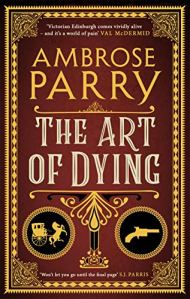
The Art of Dying by Ambrose Parry

Art of Dying

Canongate Books|29 August 2019|416 pages|e-book|Review copy|5*

A Note From the Publisher


Many thanks to Canongate Books for an e-book review copy via NetGalley.

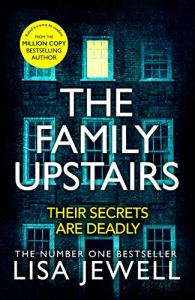
The Family Upstairs by Lisa Jewell

 A house with the darkest of secrets.

Family upstairs

Random House UK Cornerstone|8 August 2019|464 pages|e-book |Review copy|5*

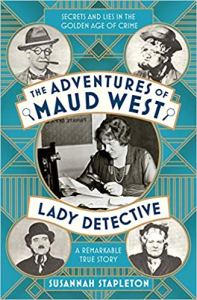
The Adventures of Maud West, Lady Detective by Susannah Stepleton

Narrative Non-Fiction 4*

Adventures of Maud West

The Adventures of Maud West, Lady Detective, by Susannah Stapleton and published by Picador, is subtitled ‘Secrets and Lies in the Golden Age of Crime‘. With a title like that I thought it sounded just the sort of book I would like – and I did.

It is so intriguing – was Maud West really who she said she was? Susannah Stapleton discovered that she really did exist and was indeed a private investigator with her own detective agency, based in London in the early part of the twentieth century, from 1905 onwards.  The book gives plenty of extracts from Maud West’s own accounts of her investigations under Golden Age crime fiction titles such as The Lady Vanishes, The Body in the Library, and They Do It With Mirrors, for example. But these accounts had me wondering just what was the truth and what was fiction. They are so incredible! Maud was truly an amazing person – a master of disguise, equally able to pass herself off as a man, or a fortune teller, or a parlour maid, and skilled with a revolver, able to face down blackmailers. There are photographs of Maud – at work in her office and in a number of disguises. And it was not just in Britain – she worked all over the place including  New York, Cape Town, Brazil, and Jakarta. 

But what makes the book so good, and what kept me glued to the pages are the details of how Susannah Stapleton went about her research, included within the main narrative of her book. I haven’t come across this before – usually  an author lists the sources used at the end – and there is just such a list (a very long and comprehensive list) at the end of this book.  I was more intrigued by Stapleton’s own methods of research into finding out about Maud than I was by Maud herself.

 I also loved all the details of the changing society in which Maud lived – the role of women in the struggle for equality, details of the living and working conditions and of the crimes that real life private detectives investigated – divorces, missing persons, adultery and theft.

It more than lived up to my expectations, but I am still wondering did she really do what she said she did? Whatever the truth she was a complex woman and a very private one at that.

Many thanks to the publishers, Picador, for my review copy via NetGalley.

Katharina: Fortitude by Margaret Skea

Historical fiction at its best

‘We are none of us perfect, and a streak of stubbornness is what is needed in dealing with a household such as yours, Kat… and with Martin.’ 

Katharina fortitude

Sanderling Books|23 July 2019|print length 446 pages|e-book review copy|5*

My thoughts:

I loved this book; beautifully written and meticulously researched Katharina: Fortitude by Margaret Skea it presents a vivid portrait of Katharina von Bora from the beginning of her married  life with Martin Luther in 1525 to her death in 1552. It is the conclusion to Katharina: Deliverance, which covered the early years of her life from 1505 up to her wedding to Luther.

They both work well as standalone novels but I think reading both gives a fully rounded picture of her life. Margaret Skea is a skilful storyteller and seamlessly blends historical fact into her fiction. She is an award winning author both for her short stories and her historical novels – and Katharina: Deliverance was Runner-up in the Historical Novel Society Novel Award 2018.

Just as in Katharina: Deliverance, I was transported back in time and place to Reformation Germany, and in particular to Wittenberg in Saxony, experiencing the social, cultural and political situation. It’s also an intensely personal novel and I feel I really came to know Katharina and Martin very well. They lived through turbulent times, suffering outbreaks of plague, political and religious conflict as well as coping with the death of two of their children. Their marriage, initially one of convenience, opposed by some of his friends and fellow reformers, eventually became full of their love for each other and Martin came to value Katharina’s candid opinions and the support she gave him.

I felt immense admiration for Katharina, for her strength of character, resilience and courageous spirit. She gave birth to six children, whilst looking after Martin, who was often ill and suffered from depression. And in addition she also managed the daily life of the Lutherhaus in Wittenberg, often under financial difficulties because of Martin’s generosity towards others. She catered for the students and all the visitors and boarders, as well as working in the garden, with its vegetable beds and herb garden, the brewhouse, stable and piggery. Luther continued to be involved in religious controversy, whilst lecturing students, and holding his Table Talk sessions discussing a variety of topics ranging from theology and politics to diseases and their remedies.  He also translated the Bible into German, composed hymns, catechisms and treatises. 

I have often written in my reviews that I am not a fan of novels written in the present tense, but I had no issues with it in either of these books about Katharina and I think it fits the story perfectly. I was totally immersed in the story, enhanced by the richly descriptive writing, which made it compulsively readable for me.

In her Author’s Note Margaret Skea states that her book, based on a research trip in Saxony, ‘is a work of fiction, and though based on extensive research, the Katharina depicted here is my own interpretation’. There is a list of the main characters, a glossary of German terms and a map showing Saxony and Surroundings to help with the locations. It is a remarkable story, full of drama, centred on Katharina, a strong and courageous woman who never gave up no matter the difficulties that life with Luther brought her. I loved it.

With many thanks to Margaret Skea for sending me an advance review copy.