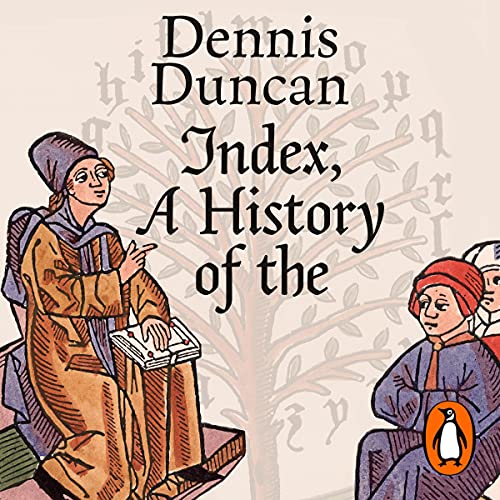
Index, A History of the by Dennis Duncan

Penguin| 19 August 2021| 339 pages| Review copy| 4*

Synopsis:

Most of us give little thought to the back of the book – it’s just where you go to look things up. But here, hiding in plain sight, is an unlikely realm of ambition and obsession, sparring and politicking, pleasure and play. Here we might find Butchers, to be avoided, or Cows that sh-te Fire, or even catch Calvin in his chamberwithaNonne. This is the secret world of the index: an unsung but extraordinary everyday tool, with an illustrious but little-known past. Here, for the first time, its story is told.

Charting its curious path from the monasteries and universities of thirteenth-century Europe to Silicon Valley in the twenty-first, Dennis Duncan reveals how the index has saved heretics from the stake, kept politicians from high office and made us all into the readers we are today. We follow it through German print shops and Enlightenment coffee houses, novelists’ living rooms and university laboratories, encountering emperors and popes, philosophers and prime ministers, poets, librarians and – of course – indexers along the way. Revealing its vast role in our evolving literary and intellectual culture, Duncan shows that, for all our anxieties about the Age of Search, we are all index-rakers at heart, and we have been for eight hundred years.

My thoughts:

This book is not just about the history of the index, but also about the history of reading and the evolution of the book from the scrolls, manuscripts and the codex before the the invention of printing – how they were produced and used. I was interested in reading it as I’m an ex-librarian and cataloguer, later an assistant in a county record office where a large part of my job involved indexing. If you think like me that an index is an indispensable part of a non fiction book then you’ll enjoy this book, which is both informative and entertaining. And I often wish fiction books were indexed too – one of the advantages of an e-book is that you can search the text, even better if it has the X-Ray feature.

It explains the difference between the index and the table of contents, goes into the evolution of page numbers and the problems of alphabetisation. This is not a dry, factual account it is written with humour and insights into the past, using examples from historical texts, and from indexes complied as satirical attacks on their authors. I never knew indexes had been used as weapons! Nor did I know that some works of fiction had been indexed in the past – full details in Chapter 6 ‘Indexing Fictions: Naming was Always a Difficult Art’, quoting from Lewis Carroll’s works. Carroll was fascinated with indexes, leaning particularly towards the whimsical, using his logician’s wit.

Neither is it stuck in the far distant past, Duncan brings it up to date in the digital age and the ubiquity of the search engine with the rise of anxiety that this is changing our brains, shortening our attention spans and eroding our capacity for memory. But this, Duncan explains is nothing new as the history of the index shows that there have always been fears that nobody will read properly any more when they could just use an index to replace the ways of close reading. The ways we read have changed over the generations.

The Index, a History of the is simply fascinating.

About the Author

Dennis Duncan is a writer, translator and lecturer in English at University College London. He has published numerous academic books, including Book Parts and The Oulipo and Modern Thought, as well as translations of Michel Foucault, Boris Vian, and Alfred Jarry. His writing has appeared in the Guardian, the Times Literary Supplement, and the London Review of Books, and recent articles have considered Mallarmé and jugs, James Joyce and pornography, and the history of Times New Roman. 
A Line to Kill by Anthony Horowitz

Random House UK, Cornerstone Digital| 19 August 2021| 368 pages| Review copy| 4*

Synopsis:

There has never been a murder on Alderney.

It’s a tiny island, just three miles long and a mile and a half wide. The perfect location for a brand new literary festival. Private Investigator Daniel Hawthorne has been invited to talk about his new book. The writer, Anthony Horowitz, travels with him.

Very soon they discover that not all is as it should be. Alderney is in turmoil over a planned power line that will cut through it, desecrating a war cemetery and turning neighbour against neighbour.

The visiting authors – including a blind medium, a French performance poet and a celebrity chef – seem to be harbouring any number of unpleasant secrets. When the festival’s wealthy sponsor is found brutally killed, Alderney goes into lockdown and Hawthorne knows that he doesn’t have to look too far for suspects.

There’s no escape. The killer is still on the island. And there’s about to be a second death…

A Line to Kill is the third in Anthony Horowitz’s Hawthorne and Horowitz Mystery series. I have read the earlier books, The Word is Murder and The Sentence is Death and I think it really it best if you read these books in order to fully understand the main characters and their relationship. Daniel Hawthorne, an ex-policeman, is now a private investigator, who the police call in to help with their more complicated cases. Anthony Horowitz himself plays a major role as one of the main characters, recruited by Hawthorne to write a book about him and the cases he investigates and he’d agreed to a three-book contract with Hawthorne.

This third book is about the third case they investigate. I loved the setting on the island of Alderney where the literary festival is being held. I enjoyed the interplay between Hawthorne and the fictional Horowitz, a somewhat difficult relationship as Hawthorne is particularly secretive about his personal life and about the reason he left the police force. In a way he is a Sherlock Holmes type of character keeping Horowitz very much in the dark about what he thinks about the identity of the murder. He is not an easy person to like, single minded with a somewhat superior air about him, but he does get results.

Like the two earlier books this is a complicated murder mystery, with a type of ‘locked room’ puzzle to be solved. As you would expect it is full of red herrings and multiple twists and turns. I was soon totally immersed in this fascinating novel. The characters are fully formed, all with secrets they want to keep hidden and clues are all there, but so well hidden that I was once again totally bemused by it all.

The fictional Horowitz is by now, thoroughly intrigued by Hawthorne himself – just what is he keeping hidden about himself, why did he really leave the police force? Will the writer Horowitz reveal the secret is his next book – if there is to be one? I do hope so.

Thank you to Anthony Horowitz, Random House and NetGalley for an ARC of A Line to Kill.

Above the Bay of Angels by Rhys Bowen

Lake Union| February 2020| 323 pages| 3*

A single twist of fate puts a servant girl to work in Queen Victoria’s royal kitchen, setting off a suspenseful, historical mystery by the New York Times bestselling author of The Tuscan Child and The Victory Garden.

Arriving as Helen Barton from Yorkshire, she pursues her passion for creating culinary delights, served to the delighted Queen Victoria herself. Best of all, she’s been chosen to accompany the queen to Nice. What fortune! Until the threat of blackmail shadows Bella to the Riviera, and a member of the queen’s retinue falls ill and dies.

Having prepared the royal guest’s last meal, Bella is suspected of the poisonous crime. An investigation is sure to follow. Her charade will be over. And her new life will come crashing down—if it doesn’t send her to the gallows.

Set towards the end of Queen Victoria’s reign in 1896/7 I thought this sounded interesting when I read the synopsis on NetGalley, and it is. It’s a pleasant easy read, but rather far-fetched.

The novel is based on facts to a certain extent. Rhys Bowen’s Historical Note explains that many aspects of the story are true, including the details about Abdul Karim, the Queen’s Indian Munshi. The Hotel Regina Excelsior above Nice was built for Queen Victoria – she had a separate wing with its own entrance – and she took a team of her cooks with her when she visited each winter.

I thought the beginning of the book was slow and predictable, and there are a few convenient coincidences. Isabella (Bella) Waverley’s father was a member of an aristocratic family, the second son of a second son, who fell on hard times and eventually died an alcoholic. Bella had gone into service and found she had a talent for baking. So when she had the opportunity to take Helen Barton’s position as an under cook at Buckingham Palace, she presented herself as Helen at the Palace. Keeping her real identity a secret was a problem that continued through the book, providing an element of suspense. Then when one of the Queen’s German relatives died, Bella is suspected of poisoning him, and I enjoyed the intrigue and the puzzle of who killed the Count.

Overall I did find the book entertaining. I enjoyed reading about the meals the Queen Victoria’s household were served and the settings both in Buckingham Palace and in the French Riviera are beautifully described. Compared to the slow start the ending is packed with action and romance as well as mystery.

With thanks to NetGalley and to the publishers for my review copy.

The Rose Code by Kate Quinn

Harper Collins| 18 March 2021| 645 pages| 3*

1940, Bletchley Park, Buckinghamshire.

Three very different women are recruited to the mysterious Bletchley Park, where the best minds in Britain train to break German military codes.

Vivacious debutante Osla has the dashing Prince Philip of Greece sending her roses – but she burns to prove herself as more than a society girl, working to translate decoded enemy secrets. Self-made Mab masters the legendary codebreaking machines as she conceals old wounds and the poverty of her East-End London upbringing. And shy local girl Beth is the outsider who trains as one of the Park’s few female cryptanalysts.

1947, London.

Seven years after they first meet, on the eve of the royal wedding between Princess Elizabeth and Prince Philip, disaster threatens. Osla, Mab and Beth are estranged, their friendship torn apart by secrets and betrayal. Yet now they must race against the clock to crack one final code together, before it’s too late, for them and for their country.

My Thoughts:

I have very mixed thoughts about The Rose Code. On the one hand it’s just the sort of book I love – historical fiction with a thrilling story and interesting characters that kept me wanting to read on and yet also made me want it to last as long as possible. On the other hand, it’s unevenly paced, with a slow start and a rushed ending that was somewhat of an anti-climax. My favourite character was Beth and I enjoyed reading how her character developed from a shy down trodden young woman into a brilliant cryptanalyst.

But when I first began reading it earlier this year I stopped after the opening pages and only picked it up again a couple of weeks or so ago. I initially stopped as the storyline involving Prince Philip made me very uncomfortable – Prince Philip was still alive when this book was written and when I first started to read it. He died in April this year.

The book begins in 1947 as Osla Kendall, a journalist working for the Tatler, is wondering what to wear for the Royal Wedding. She is in a ‘foul mood‘ as she wonders what to wear to the wedding of Princess Elizabeth and Lieutenant Philip Mountbatten.

Historical fiction mixes fact and fiction with both real and imaginary characters and I don’t have a problem with that. The character of Osla Kendall is based on a real person – in her Author’s Note Kate Quinn writes that she is ‘lightly fictionalized from the real-life Osla Benning, a beautiful, effervescent, Canadian-born heiress and Hut 4 translator who was Prince Philip’s long-term wartime girlfriend.‘ But by the time of the Royal Wedding Osla Benning was already married, not pining after Prince Philip. In writing their story Kate Quinn was not writing from facts but from her imagination as she put words in her characters’ mouths and described their emotions thoughts and feelings, which, of course, she could not have known.

However, I got over my dislike and read on – after all, this is fiction, not an accurate historical account. I like to know which is fact and which is fiction when I read historical fiction. So, after reading the review copy I received via NetGalley, I decided I needed to buy the published book and read the Author’s Note. And I’m glad did because I was relieved to find that Kate Quinn goes into a lot of detail to identify which characters are real and which fictional and how she has fictionalised them. She also reveals that she has also deviated from the historical records ‘to serve the story.’ I think this explains why I was uncomfortable with the book and why I don’t often read historical romances.

With thanks to NetGalley and to the publishers for my review copy.

Six Queens: Katheryn Howard the Tainted Queen by Alison Weir

Headline Review| 20 August 2020| 479 pages| Review copy| 2*

I wanted to read this book because I knew very little about Henry VIII’s 5th wife, except that she was beheaded on the grounds that she had committed adultery and treason.

Description

A NAIVE YOUNG WOMAN AT THE MERCY OF HER AMBITIOUS FAMILY.

At just nineteen, Katheryn Howard is quick to trust and fall in love.

She comes to court. She sings, she dances. She captures the heart of the King.

But Henry knows nothing of Katheryn’s past – one that comes back increasingly to haunt her. For those who share her secrets are waiting in the shadows, whispering words of love… and blackmail.

Having read it, I don’t think I know much more, except that Katheryn Howard comes across as a very shallow character, obsessed with sex, with luxury in all its forms, naive and easily manipulated. Alison Weir excels in her descriptive writing, bringing the Tudor court to life in all of its settings, locations, clothes and jewellery.

It has glowing reviews on Amazon full of praise and it is based on extensive research. Clearly other people love this book, but I didn’t. For me it came across as a romance novel, primarily focused on Katheryn’s imagined thoughts, emotions, and sexual encounters. It is simply written, but with too many cliches and modernised text.

Alison Weir’s Author’s Note is much more interesting than her novel, in which she acknowledges her sources, including Dr. Nicola Tallis’ unpublished DPhil thesis, All the Queen’s Jewels, 1445 – 1548, and a number of biographies of Katheryn Howard. She refers to original sources she used as the basis of the book – contemporary writers and wills, portraits showing her rich clothes and jewellery – jewels that have been tentatively identified in Katheryn Howard’s inventory.

She used these sources for the narrative of the book, weaving them into the dialogue and modernising the speech ‘where Tudor English looks out of place in a modern text.’ She states that ‘apart from fictionalising the historical record’ she has invented very little.’ There is also a Dramatis Personae, usefully indicating which characters are fictional and a Timeline, which is also very useful.

I think the Author’s Note is the best part of the book. There is rather too much of ‘fictionalising the historical record’ for me in the novel. I don’t like writing about a book I didn’t enjoy when I know so much work has gone into it and clearly other people have loved it. But this is just my opinion, for what it is worth.

With thanks to NetGalley and to the publishers for my review copy.

The Paris Library by Janet Skeslien Charles

Two Roads| 9th February 2021| 369 pages| Review copy| 3*

Before I read the summary of the book the title led me to think this was about the Bibliothèque Nationale de France, located in Paris. It’s not, it’s about the American Library in Paris.

PARIS, 1939
Odile Souchet is obsessed with books, and her new job at the American Library in Paris – with its thriving community of students, writers and book lovers – is a dream come true. When war is declared, the Library is determined to remain open. But then the Nazis invade Paris, and everything changes.
In Occupied Paris, choices as black and white as the words on a page become a murky shade of grey – choices that will put many on the wrong side of history, and the consequences of which will echo for decades to come.

MONTANA, 1983
Lily is a lonely teenager desperate to escape small-town Montana. She grows close to her neighbour Odile, discovering they share the same love of language, the same longings. But as Lily uncovers more about Odile’s mysterious past, she discovers a dark secret, closely guarded and long hidden.

As an ex-librarian I had high hopes that I would love The Paris Library. It’s historical fiction, based on the true Second World War story of the librarians at the American Library in Paris. It was established in 1920 by the American Library Association with books and periodicals donated by American libraries to US soldiers serving their allies in World War I. Since then it has developed into the largest English language lending library in Europe.

I liked the details about the Library, and about the work the library staff did during the War, including delivering books by hand to their Jewish subscribers in Paris after they were not allowed to enter the Library.

Charles’ helpful Author’s Note gives a fascinating insight into the background to the novel and explains that she had spent several years researching it. She had worked in the American Library in 2010 and her colleagues had told her the story of the Library during the Second World War and had given her access to documents, correspondence and contacts. She met with some of the staff who had worked there and was able to bring their stories up to date. Odile and Lily are both fictional characters.

Although I enjoyed the factual elements of the novel and the wartime storyline, I didn’t enjoy it as much as I had hoped. I was disappointed with the fictional stories, in particular Lily’s story in Montana in the 1980s. I really didn’t see the point of introducing her character simply to show what happened to Odile after the end of the War. Her story took the novel into the genres of YA and romantic fiction, neither of which hold much appeal for me. Overall I thought it was slow going and towards the end of the book my interest flagged making it a struggle to finish it.

With thanks to NetGalley and to the publishers, Two Roads for my review copy.