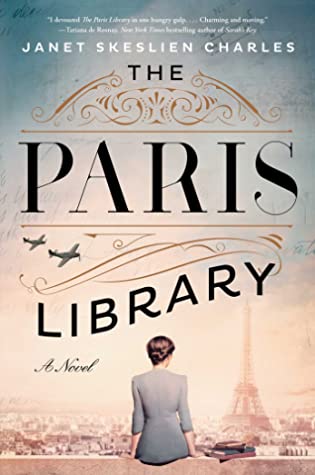
The Paris Library by Janet Skeslien Charles

Two Roads| 9th February 2021| 369 pages| Review copy| 3*

Before I read the summary of the book the title led me to think this was about the Bibliothèque Nationale de France, located in Paris. It’s not, it’s about the American Library in Paris.

PARIS, 1939
Odile Souchet is obsessed with books, and her new job at the American Library in Paris – with its thriving community of students, writers and book lovers – is a dream come true. When war is declared, the Library is determined to remain open. But then the Nazis invade Paris, and everything changes.
In Occupied Paris, choices as black and white as the words on a page become a murky shade of grey – choices that will put many on the wrong side of history, and the consequences of which will echo for decades to come.

MONTANA, 1983
Lily is a lonely teenager desperate to escape small-town Montana. She grows close to her neighbour Odile, discovering they share the same love of language, the same longings. But as Lily uncovers more about Odile’s mysterious past, she discovers a dark secret, closely guarded and long hidden.

As an ex-librarian I had high hopes that I would love The Paris Library. It’s historical fiction, based on the true Second World War story of the librarians at the American Library in Paris. It was established in 1920 by the American Library Association with books and periodicals donated by American libraries to US soldiers serving their allies in World War I. Since then it has developed into the largest English language lending library in Europe.

I liked the details about the Library, and about the work the library staff did during the War, including delivering books by hand to their Jewish subscribers in Paris after they were not allowed to enter the Library.

Charles’ helpful Author’s Note gives a fascinating insight into the background to the novel and explains that she had spent several years researching it. She had worked in the American Library in 2010 and her colleagues had told her the story of the Library during the Second World War and had given her access to documents, correspondence and contacts. She met with some of the staff who had worked there and was able to bring their stories up to date. Odile and Lily are both fictional characters.

Although I enjoyed the factual elements of the novel and the wartime storyline, I didn’t enjoy it as much as I had hoped. I was disappointed with the fictional stories, in particular Lily’s story in Montana in the 1980s. I really didn’t see the point of introducing her character simply to show what happened to Odile after the end of the War. Her story took the novel into the genres of YA and romantic fiction, neither of which hold much appeal for me. Overall I thought it was slow going and towards the end of the book my interest flagged making it a struggle to finish it.

With thanks to NetGalley and to the publishers, Two Roads for my review copy.

Coming Up For Air by Sarah Leipciger

A remarkable true story richly re-imagined

On the banks of the River Seine in 1899, a young woman takes her final breath before plunging into the icy water. Although she does not know it, her decision will set in motion an astonishing chain of events. It will lead to 1950s Norway, where a grieving toy-maker is on the cusp of a transformative invention, all the way to present-day Canada where a journalist, battling a terrible disease, risks everything for one last chance to live.

Taking inspiration from a remarkable true story, Coming Up for Air is a bold, richly imagined novel about the transcendent power of storytelling and the immeasurable impact of every human life.

Coming Up For Air is Sarah Leipciger’s second novel. It is a beautiful novel, a story of three people living in different countries and in different times. How their stories connect is gradually revealed as the novel progresses. As the author explains at the end of the novel is is a mix of fact and fiction and has its basis in truth. There is grief and loss and despair in each story, but above all, it is about love, and the desire to live.

Each story was compelling and, for once in a book that alternates between the characters, I thought the changes were just at the right moment in each one.

It begins with the unknown young woman in Paris, L’Inconnue, telling the story of her life that led to her suicide. Her death in the Seine is vividly described. As she fell in the cold water, initially she discovered the desire to live, as her body thrashed about not wanting to drown, her lungs fighting for air, for oxygen. It’s poignant and moving, set at the end of the 19th century bringing the city to life, where she lives as a lady’s companion to an old friend of her grandmother’s.

The second story is that of Norwegian, Pieter Akkrehamn, beginning in 1921, when he used to spend his summers with his grandparents on Karmoy Island. He went swimming in the North Sea, diving down several metres, holding his breath for over a minute in the freezing cold water, as the cold reached his chest, squeezing his lungs. His story is revealed, as he grieves for his little son. He is a toymaker, bored with making wooden toys, who turned to soft plastics and began making dolls with soft faces and bendable knees. What he eventually developed was truly remarkable.

The vital importance of being able to breathe comes to the fore in the third story – that of Anouk, a journalist in Canada. Anouk has cystic fibrosis and is on the list for a lung transplant. Her story is one of how she and her parents dealt with her illness, enabling her to combine her love for water and swimming with managing her cystic fibrosis, all the time struggling to breathe.

I think Sarah Leipciger is a great storyteller. It is an inspiring book, beautifully written, which emphasises the importance of the air we breathe and the desire to live. I loved it so much that I hope to read her first novel, The Mountain Can Wait.

With my thanks to NetGalley and to Random House for my review copy.

  • Publisher ‏ : ‎ Random House UK Transworld Digital (19 Mar. 2020)
  • Language ‏ : ‎ English
  • Print length ‏ : ‎ 320 pages

The Killing Kind by Jane Casey

Harper Collins| 27 May 2021|474 pages|Review copy| 5*

I love Jane Casey’s Maeve Kerrigan series, police procedurals, fast-paced novels, with intriguing and complex plots and developing the relationships between the main characters. So, when I saw that she has written a standalone novel, The Killing Kind I was keen to read it. It is a psychological thriller – and it is so, so very good. I was totally engrossed in it right from its opening page all the way through to the end. It’s a mix of courtroom scenes, police interviews and terrifying action-packed scenes.

The main character is Ingrid Lewis, a barrister, who successfully defended John Webster, who was on trial for stalking. But he then went on to stalk her, ruining her peace of mind and her life. He not only harassed her, but sent her multiple emails and texts, and uploaded YouTube videos destroying her reputation. Her relationship with her fiance, Mark Orpen, was ruined and her home was burnt down – all of which she was sure was down to him.

She took out a restraining order against him and thought she was free of him. But when the order expired she became convinced he was back in her life when one of colleagues, Belinda Grey, was killed in a road accident. Belinda had borrowed Ingrid’s red umbrella and Ingrid is sure she was the intended victim, when she sees the umbrella at the scene. Later a friend staying in her flat is brutally stabbed to death – again she is convinced Webster is behind her murder. But Webster insists he is innocent and that he is the only one who can protect her.

Ingrid doesn’t know who to believe and who she can trust – her life becomes a nightmare. Webster is clever, cold and an expert manipulator and Ingrid becomes putty in his hands. In despair she turns to DC Adam Nash for help and protection. It moves from past to present and in between the chapters there are sections in which three unnamed people exchange emails about Ingrid’s situation and I was intrigued trying to work out their identities- I was nearly right. I loved it.

With my thanks to NetGalley and to Harper Collins for my review copy.

Circus of Wonders by Elizabeth Macneal

Picador| 13 May 2021| 384 pages|Review copy| 4*

Description

1866. In a coastal village in southern England, Nell picks violets for a living. Set apart by her community because of the birthmarks that speckle her skin, Nell’s world is her beloved brother and devotion to the sea.

But when Jasper Jupiter’s Circus of Wonders arrives in the village, Nell is kidnapped. Her father has sold her, promising Jasper Jupiter his very own leopard girl. It is the greatest betrayal of Nell’s life, but as her fame grows, and she finds friendship with the other performers and Jasper’s gentle brother Toby, she begins to wonder if joining the show is the best thing that has ever happened to her.

In London, newspapers describe Nell as the eighth wonder of the world. Figurines are cast in her image, and crowds rush to watch her soar through the air. But who gets to tell Nell’s story? What happens when her fame threatens to eclipse that of the showman who bought her? And as she falls in love with Toby, can he detach himself from his past and the terrible secret that binds him to his brother.

Moving from the pleasure gardens of Victorian London to the battle-scarred plains of the Crimea, Circus of Wonders is an astonishing story about power and ownership, fame and the threat of invisibility.

I loved Elizabeth Macneal’s first book, The Doll Factory, so I was keen to read her second, Circus of Wonders, set in 1866. I liked the circus setting and the variety of characters. The main character is Nell, the ‘leopard girl’, who is both shunned and ridiculed by the people in her village because of the birthmarks on her face and all over her body. When the travelling circus visits the village her father sells her to Jasper Jupiter’s ‘Circus of Wonders‘ as it includes a ‘freak show’, highlighting the very different attitudes of the times from those of the present day. This makes for uncomfortable reading at times, as Stella, the bearded lady, Brunette, the Welsh Giantess, and Peggy the dwarf who drives a miniature carriage are treated as objects of curiosities, acts to be bought and sold, just as Nell was sold.

It’s narrated from the perspectives of the three main characters, Nell, who became a star as ‘Nellie Moon’ flying high above the circus ring suspended beneath a balloon, Jasper, the ambitious circus owner and Toby his younger, gentler brother. Jasper is the driving force as he is forever looking for new acts to draw the crowds. His ambition is to gain a pitch in London, hoping the Queen might hear of him and want to see his show. He knows that the queen is the ‘freak-fancier par excellence, who has summoned Aztecs, pinheaded people and dwarves to her Palace’.

The brothers had both taken part in the Crimean War, Jasper as a soldier and Toby as a photographer. Toby is haunted by memories of the war and in particular of what happened to Dash, Jasper’s friend, during the siege of Sevastopol. The horror of the war has never left him. Although the circus is the main focus of the novel, it is the mystery of what happened in the Crimea and the relationships between Jasper, Toby and Dash that interested me the most and made me want to read on.

This is a novel that transported me back to the Victorian period, full of the atmosphere of both the circus and of war. It reveals the insecurities, fears and isolation that the characters suffer. It emphasises the exploitation of ‘freaks of nature’, who draw the crowds and the power of illusions. I like the mix of fact and fiction and the way that Macneal interweaves the details of the Crimean War with the circus narrative. However, I don’t think it’s quite as good as The Doll Factory, which totally captivated me with its dark tale of obsession, pulsing with drama, intrigue and suspense.

With thanks to NetGalley and especially to Pan McMillan, Picador for my review copy.

Inland by Téa Obreht

Weidenfeld & Nicolson| 13 August 2019| 386 pages| Review copy| 3*

Nora is an unflinching frontierswoman awaiting the return of the men in her life, biding her time with her youngest son – who is convinced that a mysterious beast is stalking the land around their home – and her husband’s seventeen-year-old cousin, who communes with spirits.

Lurie is a former outlaw and a man haunted by ghosts. He sees lost souls who want something from him, and he finds reprieve from their longing in an unexpected relationship that inspires a momentous expedition across the West.

Mythical, lyrical, and sweeping in scope, Inland is grounded in true but little-known history. It showcases all of Téa Obreht’s talents as a writer, as she subverts and reimagines the myths of the American West, making them entirely – and unforgettably – her own.

My thoughts:

Inland by Téa Obreht has had many accolades, including being named one of the best books of the year by The Guardian, Time, Washington Post, Entertainment Weekly, Esquire, Good Housekeeping, and The New York Public Library. I love the cover and the description made me keen to read it. It’s a book that has been on my NetGalley shelf for far too long, I’m sorry to say, mainly because each time I began reading it I struggled to understand what was going on.

It is a book of two halves really, alternating between the two storylines as the blurb outlines. I found the Lurie narrative difficult to follow at first. It’s vague – at times I didn’t know who was who, who was talking, who was a camel and who was a person. I did work it out eventually! Lurie is a former outlaw, who sees and talks to the dead. He is haunted by the spirit of Hobb, a kid of four or five. But Lurie’s story is slow and meanders. I was losing interest, and often the location was unclear as he moved from place to place. However as I got further into his story I did form a clearer picture of his life as he joined the Camel Corps and became a cameleer. (I was fascinated to discover that camels were used in the American West as pack animals.)

But it’s the second story of Nora Lark and her family, which is much clearer and easier for me to understand. It saved the book for me and made me keen to read on. They are living in Arizona in a homestead. There’s been no rain for months and their water supply is nearly exhausted. Emmett, her husband has gone to get more water and has not returned . Her two sons have gone to look for him, and Nora is left at home with her youngest son, Toby, who is terrified by a mysterious beast he sees around their house at night, and Josie, her husband’s seventeen year old ward and cousin, who see spirits. Nora’s daughter, Evelyn died before her sons were born, under mysterious circumstances, and she is constantly in Nora’s mind as she imagines her growing up and having conversations with her.

Several times as the narrative turned from Nora back to Lurie, I was about to give up on the book, but I wanted to know what happened to the Larks and to find out how the two strands would interlink, or if indeed they ever did interlink (they do). As I read on I began to understand more about Lurie and his life, but it was hard work. If I re-read it I think I would enjoy it more, but I don’t feel inclined to right now. But I really liked Nora’s story and the depiction of life in the American West during the mid-to-late 19th century.

In her acknowledgements Téa Obreht explains that Inland is a work of imagination based in part on the journals, letters and reports of the men who were part of at least one aspect of this history and on the work of the historians of the American West.

My thanks to the publishers and NetGalley for my review copy, with apologies for taking so long to read the book.

A Town Called Solace by Mary Lawson

Chatto & Windus| 18 February 2021| 294 pages| Review copy| 5*

It was a complete pleasure to read A Town Called Solace by Mary Lawson. I loved the clarity of the narrative, focused on three main characters, each perfectly distinct and finely described and the sense of location in a small town is excellent.

It’s set in North Ontario in 1972, but looks back to events thirty years earlier when Elizabeth Orchard first met Liam who was then a small boy of 3 when he and his family lived in the house next door. The last time she saw him he was still only 4 years old. It was not a happy time for either of them, and thirty years later, when she is dying she wants to make amends and gives him her house.

Clara lives next door to Elizabeth, who she loves, and she is alarmed when she sees Liam moving into Elizabeth’s house. Elizabeth had given her a key and she goes in every day to feed Moses, Elizabeth’s cat. She has no idea that Elizabeth is dying and is furious when she discovers that Liam is moving Elizabeth’s things and packing them in boxes. Her life is in turmoil in any case as she is devastated that Rose, her 16 year old sister has gone missing.

The narration moves between these three people, seeing events through their eyes. Elizabeth, in hospital looks back over her life, remembering her despair at not having a child of her own, and her love for little Liam that ended badly, despite her good intentions. Clara spends the time before and after school at the window looking out for Rose’s return and Liam, whilst remembering his sad childhood, is trying to rebuild his life after his marriage ended in divorce.

I loved this book. It’s about families, the things that go wrong, about memories and about friendships and the care that people have for each other. It’s moving and sad, but also filled with hope. And it’s beautifully written.

Many thanks to the publishers and NetGalley for my review copy.