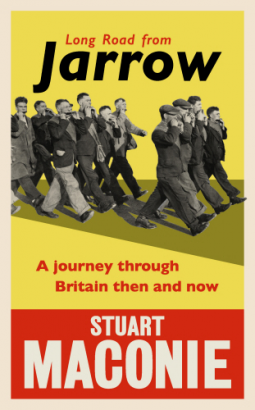
I knew of the Jarrow March/Crusade in 1936, but not much about it beyond the fact that men from Jarrow in Tyneside marched from their home town to London to present a petition against the mass unemployment and extreme poverty in the north-east of England. Stuart Maconie has filled in the gaps in his excellent book Long Road from Jarrow: A journey through Britain then and now. In October last year he retraced the route they took, 300 miles, comparing what conditions and attitudes were like in 1936 with those of 2016. The men were accompanied for part of their march by Ellen Wilkinson, who was the MP for Middlesbrough East and it was Ellen who presented their petition to the House of Commons. But despite their protest and all Ellen Wilkinson’s efforts on their behalf it didn’t result in any improvements for employment in Jarrow.
Maconie a writer, broadcaster and journalist, writes fluently and with conviction. The Long Road from Jarrow is a mix of travel writing, social and cultural history and political commentary, with the main emphasis on the current social, cultural and political scene. It’s a thought-provoking book that both entertained and enlightened me. Maconie writes about the past, the history of the places he walked through and the tales and reminiscences of the people he met. He also writes with enthusiasm on such topics as football and music and food. It’s a lively, chatty account that includes the thorny topic of Brexit, the current and past state of the north/south divide and considers what it is to be ‘British’.
I was fascinated and thoroughly enjoyed this walk through England, past and present. My copy is an ARC from the publishers via Netgalley.
On the 200th anniversary of Jane Austen’s death, historian Lucy Worsley leads us into the rooms from which our best-loved novelist quietly changed the world.
This new telling of the story of Jane’s life shows us how and why she lived as she did, examining the places and spaces that mattered to her. It wasn’t all country houses and ballrooms, but a life that was often a painful struggle. Jane famously lived a ‘life without incident’, but with new research and insights Lucy Worsley reveals a passionate woman who fought for her freedom. A woman who far from being a lonely spinster in fact had at least five marriage prospects, but who in the end refused to settle for anything less than Mr Darcy.
My view:
I think it was a foregone conclusion that I would really enjoy Lucy Worsley’s Jane Austen at Home. I have loved Jane Austen’s books for many years, going back to when I was about 12 and read Pride and Prejudice for the first time. I’ve previously read Carol Shields’s biography Jane Austen and Claire Tomalin’s Jane Austen: a Life so there was really very little I learned reading Jane Austen at Home that surprised me or that I hadn’t known before.
I suppose what was new to me was the emphasis on what home life was like during the period of Jane’s life and seeing photos of the houses and places that she had lived or stayed in as a visitor. And I think I gained a better understanding of the social history of Georgian England and of Jane’s wider family connections and what her family and friends thought of her both as a person and as an author.
Lucy Worsley is an historian and has presented several television history programmes. I am not a great fan of her style – the play acting and dressing up – but she writes in a lively, chatty style and reading her book I could easily hear her voice. Jane Austen at Home is both very readable and very detailed, which is not an easy thing to achieve. There is an extensive section at the end of the book, listing sources, a bibliography, notes on the text and an index. There are two sections of colour plates.
Needless to say it has spurred me on to re-read Jane Austen’s books, and I shall probably begin with re-reading Emma, a book I’ve only read once.
I received an e-galley from the publishers via NetGalley for review and part way through reading it I bought a hardback copy to get the finished product.
Alasdair Maclean was a Scottish poet, born in Glasgow. He left school at fourteen to work in the Clydeside shipyards. In his late thirties he read English at Edinburgh University, later returning to the family croft at Sanna in Ardnamurchan to write. His father had worked as Deputy Harbour Master in the Greater Glasgow docks until he retired in the 1950s and moved back to take over the croft from his father.
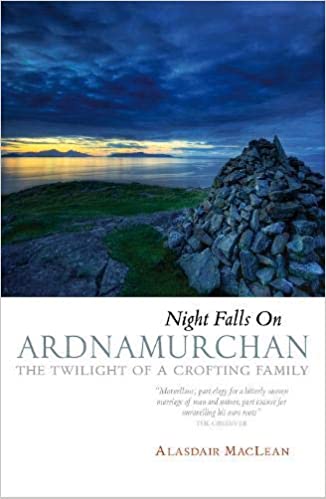
What their life was like on the croft is captured in detail in Maclean’s only book of prose Night Falls on Ardnamurchan: the Twilight of a Crofting Family.
The main section of the book is made up of extracts from his father’s journals forming a factual account of his daily life on the croft covering two years, a decade apart: 1960 and 1970, for the same three days at the beginning, middle and end of every month in those years, with explanatory comments where he thought necessary.
I enjoyed this section together with the Prologue and two introductions – the first about his father and their relationship and the second, a brief history of Ardnamuchan – more that the section on Alasdair’s own journal of 1979 – 1980.
I quoted the opening of the book with an extract from page 56 in this earlier post. Here are a few more extracts to give a flavour of the book:
Due to Father’s complete lack of push, coupled with his unwillingness to flatter or connive, he was passed over for promotion on several occasions. In the early 1950s he retired, somewhat prematurely, and came back to Ardnamurchan to operate the family croft, which my grandparents were getting too old to look after. Poverty accompanied him north and this lasted till a state pension at sixty-five brought some slight ease. He died five months after my mother of a coronary, they said, but of being worn out and heartbroken, say I. (page 23)
Each journal entry begins with a description of the weather and its effects. This is a typical example:
November 15 1969
Moderate to fresh Southerly wind became strong in evening. Drizzle in early forenoon. Dry for an hour in the middle of the day. In the afternoon the sleety rain became torrential and continued into the night. Did a little more to a new house for Tilly. Gave cattle a little hay. Managed across river at Cnoc Brac peats.
Alasdair commented: Tilly was a pet sheep, the first of many orphans we hand-reared. She was a privileged character (I tell her story later) and no ageing butler, slopping sherry around the salver on his tottering passage between pantry and drawing room, could have been more conscious of possessing security of tenure or more determined to exploit it. The ‘house’ that was being built for her was but one indication of her status. Your ordinary sheep shivers it out on the hillside all night, having no roof but the low cloud of winter. (pages 84-85)
The state of the weather had great importance. To the crofter:
… clinging by a mixture of instinct and experience to the remote fringes of these islands, the weather is a god. It is the difference not merely between a pleasant and an unpleasant life, but between success and failure, until the advent of the welfare state between – possibly – living and dying. (page 52)
Winter is hard on Sanna:
Gales often blow for days on end, accompanied for much of the time by rain. The ground around house and outbuildings, with the constant to-ing and fro-ing of animals and people becomes a churned-up quagmire, a constant drag and hindrance to everything one tries to do.
… Even to enter or leave one’s house, if it lacks a back door – and most of the old cottages did – may be a hazardous operation in a gale and a door once opened may not be easy to shut again. I have seen old people in Sanna go from house to steading on hands and knees, being unable to proceed any other way. (page 52)
This is an unusual book describing not only life in a dying community but also revealing the relationship between children and parents, particularly in an isolated community. I was fascinated.
I was also interested to know what Ardnamurchan is like today. The Ardnamuchan website states it is on the most westerly peninsular of the British mainland, jutting out into the Atlantic Ocean and with views from every shore of islands, castles, lochs and wilderness, an amazing part of the West Coast of Scotland.
Sanna Bay (The copyright on this image is owned by Stuart Wilding and is licensed for reuse under the Creative Commons Attribution-ShareAlike 2.0 license.)
Amazon UK – only available from third-party sellers
Paperback: 224 pages
Publisher: Penguin Books Ltd; New edition edition (22 Feb. 1990)
Every Friday Book Beginnings on Friday is hosted by Gillion at Rose City
Reader where you can share the first sentence (or so) of the book you are reading, along with your initial thoughts about the sentence, impressions of the book, or anything else the opener inspires.
We hardly conceive of our parents as human. There are innumerable actions, there are whole areas of life and thought, that we do not care to see connected with them, that we scarcely allow ourselves, far less others, to connect with them.
From the back cover:
The Scottish poet Alasdair Maclean records the rise and fall of the remote crofting hamlet in the little-known area of Ardnamurchan where his family had its roots.
Perceptive, humorous and sharp he binds his own account of the crofter’s lifestyle and extracts from his father’s journal, a terser, more factual and down-to-earth vision of the day-to-day. It is an unusual and memorable story, one that not only describes life in a dying crofting community but also illuminates the shifting, often tortuous, relationship between children and their parents.
Find any sentence (or a few, just don’t spoil it) that grabs you.
Post it.
Add the URL to your post in the link on Freda’s most recent Friday 56 post.
The events on page 56 are concerned with winkle gathering, which provided an additional income to many of the crofters. The winkles were gathered and then stored where they could be refreshed by sea water until they were shipped to a merchant.
The reaction of a bag of thirsty winkles to a good splash of Mother Atlantic is delightful. For a few minutes all is creaks and squeaks and bubblings, as though a buzz of winkly conversation had broken out.
I found it was slow going at first, but now I’ve read half the book I’m really enjoying Maclean’s commentary on his father’s journal.
‘Every minute was magical, every single thing it did was fascinating and everything it didn’t do was equally wondrous, and to be sat there, with a Kestrel, a real live Kestrel, my own real live Kestrel on my wrist! I felt like I’d climbed through a hole in heaven’s fence.’
An introverted, unusual young boy, isolated by his obsessions and a loner at school, Chris Packham only felt at ease in the fields and woods around his suburban home. But when he stole a young Kestrel from its nest, he was about to embark on a friendship that would teach him what it meant to love, and that would change him forever. In his rich, lyrical and emotionally exposing memoir, Chris brings to life his childhood in the 70s, from his bedroom bursting with fox skulls, birds’ eggs and sweaty jam jars, to his feral adventures. But pervading his story is the search for freedom, meaning and acceptance in a world that didn’t understand him.
Beautifully wrought, this coming-of-age memoir will be unlike any you’ve ever read.
Chris Packham’s Fingers in the Sparkle Jar: a Memoir is indeed unlike any other memoir I’ve ever read. I loved it. It is deeply personal and honest about his childhood and early teenage years. It doesn’t follow any chronological time-line but moves to an event in 1975 when he was fourteen that touched him to his core. Some chapters are in the first person, giving an intense insight into his mind and some in the third person telling of events as though through on onlooker’s eyes. Some parts are told in the third person whilst he was talking to a therapist later in his life – these are raw and intensely moving. There are parts that are so sad and parts where his anger and indeed rage and the cruelty of others come through so very clearly.
They describe his isolation, his separation from other people and his acceptance and recognition that he was different, the ‘loops’ or obsessive thoughts that run repeatedly through your mind, and the stress he experienced because of all that.
I think it is beautifully written, richly descriptive – although if you don’t like adjectives you probably won’t agree with me. I do, and I can’t imagine the book without them, they paint such vivid and colourful images, especially in passages such as those where he describes his ‘sparkle jar‘ – simply wonderful. There is no way I can summarise that, other than to say it is dazzling and scintillating – you need to read the book.
There are many, many passages that will remain with me, such as those about his obsessions with a variety of things from dinosaurs, tadpoles, otters, and snakes, (his description of the enclosure for his snakes they built in the garden is most alarming – they escaped) for example, culminating in his love for the Kestrel he stole from its nest and then took home to rear and train.
Fingers in the Sparkle Jar is a very special book. In his acknowledgements Chris Packham explains the encouragement, patience, tolerance and help he had from his parents, and how he turned their house into a menagerie and the garden into a safari park.
Extraordinarily creative and prolific, Chris Packham has led a remarkable life. He’s gained recognition as a naturalist, television presenter, writer, photographer, conservationist, campaigner and filmmaker.
As a broadcaster he is a presenter of BBC’s BAAFTA Award winning Springwatch, Autumnwatch and Winterwatch series. He presents notable natural history series such as Nature’s Weirdest Events, World’s Weirdest Events, World’s Sneakiest Animals, Cats V Dogs, The Burrowers, Inside the Animal Mind, Operation Iceberg and Secrets of our Living Planet. He was featured in The Tonight Show starring Jimmy Fallon (NBC ‘“ US) where he introduced Jimmy to a Porcupine and baby spotted Hyena, and sent a Black Vulture flying to him as he stood in the audience.
Paperback: 384 pages
Publisher: Ebury Press (6 April 2017)
Language: English
ISBN-10: 1785033506
ISBN-13: 978-1785033506
Many thanks to the publishers and NetGalley for my copy of this book!
A celebratory book to mark the 200th anniversary of the death of Jane Austen in 2017
Blurb:
2017 marks the 200th anniversary of the death of Jane Austen, whose six completed novels have never been out of print. Best known for her novels, ‘Sense and Sensibility’, ‘Pride and Prejudice’, ‘Mansfield Park’, and ‘Emma’, first published anonymously, Jane commented, critiqued and illuminated the life of the English upper classes.
But did Jane’s writings highlight anything about her own spirituality? In this celebratory book, Paula Hollingsworth explores Jane Austen’s gentle but strong faith and the effect it had both on her life and her writing. Drawing on Jane’s life story, her letters, her friendships, her books and the characters portrayed, Paula shows the depth of Jane Austen’s spirituality.
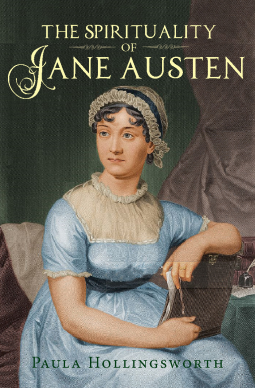
Jane Austen has long been one of my favourite authors, so when I saw The Spirituality of Jane Austen by Paula Hollingsworth on NetGalley I was keen to read it. It’s a combination of a biography, which complements other biographies that I’ve read, and an analysis of Jane Austen’s works from the point of how they reveal her spirituality.
‘Spirituality‘, in Jane Austen’s day was used in the sense of the word ‘religious‘, but used in a narrower sense than we would today. It would have meant ‘Christian‘ and in particular almost exclusively ‘Protestant Christianity‘. In the Austen family that would mean the beliefs and practices of 18th century Anglicanism – ‘a faith that was tolerant and pragmatic, focusing on self-improvement and right behaviour, with a belief in change that comes not so much from miracles but through self-reflection and inner growth.’
With this definition in mind Paula Hollingsworth then considers Jane Austen’s letters, her early writings and novels, focusing on how they reveal Jane’s spirituality implicitly rather than explicitly, seeing parallels between her life and her writings. I enjoyed this way of looking at her novels in particular.
I think the last chapter in which Paula Hollingsworth considers modern adaptations and dramatisations of Jane Austen’s books is very interesting. Whilst they have brought her work to a wider audience it has meant that character development has been lost, or the values of the times in which the novels are set have been changed to make the story more acceptable to a modern audience.
And given that Jane Austen disliked Bath when she lived there, Paula Hollingsworth believes she would be disappointed by the focus on some of the activities and merchandise rather than on her books. She also considers the recent Austen Project books in which modern authors set the novels in the present day and the problems they have in making them credible to modern readers.
She describes the many ways people today can enjoy Jane Austen’s work, such as watching screen adaptations, dancing at a Regency Ball, reading books about Jane Austen and her world, dressing in Regency costume and parading through Bath and other events, but considers that the best way is to read the novels themselves and to read them slowly. I agree. I really enjoyed reading this book and it has made me want to re-read the novels, particularly those I haven’t re-read recently.
There are comprehensive notes on the chapters, an appendix of Jane Austen’s prayers and a select bibliography.
My copy is an ARC I received from the publishers, Lion Books via NetGalley. The paperback (240 pages) will be published on 24 March 2017.