My Friday Post: World Enough & Time by Christian McEwan

Book Beginnings Button

Every Friday Book Beginnings on Friday is hosted by Gillion at Rose City Reader where you can share the first sentence (or so) of the book you are reading, along with your initial thoughts about the sentence, impressions of the book, or anything else the opener inspires.

World Enough & Time: On Creativity and Slowing Down

This week I’m featuring World Enough & Time: On Creativity and Slowing Down by Christian McEwen, a book I’ve borrowed from a friend:


When the Lilliputians first saw Gulliver’s watch, ‘that wonderful kind of engine … a globe, half silver and half of some transparent metal [glass!]’, they told themselves it had to be his god. After all, ‘he very seldom did anything without consulting it; he called it his oracle, and said it pointed out the time for every action of his life.’

Also every Friday there is The Friday 56, hosted by Freda at Freda’s Voice.

30879-friday2b56These are the rules:

  1. Grab a book, any book.
  2. Turn to page 56, or 56% on your eReader. If you have to improvise, that is okay.
  3. Find any sentence (or a few, just don’t spoil it) that grabs you.
  4. Post it.
  5. Add the URL to your post in the link on Freda’s most recent Friday 56 post.

Page 56:

Consider this quotation:

and this is what we mean by friends. Even when they are absent, they are with us … even when they are weak, they are strong; and … even when they are dead, they are alive.

CICERO

~~~

About the Book (extracted from Goodreads)

Slowness can open doors to sustained creativity, claims poet and teacher Christian McEwen. Over the course of ten years training teachers to write their own poems in order to pass the craft along to students, McEwen realized that nothing comes easily when life is conducted at a high rate of speed. She draws not only on personal experience, but on readings ranging from literary anecdote and poetry to Buddhism, anthropology, current news, and social history, all supplemented by interviews with contemporary writers and artists. This is a real reader’s book, one that stands up as both sustained narrative and occasional inspiration.

~~~

This is a book to take your time over reading it – you can read straight through or dip in and out of the chapters, focusing on different themes. I don’t want to rush through it – so at times, as I’m reading it I may quote further extracts  in future posts rather than writing a review.

What about you? Does it tempt you or would you stop reading? 

WWW Wednesday: 19 December 2018

IMG_1384-0

WWW Wednesday is run by Taking on a World of Words.

The Three Ws are:

What are you currently reading?
What did you recently finish reading?
What do you think you’ll read next?

It’s been over a month since I last wrote a WWW post so I thought it was time for another one.

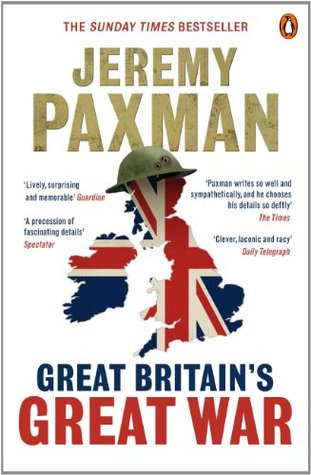
I’m currently reading: just one book – Great Britain’s Great War by Jeremy Paxman. I began it in November because it was the 100th  anniversary of the end of the First World War and I wanted to know more about it.

Great Britain's Great War

So far I’ve read just over half the book – now just starting to read about 1916 and the situation in Ireland. It’s written chronologically, analysing the causes of the war and why people at the time believed it to be unavoidable and even necessary. Paxman writes clearly and goes into detail which means it’s not a quick read and I’m taking it slowly. He writes about the people involved – the men who enlisted and those who were conscripted, the conditions they experienced from the trenches to the French brothels they frequented. It’s also about life back in Britain and the changes the war brought about. It is fascinating.

This morning I finished:

The Division Bell Mystery

Qnother fascinating book – The The Division Bell Mystery first published in 1932 by Ellen Wilkinson, a 1930s politician, about a murder in the House of Commons.  One of the reasons I enjoyed this so much is the setting in the House of Commons and the details it gives of not only the procedures and traditions, but a look behind the scenes and what it was like for the early women MPs. It’s a good murder mystery too!

My next book could be:

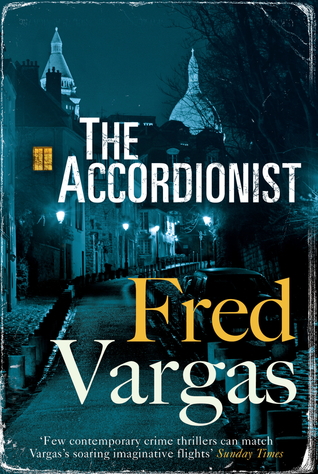
It’s time to start another novel but I am torn, as usual, and am trying to decide what to read next. It will probably be The Accordionist by Fred Vargas as it is a library book dues back at the beginning of January.

The Accordionist (Three Evangelists 3)

It’s the final novel in the Three Evangelists Trilogy – I’ve read the first two. This one has the same characters – three thirty-something historians, Mathias, Marc and Lucien, all specialists in three different periods of history, who live in a rambling house in Paris.

I love Fred Vargas’s quirky crime fiction, with eccentric characters and intricate plots that I find so difficult to solve. This one is about the murder of two Parisian women killed in their homes. The police suspect young accordionist Clément Vauquer and it seems like an open-and-shut case.

Have you read any of these books?  Do any of them tempt you? 

Books Read in November 2018

This month I read seven books, made up of one review copy that came to me via  NetGalley, two library books and four of my own books (two of these on Kindle). Two of the seven books are non-fiction and the rest are fiction. My ratings range from 5 to 2.5 stars and are based solely on my reactions to the books.

I’ve written about three of these books (click on the links to read my reviews):

Jacob's Room is Full of Books: A Year of ReadingAbsolute ProofIn a Dark, Dark Wood

  1. Jacob’s Room is Full of Books by Susan Hill 5*  – in which Susan Hill describes a year of her reading.
  2. Absolute Proof by Peter James 3.5* –  a standalone thriller that is very different from his Roy Grace books. It has similarities to Dan Brown’s The Da Vinci Code, as the search is on for proof of  God’s existence.
  3. In a Dark, Dark Wood by Ruth Ware 2.5* – I was disappointed as this book promised to be a psychological thriller but it neither thrilled nor scared me, although it is a page-tuner. Leonora and Clare haven’t seen  or even spoken to each other since they were 16, ten years ago. So why has Clare invited Leonora to her hen party held in a glass house in the middle of a wood?

Here are some brief notes about the remaining four books:

I Am, I Am, I Am: Seventeen Brushes With DeathThe ReckoningThe New Mrs CliftonTombland (Matthew Shardlake, #7)

I Am, I Am, I Am by Maggie O’Farrell 5* – I wrote this Friday post about this book, with two quotations and a summary of the book. It’s a memoir with a difference: seventeen encounters of near-death experiences, with Maggie at different ages, in different locations, revealing a whole life in a series of tense, visceral snapshots. It’s a beautifully written book that I loved.

The Reckoning by John Grisham 5*, about Pete Banning, Clanton’s favourite son, a returning war hero, the patriarch of a prominent family, a farmer, father, neighbour, and a faithful member of the Methodist Church. Why did he shoot and kill the Reverend Dexter Bell? And then refuse to say why he killed him? I was intrigued and fascinated by the whole book that went back into Pete’s wartime experiences during world War Two during the Bataan Death March in the Philippines.

The New Mrs Clifton by Elizabeth Buchan 4* this begins in 1974 with the discovery of a skeleton, the remains of a woman, between twenty-five and thirty, buried beneath a tree in the garden of house in Clapham, facing the Common. Her identity and why and how she was killed is not revealed until very nearly the end of the book.

It then moves back in time to 1945 when Intelligence Officer Gus Clifton returns to London with Krista, the German wife he married secretly in Berlin. For his sisters, Julia and Tilly, this broken woman is nothing more than the enemy. For Nella, Gus’s loyal fiancée, it is a terrible betrayal. Elizabeth Buchan paints a convincing and moving picture of life in both London and Berlin post-war, highlighting the devastation of the bombing and showing how people have to come to terms with the changes in their lives. All the way through the book I wondered who the killer was and which woman had been murdered.

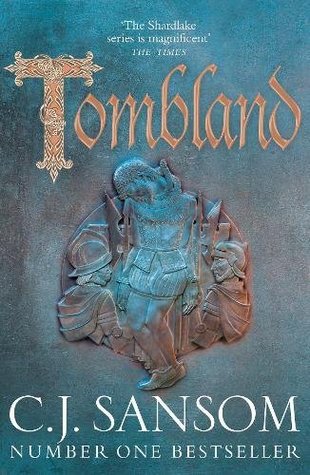
Tombland by C J Sansom 5* – I wrote this Friday post this book, giving two quotations and a summary of the book. Set in 1549 this is a remarkable and detailed book about the situation as Edward VI is on the throne following the death of his father Henry VIII and his uncle Edward Seymour, Duke of Somerset, rules as Protector.

Matthew Shardlake has been working as a lawyer in the service of Edward’s sister, the Lady Elizabeth. He is employed to investigate the gruesome murder of Edith Boleyn, the wife of John Boleyn – a distant Norfolk relation of Elizabeth’s mother. But the main part of the book is about Kett’s Rebellion – as thousands of peasants, in protest about the enclosures of common land, gather together on Mousehold Heath outside Norwich and battle ensues.

It’s an enormous book and I’m planning to write a longer post about it.


Jacob’s Room is Full of Books by Susan Hill

Nine years ago I read Susan Hill’s Howards End is on the Landing: A Year of Reading, a book in which she wrote about the books from her own collection she’d read or re-read over the course of a year. Jacob’s Room is Full of Books is a similar book in that it follows month by month a year during which she reflects on the books she has read, reread, or returned to the shelves as well as her thoughts on a whole variety of topics.

Jacob's Room is Full of Books: A Year of Reading

It’s full of her observations on the weather, on nature – birds, flowers, trees, moles, eels, egrets and so on – on writers and writing, about religion and fairy tales and many more besides as well as on books. She also writes about herself and notes her obsessions with, for example, Virginia Woolf and the Bloomsbury Set, Marilyn Monroe, wood engravings, medieval monasticism, Elizabeth Bowen, Benjamin Britten and her collection of Ladybird Books. Some of her observations on other topics are short but conjure up vivid pictures, such as in November she recorded: ‘RAINING. Sky like the inside of a saucepan.‘ (page 208) And in October: ‘THIS GOLDEN OCTOBER continues to drift slowly down like a twirling leaf.’  (page 186)

One of the things I like about this book is the passion with which Susan Hill writes and her strong opinions about books, writers, literary prizes, what makes a good reader and so on and so forth, that she has no qualms about expressing (and why should she?) You are left in no doubt about what she does and does not like. For example she likes Robert Louis Stevenson (so do I) and the way he cleverly and cunningly creates a sense of sinister and evil in his creation of Mr Hyde. She thinks he’s the ‘perfect writer’ (page 188) and describes him thus: ‘Next to Dickens, I think RLS was the greatest writer of his time.’ (page 54) She didn’t like fairy tales as a child (I did), describing fairies as

Wispy, wafty, wish-washy things. Nowhere near on a par with sprites and goblins, witches, wizards, trolls. As a child I lapped up stories about any of these. I can understand why I did not, and do not, have any patience with fairies and their stories. They are so colourless (despite Andrew Lang’s best attempts). So dull. Yes. Just dull. (page 21)

And yet as a child she also liked the Flower Fairies books by Cecily Mary Baker (as did I) and pored over their illustrations, but followed that up by describing them as ‘just an excuse for pretty pastel pictures.

She doesn’t like fantasy and science fiction, although as a child she loved fantasy. She likes, amongst others, Thomas Hardy, Somerset Maugham, Raymond Chandler, Muriel Spark and Barbara Pym, to a certain extent, describing her books as ‘dated, but not dated enough’, but not Jane Austen – oh my, I love Jane Austen’s books:

I read most of the reissued novels [of Pym’s] at the time and never entirely saw the point of the praise, probably because everyone compared them to Jane Austen and that is never a good recommendation to me. (page 200)

She then goes on to change her mind about Pym after reading Shirley Hazzard’s review of Pym’s Quartet in Autumn, which I haven’t read, but after reading her description I think I would like.

She has no interest left in the First World War, particularly in fiction about it (I have) since she wrote Strange Meeting in 1971, but she admires Ford Madox Ford’s The Good Soldier, but has ‘not even tried Parade’s End‘. She seems to have more time for the Second World War novels, praising Olivia Manning’s novels, the Balkan and Levant trilogies, which reminds  me I still haven’t read the third book in the Balkan Trilogy.

She is scathing about creative writing courses: ‘I don’t suppose anything is obligatory for these courses, which are as thick as autumn leaves on the ground. Writing is the thing. Ye gods.’ (page 189)

There’s plenty more on the same lines about other authors and books – there are many, many more that I could mention – and I found it all fascinating, rambling and chatty, a bit repetitive in parts, but still fascinating. And there is a list of the books she refers to at the end of the book. It’s probably a book that could stand a second reading.

And as she says:

Reading is magic. Books are magic. It starts when we are shown picture books and realise there is another world beyond the everyday one we know. Once we can read ourselves, we live inside the magic. The only problem is that we have to emerge at the end of a book, and we don’t want to return to that dull domestic world we know. The only solution to that problem, of course, is that there is always the next book, and the next and there is bonus magic if it is another in a series we already love, so we are plunging back into a magic other world but one we already know. We feel a lift of the heart, a lurch of the stomach, when we find ourselves in it again. (pages 55 – 56)

Yes, reading is, indeed, magic!

  • Hardcover: 272 pages
  • Publisher: Profile Books (5 Oct. 2017)
  • Language: English
  • ISBN-10: 9781781250808
  • ISBN-13: 978-1781250808
  • ASIN: 1781250804
  • Source: a library book
  • My Rating: 5*

Nonfiction November Week 5: Additions to my TBR

Week 5: (Nov. 26 to 30) – New to My TBR (Katie @ Doing Dewey): It’s been a month full of amazing nonfiction books! Which ones have made it onto your TBR? Be sure to link back to the original blogger who posted about that book!

I’ve had a great time doing these Nonfiction November posts, found yet more book bloggers and I’ve added these books to my TBR:

From the comments on my Ask the Expert post asking for recommendations about books on World War One:

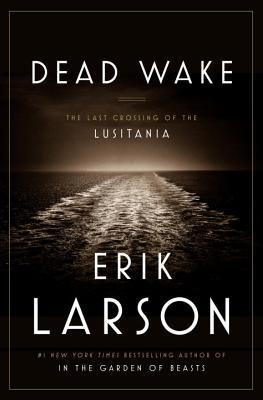
The War that Ended Peace: How Europe abandoned Peace for the First World WarThe Sleepwalkers: How Europe Went to War in 1914Rites of Spring: The Great War and the Birth of the Modern AgeDead Wake: The Last Crossing of the Lusitania

From posts on Nonfiction that reads like fiction:

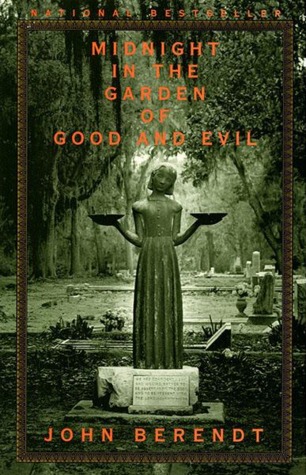
Midnight in the Garden of Good and EvilLeonardo da VinciThe Sound of a Wild Snail Eating

  • Midnight in the Garden of Good and Evil by John Berendt from Rennie of What’s Nonfiction. She writes ‘Berendt’s story begins with a murder in the old-fashioned, uniquely southern atmosphere of Savannah but develops into so much more.’
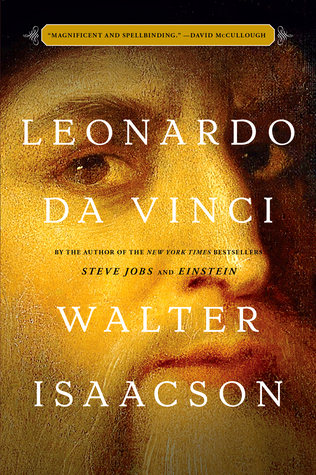
  • Leonardo da Vinci by Walter Isaacson from Deb Nance at ReaderbuzzWalter Isaacson is not an art historian, he’s simply a lover of Leonardo, who manages to communicate the sheer joy of this remarkable man’ Books of the Year – The Times.
  • The Sound of a Wild Snail Eating by Elisabeth Tova Bailey from Brona’s Books, Brona writes, ‘Bailey uses examples from poetry, literature and science to bring forth the nature of her snail. Each little nugget is revealed with care and circumspection. Watching her snail, Bailey comes to terms with her own illness.’

Thanks everyone for your recommendations!

Nonfiction November Week 4: Reads Like Fiction

The topic for Week 4: (Nov. 19 to 23) is Reads Like Fiction (Rennie @ What’s Nonfiction): 

Nonfiction books often get praised for how they stack up to fiction. Does it matter to you whether nonfiction reads like a novel? If it does, what gives it that fiction-like feeling? Does it depend on the topic, the writing, the use of certain literary elements and techniques? What are your favorite nonfiction recommendations that read like fiction? And if your nonfiction picks could never be mistaken for novels, what do you love about the differences?

It doesn’t matter to me whether a nonfiction book reads like a novel, although I think those that do read like novels are easier to read, even though they are packed full of details and information. It does depend on the topic though and looking through the nonfiction I’ve read in recent years I see that most of the ones that read like fiction are either autobiographies or biographies.

Biographies are written using a mass of material gathered from various sources and are a result of selection – choosing what to include and what to leave out, how to interpret the gaps in the material available. Claire Tomalin in the foreword to her biography of Dora Jordan writes that ‘History – and biography, which is a branch of history is always a matter of choice and control. The writer or editor decides what is history and what is not.

Likeness must be there in a biography, whether it is more like history or fiction. I like historical fiction and, to a certain extent, fictionalised biography but I like to know what is fact and what is not. But then facts are open to interpretation – biographies are given a story-like shape  but still need to be accurate.

Mrs. Jordan's Profession: The Actress and the PrinceSisters of Sinai: How Two Lady Adventurers Found the Hidden Gospels

Mrs Jordan’s Profession: The Story of a Great Actress and a King, Claire Tomalin’s biography of Dora Jordan. It is both well researched and well written making it easy to read despite being packed with information, brilliantly bringing the late 18th and early 19th centuries to life as she tells the story of Dora and her relationship with the Duke of Clarence, later King William IV. Dora was an actress, known as ‘Mrs Jordan’, although there was never a Mr Jordan. She made her stage debut in 1777 at the age of 15 and her first Drury Lane appearance in 1785. She met William, the Duke of Clarence (later William IV) and she became his mistress in 1790.

Another example of a biography that reads like fiction is Sisters of Sinai: How Two Lady Adventurers Found the Hidden Gospels by Janet Soskice. As I was reading I remember thinking that if this were a novel I would think it was a most unlikely story. It tells the story of twin sisters in the latter half of the nineteenth century, who travelled to St Catherine’s Monastery at Mount Sinai where they discovered one of the earliest copies of the Gospels written in ancient Syriac. They also went to Jerusalem and beyond crossing the desert on camel or walking miles on foot.

An AutobiographyCider With Rosie

Then there are autobiographies. These can be very different depending on how much the author wants to reveal about themselves. I loved Agatha Christie’s An Autobiography, written in such an easy style that it was as though I was listening to her talking. It took her fifteen years to write and is filled with her thoughts and reflections as well as telling the story of her life. But although she wrote about her childhood, teenage years, friends and family, her marriage to Archibald Christie and their divorce, about her travels around the world, the two world wars, her interest and involvement with archaeology and her marriage to Max Mallowan, she didn’t write about her disappearance in 1926.

A very different autobiography is Laurie Lee’s autobiography Cider With RosieIt is a beautiful book, full of wonderful word pictures of life in a remote Cotswold village at the beginning of the twentieth century. Laurie Lee was also a poet and this book reads like a prose poem throughout. Cider with Rosie covers his childhood years and it is absolutely fascinating. He was born in Stroud and moved to Slad when he was three in 1917. His love for his mother permeates the book (his father had left his wife with seven young children).

I’ve also read two more of Laurie Lee’s books – As I Walked Out One Midsummer Morning (1969), which is about his life after he left his home in Slad, and A Rose for Winter (1955), which is a record of his travels in Andalusia 15 years after he first went there. Again in these books he writes vivid, lyrical prose with beautiful descriptions of the countryside, the scorching heat, the poverty and the people, It’s not just the scenery he captures, but also the atmosphere, the splendour and squalor, and the desperation and also the love and enthusiasm for life.

But are these books fiction? There are doubts that Lee falsified and embellished his involvement in the Spanish Civil War in A Moment of War (which I haven’t read). However, his widow denied this. In an interview recorded in The New York Times, 24 February 1985, Lee, talking about Cider With Rosie said  “… it is not so much about me as about the world that I observed from my earliest years. It was a world that I wanted to record because it was such a miracle visitation to me. I wanted to communicate what I had seen, so that others could see it.”

It’s a fascinating topic – and I’m looking forward to seeing what other readers think? do let me know.