Nonfiction November is Coming!

nonficnov 19

I’ll be taking part in Nonfiction November 2019 again this year. It was one of my favourite events last year – this year it will run from Oct 28 to Nov 30. Each Monday a link-up for the week’s topic will be posted at the host’s blog for you to link your posts throughout the week.

The hosts and topics are: 

Week 1: (Oct. 28 to Nov. 1) –  Your Year in Nonfiction (Julie @ Julz Reads) : Take a look back at your year of nonfiction and reflect on the following questions – What was your favourite nonfiction read of the year? Do you have a particular topic you’ve been attracted to more this year? What nonfiction book have you recommended the most? What are you hoping to get out of participating in Nonfiction November?

Week 2: (Nov. 4 to 8) – Book Pairing (Sarah @ Sarah’s Book Shelves) : This week, pair up a nonfiction book with a fiction title. It can be a “If you loved this book, read this!” or just two titles that you think would go well together. Maybe it’s a historical novel and you’d like to get the real history by reading a nonfiction version of the story. 

Week 3: (Nov. 11 to 15) – Be The Expert/Ask the Expert/Become the Expert (Katie @ Doing Dewey): Three ways to join in this week! You can either share 3 or more books on a single topic that you have read and can recommend (be the expert), you can put the call out for good nonfiction on a specific topic that you have been dying to read (ask the expert), or you can create your own list of books on a topic that you’d like to read (become the expert).

Week 4: (Nov. 18 to 22) – Nonfiction Favourites (Leann @ Shelf Aware): We’ve talked about how you pick nonfiction books in previous years, but this week I’m excited to talk about what makes a book you’ve read one of your favourites. Is the topic pretty much all that matters? Are there particular ways a story can be told or particular writing styles that you love? Do you look for a light, humorous approach or do you prefer a more serious tone? Let us know what qualities make you add a nonfiction book to your list of favourite.

Week 5: (Nov. 25 to 29) –New to My TBR (Rennie @ What’s Nonfiction): It’s been a month full of amazing nonfiction books! Which ones have made it onto your TBR? Be sure to link back to the original blogger who posted about that book!

Six Degrees of Separation: from Three Women to …

I love doing Six Degrees of Separation, a monthly link-up hosted by Kate at Books Are My Favourite and Best. Each month a book is chosen as a starting point and linked to six other books to form a chain. A book doesn’t need to be connected to all the other books on the list, only to the one next to it in the chain.
Three Women


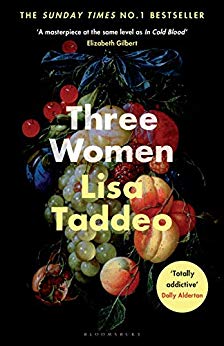
This month the chain begins with Three Women by Lisa Taddeo – a book I haven’t read, or even heard of before. It’s described on Goodreads as Desire as we’ve never seen it before: a riveting true story about the sex lives of three real American women, based on nearly a decade of reporting. I have no desire to read it.

My first link is to one of the books I’m currently reading – a biography of D H Lawrence, a man who believed himself to be an outsider in angry revolt against his class, culture and country, and who was engaged in a furious commitment to his writing and a passionate struggle to live according to his beliefs. He also struggled all his life with his relationships with women, particularly about those with his mother and his wife, Frieda.

Leading on from Lawrence’s biography my second link is to his book, Women in Love,  a book I first read as a teenager. It’s about the relationships of two sisters, Ursula and Gudrun. Ursula falls in love with Birkin (a self portrait of Lawrence) and Gudrun has an affair with Gerald, the son of the local colliery owner. Later on I watched the film version with Glenda Jackson as Gudrun, Oliver Reed as Gerald, Alan Bates as Birkin and Jennie Linden as Ursula. Lawrence considered this book to be his best and the one that clearly showed his ideas of society at the time (1922).

Moving on from a book about sisters, my third link is to a book about brothers. It’s The Lost Man by Jane Harper, set in an isolated part of Australia hundreds of miles from anywhere and revolving around the death of Cameron Bright. There are three Bright brothers – Nathan the oldest, then Cameron and the youngest brother, Bub. They have a vast cattle ranch in the Queensland outback. The book begins with the discovery of Cameron’s body lying at the the base of the headstone of the stockman’s grave – a headstone standing alone, a metre high, facing west, towards the desert, in a land of mirages.

My fourth link is to another book set in Australia – Sarah Thornhill by Kate Grenville, a love story set in 19th century Australia, where the convicts, transported or ‘sent out‘ are  now called ‘old colonists‘. A story about prejudice – some people, those who had ‘come free‘,  thought being ‘sent out‘ meant you were tainted for all time, but for others having money and land overcame their distaste. And then there is the prejudice about the ‘blacks’. When Sarah, the daughter of William Thornhill, an ‘old colonist’ and now a landowner on the Hawkesbury River, falls in love with Jack Langland, whose mother was a native woman, racial prejudice and hatred rear their ugly heads.

Prejudice and racial tension is also uppermost in The Tea Planter’s Wife by Dinah Jefferies, set in Ceylon (now called Sri Lanka) in 1913. It was a time of unrest, with political and racial tension between the Sinhalese and Tamil workers and the British plantation owners. After a whirlwind romance, Gwendolyn Hooper marries a tea planter, Laurence, an older man, and a widower. But this is not the idyllic life she expected – there are secrets, locked doors and a caste system and culture that is alien to her. There is a mystery, too, surrounding the death of Caroline, Laurence’s first wife.

And so to the last link, which is to another book about the death of a wife. It’s The Evidence Against You by Gillian McAllister – Gabe English has been released from prison on parole, having served seventeen years for the murder of his wife, Alexandra. But nobody really knew exactly what had happened the night Alexandra was killed – she simply went missing and then her body was found – she’d been strangled. Gabe’s daughter Izzy thought that her father could never have harmed anybody, let alone her mother. Now, he swears that he is innocent and wants to tell his side of it. He asks her to consider the evidence for herself. But is he really guilty – can she trust her father?

My chain is link by books about women, sisters and brothers, prejudice and racial tension, books set in Australia and about the deaths of wives. It passes from America to Great Britain,  and Sri Lanka, via books of crime fiction, historical fiction and non-fiction.

Next month (November 2, 2019), we’ll begin with Alice’s Adventures in Wonderland – a book I have read and loved.

The Riviera Set by Mary S Lovell

Riviera Set

Little, Brown Book Group|November 2016|448 pages|Library book|3.5 rounded up to 4 on Goodreads*

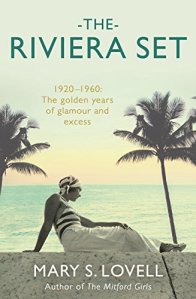
When I read Cath’s review of The Riviera Set: 1920 – 1960: The Golden Years of Glamour and Excess on her blog Read Warbler I thought it sounded fascinating, so I reserved a copy at the library. I has taken me almost a month to read it, but I did enjoy it.

Mary S Lovell explains in her Introduction that this is ‘less of a biography, more the story of a house and those who peopled it between the years 1930 and 1960.‘ The book begins with Maxine Elliott, telling of her early life  – she was an American, born Jessica Dermot in Rockland, Maine in 1868. She was a most remarkable woman who became an actress, famed for her beauty and her pure speaking voice. She came over to England, had successfully entered the Edwardian social scene in 1899 and after divorcing her husband, actor Nat Goodwin in 1908 she established herself at Hartsbourne, a country house in Hertfordshire. During the First World War she bought a barge and fitted it out as a first-aid clinic and soup kitchen to help with the war relief effort, bringing food and medical supplies to thousands of displaced people in Belgium. Many of the people who socialised at Hartsbourne flocked to visit her there. 

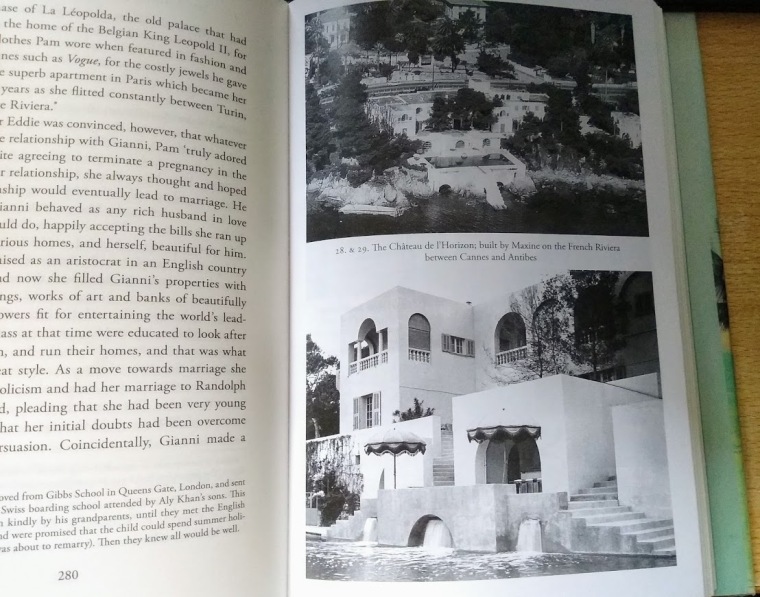
And then in 1930 she commissioned the architect Barry Dierks to build  the Chateau de l’Horizon on the land she had bought on a narrow stretch of rocks with a small promontory between Cannes and Juan-les-Pins. This is the part of the book I enjoyed the most, first of all about Maxine herself, then the description of the construction of the Chateaux and the years that Maxine owned it and lived there. Maxine really came into her own there as a superb hostess.

chateau de l'horizon

Regular visitors included Winston Churchill, Cole Porter, Noel Coward, Somerset Maugham among many others – famous actors and actresses as well as members of the aristocracy and politicians. I was interested in Clementine Churchill’s reaction to the Riviera set – she disapproved of their behaviour and often didn’t accompany him on his visits.  She also disapproved of Winston’s gambling at the Casino. Then there were the Duke and Duchess of Windsor, who lived nearby before the Second World War – the picture painted of them is not flattering – and there was much talk about how to address Wallis and whether the women should curtsy to her. By the time the War approached Maxine had lost her sparkle, suffering from ill health and she died in March 1940.

And after her death nothing was the same – and my interest in the book began to wane. The Chateau was bought by Aly Khan, the Aga Khan’s heir presumptive at the time. There is quite a lot about his time there, his womanising, his marriage to Rita Hayworth and the social scene of the post-war period up to 1960. Nevertheless it is a fascinating and entertaining book about a pampered, luxurious and decadent world.

Reading challenge: Virtual Mount TBR as it is a library book.

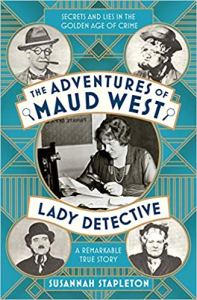
The Adventures of Maud West, Lady Detective by Susannah Stepleton

Narrative Non-Fiction 4*

Adventures of Maud West

The Adventures of Maud West, Lady Detective, by Susannah Stapleton and published by Picador, is subtitled ‘Secrets and Lies in the Golden Age of Crime‘. With a title like that I thought it sounded just the sort of book I would like – and I did.

It is so intriguing – was Maud West really who she said she was? Susannah Stapleton discovered that she really did exist and was indeed a private investigator with her own detective agency, based in London in the early part of the twentieth century, from 1905 onwards.  The book gives plenty of extracts from Maud West’s own accounts of her investigations under Golden Age crime fiction titles such as The Lady Vanishes, The Body in the Library, and They Do It With Mirrors, for example. But these accounts had me wondering just what was the truth and what was fiction. They are so incredible! Maud was truly an amazing person – a master of disguise, equally able to pass herself off as a man, or a fortune teller, or a parlour maid, and skilled with a revolver, able to face down blackmailers. There are photographs of Maud – at work in her office and in a number of disguises. And it was not just in Britain – she worked all over the place including  New York, Cape Town, Brazil, and Jakarta. 

But what makes the book so good, and what kept me glued to the pages are the details of how Susannah Stapleton went about her research, included within the main narrative of her book. I haven’t come across this before – usually  an author lists the sources used at the end – and there is just such a list (a very long and comprehensive list) at the end of this book.  I was more intrigued by Stapleton’s own methods of research into finding out about Maud than I was by Maud herself.

 I also loved all the details of the changing society in which Maud lived – the role of women in the struggle for equality, details of the living and working conditions and of the crimes that real life private detectives investigated – divorces, missing persons, adultery and theft.

It more than lived up to my expectations, but I am still wondering did she really do what she said she did? Whatever the truth she was a complex woman and a very private one at that.

Many thanks to the publishers, Picador, for my review copy via NetGalley.

WWW Wednesday: 5 June 2019

IMG_1384-0

WWW Wednesday is run by Taking on a World of Words.

The Three Ws are:

What are you currently reading?
What did you recently finish reading?
What do you think you’ll read next?


Currently reading: I’m still making slow progress with reading  D H Lawrence: the Life of an Outsider by John Worthen,  but I’ve almost finished Sweet Thursday by John Steinbeck. So, I’ve started to read Those Who Are Loved by Victoria Hislop, one of the books on my 20 Books of Summer list.

Those Who Are Loved is historical fiction, set against the backdrop of the German occupation of Greece, the subsequent civil war and a military dictatorship, all of which left deep scars. I know very little about Greece during the Second World War so I’m finding it very interesting, but it is very slow going. It begins as Themis remembers her life and the conflicts within her family as well as their experience of the war.

I’ve recently finished The Ruin by Dervla Mactiernan and will be writing more about it in a later post.

Ruin

Blurb:

It’s been twenty years since Cormac Reilly discovered the body of Hilaria Blake in her crumbling Georgian home. But he’s never forgotten the two children she left behind…

When Aisling Conroy’s boyfriend Jack is found in the freezing black waters of the river Corrib, the police tell her it was suicide. A surgical resident, she throws herself into study and work, trying to forget – until Jack’s sister Maude shows up. Maude suspects foul play, and she is determined to prove it.

DI Cormac Reilly is the detective assigned with the re-investigation of an ‘accidental’ overdose twenty years ago – of Jack and Maude’s drug- and alcohol-addled mother. Cormac is under increasing pressure to charge Maude for murder when his colleague Danny uncovers a piece of evidence that will change everything…

My next book could be:

I think, but I could always change my mind, it’ll be Anything You Do Say by Gillian Mcallister, another book that is on my 20 Books of Summer list.

Anything you do say

Blurb:

Joanna is an avoider. So far she has spent her adult life hiding bank statements and changing career aspirations weekly.

But then one night Joanna hears footsteps on the way home. Is she being followed? She is sure it’s him; the man from the bar who wouldn’t leave her alone. Hearing the steps speed up Joanna turns and pushes with all of her might, sending her pursuer tumbling down the steps and lying motionless on the floor.

Now Joanna has to do the thing she hates most – make a decision. Fight or flight? Truth or lie? Right or wrong?

Have you read any of these books?  Do any of them tempt you? 

Reading in May

I’ve been reading eight books in May, and have finished reading six of them, but only reviewed four of them:

  1. The Butterfly Room by Lucinda Riley 4* –  a family saga spanning generations  revealing the dark secret hidden behind the locked door of the Butterfly Room
  2. Mrs Whistler by Matthew Plampin 5* – not about his mother, but about him and his model and mistress, Maud Franklin
  3. Codename Villanelle by Luke Jennings 3* – the basis for the TV series Killing Eve 
  4. The Doll Factory by Elizabeth Macneal 5* –  the story of Iris who dreamed of being an artist and her involvement with the Pre-Raphaelites

The other two books I finished are:

Before the Fall by Noah Hawley, which I didn’t enjoy and I’m just writing a few notes here about it. It won the 2017 Edgar Award for Best Novel and was selected by The Sunday Times as one of the top page-turners of summer 2017, so I’m in the minority because I thought it was boring and tedious. The plot is simple – a plane crashes into the sea after taking off from Martha’s Vineyard, just two people survive and the mystery is why did the plane crash and who was responsible. The main part of the book is made up of the long backstories of the people on the plane. It’s not gripping or thrilling and definitely not a page-turner. 1*

However I thoroughly enjoyed The Ruin Dervla McTiernan’s debut novel and I’ll be writing more about it in the next few days. Now this is a page-turner, about a current murder linked to a cold case. It’s complex and compelling reading as DI Cormac Reilly unravels a web of secrets. 4*

I’m still reading two books:

D H Lawrence: the Life of an Outsider by John Worthen, from his childhood in Nottinghamshire to his death at the age of 44. I’m reading this slowly and it will be some time before I finish it. An ‘outsider’, he always felt he didn’t fit in or belong either with his family or his work colleagues or the literary elite of the times.

The other book I’ve been reading is Sweet Thursday by John Steinbeck, my Classics Club Spin book that I was hoping to finish by the end of May. I’ve only read half of it so far. It’s a follow up to Cannery Row, with some of the same characters and I’m enjoying its humour and view of life in Monterey in the 1950s.

And now it’s June! I’ll be concentrating on reading the books I’ve listed for the 20 Books of Summer challenge – and hoping I won’t be distracted by too many other books!