Book Beginnings & The Friday 56: Ammonites and Leaping Fish by Penelope Lively

Every Friday Book Beginnings on Friday is hosted by Gillion at Rose City Reader where you can share the first sentence (or so) of the book you are reading. You can also share from a book you want to highlight just because it caught your fancy.

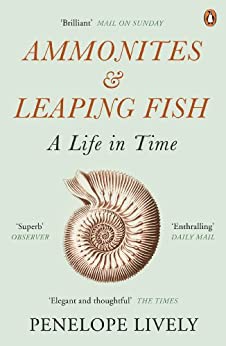
I was on holiday in the Lake District last week, overlooking Esthwaite Water. There were two shelves of books in our apartment and one of them was Ammonites and Leaping Fish: a Life in Time by Penelope Lively, so I read it whilst we were away. I’ll write more about it in a later post (although I’ve not been keeping up with reviewing the books I’ve read this summer).

This is not quite a memoir. Rather it is a view from old age.

And a view of old age itself, this place at which we arrive with a certain surprise – ambushed, or so it can seem. The view from eighty for me. One of the few advantages of age is that you can report on it with a certain authority; you are a native now and know what goes on here.

Also every Friday there is The Friday 56, hosted by Freda at Freda’s Voice, where you grab a book and turn to page 56 (or 56% of an eBook), find one or more interesting sentences (no spoilers), and post them.

Page 56:

When I was on the other side of the Atlantic a few years ago staying with my best friend in America, she produced a photo she had found of the two of us taken in the early 1980s. We gazed at it with surprised respect; ‘Weren’t we young!’ said Betty. Actually verging on middle age, but never mind – our reaction was in perfect accord: an acknowledgement of those other selves.

Penelope Lively is one of my favourite authors and I’ve been reading her books for years, all of them are enjoyable and this one is no exception. I thoroughly enjoyed it.

Synopsis from Amazon:

In this charming but powerful memoir, Penelope Lively reports from beyond the horizon of old age. She describes what old age feels like for those who have arrived there and considers the implications of this new demographic. She looks at the context of a life and times, the history and archaeology that is actually being made as we live out our lives in real time, in her case World War II; post war penny-pinching Britain; the Suez crisis; the Cold War and up to the present day. She examines the tricks and truths of memory. She looks back over a lifetime of reading and writing. And finally she looks at her identifying cargo of possessions – two ammonites, a cat, a pair of American ducks and a leaping fish sherd, amongst others. This is an elegant, moving and deeply enjoyable memoir by one of our most loved writers.

Book Beginnings & The Friday 56: Extra Virgin by Annie Hawes

Every Friday Book Beginnings on Friday is hosted by Gillion at Rose City Reader where you can share the first sentence (or so) of the book you are reading. You can also share from a book you want to highlight just because it caught your fancy.

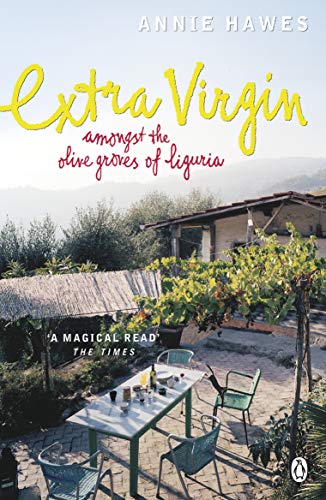
My book this week is Extra Virgin: Amongst the Olive Groves of Liguria by Annie Hawes. I had completely forgotten that I had bought this book; I have no idea when or where I bought it, but it’s there on my bookshelves waiting to be read. I’m guessing I bought it after reading other books about life in Italy by Frances Mayes, Bella Tuscany and  Under the Tuscan Sun about restoring a crumbling villa and building a new life in the Italian countryside, full of the pleasures of living in Tuscany – the sun, the food, the wine and the local people. 

It begins with a Prologue:

Hearing the racket from above, Franco wades through his pile of prunings and peers up through the trailing branches. A pair of foreign females, skin so white it’s blinding in the glare of the sun, are messing about outside Pompeo’s old place, a few terraces uphill, shouting and giggling.

Followed by Chapter I :

Glamour , we soon spotted was not the outstanding feature of the village of Diano San Pietro.

Also every Friday there is The Friday 56, hosted by Freda at Freda’s Voice, where you grab a book and turn to page 56 (or 56% of an eBook), find one or more interesting sentences (no spoilers), and post them.

Page 56:

Here in Liguria you are surrounded by life-threatening terrors.

Synopsis from Amazon

A small stone house deep among the olive groves of Liguria, going for the price of a dodgy second-hand car. Annie Hawes and her sister, on the spot by chance, have no plans whatsoever to move to the Italian Riviera but find naturally that it’s an offer they can’t refuse. The laugh is on the Foreign Females who discover that here amongst the hardcore olive farming folk their incompetence is positively alarming. Not to worry: the thrifty villagers of Diano San Pietro are on the case, and soon plying the Pallid Sisters with advice, ridicule, tall tales and copious hillside refreshments …

Throwback Thursday: Painting as a Pastime by Winston S. Churchill

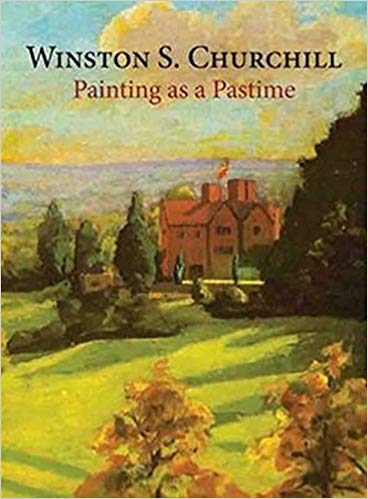
Today I’m looking back at my post on Painting as a Pastime by Winston S. Churchill. I first reviewed it on March 15, 2018.

My review begins:

I was delighted on Sunday when my son gave me Painting as a Pastime by Winston Churchill as a Mother’s Day present. I read it straight away and loved it. The cover shows Churchill’s painting of his home, Chartwell. Churchill was forty when he first started to paint at ‘a most trying time‘ in his life and art became his passion and an ‘astonishing and enriching experience‘.

Click here to read my full review

The next Throwback Thursday post is scheduled for June 2, 2022.

New Additions to BooksPlease

Yesterday we went Barter Books in Alnwick, my favourite bookshop (this is a secondhand bookshop where you can ‘swap’ books for credit that you can then use to get more books from the Barter Books shelves). It’s only the second time we’ve visited since January 2020 before the first lockdown.

It’s almost back to ‘normal’ now, so there was no queue to get in. Some people, but not all, were wearing face masks and it was busy, busier than I would have liked and in some sections such as crime fiction and paperback fiction in particular where the bookcases are close together, people were crowded together choosing books, so I didn’t linger, as I would normally do. Consequently I didn’t get any crime fiction books. I did manage to get three historical novels, seizing the opportunity when people had moved away.

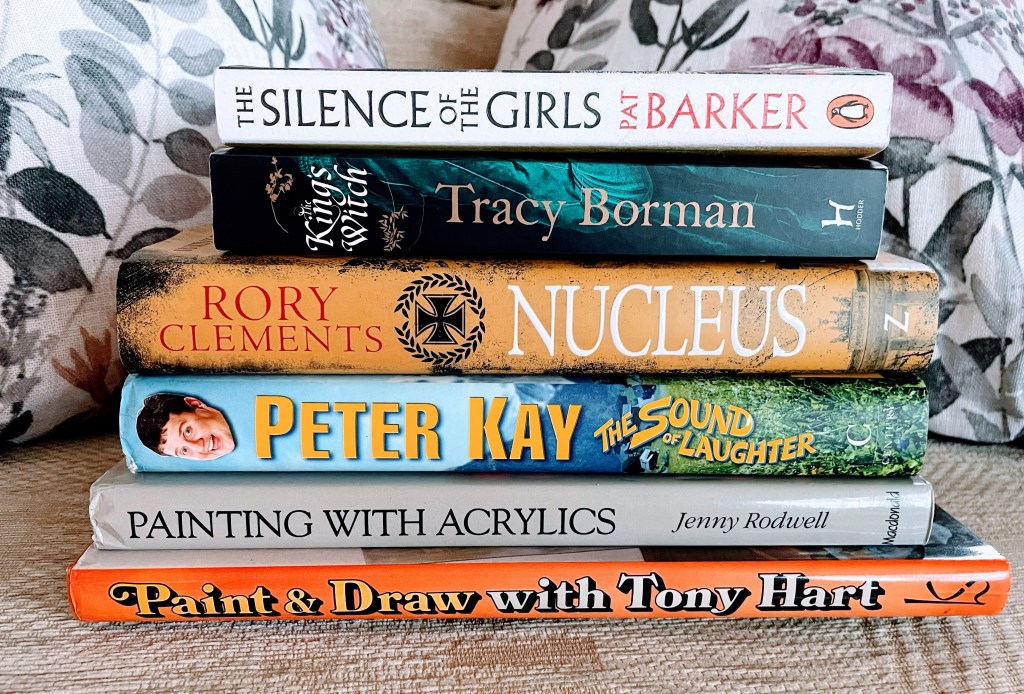
I took back 18 books and brought home 6, so I’m still in credit:

The descriptions are from Amazon and from top to bottom the books are:

The Silence of the Girls by Pat Barker, the first book in the Troy series.

There was a woman at the heart of the Trojan War whose voice has been silent – until now. Discover the greatest Greek myth of all – retold by the witness that history forgot . . . Briseis was a queen until her city was destroyed. Now she is a slave to the man who butchered her husband and brothers. Trapped in a world defined by men, can she survive to become the author of her own story?

The King’s Witch – this is historian, Tracy Borman’s debut novel.

As she helps to nurse the dying Queen Elizabeth, Frances Gorges longs for the fields and ancient woods of her parents’ Hampshire estate, where she has learned to use the flowers and herbs to become a much-loved healer.

Frances is happy to stay in her beloved countryside when the new King arrives from Scotland, bringing change, fear and suspicion. His court may be shockingly decadent, but James’s religion is Puritan, intolerant of all the old ways; he has already put to death many men for treason and women for witchcraft.

So when her ambitious uncle forcibly brings Frances to court, she is trapped in a claustrophobic world of intrigue and betrayal – and a ready target for the twisted scheming of Lord Cecil, the King’s first minister. Surrounded by mortal dangers, Frances finds happiness only with the precocious young Princess Elizabeth, and Tom Wintour, the one courtier she can trust.

Nucleus by Roy Clemens – the second in the Tom Wilde series. I’ve already read book 1, Corpus and book 4, Hitler’s Secret.

June 1939. England is partying like there’s no tomorrow . . . but the good times won’t last. The Nazis have invaded Czechoslovakia, in Germany Jewish persecution is widespread and, closer to home, the IRA has embarked on a bombing campaign.

Perhaps most worryingly of all, in Germany Otto Hahn has produced man-made fission and an atomic device is now possible. German High Command knows Cambridge’s Cavendish Laboratory is also close, and when one of the Cavendish’s finest brains is murdered, Professor Tom Wilde is drawn into the investigation. In a conspiracy that stretches from Cambridge to Berlin, and from the US to Ireland, can he discover the truth before it’s too late?

The Sound of Laughter: the Autobiography of Peter Kay – this is my husband’s choice, but I like Peter Kay too, so I’ll probably read this one too.

Peter Kay’s unerring gift for observing the absurdities and eccentricities of family life has earned himself a widespread, everyman appeal. These vivid observations coupled with a kind of nostalgia that never fails to grab his audience’s shared understanding, have earned him comparisons with Alan Bennett and Ronnie Barker.

In his award winning TV series’ he creates worlds populated by degenerate, bitter, useless, endearing and always recognisable characters which have attracted a huge and loyal following.In many ways he’s an old fashioned kind of comedian and the scope and enormity of his fanbase reflects this. He doesn’t tell jokes about politics or sex, but rather rejoices in the far funnier areas of life: elderly relatives and answering machines, dads dancing badly at weddings, garlic bread and cheesecake, your mum’s HRT…

His autobiography is full of this kind of humour and nostalgia, beginning with Kay’s first ever driving lesson, taking him back through his Bolton childhood, the numerous jobs he held after school and leading up until the time he passed his driving test and found fame. 

And finally two books on painting – both to encourage me to actually do some painting, rather than just reading about it.

Painting with Acrylics by Jenny Rodwell – 27 Acrylics Painting Projects, Illustrated Step-By-Step With Advice on Materials and Techniques with demonstrations of how to paint a variety of project, such as landscapes, portraits and still life etc.

Paint and Draw with Tony Hart – I remember enjoying watching Tony Hart’s TV programmes. This book contains 50 projects in a variety of materials – oil, watercolour, acrylic, gouache, pastel, crayon and other material. It looks excellent.

Book Beginnings & The Friday 56: Rain by Melissa Harrison

Every Friday Book Beginnings on Friday is hosted by Gillion at Rose City Reader where you can share the first sentence (or so) of the book you are reading. You can also share from a book you want to highlight just because it caught your fancy.

I’ve just started reading Rain: Four Walks in English Weather by Melissa Harrison, a ‘meditation on the English landscape in wet weather.’ She describes four walks in the rain over four seasons, across Wicken Fen, Shropshire, the Darent Valley and Dartmoor.

The Book begins with an Introduction:

What does rain mean to you? Do you see it as a dreadful inconvenience, a strange national obsession, or an agricultural necessity? We love to grumble about it, yet we invent dozens of terms to describe it and swap them gleefully; it trickles through our literature from Geoffrey Chaucer to Alice Oswald, and there are websites and apps that mimic its sound, soothing us while we work or sleep. Rain is what makes the English countryside so green and pleasant; it’s also what swells rivers, floods farms and villages and drives people out of their homes.

Also every Friday there is The Friday 56, hosted by Freda at Freda’s Voice, where you grab a book and turn to page 56 (or 56% of an eBook), find one or more interesting sentences (no spoilers), and post them.

Page 56 is in the chapter about her walk in the Darent Valley, in Kent, in August:

Behind the cumulonimbus currently discharging itself over the Darent Valley, more are forming; the afternoon will see thunder and lightning over much of the south-east of England, including London, less than twenty miles away.

Synopsis from Amazon UK:

Whenever rain falls, our countryside changes. Fields, farms, hills and hedgerows appear altered, the wildlife behaves differently, and over time the terrain itself is transformed.

In Rain, Melissa Harrison explores our relationship with the weather as she follows the course of four rain showers, in four seasons, across Wicken Fen, Shropshire, the Darent Valley and Dartmoor.

Blending these expeditions with reading, research, memory and imagination, she reveals how rain is not just an essential element of the world around us, but a key part of our own identity too.

I think I’m going to enjoy this book.

About the Author:

Melissa Harrison is a novelist, children’s author, journalist and nature writer. She contributes a monthly Nature Notebook column to The Times, and also writes regularly for the FT Weekend, the Guardian and the New Statesman. Her most recent novel, All Among the Barley, was the UK winner of the European Union Prize for Literature. It was a Waterstones Paperback of the Year and a Book of the Year in the Observer, the New Statesman and the Irish Times. At Hawthorn Time was shortlisted for the Costa Novel Award and longlisted for the Women’s Prize for Fiction, while Rain: Four Walks in English Weather was longlisted for the Wainwright Prize.

How to Catch a Mole by Marc Hamer

Longlisted for the Wainwright Book Prize 2019, How to Catch a Mole and Find Yourself in Nature is a beautiful book by Marc Hamer and illustrated by Joe McLaren. It is part memoir, part a nature study of the British Countryside, part poetry, and, of course, about moles. It is a mine of information. After leaving school Marc Hamer was homeless for a while, then worked on the railway, before returning to education and studying fine art in Manchester and Stoke-on-Trent. He has worked in art galleries, marketing, graphic design and taught creative writing in a prison before becoming a gardener. And before writing this book he had been a traditional molecatcher for years.

I read the book in January and have been wondering what to write about it, mulling it over in my mind. I’ve made several attempts to write this post as it’s not a straight forward non fiction book. He tells the story of his life intermingled with that of the mole, writing about what his life as a molecatcher was like, how it affected him and why eventually he decided to stop. The result is that this book is a mix of recollections and information about moles. He doesn’t write his recollections in chronological order – the harder he tries to remember, the more his memory seems to shift and change as though he is looking into a kaleidoscope where the colours remain the same and although the patterns are slightly different every time, the picture remains true to itself.

He no longer catches moles and says:

Molecatching is a traditional skill that has given me a good life but I am old and tired of hunting and it has taught me what I wanted to learn.

I’ve only seen a mole once when our cat caught what I think, sadly, was a baby one, and I know very little about them. Our garden has mole hills on the edges of it, piles of earth that the moles have turned over, and dug to a fine crumb – ‘the kind of damp rich earth that farmers and gardeners love for its texture and nutrients.’ So, I’m comfortable with having moles in the garden.

Not everybody is happy about them, however as Hamer points out:

Apparently sane people lose sleep over the chaos the moles create. We do not like to lose control of our property it makes us feel uncomfortable, impermanent, weak. Moles can ruin domestic lawns, and I have seen real hatred developing in homeowners as they lose control and ownership of their gardens. An obsession grows and an endless, unwinnable war can take over their lives. (pages 17-18)

Moles are small and powerful, moving at speed in their tunnels hunting worms and digging about 20 metres of tunnel in a day. They pack the soil into the roof and walls, pushing the soil ahead until there is too much to push and then make a diversion pushing the earth out onto the surface making a molehill. They go where the worms go. I was fascinated by this fact:

In times of plenty a mole will dig a little room in the wall of his tunnel, then gather lots of worms and bite their heads off, leaving them all knotted together in a section of tunnel. We call this the worm larder; it is a fairly common sight. A tunnel system could have any number of worm larders. (pages 202-203)

I was also interested in his thoughts on gardening. Here are a few extracts:

Gardening is not nature: it is using the laws of nature and science to impose our will on a place; and for some people this need for control goes to extremes. (page 19)

As a gardener I do not dig any more: I hoe off the weeds and top-dress the gardens in autumn with compost just as nature does with falling leaves and grasses. This keeps the moisture in and the weeds suppressed; it allows the worms to break up hard soil and increases microbial activity, allowing life to expand its range, and lets air and water into the soil. Moles do this for us. Some gardeners still double-dig, but more and more people are coming to understand the importance of microbes and fungi, and often see digging as destructive and prefer to stay off the soil to avoid compacting it. (pages 58-59)

And

A fine-looking garden is a sterile place. A perfect green lawn is only kept that way by continually dousing it with chemicals. A lawn that is not treated will naturally become home to a massive number of species of birds and worms and native wild plants, crane-fly larvae, beetles, invertebrates. (page 223)

I don’t usually include so many quotations and such lengthy ones, but I’ll end with one more quotation:

Having worked all my life, created a family, discovered a home, I feel as secure as a working-class man ever feels, and I feel a sense of equality again with the crow and the toad and the hawthorn, with the rain and wind. I am them and they are me. . . . I am just another animal, another tree, another wild flower in the meadow among billions of others. . . . There is something deeply magnificent in being just ordinary. (page 115)

  • Publisher ‏ : ‎ Harvill Secker; 1st edition (4 April 2019)
  • Language ‏ : ‎ English
  • Hardcover ‏ : ‎ 256 pages
  • ISBN-10 ‏ : ‎ 1787301249
  • ISBN-13 ‏ : ‎ 978-1787301245
  • Source: Borrowed from my son
  • My Rating: 5*