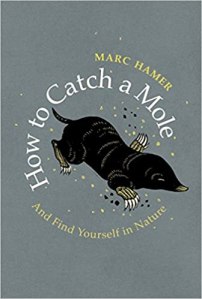
How to Catch a Mole by Marc Hamer

Longlisted for the Wainwright Book Prize 2019, How to Catch a Mole and Find Yourself in Nature is a beautiful book by Marc Hamer and illustrated by Joe McLaren. It is part memoir, part a nature study of the British Countryside, part poetry, and, of course, about moles. It is a mine of information. After leaving school Marc Hamer was homeless for a while, then worked on the railway, before returning to education and studying fine art in Manchester and Stoke-on-Trent. He has worked in art galleries, marketing, graphic design and taught creative writing in a prison before becoming a gardener. And before writing this book he had been a traditional molecatcher for years.

I read the book in January and have been wondering what to write about it, mulling it over in my mind. I’ve made several attempts to write this post as it’s not a straight forward non fiction book. He tells the story of his life intermingled with that of the mole, writing about what his life as a molecatcher was like, how it affected him and why eventually he decided to stop. The result is that this book is a mix of recollections and information about moles. He doesn’t write his recollections in chronological order – the harder he tries to remember, the more his memory seems to shift and change as though he is looking into a kaleidoscope where the colours remain the same and although the patterns are slightly different every time, the picture remains true to itself.

He no longer catches moles and says:

Molecatching is a traditional skill that has given me a good life but I am old and tired of hunting and it has taught me what I wanted to learn.

I’ve only seen a mole once when our cat caught what I think, sadly, was a baby one, and I know very little about them. Our garden has mole hills on the edges of it, piles of earth that the moles have turned over, and dug to a fine crumb – ‘the kind of damp rich earth that farmers and gardeners love for its texture and nutrients.’ So, I’m comfortable with having moles in the garden.

Not everybody is happy about them, however as Hamer points out:

Apparently sane people lose sleep over the chaos the moles create. We do not like to lose control of our property it makes us feel uncomfortable, impermanent, weak. Moles can ruin domestic lawns, and I have seen real hatred developing in homeowners as they lose control and ownership of their gardens. An obsession grows and an endless, unwinnable war can take over their lives. (pages 17-18)

Moles are small and powerful, moving at speed in their tunnels hunting worms and digging about 20 metres of tunnel in a day. They pack the soil into the roof and walls, pushing the soil ahead until there is too much to push and then make a diversion pushing the earth out onto the surface making a molehill. They go where the worms go. I was fascinated by this fact:

In times of plenty a mole will dig a little room in the wall of his tunnel, then gather lots of worms and bite their heads off, leaving them all knotted together in a section of tunnel. We call this the worm larder; it is a fairly common sight. A tunnel system could have any number of worm larders. (pages 202-203)

I was also interested in his thoughts on gardening. Here are a few extracts:

Gardening is not nature: it is using the laws of nature and science to impose our will on a place; and for some people this need for control goes to extremes. (page 19)

As a gardener I do not dig any more: I hoe off the weeds and top-dress the gardens in autumn with compost just as nature does with falling leaves and grasses. This keeps the moisture in and the weeds suppressed; it allows the worms to break up hard soil and increases microbial activity, allowing life to expand its range, and lets air and water into the soil. Moles do this for us. Some gardeners still double-dig, but more and more people are coming to understand the importance of microbes and fungi, and often see digging as destructive and prefer to stay off the soil to avoid compacting it. (pages 58-59)

And

A fine-looking garden is a sterile place. A perfect green lawn is only kept that way by continually dousing it with chemicals. A lawn that is not treated will naturally become home to a massive number of species of birds and worms and native wild plants, crane-fly larvae, beetles, invertebrates. (page 223)

I don’t usually include so many quotations and such lengthy ones, but I’ll end with one more quotation:

Having worked all my life, created a family, discovered a home, I feel as secure as a working-class man ever feels, and I feel a sense of equality again with the crow and the toad and the hawthorn, with the rain and wind. I am them and they are me. . . . I am just another animal, another tree, another wild flower in the meadow among billions of others. . . . There is something deeply magnificent in being just ordinary. (page 115)

  • Publisher ‏ : ‎ Harvill Secker; 1st edition (4 April 2019)
  • Language ‏ : ‎ English
  • Hardcover ‏ : ‎ 256 pages
  • ISBN-10 ‏ : ‎ 1787301249
  • ISBN-13 ‏ : ‎ 978-1787301245
  • Source: Borrowed from my son
  • My Rating: 5*

Book Beginnings & The Friday 56: Out of Africa by Karen Blixen

Every Friday Book Beginnings on Friday is hosted by Gillion at Rose City Reader where you can share the first sentence (or so) of the book you are reading. You can also share from a book you want to highlight just because it caught your fancy.

I’m currently reading two long books, one nonfiction and the other fiction, so it will be some time before I can read another book. But I’m thinking of read Out of Africa by Karen Blixen next.

The Book Begins:

I had a farm in Africa, at the foot of the Ngong Hills. The Equator runs across these highlands, a hundred miles to the north, and the farm lay at an altitude of over six thousand feet. In the day-time you felt you had got high up, near to the sun, but the early mornings and evenings were limpid and restful, and the nights were cold.

Also every Friday there is The Friday 56, hosted by Freda at Freda’s Voice. *Grab a book, any book. *Turn to Page 56 or 56% on your  ereader . If you have to improvise, that is okay. *Find a snippet, short and sweet, but no spoilers!

These are the rules:

  1. Grab a book, any book.
  2. Turn to page 56, or 56% on your eReader. If you have to improvise, that is okay.
  3. Find any sentence (or a few, just don’t spoil it) that grabs you.
  4. Post it.
  5. Add the URL to your post in the link on Freda’s most recent Friday 56 post.

Page 56:

‘After Kamante had become a Christian he was no longer afraid to touch a dead body.

Summary:

‘I had a farm in Africa, at the foot of the Ngong Hills . . . Up in this high air you breathed easily . . . you woke up in the morning and thought: Here I am, where I ought to be.’

From the moment Karen Blixen arrived in Kenya in 1914 to manage a coffee plantation, her heart belonged to Africa. Drawn to the intense colours and ravishing landscapes, Blixen spent her happiest years on the farm, and her experiences and friendships with the people around her are vividly recalled in these memoirs.

Out of Africa is the story of a remarkable and unconventional woman, and of a way of life that has vanished for ever.  (Goodreads)

~~~

What have you been reading lately?

Throwback Thursday: The Perfect Summer

Today I’m looking back at my post on The Perfect Summer by Juliet Nicolson a book I loved. I first reviewed it on October 29, 2009. It focuses on the period from May, when King George V was crowned, to September, describing the minutiae of everyday life of both the rich and the poor. 

My review begins:

The Perfect Summer: Dancing into Shadow in 1911 by Juliet Nicolson is a fascinating look at life in Britain during the summer of George V’s Coronation year, 1911.

When I finished reading this book I decided that the summer of 1911 was not “the perfect summer”. It was one of the hottest years of the twentieth century, making life most uncomfortable at a time when most people had no means of getting out of the sweltering heat. Even a trip to the seaside for working class people meant they donned their Sunday best clothes and spent the day standing because they couldn’t afford to hire deck chairs!

Click here to read my full review

The next Throwback Thursday post is scheduled for December 30 2021.

Recent Loans from the Library

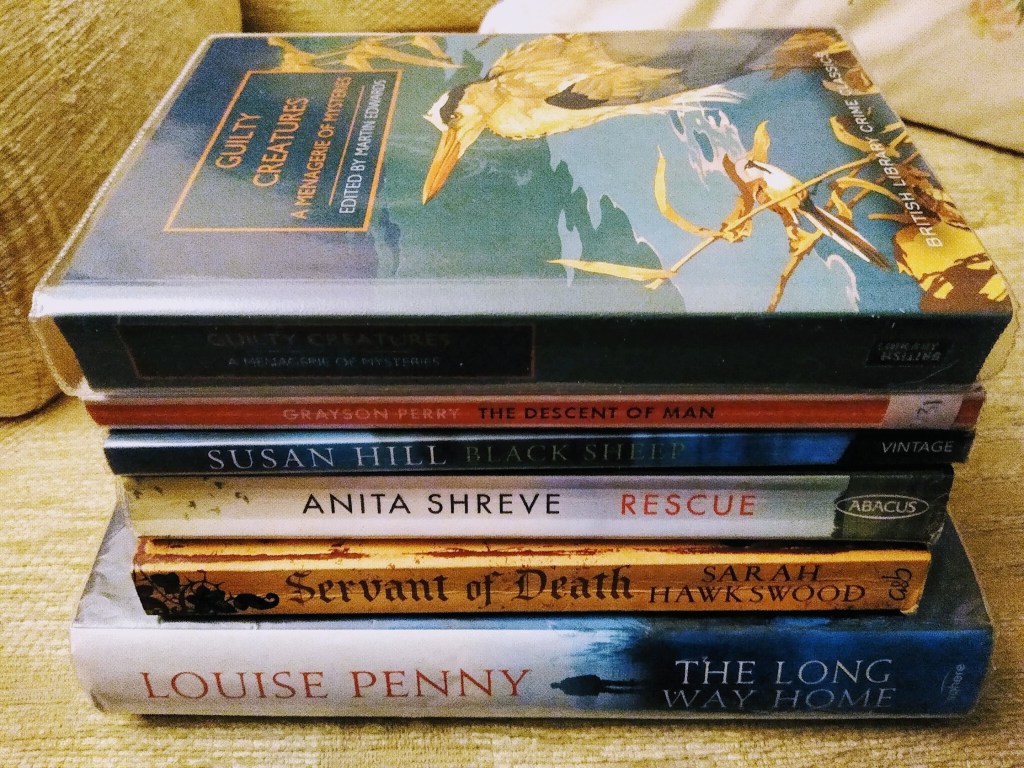
Guilty Creatures: A Menagerie of Mysteries edited and introduce by Martin Edwards. I like these anthologies as much, if not more, for Martin Edwards’ introductions than for the actual stories. I often find that they’re too short for my liking, but I’m hoping there will be some that will prove me wrong. This collection includes stories by Arthur Conan Doyle, G K Chesterton, Edgar Wallace, Josephine Bell and Christianna Brand, among others.

The Descent of Man by Grayson Perry. During the fist lockdown I loved watching Grayson’s Art Club, Channel 4’s documentary series hosted by him and his wife, psychotherapist Philippa Perry. In this book he is looking at masculinity, particularly examining how men dominate much of our world, how men dress and act, how men resort to crime and violence, and how men feel.

Black Sheep by Susan Hill, a novella about a brother an sister who grew up in a coal mining village and yearn to escape. Neither can break free and their decisions result in brutal consequences. It sounds a bit grim!

Rescue by Anita Shreve. The last few books by Anita Shreve I’ve read haven’t been as good as her earlier ones, so I’m hoping this one won’t be disappointing. It’s about a paramedic who rescues a troubled young woman from a car crash. They start a love affair and have a daughter. Eighteen years later he is raising the girl on his own,

Servant of Death by Sarah Hawkswood, historical murder mystery set in the 12th century, the first in the Bradcote and Catchpole mystery series. The Lord Bishop of Winchester’s clerk – is bludgeoned to death in Pershore Abbey and laid before the altar in the attitude of a penitent. Who hated him enough to murder him?

The Long Way Home by Louise Perry. I thought it looked familiar and when I got home and checked my blog I realised I’d borrowed this book before – in 2018! But I took it back unread, thinking I’d try to get the first one. It’s the 10th Chief Inspector Gamache novel – and I still haven’t read any of the previous books, so maybe I’ll read this one this time.

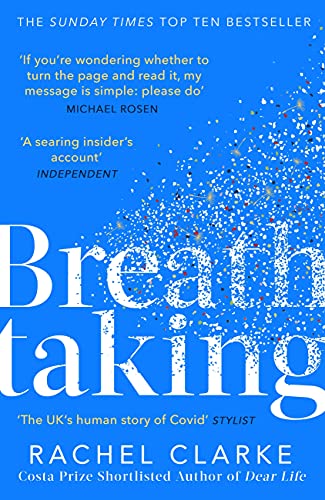
Short Nonfiction: Breathtaking by Rachel Clarke

Little, Brown Book Group| 26 January 2021| 154 pages| 4*

Novellas in November is hosted by Cathy and Rebecca. This week the focus is on short nonfiction.

I’ve watched TV programmes about Covid-19, seeing what it was like in a number of hospitals as the virus took hold in the UK, so a lot of the information in Rachel Clarke’s book, Breathtaking: Inside the NHS in a Time of Pandemic wasn’t new to me. But, I wanted to read this book to get an inside perspective on what it was like working in the NHS during the pandemic.

There have been so many fears that the NHS would be overwhelmed and reports criticising the way the government has dealt with the situation – and this is still the case now as winter approaches and the number of daily confirmed cases of coronavirus is still high, whilst hospital waiting lists for non-Covid-19 treatment remain high. Add to this there are now reports that doctors are saying that casualty departments are on the ‘edge of a precipice’, leading to dangerous levels of handover delays with patients forced to wait in ambulances for up to 11 hours outside hospitals. On TV I’ve seen the enormous queues of ambulances outside hospitals waiting to admit patients!

Rachel Clarke is a palliative care doctor and her book recounts her experiences during the first four months of 2020, when she worked on the Covid-19 wards in the Oxford University Hospitals system. Taken from her diary that she kept at the time it has an immediacy as she records her insomnia, her fears for her family and also the tremendous resilience, courage and empathy that she and the rest of the hospital staff had.

She tells the now familiar story about the PPE shortages, the lack of funding they experienced and criticises the government for their failure to act quickly enough – which I echo. Although it is a grim account, as I expected, it is also uplifting to know the care they took of their patients and the attentiveness to their patients’ needs despite the fact that many of the staff were not trained in intensive care and had never dealt with anything like this before.The way they had to prioritise patients is shocking, but I suppose inevitable given the lack of resources and staff.

She found that being a pandemic doctor was revelatory:

The crisis has undeniably revealed sweeping truths about social and economic inequalities, class divisions, global interconnectedness and the fact that our society’s most vital key workers were, and remain, among the lowest paid and the least empowered. Historians will dissect the issues for years to come. My revelations were about people. I learned from ward to ward, from bedside to bedside, paying meticulous attention to one human being and then another. I discovered how to distinguish what we absolutely cannot do without from what is really in the end, superfluous. (page 18)

This book is a snapshot, written at the time:

It depicts life and death, hope, fear, medicine at its most impotent and also at its finest, the courage of patients in enormous adversity, the stress of being torn between helping those patients and endangering your spouse and children, the long, fretful nights ruminating over whether the PPE you wear fits the science or the size of the government stockpile. I needed, I think, to take a stand with my pen and simply say: I was there. I have seen it, from the inside. I know what it was like. Here, with all its flaws and its inherent subjectivity, is my testimony. Make of it what you will. (pages 18-19)

Breathtaking records the compassion and kindness of numerous people, and pays tribute to both NHS staff and volunteers in dealing with such a distressing and immensely horrific situation.

Novellas in November: Short Nonfiction

Novellas in November is hosted by Cathy and Rebecca. This week the theme is short nonfiction and these are some I’ve read in previous years.
  1. Alive, Alive Oh and Other Things That Matter by Diana Athill (21 December 1917 – 23 January 2019). She was a British literary editor, novelist and memoirist who worked with some of the greatest writers of the 20th century at the London-based publishing company Andre Deutsch Ltd. This book contains her memories, thoughts and reflections on her life as she approached her 100th year, covering events from her childhood in the 1920s and 1930s, her post-war life, visits to Florence, and in the Club Mediterranee in Corfu in the 1950s, and the friends and lovers she has known upto 2009 when she moved into a home. The chapters follow on chronologically but are unconnected except for the fact that they demonstrate her love of life. And it is this love of life that is evident in her writing that makes it such a remarkable book. I loved it.
  2. Ink in the Blood: A Hospital Diary by Hilary Mantel, another short memoir. I read this in 2011 after Hilary Mantel’s talk at the Borders Book Festival at Melrose had been cancelled in the previous summer.  She had to cancel that because she wasn’t well – I didn’t know just how ill she was. Ink in the Blood reveals all – how she had surgery to remove an intestinal obstruction that ended up in a marathon operation, followed by intense pain, nightmares and hallucinations. Illness she found knocks down our defences, revealing things we should never see, needing moment by moment concentration on breathing, on not being sick and being dependent on others for your well-being. Writing was Hilary Mantel’s lifeline – it was the ink, as she wrote in her diary, that reassured her she was alive.
  3. James Herriot’s Cat Stories is a collection of ten stories clearly demonstrating his love of cats. In the introduction James writes that cats were one of the main reasons he chose a career as a vet. They have always played a large part in his life and and when he retired they were still there ‘lightening’ his days. This is a short book of 158 pages with illustrations by by Lesley Holmes.

I’ve recently read Breathtaking by Rachel Clarke and I’ll post a review later.