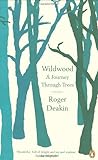
Roger Deakin was a writer, broadcaster and film-maker with a particular interest in nature and the environment. He completed the manuscript for Wildwood, his second book, just before he died in 2006. As the sub-title explains it’s about Deakin’s journeys through a wide variety of trees and woods in various parts of the world. It’s a memoir, a travelogue and also it’s about the interdependence of human beings and trees, or in his own words:
Wildwood is about the element of wood, as it exists in nature, in our souls and in our lives. (page x)
I think parts of this book are brilliant and fascinating, but my eyes glazed over in other parts as I got lost in all the facts and details that he recounts, which were just too much at times for me. But sometimes his writing is poetical, full of imagery. For example in writing about pencils he concludes:
The fine-grained, slow grown mother of all pencils is incense cedar from the forests of Oregon, where a single tree may grow 140 feet high, with a trunk five feet across, enough cedar wood to make 150,000 pencils. It is the incense cedar that infuses pencils with the nutty aroma I remember as I open my pencil-box. In a scooped out hollow in my Oregon pine work table in front of me lies a smooth, round pebble from the Hebrides. It sits snugly in the wood, like the pencil between finger and thumb, and like the hidden vein of graphite, poised inside the cedar to spin itself into words like gossamer from the spider. (page 30)
I love the image that last simile brings to my mind. I also marked these passages: ‘The pencil whispers across the page and is never dogmatic.‘ And this, ‘Rub your finger long enough on a soft-pencilled phrase and it will evaporate into a pale-grey cloud. In this way, pencil is close to watercolour painting.’ (both from page 29)
He wrote about Walnut Tree Farm, his house in Suffolk. It was a ruin when he bought it and he took enormous delight in renovating and restoring it, including personally shaping and repairing every single timber beam – all 323 of them. His love of trees stemmed from his early years and his school days when in the sixth form he and his school friends camped in the New Forest where their Biology teacher filled them with enthusiasm, setting them to studying and mapping the natural history of a stretch of the woodland, bog and heathland.
He covers a huge area of natural history, not just trees, but also plants, birds, moths, hedges, as well as the uses of wood for living, working and pleasure. He also describes his journeys to numerous places – not just in Britain, but also to the Pyrenees, Bieszczady, Australia, east to Kazakhstan, China, and the walnut forests of Kyrgyzstan. There is so much to take in – I really think this book deserves an index!
I liked the southern English chapters best, as the further afield he went it seemed more of a travel book. It’s a book of several parts and maybe it would have been more of a whole if Deakin had lived to see it through to publication. I think it’s a bit fragmented.
My favourite chapters cover the work of David Nash, a sculptor in wood and the paintings by Mary Newcomb. Deakin visited David Nash’s studio at Blaenau Ffestiniog, where he was particularly drawn to the Cracking Box made of oak:
As if entering the wild life of the wood, or at least taking its side, Nash has put as many difficulties in his way in the making of the box as he can. … The anarchic work thumbs its nose at the basic rules of woodwork, triumphantly so, because it holds together in spite of the wriggling of the wood as it warps and cracks. The more the wood struggles , the tighter the grips of the oak pegs in their augured sockets. (pages 154 -5)
Mary Newcomb was a Suffolk painter, who Deakin described as belonging ‘in the greenwood tradition, peering unnoticed from behind leaves like the Green Man’.. (page 179) (There is also has a chapter on the Green Man.) I hadn’t heard of Mary Newcomb and was intrigued by Deakin’s description of her work in which people seem to be part of the landscape, where proportion is very often skewed as in children’s art or ‘naive’ painting.
I also liked the chapter on walnuts, entitled Among Jaguars, describing how shapes of delicate walnut veneer are cut for the dashboards and door panels of Jaguar cars, and how the rare walnut burr veneer is produced. Walnuts figure quite prominently in Wildwood, with chapters on the walnut forests of Ferghana Valley in Kyrgyzstan.
Throughout the book Deakin referred to other books – one that stands out for me is Thomas Hardy’s The Woodlanders, one of my favourites of Hardy’s books, full of beautiful descriptions of the landscape and woods.
Overall, then I found this an interesting book, with some outstanding chapters. It’s not a book to read quickly and some parts are written much more fluently than others, but it’s full of fascinating information and meditations on the natural world. One final quotation:
To enter a wood is to pass into a different world in which we ourselves are transformed. It is no accident that in the comedies of Shakespeare, people go into the greenwood to grow, learn and change. It is where you travel to find yourself, often, paradoxically , by getting lost. Merlin sends the future King Arthur as a boy into the greenwood to fend for himself in The Sword in the Stone. There, he falls asleep and dreams himself, like a chameleon, into the lives of the animals and the trees. In As You Like It, the banished Duke Senior goes to live in the Forest of Arden like Robin Hood, and in Midsummer Night’s Dream the magical metamorphosis of the lovers takes place in a wood ‘outside Athens’ that is obviously an English wood, full of the faeries and Robin Goodfellows of our folklore. (page x)


 BooksPlease